
Teaching Ionic Bonds: Visual Tools & Activities for the Middle School Science Classroom
What Is an Ionic Bond — and Why Do Atoms Trade Electrons?
Atoms aren’t just building blocks — they’re dealmakers. Some give up electrons. Others take them. When this exchange happens, they form a powerful connection called an ionic bond.
An ionic bond occurs when:
- A metal atom loses electrons → becomes a positive ion (cation)
- A nonmetal atom gains electrons → becomes a negative ion (anion)
- Opposite charges attract → forming a strong ionic compound like salt
Example: Sodium (Na) gives one electron to chlorine (Cl), forming Na⁺ and Cl⁻ → together they make NaCl (table salt)
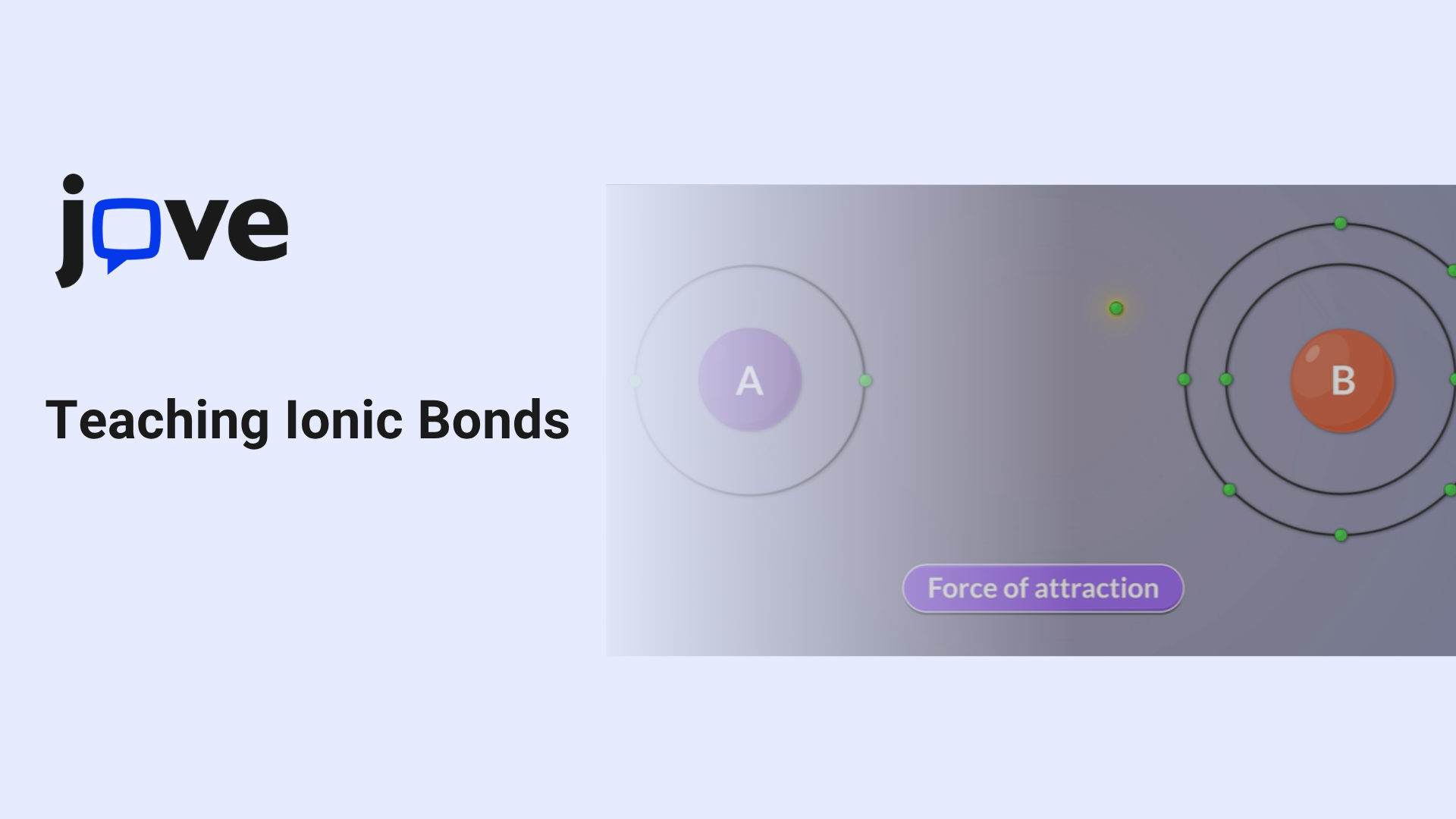
Visualize this with JoVE’s Ionic Bonding video, where real animations and molecule models help students understand bonding in action.
Science and Engineering Practices (SEP): Develop and Use Models
To truly grasp ionic bonding, students must see it. NGSS encourages modeling to explore electron behavior.
JoVE videos help students:
- Watch electron transfers in real time
- Understand attraction between positive and negative ions
- Connect particle-level visuals to observable properties (e.g. melting points, conductivity)
According to JoVE’s own research, students who used JoVE videos showed up to 60% higher comprehension on post-assessments vs. lecture alone.
Activity 1 – Build an Ionic Bond Model
Objective: Show electron transfer visually
Materials:
- Colored beads or pom-poms (electrons)
- Foam balls (atoms)
- Toothpicks or yarn (to show electron movement)
Instructions:
- Assign pairs of students metal and nonmetal atoms (e.g., Na and Cl)
- Use beads to transfer electrons and create labeled Na⁺ and Cl⁻ ions
- Stick models together to show attraction
Use this immediately after JoVE’s Ionic Bonding video to reinforce Developing and Using Models (SEP).
Activity 2 – Predict Ionic Compounds Using the Periodic Table
Objective: Help students recognize patterns in bond formation
Instructions:
- Give students the Periodic Table
- Ask them to pair metals (Groups 1–2) with nonmetals (Groups 16–17)
- Predict the chemical formula (e.g., Mg + Cl₂ = MgCl₂)
- Explain how many electrons would be transferred
Reinforce by watching JoVE’s Chemical Formulas video to understand subscripts and atom ratios.
Crosscutting Concept (CCC): Cause and Effect in Bonding
Cause-and-effect relationships explain why ionic bonds form and how they behave:
- Cause: Sodium loses one electron; chlorine gains one.
Effect: A strong electrostatic bond forms = NaCl - Cause: Ionic bonds involve strong attractions between charged ions.
Effect: Compounds like NaCl have high melting points and form solid crystals. - Cause: Ionic compounds dissolve in water into separate ions.
Effect: They conduct electricity when dissolved → key in batteries and biological systems.
See this process clearly in JoVE’s Electrolyte Conductivity video.
Why Teaching Ionic Bonds Visually Matters
Students often confuse ionic and covalent bonding. They may think:
- All bonds share electrons (false for ionic)
- Atoms keep the same number of electrons (not in bonding!)
- The Periodic Table doesn’t affect bonding
JoVE videos tackle these misconceptions head-on — using motion, modeling, and real-world examples to deepen understanding.
Did you know? Over 85% of students say JoVE’s Core videos are more helpful than textbooks in learning concepts like bonding.
Extend the Learning with JoVE
Use JoVE’s middle school science platform to:
- Meet NGSS with standards-aligned lessons
- Reinforce Science & Engineering Practices
- Help students connect classroom content with real-world materials
Explore NGSS-mapped video collections for your next chemistry unit
Access more bonding resources
Conclusion: Build Ionic Bonding Confidence with JoVE
From the salt on the table to the circuits in your phone — ionic bonding is everywhere.
And when students can visualize how electrons move and ions form, chemistry clicks.
🎓 Book a Demo to get full access to JoVE’s chemistry video lessons, models, and NGSS-aligned activities — perfect for middle school teachers ready to level up engagement.
Bring JoVE to your classroom starting as low as $2 per student.*
Schools can use a wide range of funding sources—state and local options, or federal options like Title I, III, IV, and EdTech—to support access.
Explore funding resources to learn how your school can start using JoVE’s complete STEM video library today.
*Pricing based on 1,500 students.

