
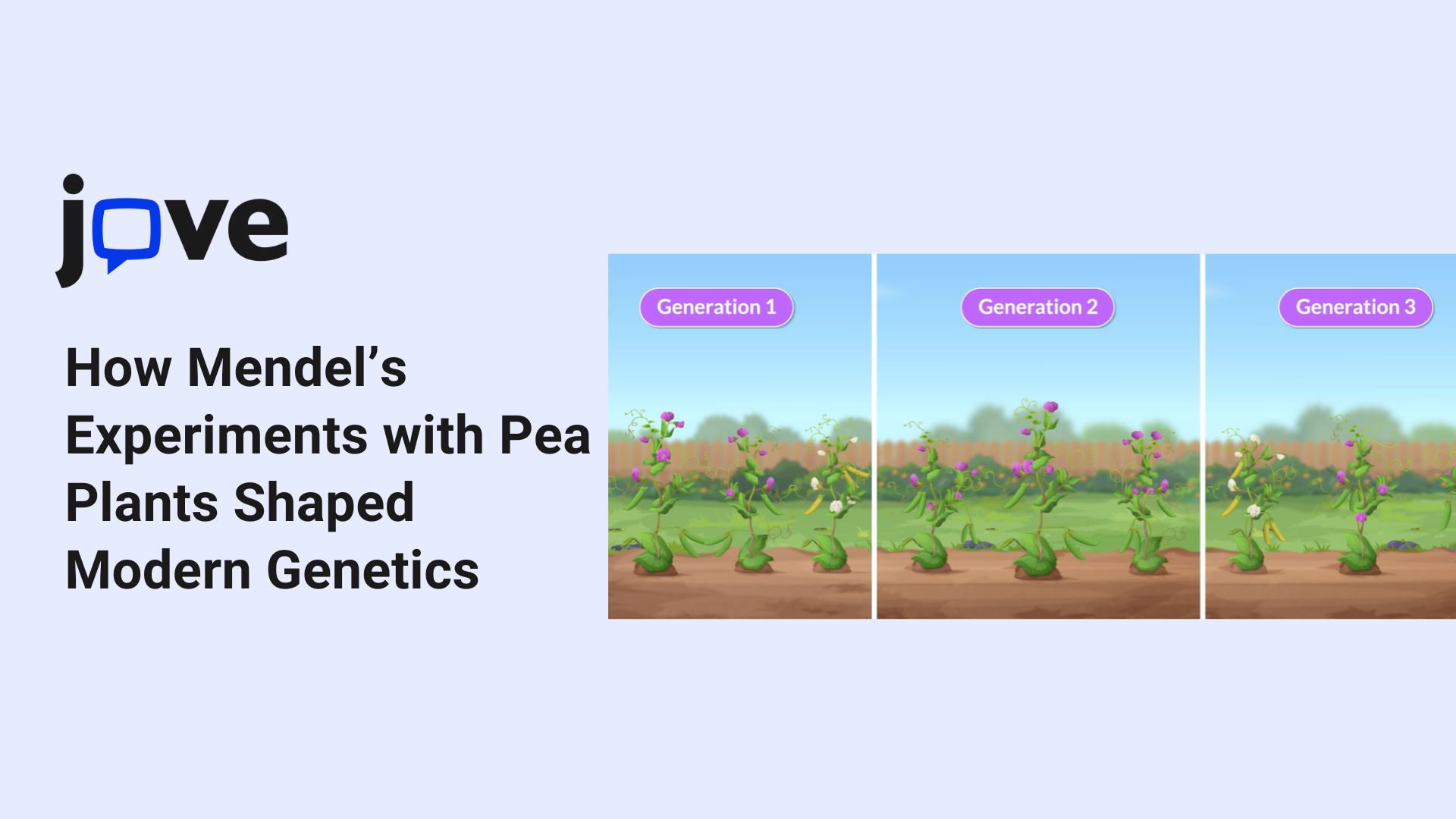
How Mendel’s Experiments with Pea Plants Shaped Modern Genetics
Mendel’s experiment revealed that traits are inherited in predictable patterns — laying the foundation for modern genetics.
Before Gregor Mendel, inheritance was a mystery. After him, we had ratios, rules, and reliable predictions. And even though he worked with peas, his findings shaped how we understand everything from eye color to genetic diseases today.
Gregor Mendel’s Pea Plant Experiment: The Origin of Genetics
Gregor Mendel’s pea plant experiment began in the 1850s when he observed how traits were passed from one generation to the next in garden peas.
He studied seven different traits, including:
- Flower color (purple vs. white)
- Seed shape (round vs. wrinkled)
- Pod color and position
These are the traits Mendel studied because they showed up in clear, contrasting forms — perfect for identifying patterns.
🎥 Use JoVE’S concept videos to show how Mendel cross-pollinated pea plants and tracked outcomes over generations. Students grasp the “why” behind his methods when they can see them visually.
What Did Mendel Discover About Inheritance?
So, what did Mendel discover about inheritance that was so revolutionary?
- Traits are controlled by “factors” (now called genes)
- One factor can mask another (dominant vs. recessive)
- These factors are passed down independently
- Predictable ratios appear in offspring (like 3:1)
Mendel’s work laid the foundation for Mendelian genetics for students, including the idea that dominant and recessive genes determine visible traits.
How Did Mendel’s Pea Plant Experiment Influence Genetics?
How did Mendel’s pea plant experiment influence genetics?
His work was the first to show that traits are inherited in units — not blended, as scientists once thought. Though his work was overlooked at first, it became the cornerstone of classical genetics in the 20th century.
Today, we still use his ideas in:
- Predicting disease inheritance
- Understanding agricultural traits
- Genetic counseling and bioengineering
Students will appreciate that a monk with a pea garden laid the groundwork for genetic testing, cloning, and CRISPR.
How to Teach Mendelian Genetics with Punnett Squares
Here’s how to teach Mendelian genetics with Punnett squares in a way that’s both hands-on and visual:
- Introduce a trait — like plant height (T = tall, t = short)
- Cross TT (tall) with tt (short)
- Use a Punnett square to predict F1 and F2 generations
- Discuss genotype (TT, Tt, tt) vs. phenotype (tall, short)
🎥 JoVE videos animate these crosses and let students visualize gene combinations in real time — perfect for reinforcing vocabulary and math skills.
Dominant and Recessive Traits Middle School Activity
Try this engaging, hands-on dominant and recessive traits middle school activity to bring Mendel’s work to life — right in your classroom.
🧬 Activity: Trait Inventory in the Classroom
Objective: Help students identify dominant and recessive traits in themselves and their peers, reinforcing the concept of heredity through real-world data collection and analysis.
Step 1: Create a Trait Checklist
Prepare a list of simple, observable traits that have dominant and recessive gene associations. Include traits like:
- Tongue rolling ability (dominant)
- Earlobe attachment (free = dominant, attached = recessive)
- Widow’s peak (dominant)
- Hitchhiker’s thumb (recessive)
- Mid-digit hair (dominant)
Print the checklist or project it for students to record their answers individually.
Step 2: Survey and Collect Class Data
Have each student observe and mark their own traits on the checklist. Then, compile the class data on the board or using a shared digital spreadsheet.
Encourage discussion:
- “How many students can roll their tongue?”
- “How common is the widow’s peak in our class?”
Step 3: Graph the Results
Create a bar graph or pie chart showing the distribution of dominant vs. recessive traits in the class. This visual makes patterns easier to spot and discuss.
Ask guiding questions:
- “Why do we see more dominant traits?”
- “Can two parents with a dominant trait have a child with a recessive one?”
Step 4: Discuss Genetics in Action
Use the results to introduce the concept of genotype vs. phenotype and explain how some students with dominant traits might still carry a recessive allele.
Conclusion: Making Mendel Relevant for Today’s Learners
Mendel’s experiment may have started with peas, but its impact continues across all of biology. His simple idea — that traits follow rules — is still used by geneticists, doctors, and farmers alike.
JoVE’s visual tools make it easier than ever to explain these timeless ideas to a new generation of students.
🎓 Book a Free Demo to access JoVE’s full genetics video library, including Mendelian inheritance, Punnett squares, and traits exploration — designed for NGSS-aligned middle school instruction.
Bring JoVE to your classroom starting as low as $2 per student.*
Explore funding resources to learn how your school can start using JoVE’s complete STEM video library today.
*Pricing based on 1,500 students.

