
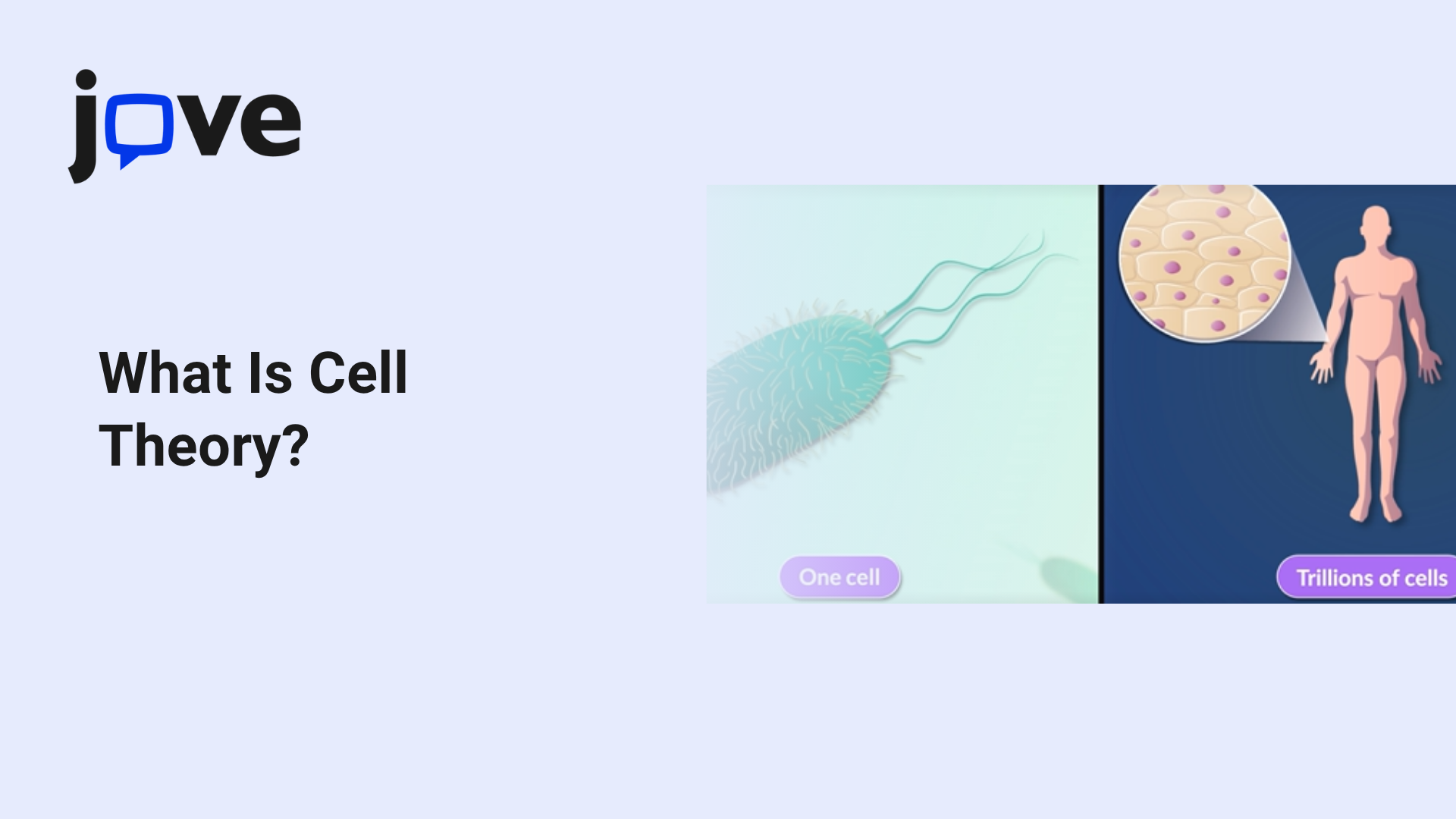
What Is Cell Theory? A Beginner’s Guide for Middle School Science
Cell theory is one of the biggest ideas in biology – it’s the reason scientists understand that all living things are made of cells. For middle school students, learning about cell theory builds a foundation for everything from anatomy to ecology. But without visuals and hands-on examples, it can feel abstract.
JoVE’s videos on Cells and Microscope Use make the concept easier to grasp. They show exactly how scientists first made these discoveries and how they apply to living organisms today. Let’s break down the key ideas and explore ways to bring cell theory to life in the classroom.
Unlock Free Full Access to JoVE!
Why Understanding Cell Theory Matters
Knowing cell theory helps students see how living things are connected at the smallest level. It’s a unifying principle in biology that answers questions like:
- How do plants and animals grow?
- Why can’t we live without cells?
- How are cells related to health and disease?
Cell theory connects to real-world science – from microscope discoveries to modern medicine. Understanding it also helps students appreciate why scientists spend so much time studying cells.
The Three Parts of Cell Theory
1. All living things are made of one or more cells.
This means that whether it’s a single-celled bacterium or a giant elephant, all life starts with cells.
2. The cell is the basic unit of structure and function in living things.
Just like bricks form buildings, cells build every part of a living organism.
3. All cells come from pre-existing cells.
Cells don’t appear out of nowhere – they divide and reproduce, passing on genetic material.
Scientists Who Contributed to Cell Theory
- Robert Hooke – First used the term “cell” when observing cork.
- Anton van Leeuwenhoek – Improved microscopes and observed living microorganisms.
- Matthias Schleiden & Theodor Schwann – Proposed that plants and animals are made of cells.
- Rudolf Virchow – Stated that cells come from other cells, completing the modern cell theory.
Hands-On Classroom Activities
Activity 1: Microscope Exploration
Provide prepared slides of plant and animal cells. Let students observe and sketch them.
Supports: three parts of cell theory, microscope discoveries.
Activity 2: Cell Theory Timeline
Assign each student a scientist from the history of cell theory. Have them create a short presentation with an image and key discovery.
Supports: scientists who contributed to cell theory, and modern cell theory.
Activity 3: Model a Cell
Use clay, beads, or paper cutouts to build a 3D or 2D model showing the cell as the basic unit of life.
Supports: cells as the basic unit of life, and examples of cell theory in everyday life.
Connecting Cell Theory to Everyday Life
Show students how cell theory is applied outside the classroom:
- Healthcare – Understanding how cells work helps in treating diseases.
- Food science – Studying yeast cells in bread making.
- Environmental science – Observing algae cells in pond water to monitor ecosystems.
FAQ: Teaching Cell Theory
Use microscope observations, timeline activities, and visual aids like JoVE videos.
- All living things are made of one or more cells.
- The cell is the basic unit of structure and function.
- All cells come from pre-existing cells.
Hooke, Leeuwenhoek, Schleiden, Schwann, and Virchow.
Healing wounds, plant growth, and the spread of diseases all follow cell theory principles.
Conclusion: Bring Cell Theory to Life with JoVE
Cell theory isn’t just a definition in a textbook—it’s a way of understanding life itself. With JoVE’s curriculum-aligned resources, your students can explore the microscopic world, see real cells in action, and connect history to modern science.
Make science visual and memorable – start your free JoVE trial by booking a demo with us.
JoVE’s science video library starts at just $2 per student*. Explore funding options now.
*Pricing based on 1,500 students.

