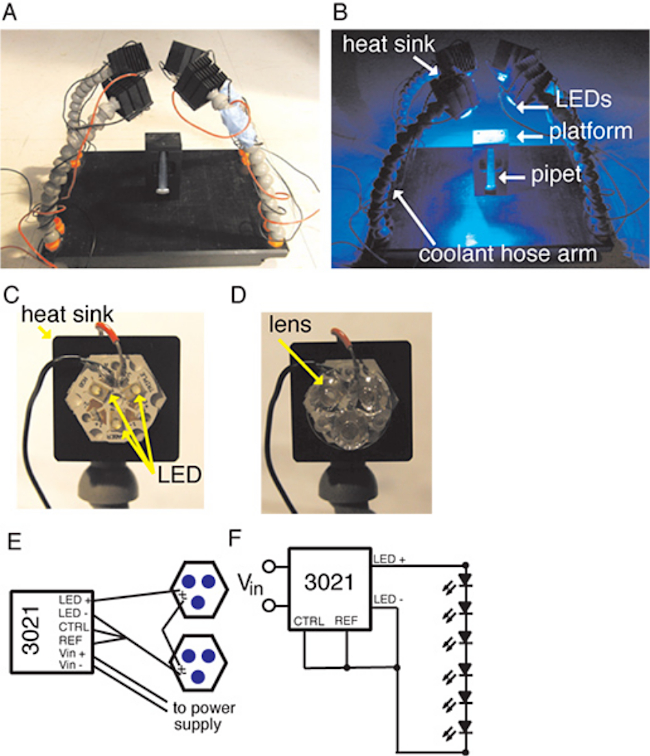
This protocol is an excerpt from de Vries and Clandinin, Optogenetic Stimulation of Escape Behavior in Drosophila melanogaster, J. Vis. Exp. (2013).
1. Generate Channelrhodopsin Flies
- Cross UAS-ChR2 flies with the Gal4 driver of your choosing, we use G105-Gal4, which is expressed in Foma-1 neurons in the optic lobe.
- To eliminate the possibility of a visual response to the blue light stimulation, both fly lines are in a w+norpA background.
- End result: w+norpA;G105-Gal4/UAS-ChR2 +
- After adult flies eclose, put selected females on fresh food, supplemented with 10 μM all-trans-retinal (a co-factor required for ChR2) and protected from light, for 3 days before performing the behavioral assay.
2. Make 10 μM All-trans-retinal Enhanced Food
- Dissolve 100 mg of all-trans-retinal in 17.6 ml of 95% ethanol to make 20 mM retinal. Keep all-trans-retinal protected from light at all times.
- Melt standard cornmeal fly food in microwave, and let cool until warm to touch.
- Mix 50 μl of 20 mM all-trans-retinal into vials of 10 ml of fly food.
- Let vials cool and keep protected from light.
3. Equipment
- Pipet tips: Standard 1,000 μl pipet tips are cut near the tip, creating a pore diameter of ~2.25 mm.
- Platform (see Figure 1).
- A Delrin base, 17 cm X 25 cm, was constructed with threaded holes at each corner to fit ¼" NPT coolant hose connectors.
- A vertical holder, made from Delrin, is attached to the center of the base. The overall dimensions are 25 mm X 40 mm X 65 mm (width X depth X height). A 10 mm wide groove runs the length of the holder, with a thumb screw at the bottom. A platform is attached to the top of the holder, 25 mm X 40 mm X 10 mm, with a 3.5 mm diameter hole aligned with the groove in the holder.
- LED arrays (see Figure 1).
- Four arms of coolant hose, ~18 cm long, are affixed to the platform base using the coolant hose connector. Coolant hose is used only as structural support and is not used for cooling purposes.
- Properly spaced grooves are cut into the final piece of coolant hosing of each arm to affix a heat sink to the end of each arm.
- A blue LED Rebel Tri-Stars is mounted to each heat sink using pre-cut thermal adhesive tape. A Carclo 18° Tri-lens is affixed to each Tri-Star.
- LED Tri-Stars are wired to the BuckPuck DC drivers and a power supply as specified. We have arranged our set-up with each BuckPuck powering two Tri-Stars in series.
- Illumination of all four LED Tri-Stars at 700 mA yielded an irradiance of 713 W/m2 on our platform.
- Camera: The camera is mounted on a small tripod and focused on the top of the platform.
4. Behavioral Assay
- Briefly anaesthetize flies on ice.
- Place individual flies in pipet tips, using tape to close both ends of the tip.
- After the flies have awoken and are actively exploring the pipet tip, remove the tape and place a pipet in the groove in vertical holder. The thumbscrew is used to secure the pipet tip in place and to close the bottom of the tip.
- As the fly explores the pipet tip (typically 30 - 60 sec), start the camera recording just before the fly emerges from the tip onto the platform.
- After the fly has emerged onto the platform, wait 1-2 seconds, and turn on the blue LEDs. Use a timer to manually measure the time until the fly initiates flight.