This video demonstrates the use of photodegradable hydrogels to isolate bacterial colonies within silicon microwell arrays. Bacterial cells are first loaded into microwells, encapsulated in a crosslinked hydrogel, and cultured into distinct colonies. Upon exposure to ultraviolet light, targeted degradation of the hydrogel enables selective extraction of individual colonies.
A subscription to JoVE is required to view this content. Sign in or start your free trial.
Method Article
Photodegradable Hydrogel-Based Isolation of Bacterial Colonies in Microwell Arrays
482 views
⸱
August 29th, 2025
In This Article
Abstract
Protocol
1. Bacterial strains and culture protocols
- Streak colonies of bacteria on agar plates supplemented with appropriate growth media. In this report, Bacillus subtilis (strain 1A1135, Bacillus Genetic Stock Center) is cultured on ATGN (0.079 M KH2PO4, 0.015 M (NH4)2SO4, 0.6 mM MgSO4·7H2O, 0.06 mM CaCl2·2H2O, 0.0071 mM MnSO4·H2O, 0.125 M FeSO4·7H2O, 28 mM glucose, pH: 7 ± 0.2, 15 g/L agar) agar plates supplemented with 100 µg/mL spectinomycin and Escherichia coli (strain 25922, ATCC) on ATGN agar plates supplemented with 100 µg/mL ampicillin.
NOTE: Prior reports of hydrogel encapsulation and release with these materials instead used A. tumefaciens C58 cells - Pick desired colonies from ATGN agar plates and start overnight cultures. For E. coli and B. subtilis strains used here, culture at 37 °C while shaking at 215 rpm in ATGN liquid medium for 24 h. Store the cell cultures in 50% glycerol at -80 °C until future use.
- Pick colonies of both strains from glycerol stocks using sterile inoculation loops and incubate in ATGN liquid media for 24 h at 37 °C and 215 rpm.
2. Preparation of the material needed for hydrogel formation
- Photodegradable poly(ethylene glycol)-o-nitrobenzyl diacrylate (PEG-o-NB-diacrylate) synthesis
NOTE: The in-house synthesis of the PEG-o-NB-diacrylate has been well-described and previously reported. Alternatively, because the synthesis is routine, it can be outsourced from a chemical synthesis facility. - Crosslinking buffer
- Take the recipe of the selected medium for the bacterial strain and prepare media with 2x nutrients. Add phosphate, e.g., NaH2PO4, to the medium to a final concentration of 100 mM. Then, adjust the pH value to 8 using 5 M NaOH (aq).
- Sterilize the buffer solution and store it at -20 °C until further use.
NOTE: Leave out any transition metals present in the media, as these metals catalyze the oxidation of the thiols to disulfides.
- PEG-o-NB-diacrylate solution
- For each mg of the aliquot PEG-o-NB-diacrylate (3,400 Da molecular weight) powder, add 3.08 µL of ultrapure water to reach a 49 mM concentration of PEG-o-NB-diacrylate (98 mM acrylate concentration).
- Vortex the solution until it is well mixed and store this solution at -20 °C until further use.
- 4-arm PEG-thiol solution
- For 4-arm PEG-thiol (10,000 Da molecular weight) preparation, add 4 µL of ultrapure water per mg powder to reach a 20 mM concentration (80 mM of thiol concentration).
- Vortex this solution until it is well-mixed and store this solution at -20 °C until further use.
5. Fabrication of silicon microwell arrays
- Parylene coating: Use the standard protocol described in previous research articles to coat silicon wafers with parylene.
- Microfabrication: Follow the protocol described in the literature to design and fabricate the microwell array (Figure 1).
NOTE: Standard photolithographic techniques were applied to fabricate microwell arrays on parylene-coated silicon wafers.
7. Hydrogel formation over microwell arrays
- Bacteria seeding in microwell arrays
NOTE: 700 µL of 0.1 OD600 (optical density at a wavelength of 600 nm) cell suspensions were seeded over the microwell array substrates, and the parylene lift-off method was applied to remove cells from the background. - Prepare the hydrogel precursor solution by adding 5.6 µL of the PEG-o-NB-diacrylate with 12.5 µL of pH 8 phosphate-buffered saline ATGN and mixing with 6.9 µL of the four-arm PEG thiol solution.
- Pipette 12.5 µL of the precursor solution on a non-reactive, perfluoroalkylated glass slide and place two 38 µm steel spacers (see Table of Materials) on two opposing sides of the microwell array substrate inoculated with cells.
- Invert the perfluoroalkylated glass slide with the precursor solution droplet and place the droplet in the middle of the microwell substrate. Then, incubate for 25 min at room temperature (RT) for hydrogel formation.
- Gently remove the glass slide from the microwell substrate. The hydrogel membrane should remain attached to the microwell substrate.
Access restricted. Please log in or start a trial to view this content.
Results
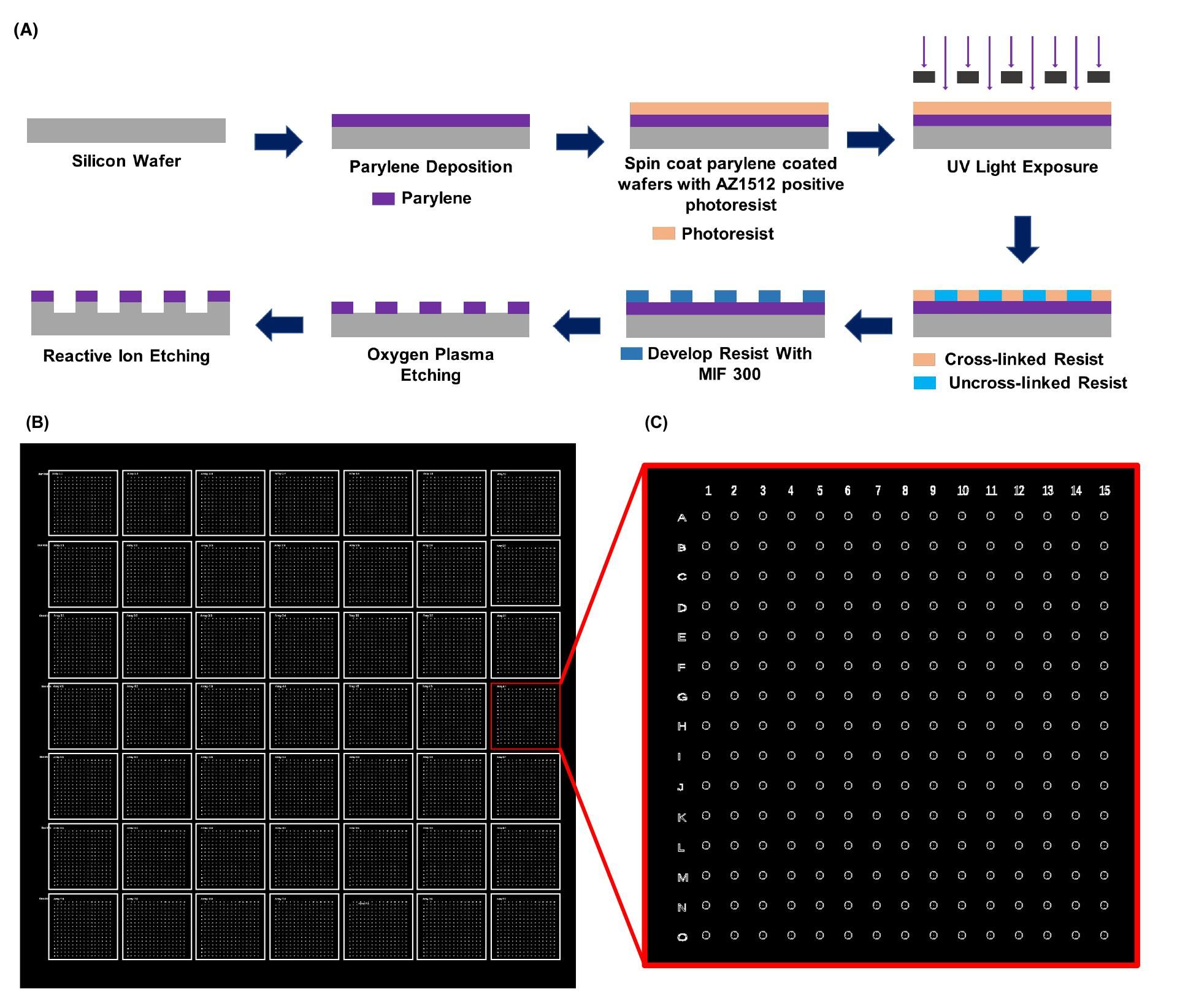
Figure 1: Design and fabrication of microwell arrays. (A) Standard microfabrication te...
Access restricted. Please log in or start a trial to view this content.
Materials
| Name | Company | Catalog Number | Comments |
|---|---|---|---|
| Ammonium sulfate | Fisher Chemical | A702-500 | Certified ACS Granular |
| Bacillus subtilis 1A1135 | Bacillus Genetic Stock Center | 1A1135 | |
| Brightfield upright microscope | Olympus Corporation | BX51 | |
| Calcium chloride, anhydrous | Fisher Chemical | C614-500 | For Desiccators Pellets, 4-20 Mesh |
| DOWSIL 184 silicone elastomer base | Dow Silicones Corporation | Storage temperature: -30-60 °C | |
| DOWSIL 184 silicone elastomer curing agent | Dow Silicones Corporation | Storage temperature: < 32 C | |
| EPOCH2 microplate spectrophotometer | BioTek Instruments | EPOCH2 | |
| Escherichia coli ATCC 25922 | Thermo Fisher Scientific | R19020 | |
| Ethanol, anhydrous | Fisher Chemical | 459844 | |
| Fisherfinest premium microscope slides plain | Fisher Scientific | 12-544-4 | |
| Hydrogen peroxide solution | Sigma-Aldrich | 216763-500ML | Contains inhibitor, 30 wt% in H2O |
| Isopropanol | Sigma-Aldrich | 190764 | |
| Magnesium sulfate, 7-hydrate | Macron Fine Chemicals | 6066-04 | Avantor Performance Materials, Inc. |
| Methanol | Sigma-Aldrich | 179337-4L | ACS reagent, > 99.8% |
| Nitrogen, compressed | Matheson | UN1066 | |
| Pentaerythritol tetra(mercaptoethyl) polyoxyethylene (4 arm-PEG) | NOF America Corporation | PTE-100SH | Sunbright-PTE-100SH |
| Phosphate buffered saline (PBS), 10X | VWR Amresco Life Science | K813-500ML | Store between 15 °C–30 °C |
| Premium microscope slides | Fisher Scientific | 12-544-4 | 25 x 75 x 1 mm |
| Sodium chloride | Sigma Life Science | S5886-500G | Bioreagent, suitable for cell culture |
| Sodium hydroxide | Sigma-Aldrich | S8045-500G | BioXtra, > 98%, pellets (anhydrous) |
| Sodium phosphate monobasic dihydrate | Sigma-Aldrich | 71505-250G | BioUltra, for molecular biology, > 99.0% (T) |
| Stainless steel thickness gage | Precision Brand Products | 77739 |
