This video demonstrates a hydroponic co-cultivation system for studying plant–bacteria interactions under sterile conditions. Plant seedlings are transferred into a sterile, acidic growth medium, incubated, and inspected for contamination before inoculation with Agrobacterium. The activated bacteria attach to plant roots, transfer T-DNA into plant cells, and promote molecular changes that enhance bacterial colonization.
A subscription to JoVE is required to view this content. Sign in or start your free trial.
Method Article
A Co-Cultivation System to Study the Molecular Responses of Plant Hosts and Interacting Bacteria
741 views
⸱
September 26th, 2025
In This Article
Abstract
Protocol
1. Hydroponic Co-cultivation System
- Prepare liquid Murashige and Skoog (MS) medium: 2.165 g/L MS basal salts, 10 g/L sucrose, 0.25 g/L 2-(N-morpholino)ethanesulfonic acid (MES), and 59 mL/L B5 vitamin mix, pH 5.75.
- Autoclave the medium. Pour 18 mL of it into each sterile cylindrical glass or clear plastic tank (crystallizing dishes, 100 x 80 mm2) with sterile lids.
NOTE: Presterilize the tanks and lids by wrapping them in aluminum foil and autoclaving. - In a sterilized flow hood, use sterile forceps to gently transfer each mesh square with 10-14 day-old seedlings from the semi-solid medium to a hydroponic cylindrical tank (Figure 1d). Seal the lids onto the tanks using porous surgical tape.
- Cultivate the seedlings on the mesh in the tank for 72 h at 22-24 °C, with a 16 h photoperiod and shaking at 50 rpm for aeration (Figure 1e).
NOTE: This allows plants to adapt to the hydroponic environment prior to inoculation (cocultivation) with microorganisms. This waiting period will also allow accidental microbial contamination to be apparent prior to the inoculation.- Begin the next step the day prior to the end of the incubation period.
- Grow Agrobacterium tumefaciens in agrobacterium (AB) medium (0.5% w/v yeast extract, 0.5% w/v tryptone, 0.5% w/v sucrose, 50 mM MgSO4, pH 7.0) at 28 °C with shaking overnight until the culture reaches a final optical density of 1.0 at 600 nm (OD600), as measured using a spectrophotometer, with uninoculated AB medium as a blank.
NOTE: An OD600 of 1.0 is equivalent to approximately 109 cells/mL. - Wash the A. tumefaciens three times in an equal volume of 0.85% NaCl. Resuspend in an equal volume of sterile double-distilled water.
- Prior to the inoculation, examine the tank with seedlings carefully to ensure that there is no contamination; the medium in the uncontaminated tanks should be clear and transparent.
- Discard any tank with cloudy liquid (contamination) and number the rest of the tanks. Sample a small amount (20 µL) of hydroponic medium from each numbered tank and spot it on a petri dish filled with Luria broth (LB). Incubate the dish at 28 °C.
- Immediately, add 50 µL of the A. tumefaciens suspension (approximately 5 x 10⁷ cells, estimated from the OD600) into each numbered hydroponic tank. Cocultivate the Arabidopsis thaliana seedlings and A. tumefaciens at 22-24 °C with a 16 h photoperiod and shaking at 50 rpm (Figure 3f).
- Examine the spotted LB plate from step 1.7.1. after 12 and 28 h incubation to verify the sterility of the tanks. If there is any contamination, do not use the corresponding numbered tank (inoculated with bacteria) for further downstream assays.
- If desired, monitor the growth of A. tumefaciens at regular intervals by removing a sample of medium from the tank and measuring the OD600 using a spectrophotometer with medium from an un-inoculated control as a blank (Figure 2).
NOTE: Plant disease symptoms should be apparent after 7 d (Figure 3).
Access restricted. Please log in or start a trial to view this content.
Results
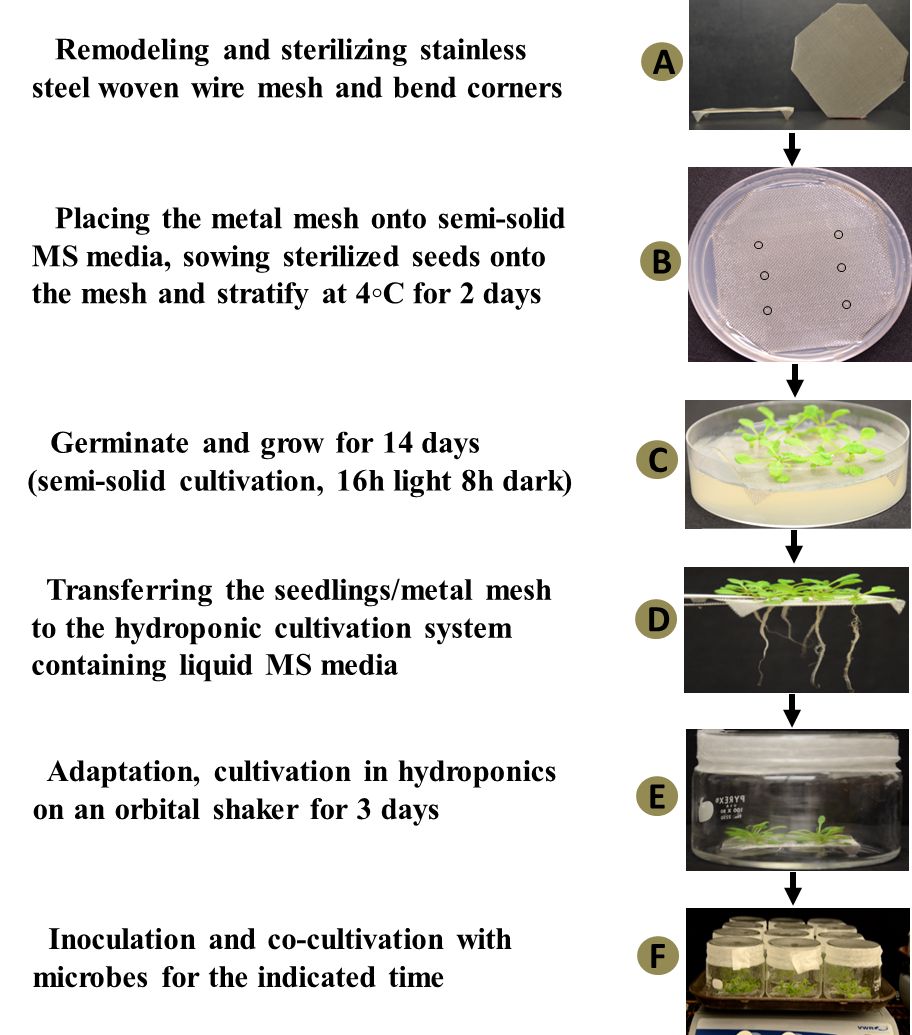
Figure 1: Hydroponic Plant-Microbe Cocultivation System. The left panel represents a flow chart o...
Access restricted. Please log in or start a trial to view this content.
Materials
| Name | Company | Catalog Number | Comments |
|---|---|---|---|
| Plant seeds (Arabidopsis thaliana Col-0) | Arabidopsis Biological Resource Centre | CS7000 | https://abrc.osu.edu/order-stocks |
| Bacteria (Agrobacterium tumefaciens C58) | University of Washington | N/A | |
| Labeled bacteria | in-house | optional, depends on downstream analyses | |
| Double distilled water | (various) | ||
| Micropipette | (various) | ||
| Murashige and Skoog (MS) basal salts | Sigma-Aldrich | M5524 | |
| Sucrose | (various) | ||
| MES | (various) | ||
| B5 vitamin mix | Sigma-Aldrich | G1019 | |
| Phytoagar | (various) | ||
| Deep Petri dishes | (various) | ||
| Stainless steel mesh | Ferrier Wire Goods Company Ltd | N/A | grade: 304; mesh count: 40 × 40; wire DIA: 0.01 |
| Micropore tape, 1" | 3M | 1530-1 | |
| Diurnal growth chamber | (various) | ||
| Cylindrical glass tanks, 100 × 80 mm | Pyrex | 3250 | other sizes can be used, in which case liquid content may need adjustment |
| Flow hood | (various) | ||
| Forceps | (various) | ||
| Yeast extract | (various) | ||
| Tryptone | (various) | ||
| MgSO₄ | (various) | ||
| Shaking incubator | (various) |
