This video demonstrates the selection, quantification, and preservation of Gram-negative recipient bacteria carrying transposon insertions based on kanamycin resistance.
A subscription to JoVE is required to view this content. Sign in or start your free trial.
Method Article
Isolation of Gram-Negative Bacteria with Genomic Transposon Insertions
567 views
⸱
September 26th, 2025
In This Article
Abstract
Protocol
Generation of the final bacterial mutant library
- Thaw an aliquot of the frozen mating on ice.
- Plate mating on 150 mm Luria-Bertani (LB) agar plates supplemented with kanamycin based on colony-forming units (CFU) calculated in step 3.1. Adjust the volume with LB to yield 13,333 colonies per 150 µL before plating.
NOTE: The CFU count here was determined to be about 105 CFU/mL, so the mating volume was adjusted to obtain 13,333 colonies per plate. This would provide an optimal number of colonies on 30 plates for a high-resolution mutant library without overcrowding the plates. - Use sterile glass beads to spread 150 µL of the dilution per plate on 30 x 150 mm Luria-Bertani agar plates supplemented with kanamycin to obtain 400,000 colonies (Figure 1C).
NOTE: Sterile rods or any kind of sterile spreader tool (i.e., glass beads) may be used to spread the bacteria on plates. - Dispose of the used tube containing excess mating.
NOTE: Freeze/thaw cycles add selective pressures on the bacterial culture, which can skew the Tn-seq experiment results. Use a fresh aliquot each time. - Incubate plates at 37 °C for 14 h.
NOTE: The incubation time is optimized to prevent overgrowth (colonies touching). Minimizing growth by reducing the incubation time is suggested.
Estimating library density and pooling for storage
- Count CFUs on each plate to estimate the total mutants in the transposon library. Count 20% of at least 3 plates to determine the colony count estimate for the entire group of plates (Figure 2A). Ensure that the colonies are not touching another colony.
- After calculating the estimated colony yield, add 3-5 mL of LB (or more if needed) to each plate and scrape off the bacteria using a sterile scraping tool.NOTE: Sterile inoculating loops were used to efficiently scrape plates.
- Pool bacterial suspensions from all plates into 50 mL conical tubes (Figure 1D). This will require multiple 50 mL conical tubes, at least 3.
- Pellet pooled bacterial suspension using centrifugation at 5,000 x g for 7 min.
- Discard the supernatant and resuspend the pellet in 5 mL of LB supplemented with 30% glycerol.
- Aliquot 1 mL of the transposon library into cryovials and store at -80 °C.
Access restricted. Please log in or start a trial to view this content.
Results
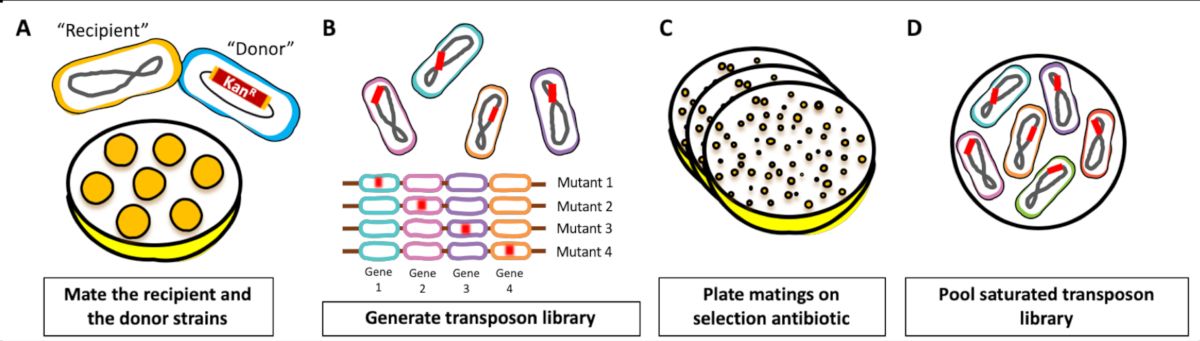
Figure 1: Schematic of transposon mutant library construction. (A) Bacterial conjugation. The &#...
Access restricted. Please log in or start a trial to view this content.
Materials
| Name | Company | Catalog Number | Comments |
|---|---|---|---|
| 150mm x 15mm Petri Dishes | Corning | 351058 | |
| 50mL Conical Sterile Polypropylene Centrifuge Tubes | Fisher Scientific | 12-565-271 | |
| Acinetobacter baumannii ATCC 17978 | ATCC | N/A | AmpS, KanS |
| Escherichia coli MFD Dap- | N/A | N/A | DAP Auxotroph, requires 600 mM exogenously added DAP to grow. Contains RP4 machinery for plasmid transfer. Carrier for JNW68 (36). |
| Externally Threaded Cryogenic Vials | Corning | 09-761-71 | |
| Glass beads | Corning | 72684 | |
| Glycerol | Fisher Scientific | G33 | |
| Inoculating loops | Fisher Scientific | 22-363-602 | Scraping tool |
| Kanamycin | Fisher Scientific | BP906 | Used at 25 mg/L |
| LB agar, Miller | Fisher Scientific | BP1425 | |
| LB broth, Miller | Fisher Scientific | BP1426 | |
| Phosphate Buffered Saline, 10X Solution | Fisher Scientific | BP39920 | Diluted to 1X |
