This video demonstrates a method for evaluating the phototoxic effects of flavin mononucleotide (FMN) on pathogenic bacteria. Bacterial cultures are exposed to increasing concentrations of FMN and illuminated with visible light to generate reactive oxygen species (ROS) that damage cellular components. The surviving bacteria are then quantified to assess the dose-dependent reduction in viability.
A subscription to JoVE is required to view this content. Sign in or start your free trial.
Method Article
Inactivation of Bacteria Using Light-Activated Flavin Mononucleotide
441 views
⸱
September 26th, 2025
In This Article
Abstract
Protocol
- Staphylococcus aureus (S. aureus) viability after FMN photolysis (Figure 1)
- Transmit a colony of S. aureus (BCRC 10451) from a cultured plate into 10 mL of Lysogeny broth taken in a 15 mL screw-capped test tube. Culture in a shaker at 37°C for 16 h.
- Transfer 0.5 mL of the culture to a 1.5 mL centrifuge tube. Add sterilized water into the centrifuge tube to dilute the culture to an optical density of 0.5 at 600 nm (OD600) (~6 x 10⁷ colony-forming unit [CFU]/mL).
- Transfer 0.5 mL of the culture to a 1.5 mL centrifuge tube, centrifuge at 14,000 x g for 10 min, and decant the supernatant to obtain a cell pellet.
- Add 1 mL of Riboflavin-5'-phosphate (or flavin mononucleotide; FMN)-buffered solution (30, 60, and 120 μM FMN in potassium phosphate buffer [PB]) to the cell pellets obtained as in step 1.3, and vortex. For irradiated control, add 1 mL of PB alone.
- Transfer 1 mL each of viable bacterial cell solutions containing 30 μM FMN and PB alone into glass tubes, and irradiate them with violet light at 10 W/m2 for 30 min.
- Transfer 1 mL each of viable bacterial cell solutions containing 30, 60, and 120 μM FMN and PB alone into glass tubes and irradiate them with blue light at 20 W/m2 for 120 min. Set up another glass tube with 1 mL of viable bacterial cell solution containing 120 μM FMN and irradiate it with blue light at 20 W/m2 for 60 min.
- Set up test tubes as described in steps 1.5 and 1.6 and cover them with thick aluminum foil. These tubes serve as dark controls.
- Keep the irradiation chamber (as well as the dark controls) in a cold room at 9 ± 1 °C during the 30-120 min irradiation period.
NOTE: Heat released by light-emitting diode (LED) lights cannot be ignored, as the LED chips placed inside the cup can heat the photoreaction system during irradiation experiments. The experiments were, therefore, conducted in a cold room maintained at 9 ± 1 °C. - After irradiation, transfer 0.2 mL from each of the reaction solutions onto a Luria agar (LA) plate. Spread the bacteria over the plate with an L-shaped glass rod and incubate overnight at 37 °C.
- Calculate the viable plate count and the inactivation rates of S. aureus after overnight growth.
NOTE: The inactivation rate of S. aureus is calculated as the percentage reduction, which is equal to [1 -I / D] ×100%, where I and D denote, respectively, the number of CFUs in the irradiated sample and dark control. The percentage reduction is defined as a negative value of the inactivation rate.
Access restricted. Please log in or start a trial to view this content.
Results
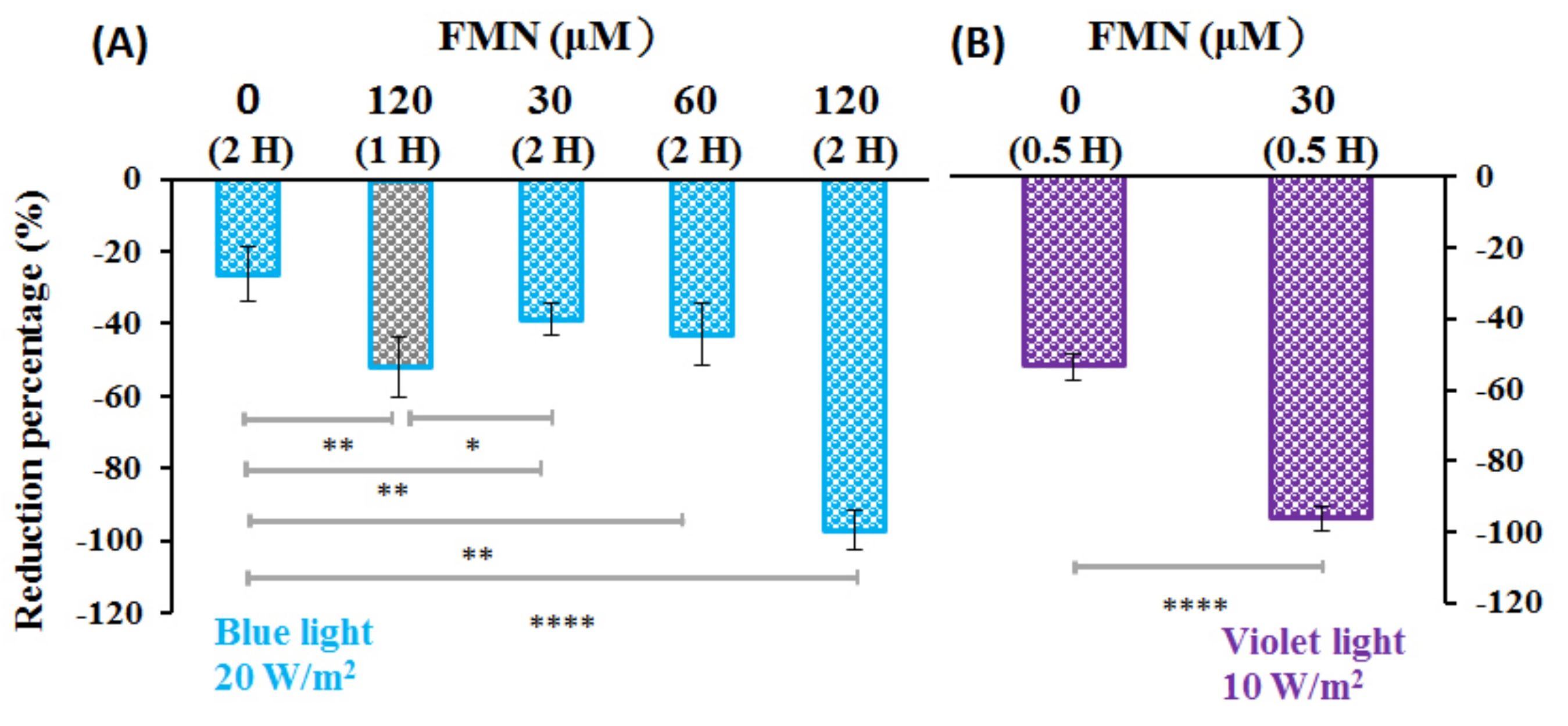
Figure 1: Effect of FMN photolysis on S. aureus viability.
Access restricted. Please log in or start a trial to view this content.
Materials
| Name | Company | Catalog Number | Comments |
|---|---|---|---|
| Blue, green and red LED lights | Vita LED Technologies Co., Tainan, Taiwan | DC 12 V 5050 | |
| Dimethyl Sulfoxide | Sigma-Aldrich, St. Louis, MO | 190186 | |
| Infrared thermometer | Raytek Co. Santa Cruz, CA | MT4 | |
| LB broth | Difco Co., NJ | ||
| L-Methionine | Sigma-Aldrich, St. Louis, MO | 1.05707 | |
| NBT | Bio Basic, Inc. Markham, Ontario, Canada | ||
| Power supply | China tech Co., New Taipei City, Taiwan | YP30-3-2 | |
| Riboflavin 5′-phosphate | Sigma-Aldrich, St. Louis, MO | R7774 | |
| RNase | New England BioLabs, Inc. Ipswich, MA | ||
| Solar power meter | Tenmars Electronics Co., Taipei, Taiwan | TM-207 | |
| Staphylococcus aureus subsp. aureus | Bioresource Collection and Research Center (BCRC), Hsinchu, Taiwan | 10451 | |
| UV-Vis optical spectrometer | Ocean Optics, Dunedin, FL | USB4000 | |
| UV-Vis spectrophotometer | Hitachi High-Tech Science Corporation,Tokyo, Japan | U-2900 | |
| Violet LED | Long-hui Electronic Co., LTD, Dongguan, China |
