This video demonstrates a whole-cell electrochemical method to assess how proton transfer affects extracellular electron transport (EET) in electroactive bacteria. By replacing protons with deuterons using deuterium oxide, the method measures changes in current to reveal a kinetic isotope effect, highlighting the role of proton movement in regulating electron flow.
A subscription to JoVE is required to view this content. Sign in or start your free trial.
Method Article
Measuring the Kinetic Isotope Effect on Microbial Electron Transport Using Deuterium Oxide
512 views
⸱
October 30th, 2025
In This Article
Abstract
Protocol
- Addition of Deuterium Water to Measure the KIE on the EET Process (Figure 1)
- Confirm that the current production from a monolayer biofilm of Shewanella oneidensis MR-1 is stable and does not increase rapidly. If the current increases steeply, wait until the current stabilizes within a 5% increase over 10 min.adding shuttling electron mediators such as 100 µM anthraquinone-1-sulfonate (α-AQS).
NOTE: The formation of a monolayer biofilm on an indium tin-doped oxide (ITO) electrode without contamination of other microbial strains was confirmed by rDNA sequences and a scanning electron microscopic image of the biofilm on an ITO electrode. For confirmation of the rate limitation by the EET process, monitor the effect of adding shuttling electron mediators such as 100 µM anthraquinone-1-sulfonate (α-AQS). - Add 40 µL of anoxic 50% (v/v) D2O into the electrochemical reactor using a syringe such that the concentration is 0.5% (v/v) D2O in the reactor.
NOTE: To prevent damage to the biofilm by D2O addition, inject the D2O drop-wise. - Wait for the current to stabilize and subsequently add the D2O up to 4.0% (v/v).
NOTE: To obtain the KIE value (the ratio of current production in the presence of D2O and H2O), check the effect of the same volume of H2O addition on the current production.
- Confirm that the current production from a monolayer biofilm of Shewanella oneidensis MR-1 is stable and does not increase rapidly. If the current increases steeply, wait until the current stabilizes within a 5% increase over 10 min.adding shuttling electron mediators such as 100 µM anthraquinone-1-sulfonate (α-AQS).
Access restricted. Please log in or start a trial to view this content.
Results
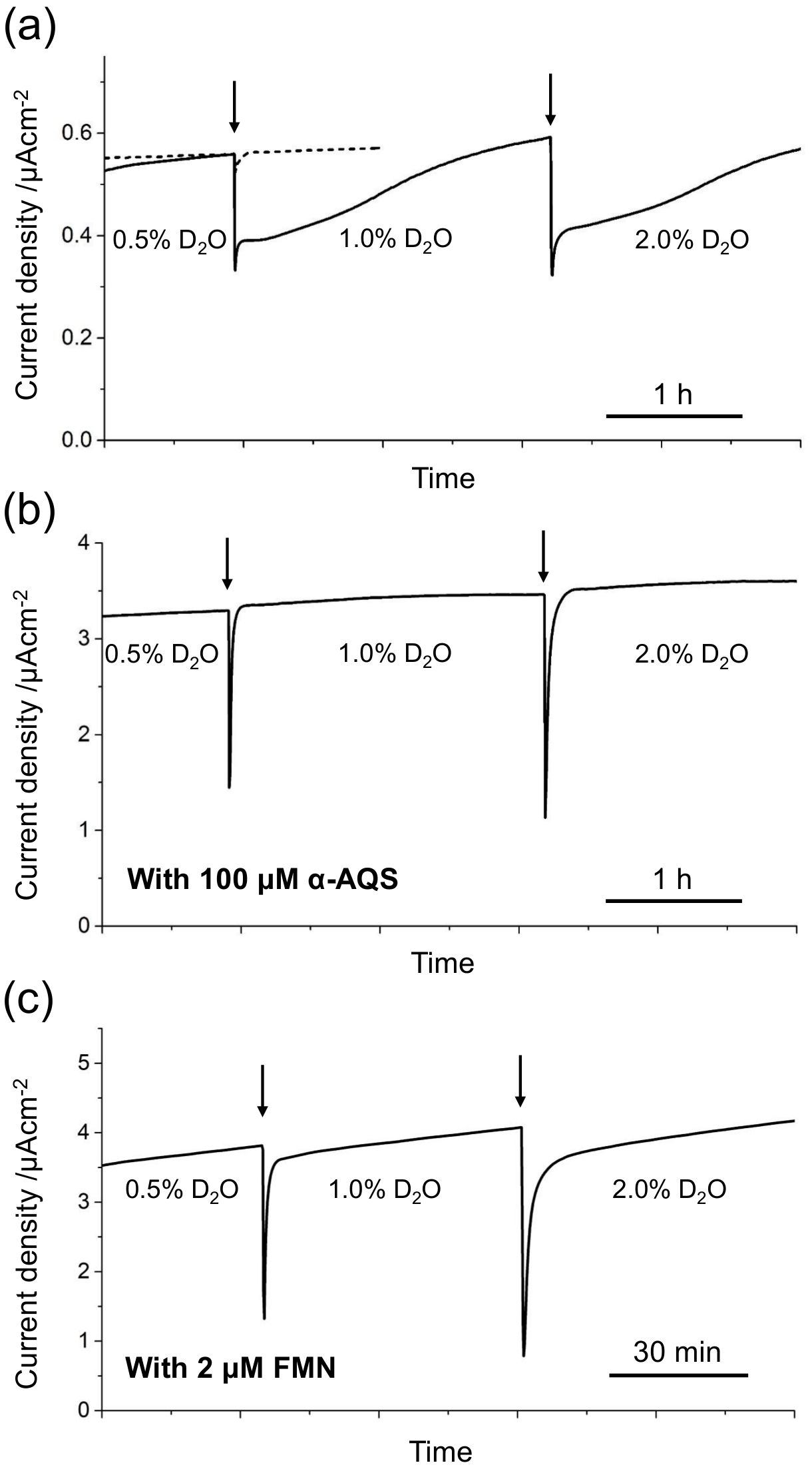
Figure 1: Effect of D2O addition on the current production from a monolayer biofi...
Access restricted. Please log in or start a trial to view this content.
Materials
| Name | Company | Catalog Number | Comments |
|---|---|---|---|
| Indium tin-doped oxide (ITO) electrode | GEOMATEC | No.0001 | Used as a working electrode, 5Ω/sq |
| Ag/AgCl KCl saturated electrode | HOKUTO DENKO | HX-R5 | Used as a reference electrode, Φ0.30mm |
| Platinum wire | The Nilaco Cooporation | PT-351325 | Used as a counter electrode |
| Anthraquinone-1-sulfonate (α-AQS) | TCI | A1428 | |
| Thermal water circulator | AS ONE | TR-1A | Used for maintanance of temperature of electrochemcial reactor |
| Deuterium oxide (D, 99.9%) | Cambridge Isotope Laboratories, Inc. | DLM-4-PK | Additive for kinetic isotope effect experiments |
