This video demonstrates the preparation of a cell extract from Vibrio natriegens, a rapidly growing bacterium known for its high protein synthesis rate. The bacterial pellet is washed and resuspended in lysis buffer before sonication on ice to prevent cellular degradation. The lysate is centrifuged to separate insoluble cell debris, and the cell extract is collected, flash-frozen, and stored for future use.
A subscription to JoVE is required to view this content. Sign in or start your free trial.
Method Article
Preparation of Crude Cell Extract from Vibrio natriegens
511 views
⸱
October 30th, 2025
In This Article
Abstract
Protocol
1. Preparation of V. natriegens Crude Cell Extracts – Bacterial Culture
- Prepare V. natriegens bacterial growth media, lysogeny broth version 2 (LB-V2) as per Table 1. Sterilize the growth media by autoclaving. Allow the media to reach room temperature (RT). Store excess media at RT.
CAUTION: Wear proper personal protection equipment (PPE) and consult lab-specific instructions when operating an autoclave. - Use a glycerol stock of wild-type V. natriegens to inoculate 3 mL of LB-V2 media. Grow overnight at 30 °C while shaking at 225 rpm.
- Wash 1 mL of the overnight culture by centrifugation at 10,600 x g on a benchtop centrifuge for 1 min. Aspirate the supernatant without disturbing the resulting pellet and resuspend in 1 mL of fresh LB-V2 media.
- In an autoclaved 4 L baffled Erlenmeyer flask with a sterile cover, add 1 L of fresh LB-V2 growth media. Inoculate using 1 mL of washed overnight culture (1:1,000 dilution ratio). Grow culture at 30 °C while shaking at 225 rpm.
NOTE: V. natriegens cultures can be scaled up or down while maintaining the 1:1,000 dilution ratio. For example, add 250 μL of washed overnight culture to 250 mL of fresh LB-V2 growth media in a 2 L baffled Erlenmeyer flask with a sterile cover. - Monitor the culture’s OD600 using a spectrophotometer. When culture reaches OD600 = 1.0 ± 0.2, harvest culture via centrifugation at 3,500 x g for 20 min at 4 °C. Place pellet on ice.
NOTE: V. natriegens grows rapidly, so close monitoring of the culture is necessary. Growth to OD600 = 1.0 should take approximately 1.5−2 h at the 1:1,000 dilution ratio. - Aspirate the supernatant and immediately store the resultant bacterial pellet at -80 °C or directly proceed to cell lysis described in section 2.
NOTE: This step is a good stopping point; however, it is recommended that the pellet be processed immediately or within 1−2 days for best results.
2. Preparation of V. natriegens Crude Cell Extracts – Cell Lysis
- Prepare S30 lysis buffer as per Table 1 in sterile deionized (DI) water and adjust pH to 7.7 using glacial acetic acid.
CAUTION: Glacial acetic acid should be handled with proper PPE when adjusting the pH. - Cool S30 lysis buffer to approximately 4 °C in a refrigerator or on ice before beginning the cell lysis procedure.
NOTE: For a quick cool down, lysis buffer can be placed at -20 °C. Do not allow the buffer to freeze. - Place cell pellets on ice for 10−20 min or until completely thawed. Resuspend all pellets resulting from the same 1 L culture using 10 mL of cold S30 lysis buffer, then transfer the suspension to a 50 mL tube. If pellets are not frozen in the freezer at -80 °C in step 1.6, proceed directly to resuspension.
NOTE: Increase the volume of S30 lysis buffer used to initially resuspend pellets as needed. - Centrifuge suspension at 3,500 x g for 10 min at 4 °C. Aspirate the supernatant without disturbing the pellet. Wash the pellet a second time using 10 mL of cold S30 lysis buffer. Place the pellet on ice.
- In a cold room, add 500 μL of cold S30 lysis buffer to the pellet in the 50 mL tube. Using a wide-bore pipette tip, resuspend the pellet and carefully transfer the entire pellet suspension to a 2 mL tube.
NOTE: If a wide-bore pipette is not available, use a pair of scissors to cut the end of a 1 mL pipette tip to increase the bore for pellet transfer.- Transfer as much pellet as possible without significantly increasing the volume; however, the pellet should be resuspended in enough liquid to be sonicated, as indicated by a homogenous suspension in the 2 mL tube. Do not overfill the 2 mL tube. The suspension should not exceed 1.5 mL; split into multiple tubes if necessary.
- Keep the cell pellet on ice and work in a cold room. Fill a 600 mL beaker with ice and place a 2 mL tube holder on top of the ice.
NOTE: It is helpful to place the tube holder near the side of the beaker, so the pellet suspension will be visible in the ice to monitor sonication progress (see Figure 1). - Vortex suspended pellet in a 2 mL tube briefly to homogenize the cells, flick the tubes to remove any cells on the bottom of the cap, and place into the tube holder with the cap open. Lower the sonicator tip into the suspension so that it is just under the liquid surface.
- Prepare the sonication set-up as depicted in Figure 2 using a sonicator and probe with a ⅛-inch tip diameter. Input the following settings into the sonicator control: 20 kHz frequency and 50% amplitude, pulse ON time: 10 s, pulse OFF time: 60 s.
- Run the pulse sonication protocol for three cycles. If the total volume of the pellet suspension is > 500 μL, run the pulse sonication protocol six times.
NOTE: Generally, 3−6 pulses are sufficient to lyse V. natriegens pellets; additional pulses may be required depending on the sonicator. During sonication, use the adjustment knob platform to move the probe up and down to lyse any pellet that may have settled to the bottom of the tube. The tube can be removed from the holder and briefly vortexed to re-homogenize the suspension between pulses.
CAUTION: Wear appropriate hearing protection when the sonicator is active. - Following sonication, centrifuge the crude cell extract at 16,000 x g for 30−45 min at 4 °C or until the lysate is free of any cellular debris, as depicted in Figure 3.
- In a cold room, aliquot 50 μL of the resulting supernatants to new 2 mL tubes without disturbing the pellet.
NOTE: Any debris that is transferred accidentally into the new 2 mL tubes will drastically reduce the extract’s capacity for high-yielding protein synthesis. - Flash-freeze crude cell extracts by placing tubes into a tube holder with a dipping string attached, as depicted in Figure 4. Submerge tubes into a Dewar containing liquid nitrogen and immediately place them in a freezer at -80 °C until use.CAUTION: Use appropriate PPE for handling liquid nitrogen, including a lab coat, safety glasses, a face shield, a cryogen apron, and gloves.
Table 1: Reagents for the preparation of 1 L of LB-V2 bacterial growth media and 0.5 L of S30A cell lysis buffer.
| Table 1 A | Preparation of LB-V2 Bacterial Growth Media | ||
| Component | Quantity (g) | Final Concentration (mM) | Final Volume (L) |
| LB Broth (Miller) | 25 | 1 | |
| NaCl | 11.69 | 200 | |
| MgCl2 | 2.20 | 23.1 | |
| KCl | 0.31 | 4.2 | |
| Table 1 B | Preparation of S30A Lysis Buffer | ||
| Component | Quantity (g) | Final Concentration (mM) | Final Volume (L) |
| Tris Solution (pH 8.0) - 1 M (mL)* | 25 | 50 | 0.5 |
| Mg-glutamate | 2.72 | 14 | |
| K-glutamate | 6.10 | 60 | |
| Dithiothreitol (DTT) - 1 M (mL)* | 1 | 2 | |
Access restricted. Please log in or start a trial to view this content.
Results
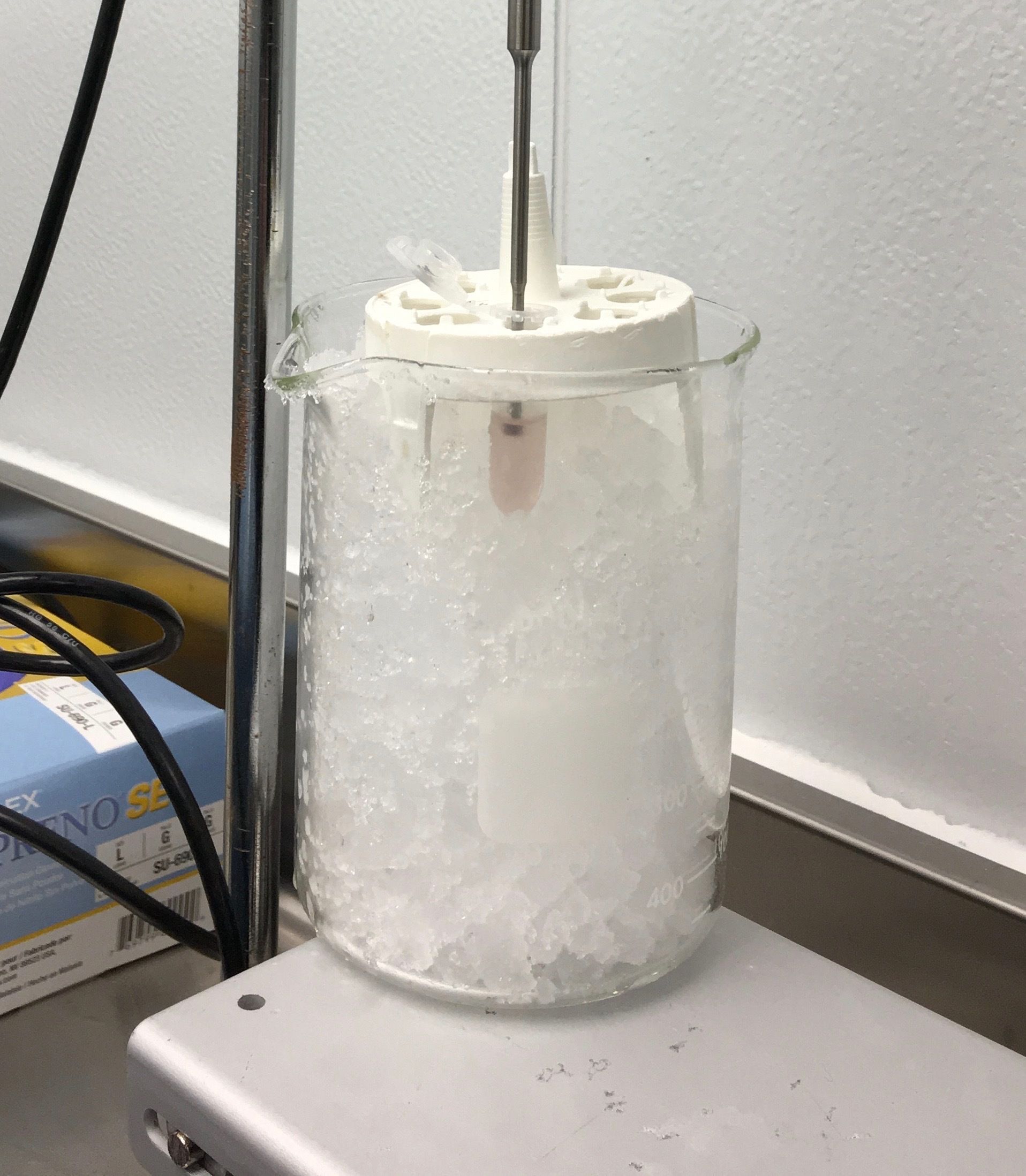
Figure 1: A close-up view of the beaker and tube holder on the sonication platform.
Access restricted. Please log in or start a trial to view this content.
Materials
| Name | Company | Catalog Number | Comments |
|---|---|---|---|
| 15 mL Tubes | Corning | 352196 | |
| 2 mL Tubes | Eppendorf | 22363352 | |
| 50 mL Tubes | Corning | 352070 | |
| Dewar Flask - 4L | ThermoScientific | 10-194-100C | |
| L-Glutamic acid hemimagnesium salt tetrahydrate | Sigma | 49605 | |
| L-Glutamic acid potassium salt monohydrate | Sigma | G1149 | |
| LB Broth (Miller) | Sigma | L3522 | |
| Magnesium chloride (MgCl₂) | Sigma | M8266 | |
| Potassium chloride (KCl) | Sigma | P9333 | |
| Potassium hydroxide Pellets | Sigma/Roche | 1050121000 | |
| Q125 Sonicator and CL-18 probe | Qsonica | 4422 | |
| Sodium chloride (NaCl) | Sigma | S7653 | |
| Vibrio natriegens (Wild-type) Lyophilized Stock | ATCC | 14048 |
