This video demonstrates a high-throughput fluorescent assay to evaluate how gut bacteria affect stress resilience in Caenorhabditis elegans. By tracking blue fluorescence from ruptured gut granules, the assay reveals earlier death signals in worms exposed to test bacteria.
A subscription to JoVE is required to view this content. Sign in or start your free trial.
Method Article
High-Throughput Fluorescent Assay to Study Microbe-Worm Interactions
358 views
⸱
November 28th, 2025
In This Article
Abstract
Protocol
1. Label-free Caenorhabditis elegans (C. elegans) survival scoring (LFASS) heat shock and oxidative assay setup (Days 13 - 14)
- Assess the worms' developmental stage. Once >90% of worms have reached L4, collect the worms in up to 10 mL of sterile M9 solution in 15 mL conical tubes.
- Wash the worms extensively (at least 4x) by spinning down at 142xg for 2 min at 4 °C, removing the supernatant, and adding 10 mL of fresh sterile M9 between each wash to get rid of Escherichia coli OP50 bacteria. Resuspend the worm pellet in 10 mL of M9.
- Transfer 50 µL of worm solution into a low surface binding tube containing 950 µL of M9. After gently mixing the tube contents to avoid worm sedimentation, quickly use a wetted low-bind pipette tip to transfer 3-4 separate 10 µL drops onto a glass slide or a nematode growth medium (NGM) plate. Count worm numbers under a stereomicroscope at 16x magnification. Average the counts from the 3-4 drops and determine the number of worms per microliter in the worm solution.
- Adjust the worm concentration in the 10 mL tube to reach ~120 worms in 8 µL. If the solution prepared in Step 1.2. is not concentrated enough, spin the worms down and remove M9 accordingly to reach 120 worms per 8 µL.
- Transfer 8 µL of worm solution (~120 worms) into each of the wells of the eight 96-well NGM-agarose plates previously prepared, using a multichannel pipette or a repeat pipette. Ensure to use low retention tips to limit worm loss. It might also be necessary to cut the tip ends to allow for large adult worms to limit mechanical stress on the adult worms.
NOTE: The assay requires a minimum of 30 live healthy worms to work reliably, but works best with about 100 worms per well. - Incubate the worm and bacterium-seeded 96-well NGM-agarose plates at 25 °C for 36 h.
- Check the plates between 12-24 h, ensuring the worms remain replete throughout. If re-feeding is required, resuspend the bacteria within the 96-well bacterial array plate stored at 15 °C, and add up to 10 µL of the corresponding bacterial solution to the 96-well NGM-agarose plates where worms are at risk of starvation before the end of the 36 h incubation period (starved worms will produce vastly differing results, so this is very important).
NOTE: The following steps need to be conducted on Day 15. Prior to starting the assay, it may be necessary to optimize the reading height. The optimal reading will be achieved 20-50 µm above the bottom of the well. This will be dependent on the model of the plate reader. Some offer the possibility of a Z-scan, while others allow manual height input. Set the optimal height at the level where the highest blue fluorescence (365 nm/430 nm) signal is detected. Some plate readers may operate at a fixed height optimized for adherent cell assays and might not be ideal for LFASS assays. - After 36 h, dispense 30 µL of M9 into each well of the 96-well plate.
NOTE: For thermal stress assays, the plate reader needs to have reached the required temperature to perform the assay and may need to be turned on ahead of time. The current protocol uses 42 °C to maximize killing speed, but the approach applies to other temperatures above 30 °C. - Transfer worms (about 20 µL) to the 384-well plate according to set layouts, using low-retention tips (consider cutting off the end of the tips to allow large worms to reduce mechanical stress for adult worms).
NOTE: For the present study, two different plate reader settings are used for the two assays described here (thermal stress and oxidative stress), and thus, samples intended for these two assays must not be plated in the same 384-well plate. - Ensure the plate readers are set up properly (Table 1).
- Top up the 384-well plates with more M9, aiming for a final volume of 60 µL per well. For thermal stress assay, add 40 µL of M9, and for tert-butyl hydroperoxide (t-BHP)-induced oxidative stress, add 34 µL of M9 in 6 µl of t-BHP.
- Start the assay within 2 min of adding t-BHP (ideally, all worms must be exposed to t-BHP simultaneously, the assay time resolution being 2 min). If not possible, use a timer to estimate the time spent pipetting t-BHP before the start of the assay to allow for later adjustment of the median time of death.
- Close the plates with their transparent lid. Seal the edges of the 384-well plates with masking tape (taping over the plate and lid), ensuring that the tape does not go over the lid or under the plate. Slit the tape between lid and plate at intervals using a scalpel to allow air exchange while minimizing evaporation during the assay.
- Insert the plate into the plate reader and start the run. Aim to excite at 365 nm and detect emission at 435 nm every 2 min for 6-12 h (Table 1).
NOTE: Typically, 6 h is enough for 42 °C heat stress assays and 8 h for 7% t-BHP oxidative stress assays.
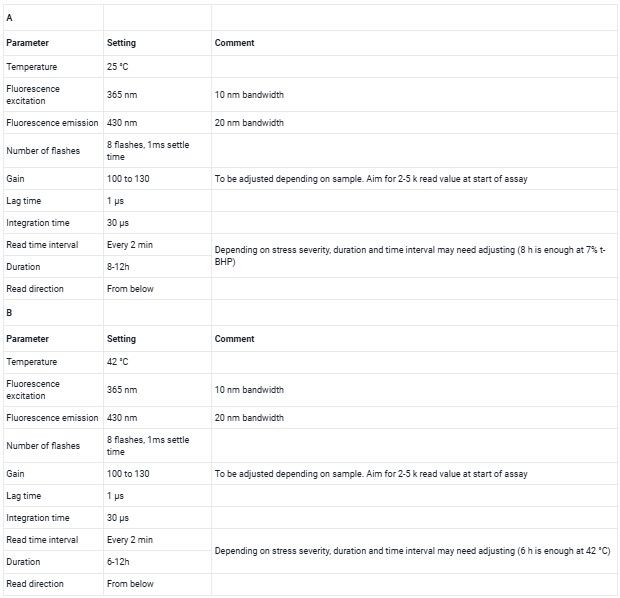
Table 1: Oxidative and heat stress assay settings. Examples of settings used for oxidative (A) and heat (B) stress assays on the fluorescence plate readers used in this study.
Access restricted. Please log in or start a trial to view this content.
Materials
| Name | Company | Catalog Number | Comments |
|---|---|---|---|
| 384-well black, transparent flat bottom plates | Corning | 3712 or 3762 | Not essential to be sterile for fast stress assays |
| 96-well transparent plates (Biolite) | Thermo | 130188 | |
| Agarose | Fisher Scientific | BP1356 | |
| LoBind tips | VWR | 732-1488 | Lo-bind reduce worm loss during transfers |
| LoBind tubes | Eppendorf | 22431081 | |
| Plate reader- infinite M nano+ | Tecan | Monochromator setup enables fluorescence tuning but adequate filter-based setups may be used | |
| Plate reader- Spark | Tecan | ||
| Stereomicroscope setup with transillumination base | Leica | MZ6, or M80 | Magnification from 0.6-0.8x up to 40-60x is necessary, as is a good quality transillumination base with a deformable, titable or slidable mirror to adjust contrast |
| t-BHP (tert-Butyl hydroperoxide) | Sigma-Aldrich | 458139 | |
| Transparent adhesive seals Nunc | Fisher Scientific | 101706871 | It is important that it is transparent and that it can tolerate the temperatures involved in the assays. |
