This video demonstrates the use of an automated microbioreactor to monitor bacterial growth and fluorescent protein secretion in response to varying media formulations. A genetically modified bacterium expressing a secretory fluorescent protein is cultured under antibiotic selection and inoculated into nutrient-varied wells. Real-time optical measurements of cell density and fluorescence enable comparative analysis of protein production across different growth conditions.
A subscription to JoVE is required to view this content. Sign in or start your free trial.
Method Article
Monitoring Bacterial Growth in Distinct Media Formulations with an Automated Microbioreactor
438 views
⸱
November 28th, 2025
In This Article
Abstract
Protocol
1. Preparation of materials and definition procedures
NOTE: It is advised to define and fix the experimental methods at a detailed level. This standardization ensures that different results can be traced back to intrinsic biological variability or different medium compositions.
NOTE: Media stock solutions: Prepare individual stock solutions for all investigated media components. Prepare highly concentrated stocks to allow for the dilution of different volumes for all components. This means that after combining all stock solutions at their highest volume according to the design plan, this cannot exceed the final cultivation volume, cf. paragraph "Generation of medium stock solution pipetting list" step 1.3.3. If the addition of a highly concentrated solution results in a very low addition volume, e.g., < 1/100th of the final cultivation volume, dilute the stock solution accordingly. For instance, in this study, a pipetting volume of less than 10 µL was defined to be infeasible. Typically, trace element solutions are concentrated as high as 1,000-fold with respect to the final standard concentration in the medium. It is advantageous to concentrate media components as multiples (X-fold) with respect to concentrations in the reference recipe. By doing so, infeasible pipetting volumes of fractional decimals are avoided. Detailed recipes for all stock solutions of CgXII medium are given in the supplementary document.
1. Working cell bank (WCB)
Note: For each growth experiment, one WCB aliquot is used. If more aliquots are needed, use 100 mL brain heart infusion (BHI) medium in 1,000 mL baffled shake flasks or inoculate multiple shake flasks, which are pooled before the addition of glycerol solution.
- Prepare single colonies of the recombinant expression strain C. glutamicum pCGPhoDBs-GFP43 on agar plates (37 g/L BHI powder, 20 g/L agar, 25 mg/L kanamycin). Plating material can either come from fresh transformation or from a cryopreserved aliquot. Incubate at 30 °C until the appearance of single colonies; this usually takes one to two days.
- Inoculate a shaker flask culture (50 mL BHI medium with 25 mg/L kanamycin, 500 mL baffled flask, 250 rpm, 25 mm shaking diameter, 30 °C) with colony material and incubate overnight (approximately 16 h).
- Combine one volume of the resulting cell suspension with one volume of 500 g/L sterile glycerol solution and distribute in 2 mL aliquots in sterile cryopreservation vials. Store at -80 °C.
2. MBR cultivation protocol
Note: For the employed BioLector MBR system in this study, scattered light (biomass) and GFP fluorescence are intensity measurements, which need a certain gain value assigned. The higher the gain, the higher the optical signal is amplified; this is also why scattered light and fluorescence are measured in arbitrary units (a.u.). Determine suitable gain values for biomass and GFP detection in preliminary experiments, along with suitable shaking frequency and filling volume to avoid oxygen limitation at higher biomass concentrations during later process stages. The employed cultivation conditions ("Flowerplates", i.e., flower-shaped 48-well MTPs, shaking frequency of 1,200 rpm, filling volume of 1,000 µL, 10 g/L glucose as the main carbon source) ensured oxygen-unlimited cultivations. For maximum oxygen transfer rates resulting from other combinations of filling volumes and shaking frequencies in flower-shaped 48-well MTPs, datasheets from the supplier are available. Also, growth defects of individual cultures may occur due to low amounts of secondary substrates (e.g., nitrogen, trace elements). Therefore, check the biomass concentrations at the end of cultivation. In this study, no such growth effects were observed.
- Define the cultivation protocol for the MBR system ("BioLector") as follows:
- Filterset 1: Biomass, gain 14. Filterset 2: pH, gain is preset. Filterset 3: pO2, gain is preset. 4: GFP, gain 80.
- Shaking frequency: 1,200 rpm.
- Temperature: 30 °C.
- Cycle time: 15 min.
- Experiment time: manual (Cultivation will not be stopped automatically).
3. Generation of medium stock solution pipetting list
Note: Almost any liquid handling robot system is capable to read pipetting actions from external files. Basically, the minimal information needed is the transfer volume and position of reagent source, as well as the destination of each represented by a labware position on the robotic deck and a specific cavity within the labware. However, different syntaxes for different liquid handling systems must be considered. Figure 1 shows an example file structure for the employed pipetting system in this study.
1. Four types of stock solutions are pipetted into each cultivation well:
- Stock solutions of media components that are varied ("Variation Stocks").
- Water to compensate for the different cumulative volumes of the above stocks.
- A stock solution ("Rest Stock") containing all components that are fixed. This stock solution can be composed from stocks containing the different components that are, e.g., stored at different temperatures or sterilized by different methods.
- Inoculum, which should be added as the last component and put onto the worktable just before addition to avoid settling of the cells.
2. Per cultivation well, calculate the volumes to be transferred for all media components according to: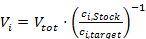
The volume to be added for certain Variation Stocks maybe zero, i.e., when this specific component is omitted.
3. Revise all calculated volumes Vi for suitable numbers. Pipetting volume increments in volume steps should not be too small. If necessary, adjust the concentrations of Variation Stocks. For instance, the minimal pipetting volume here was defined as 10 µL, and the minimal increment was defined as 5 µL. In general, these volumes should be defined based on experimentally determined precision and accuracy for the used liquid handling station.
4. Calculate the volume of Rest Stock containing the fixed components for all wells as follows:
where the maximum cumulative volume of Variation Stock  is used. Consequently, calculate the required concentrations of the fixed components in Rest Stock as follows: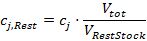
Prepare Rest Stock accordingly.
5. Per cultivation well, calculate the volume of water to be added as follows:
6. Per cultivation well, list all volumes to be added in the following order of addition: VH2O, VRestStock, Vi, VInok. Format the pipetting list according to the specifications of the liquid handling station, as shown for example in Figure 1.
2. Seed culture, automated media preparation, and start of main culture
- Create a protocol for the liquid handling robot. See Figure 2 and Figure 3 for an example protocol for a "Janus" system, implemented in the corresponding "WinPREP" software. The protocol should consider the following aspects:
1. Include a sufficient runtime of sterile housing prior to media preparation.
2. Include an initial excessive cleaning and washing of all pipetting tips and tubing.
3. Choose appropriate labware containers for stock solutions. Here, deep well plates with 12 columns are suitable for the storage of Variation Stocks, as all eight pipetting tips can dip in a parallel arrangement into the well columns. This greatly speeds up media preparation. If 15 mL or 50 mL reagent tubes are used as reservoirs, only one pipetting tip can dip into it at once. For other stocks like water and Rest Stock, 100 mL troughs are used, as these stock solutions require higher volumes in total.
4. Provide a sufficient total volume for each stock solution to compensate for waste volumes, height pipetting offsets, etc.
5. Insert a user prompt before the inoculation step, ensuring that this step is carried out immediately prior to the seed culture procedure.
- Prepare all stock solutions in a sterile manner and store until use, in appropriate containers, e.g., sterile 15 mL and 50 mL test tubes.
- Sterilize the deep well plates for stock solution storage on a worktable, e.g., by wiping with 70% ethanol and subsequent drying in a laminar flow hood.
- Start the seed culture by inoculating 50 mL BHI medium containing 25 mg/L kanamycin with one aliquot from the WCB. Before the MBR cultivation, prepare fresh, vital inoculum from exponentially growing seed cultures in a sufficient amount.
- Place all necessary labware on the robotic worktable and pour stock solutions in the corresponding labware.
- Start the robotic workflow for media preparation, so that the last step (inoculation), is reached in time with the start of seed culture. The total runtime of the robotic workflow needs to be evaluated beforehand. Here, the total runtime was approximately 1.5 h.
- Sample the seed culture after approximately 2 h, then each hour, to monitor the growth by optical density (OD600). After approximately 5 h, the culture reaches 3-4 OD600 and is used to inoculate the main cultures.
- Place the seed culture on the liquid handler worktable and continue the media preparation protocol. Seal cultivation MTP after inoculation.
- Place the sealed cultivation MTP in the BioLector device and start the pre-defined cultivation protocol.
- Dispose of the remaining stock solutions, according to biosafety regulations if necessary, and seed the culture from the robotic worktable. Clean the re-usable labware and start the liquid handler decontamination protocol.
Access restricted. Please log in or start a trial to view this content.
Results
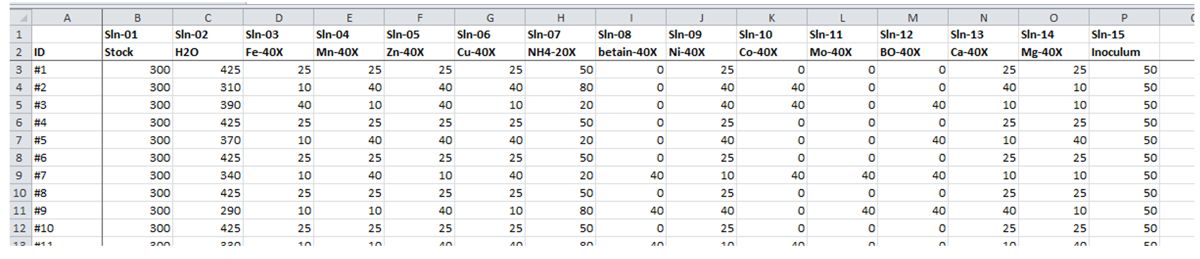
Figure 1: Screenshot from the volume pipetting list for sensitivity analysis. Entries in th...
Access restricted. Please log in or start a trial to view this content.
Materials
| Name | Company | Catalog Number | Comments |
|---|---|---|---|
| BioLector | m2p-labs | G-BL-100 | |
| Flowerplate | m2p-labs | MTP-48-BOH | For cultivation in the BioLector device |
| Sealing foil | m2p-labs | F-GP-10 | Sterile sealing for Flowerplate |
| MATLAB | Mathworks | 2016b | |
| KriKit | Forschungszentrum Jülich | n/a | Freely available, MATLAB installation required |
| Janus pipetting robot | Perkin Elmer | n/a | Includes "WinPrep" software installation |
| 12-column deep well microplate | E&K Scientific | EK-2034 | Container for medium stock solutions |
| C. glutamicum pCGPhoDBs-GFP | n/a | n/a | Carries pEKEx2 plasmid with fusion of GFP gene and PhoD signal peptide from B.subtilis as expression insert. Plasmid provides kanamycin resistance. Described and published by Meissner et al. Appl Microbiol Biotechnol 76 (3), 633–42 (2007) |
