This video demonstrates the assembly and operation of an electrochemical reactor model designed to simulate biofilm formation on electrode surfaces. Controlled electrochemical stimulation promotes microbial adhesion, leading to the gradual development of a bacterial monolayer biofilm.
A subscription to JoVE is required to view this content. Sign in or start your free trial.
Method Article
Developing a Bacterial Monolayer Biofilm Using an Electrochemical Reactor
224 views
⸱
March 31st, 2026
In This Article
Abstract
Protocol
- Construction of a three-electrode electrochemical reactor (Figure 1)
- Put an indium tin-doped oxide (ITO) substrate as the working electrode at the bottom of the reactor.
- Subsequently, insert a glass cylinder (diameter of 2 cm) and a polytetrafluoroethylene (PTFE) cover. Then insert silver/silver chloride (Ag/AgCl) (potassium chloride, KCl saturated) and a platinum wire into the reactor as the reference and counter electrodes, respectively.
NOTE: To prevent the leakage of air and solution, insert a butyl rubber sheet between each component. - Add 4.0 mL of defined medium (DM) supplemented with 10 mM lactate and 0.5 g/L yeast extract into the electrochemical reactor.
- After confirming that there is no leakage from the electrochemical reactor, flow the nitrogen gas into the electrochemical reactor over 20 min to maintain anaerobic conditions inside the electrochemical reactor.
NOTE: To prevent contamination with other microbes, the gas should be filtered before it flows into the electrochemical reactor. - Connect the electrochemical reactor to a potentiostat and apply +0.4 V (versus standard hydrogen electrode, SHE) to the ITO electrode, keeping the temperature of the electrochemical reactor at 30 °C using an external water circulation system.
NOTE: To prevent the effect of an external electric field, the electrochemical reactor should be placed in a Faraday cage.
- Electrochemical cultivation of S. oneidensis MR-1 cells (Figure 1 and Figure 2)
- Adjust the cell density of the suspension obtained in step 1.1 to an optical density of 1.43 at 600 nm (OD600) with DM supplemented by 10 mM lactate and 0.5 g/L yeast extract.
NOTE: To obtain the correct OD600, apply the cell suspension of OD600 ≤ 0.8 to a UV-vis spectrometer prior to adjusting the OD600 to 1.43. - Add 0.3 mL of the cell suspension into the electrochemical reactor through the injection port using a syringe: the OD600 in the reactor changes to 0.1.
NOTE: The addition of 0.3 mL cell suspension with OD600 = 1.43 into an electrochemical reactor containing 4.0 mL medium results in 4.3 mL of solution with an OD600 = 0.1. When using other reactors with different volumes, the calculation of the cell density is required. - Continue the potential application at +0.4 V (versus SHE) to the ITO electrode for 25 h.
NOTE: For the formation of a monolayer biofilm on an ITO electrode, ensure that the produced current exhibits a deviation less than 50% from Figure 2.
- Adjust the cell density of the suspension obtained in step 1.1 to an optical density of 1.43 at 600 nm (OD600) with DM supplemented by 10 mM lactate and 0.5 g/L yeast extract.
Access restricted. Please log in or start a trial to view this content.
Results
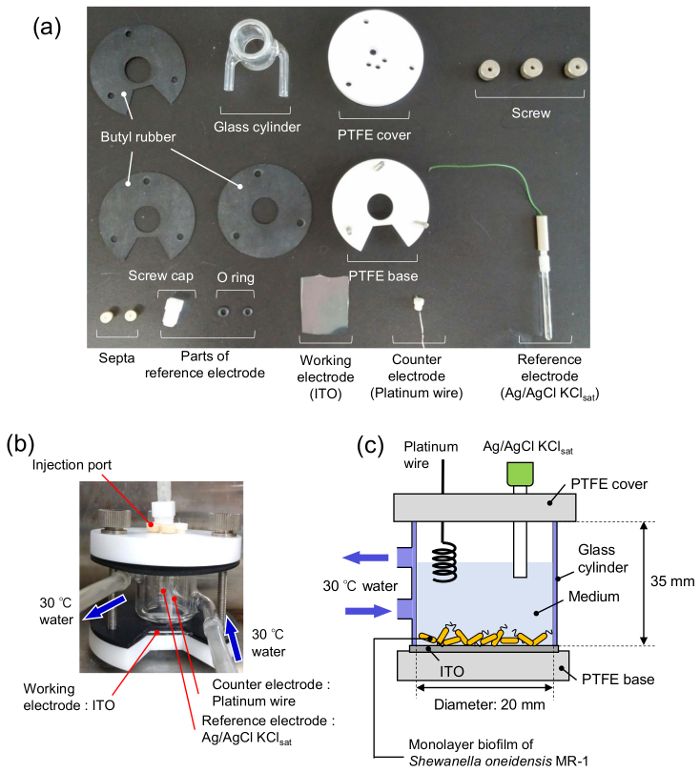
Figure 1: Electrochemical reactor used in this study. Photograph of the electrochemical cell before construction...
Access restricted. Please log in or start a trial to view this content.
Materials
| Name | Company | Catalog Number | Comments |
|---|---|---|---|
| Glass cylinder | N/A | N/A | Custom-made, used as the electrochemical reactor |
| PTFE cover and base | N/A | N/A | Custom-made, used as a cover and a foundation of the electrochemical reactor |
| Buthyl rubber | N/A | N/A | Custom-made, inserted between each component of electrochemical reactor |
| Septa | GL Science | 3007-16101 | Used as an injection port of electrochemical reactor |
| Indium tin-doped oxide (ITO) electrode | GEOMATEC | No.0001 | Used as a working electrode, 5Ω/sq |
| Ag/AgCl KCl saturated electrode | HOKUTO DENKO | HX-R5 | Used as a reference electrode, Φ0.30mm |
| Platinum wire | The Nilaco Cooporation | PT-351325 | Used as a counter electrode |
| Luria-Bertani (LB) Broth, Miller | Becton, Dichkinson and Company | 244620 | Medium for precultivation of S. oneidensis MR-1 |
| Bacto agar | Becton, Dichkinson and Company | 214010 | |
| NaHCO₃ | Wako | 191-01305 | Used for defined medium (DM) |
| CaCl₂·2H₂O | Wako | 031-00435 | Used for DM |
| NH₄Cl | Wako | 011-03015 | Used for DM |
| MgCl₂·6H₂O | Wako | 135-00165 | Used for DM |
| NaCl | Wako | 191-01665 | Used for DM |
| 2-[4-(2-hydroxyethyl)-1-piperazinyl] ethanesulfonic acid (HEPES) | DOJINDO | 346-08235 | Used for DM |
| Sodium Lactate Solution | Wako | 195-02305 | |
| Bacto yeast extract | Becton, Dichkinson and Company | 212750 | |
| Deuterium oxide (D, 99.9%) | Cambridge Isotope Laboratories, Inc. | DLM-4-PK | Additive for kinetic isotope effect experiments |
| Incubator | TOKYO RIKAKIKAI CO. LTD. | LTI-601SD | Used for precultivation |
| Shaker | TAITEC | NR-3 | Used for precultivation |
| Autoclave machine | TOMY SEIKO CO. LTD. | LSX-500 | Used for sterilization of the electrochemical reactor and the medium |
| Clean bench | SANYO | MCV-91BNF | Used to prevent the contamination of the electrochemical reactor and the medium with other microbes |
| Centrifuge separator | Eppendorf | 5430R | Rotational speed upto 6000×g is required |
| Nitrogen gas generator | Puequ CO. LTD. | PNTN-2 | Nitrogen gas cylinder can also be used instead of gas generator |
| UV-vis spectrometer | SHIMADZU | UV-1800 | Used for optimization of cell density |
| Potentiostat | BioLogic | VMP3 | Used for biofilm formation and kinetic isotope effect experiments |
| Thermal water circulator | AS ONE | TR-1A | Used for maintanance of temperature of electrochemcial reactor |
| Faraday cage | HOKUTO DENKO | HS-201S | Used for electrochemical experiments |
