This video demonstrates how a tetracistronic minigenome plasmid mimicking the Ebola virus genome is transfected into human cells along with helper plasmids. Inside the cells, viral proteins and luciferase are expressed, leading to the assembly and budding of non-pathogenic, replication-competent virus-like particles .
Method Article
Production of Reporter-Containing Ebola Virus Transcription- and Replication-Competent Virus-Like Particles
91 views
⸱
September 30th, 2026
In This Article
Abstract
Protocol
1. Transfection of Producer Cells for Initial Production of Transcription- and Replication-Competent Virus-Like Particles or trVLPs
- 24 hr after splitting the cells (see Figure 1 for an overview of the experiment timing), pipette plasmid DNA (for amounts see Table 1) into a sterile 2 mL cryovial using filtered tips. Add 100 µL OptiMEM per well to the DNA. Vortex the mixture briefly and gently spin down the tubes using a microfuge. If several wells are to be transfected with identical plasmids, a master mix for several wells can be made.
- Briefly vortex the vial with Transit LT1 before use. Add 7.5 µL Transit LT1 per well to the diluted DNA. Gently vortex the mixture, taking care not to collect liquid in the lid of the cryovial, and incubate for 15 min at room temperature.
- Gently mix the transfection complex by pipetting up and down. Add 100 µL of the transfection complexes dropwise to each well. Rock the plate forward/backward and from side to side to distribute the transfection complexes. Do not swirl the plate as this will cause uneven spreading of the transfection complexes.
- Return the cells to the incubator.
- After 24 hr, remove the supernatant from cells. Add 4 mL DMEM (Dulbecco's Modified Eagle Medium) with 5% FBS (Fetal Bovine Serum), 2 mM L-glutamine, 1x pen/strep (Penicillin/Streptomycin) (DMEM5) to the cells. This step can be done for up to 3 wells at a time without drying of the wells, assuming the wells contain identical samples (otherwise, due to the self-amplifying nature of the trVLPs (Transcription- and Replication-Competent Virus-Like Particles) in this system, cross-contamination can become an issue, and this step should be done one well at a time).
- Return the cells to the incubator.
Table 1. DNA amounts for transfection. The amount of each plasmid required for the transfection of producer and target cells is shown in ng per well of a 6-well plate.
| Producer Cells (p0) | Target Cells (p1 and higher) | |
| pCAGGS-NP | 125 | 125 |
| pCAGGS-VP35 | 125 | 125 |
| pCAGGS-VP30 | 75 | 75 |
| pCAGGS-L | 1,000 | 1,000 |
| p4cis-vRNA-RLuc | 250 | - |
| pCAGGS-T7 | 250 | - |
| pCAGGS-Tim1 | - | 250 |
Results
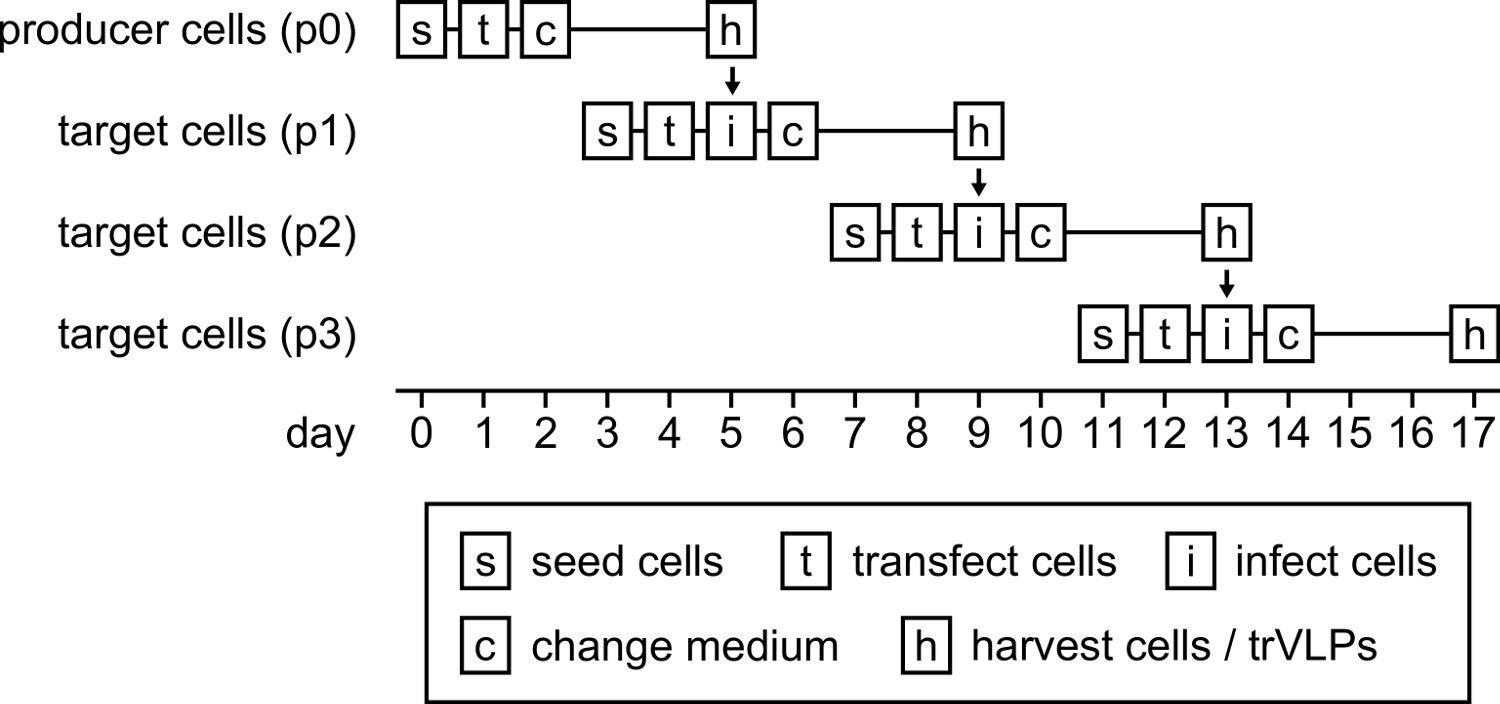
Figure 1. Timing of a tetracistronic trVLP assay for 3 consecutive passages. The days for seeding cells (s), transfecting cells (t), infecting cells (i), medium change (c) and harvesting of cells and trVLPs (h) are indicated for three consecutive passages (indicated by arrows).
Materials
| Name | Company | Catalog Number | Comments |
|---|---|---|---|
| 75 cm² cell culture flask | Corning | 430641 | |
| DMEM | Sigma | D6546 | Preheat to 37°C prior to use |
| FBS | Life technologies | 26140-079 | Heat inactivate 30 min @ 56°C |
| L-Glutamine | Life Technologies | 25030-081 | 100x |
| Pen/strep | Life Technologies | 15070-063 | 100x |
| 6-well Plates | Costar | 3516 | |
| Opti-MEM I | Life Technologies | 31985-070 | |
| Transit LT1 | Mirus | MIR 2300 |
