Method Article

Bioscaffold Fabrication by Electrospraying: A Technique to Generate Microcarrier Scaffolds Derived from Extracellular Matrix of Decellularized Tissue

April 30th, 2023

In This Article

Abstract

Loading...
$$\rightleftharpoonup{xx}$$ $$\longleftharp{xx}$$, $$\longrightharp{xx}$$,

Source: Kornmuller, A. et al. Fabrication of Extracellular Matrix-derived Foams and Microcarriers as Tissue-specific Cell Culture and Delivery Platforms. J. Vis. Exp. (2017)

This video demonstrates the procedure of extracellular matrix-derived microcarrier fabrication by electrospraying. These microcarriers simulate the native tissue-specific microenvironment and are stable in long-term 3D in vitro cell culture models.
Protocol

Loading...
$$\rightleftharpoonup{xx}$$ $$\longleftharp{xx}$$, $$\longrightharp{xx}$$,

1. ECM-derived Microcarrier Fabrication via Electrospraying

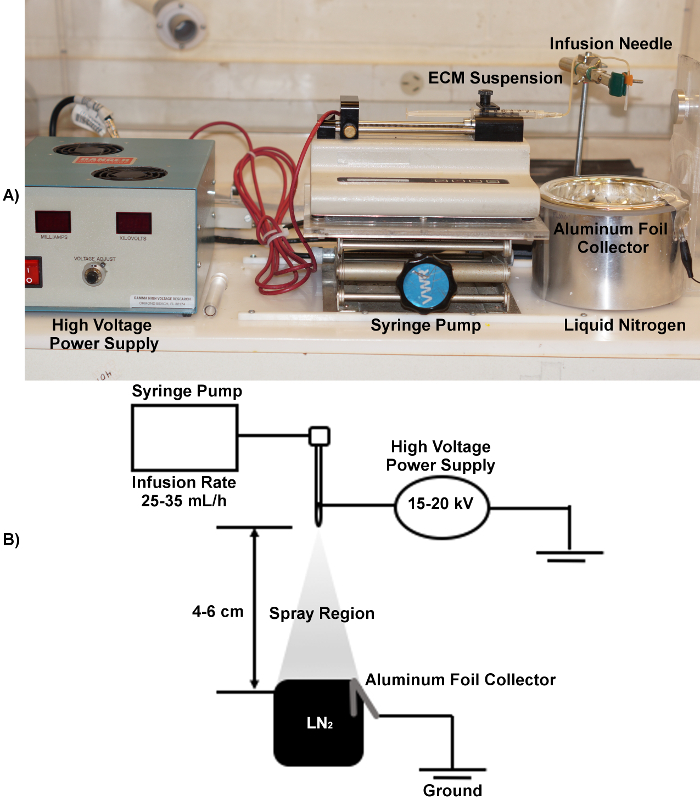
NOTE: An overview of the electrospraying set-up is shown in Figure 1.

  1. Incubate a previously prepared cryomilled ECM suspension at 37 °C with continuous agitation at 100 rpm O/N.
    NOTE: Cryomilled ECM is used to fabricate the ECM-derived microcarriers to ensure greater uniformity in the suspension and prevent clogging during electrospraying.
  2. Load 3 mL of ECM suspension into a 3 mL Luer-Lock syringe and attach a winged infusion set onto the bore of the syringe.

Access restricted. Please log in or start a trial to view this content.

Results

Loading...
$$\rightleftharpoonup{xx}$$ $$\longleftharp{xx}$$, $$\longrightharp{xx}$$,

Electrospray setup and diagram for ECM suspension with high voltage, syringe pump, aluminum foil.
Figure 1. Overview of the electrospraying apparatus used in microcarrier fabrication. A: Image showing the arrangement of the key electrospraying equipment including the syringe pump and high voltage power supply, as well as the positioning of .......

Access restricted. Please log in or start a trial to view this content.

Disclosures

Loading...
$$\rightleftharpoonup{xx}$$ $$\longleftharp{xx}$$, $$\longrightharp{xx}$$,
No conflicts of interest declared.

Materials

List of materials used in this article
NameCompanyCatalog NumberComments
Alligator clip leadsVWR470149-728
Aluminium foilFisher Scientific01-213-101
Centrifuge tubes (15 mL)Sarstedt62.554.205
Centrifuge tubes (50 mL)Sarstedt62.547.205
Dessicator Fisher Scientific 8624426 For lyophilized ECM and bioscaffold storage
Dewar flaskFisher Scientific10-196-6Low form; volume range of 250 - 500 mL
ECM (Extracellular Matrix)Isolated from human adipose tissue, porcine dermis or porcine myocardium, as described in Flynn et al. 2010, Reing et al. 2010, and Wainwright et al. 2010 (ref # 28, 8, 32)
Liquid nitrogenFor electrospraying
LyophilizerLabconco7750021FreeZone4.5
Orbital incubator shakerSciLogex8.3201E+11Temperature controlled (37 °C)
Retort standVWR470019-526
Retort stand clampVWR21573-606
Safety-Lok SyringeBD3096063 mL Luer lock syringe for microcarrier fabrication and dispensing ECM suspension
ScoopulaVWR89259-968For collecting microcarriers
Syringe pumpVWR10117-490Microprocessor controlled
High voltage power supplyGamma High Voltage ResearchES30P-5W/DDPMCapable of recommended 15 - 25 kV voltage range
Winged infusion setTerumo2225809230 cm tubing length, 25 G 3/4" recommended; Other needle gauges can be used and may influence microcarrier diameter

Reprints and Permissions

Request permission to reuse the text or figures of this JoVE article

Request Permission

Tags

Electrospraying TechniqueMicrocarrier FabricationLiquid NitrogenLyophilization ProcessHigh VoltageSyringe PumpCryogenic FlaskPorous Scaffolds

Related Articles