A subscription to JoVE is required to view this content. Sign in or start your free trial.

Method Article

Performing Injection into Orbital Lobe of Superior Lacrimal Gland: A Technique for Inducing Dry Eye Disease in Rabbit Model

2.9K views

⸱

July 8th, 2025

In This Article

Abstract

Source: Honkanen, R. A. et al, A Rabbit Model of Aqueous-Deficient Dry Eye Disease Induced by Concanavalin A Injection into the Lacrimal Glands: Application to Drug Efficacy Studies. J. Vis. Exp. (2020).

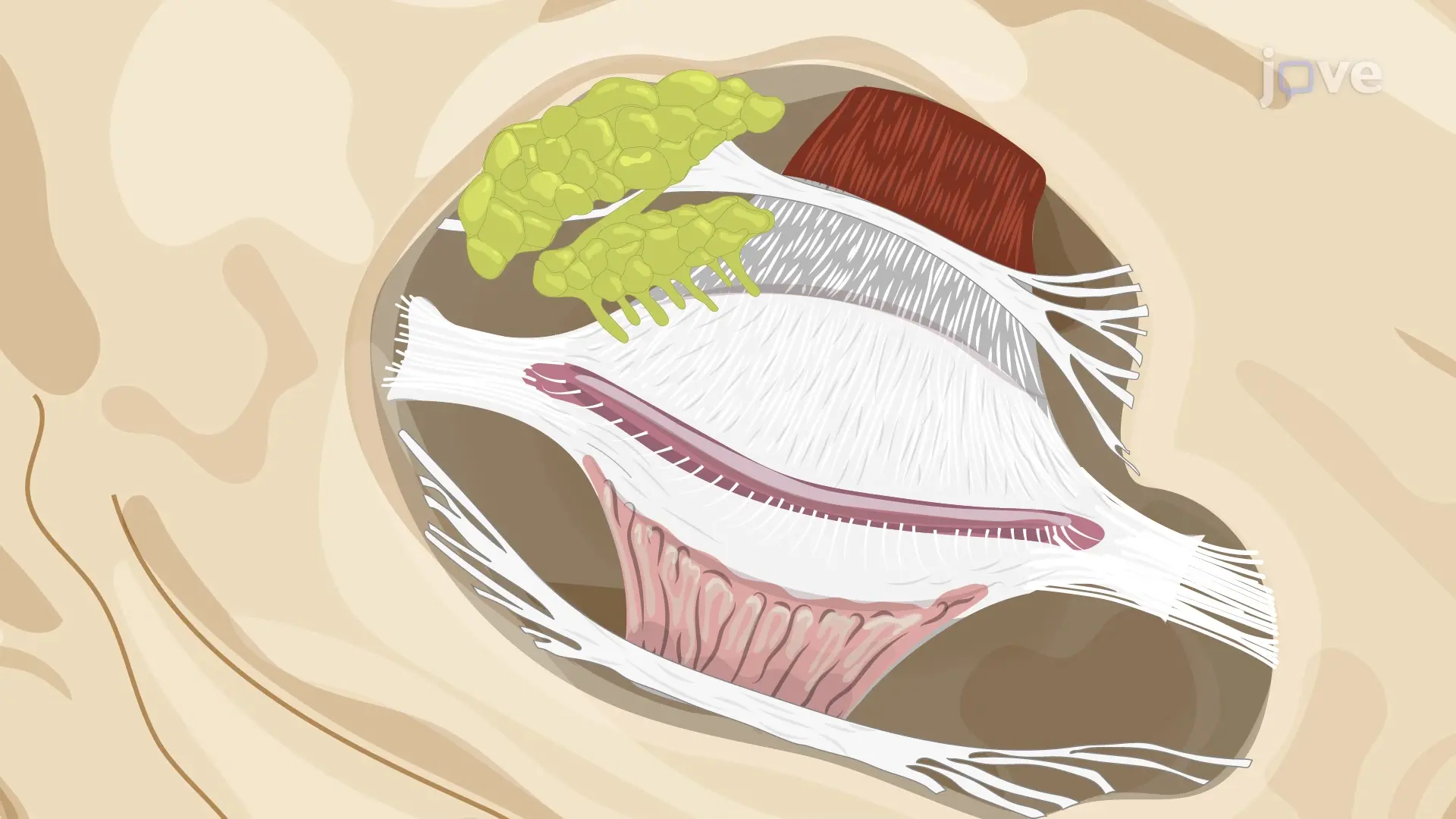
This video describes the procedure to induce dry eye disease in a rabbit model through an injection of Concanavalin A into the orbital lobe of the superior lacrimal gland. The developed model is useful to study the effectiveness of various drugs for treating dry eye disease.

Protocol

All procedures involving animal models have been reviewed by the local institutional animal care committee and the JoVE veterinary review board.

1. Animal preparation

NOTE: The portions of the orbital lacrimal gland system are injected.

  1. Sedate the rabbits with acepromazine 0.2 mg/kg subcutaneously.
  2. Shear off the fur in the periorbital and scalp area and completely remove any residual fur using Nair. Leave the skin entirely smooth for better visualization of the anatomical hallmarks and US-guided injection of concanavalin A (Figure 1).
  3. Induce modera....

Access restricted. Please log in or start a trial to view this content.

Results

Rabbit pre-op preparation, fur shaving, and skin cleaning for surgical procedure demonstration.
Figure 1: Preparation of rabbit for concanavalin A injections. (A) Small shears are used to remove fur, allowing easier visualization of landmarks to identify the orbital superior lacrimal gland. (B) Nair is used to remove h.......

Access restricted. Please log in or start a trial to view this content.

Disclosures

No conflicts of interest declared.

Materials

List of materials used in this article
NameCompanyCatalog NumberComments
100 mm macro lensCanon EF 100mm f/2.8L IS USM3554B002
26 gauge needles (5/8)Becton Dickinson and Company,<br/> Franklin Lakes, NJ305115Needles for injecting ConA into the<br/> lacrimal glands
27 gauge needles (5/8)Becton Dickinson and Company,<br/> Franklin Lakes, NJ305921Needles for injecting ConA into the<br/> lacrimal glands
Aceproinj (acepromazine)Henry Schein Animal Health,<br/> Dublin, OHNDC11695-0079-80.1ml/kg subcutaneously injection<br/> for rabbit sedation
Anesthesia vaporizerVetEquip, Pleasanton, CAItem #911103
Bishop Harmon ForcepsBausch and Lomb (Storz),<br/> Bridgewater, NJE1500-CTissue forceps
CaliperBausch and Lomb (Storz),<br/> Bridgewater, NJE-2404Caliper used to measure length of<br/> needle during ConA injection
Concanavalin ASigma, St. Louis, MOC2010Make 5mg/ml in PBS for injection<br/> into rabbit lacrimal glands
Rabbit, New Zealand White or<br/> Dutch Belted (as described in text)Charles River Labs, Waltham, MA2-3 kgResearch animals
Surgical Loupes +1.50Designs for Vision, Bohemia, NYSpecialty itemProvide magnificantion of ocular<br/> surface while observing tear break<br/> up and performing Concanavalin A<br/> injections.

Explore More Articles

Lacrimal Gland InjectionConcanavalin ATuberculin Syringe27-Gauge NeedleMedial Pressure TechniqueLymphocyte Infiltration