A subscription to JoVE is required to view this content. Sign in or start your free trial.

Method Article

Isolation and Digestion of Neutrophil Proteins

1.2K views

⸱

January 15th, 2026

In This Article

Abstract

Source:
Tia Rizakos1, Jennifer Geddes-McAlister1

1Molecular and Cellular Biology Department, University of Guelph.

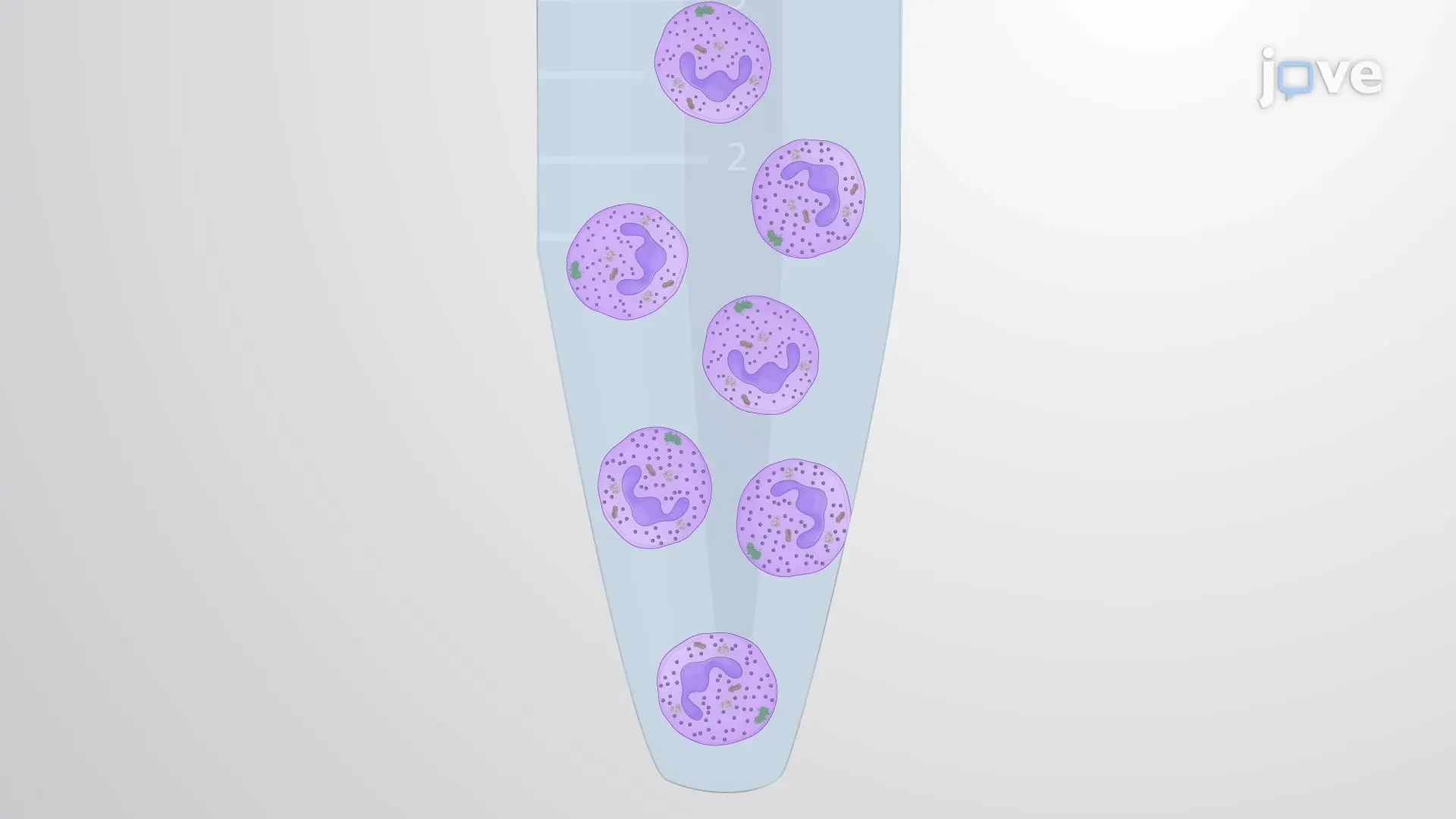
This video demonstrates the protein isolation from neutrophils, which is further processed and digested into smaller peptides. These peptides can be used for future analysis.
Protocol

1. Neutrophil Cell Collection and Lysis 

  1. Collect neutrophil-differentiated HL60 cells in a 15 mL tube by centrifuging samples at 400 x g for 5 mins. 
    NOTE: Neutrophils should be at a confluency of 3.5 x 10⁵ cells/mL after differentiation.  Harvest approximately five million cells for total proteome extraction. 
  2. Discard the supernatant, and add 15 mL of phosphate-buffered solution (PBS) into the tube.
  3. Centrifuge samples at 400 x g for 5 min.
  4. Repeat steps 1.2 to 1.3. 
    NOTE: Cell samples can be flash frozen with liquid nitrogen and stored at -80°C   after Step 1.4, depending on the experimental time frame. 
  5. Add 300 μl of cold 100 mM Tris (hydroxymethyl) aminomethane hydrochloride          (Tris-HCl) pH 8.5 containing a proteinase inhibitor cocktail (PIC) tablet to each sample. 
  6. Vortex samples briefly. 
  7. Add 1/10 volume of 20% SDS to a final concentration of 2% SDS.
  8. To lyse cell samples, probe sonicate samples in an ice bath for 30s on and 30s off for five cycles at 10% power. 
  9. Centrifuge samples on a short spin (max speed for 5-10 sec).  
    NOTE: Do not let the cell debris pellet. Use a short spin to collect spray off the tube walls.
  10. Transfer samples from the 15 mL tube into a 2 mL tube. 
  11. Add 1/10 volume of 1 M stock Dithiothreitol (DTT) to a final concentration of 10 mM DTT. 
  12. Vortex samples briefly.
  13. Incubate samples for 10 min with shaking at 800 rpm at 95°C.
  14. After 10 min, cool samples to room temperature.
    NOTE: Samples can be placed in ice to speed up the cooling process. 
  15. Add 1/10 volume of 0.55 mM Iodoacetamide (IAA) to a final concentration of 55 mM IAA.
    NOTE: Perform Step 1.15 in the dark to avoid exposing IAA to light. 
  16. Vortex samples briefly.
  17. Incubate samples at room temperature for 20 min in the dark. 
  18. Add 100% ice-cold acetone at a final concentration of 80% and store samples at      -20 °C overnight. 
    NOTE: Storage at -20 °C can be done for up to two weeks if needed.

2. Digestion of Neutrophil Proteins 

  1. Centrifuge samples at 13,500 rpm at 4°C for 10 min to precipitate cell pellets. 
  2. Discard supernatant and wash cell pellets with 500 μl of 80% ice-cold acetone.
  3. Centrifuge samples at 13,500 rpm at 4°C for 10 min, and remove supernatant. 
  4. Repeat steps 2.1 to 2.3. 
  5. Air-dry pellets. 
  6. Once dry, add 100 μl of 8 M Urea/40 mM 4-(2-hydroxyethyl)-1-piperazineethanesulfonic acid (HEPES) to cell pellet and water sonicate in a 4°C water bath for 30s on and off, for 15 cycles to resolubilize protein pellets. 
  7. Using bovine serum albumin (BSA) tryptophan assay (or equivalent) quantifies protein concentration according to the manufacturer’s instructions. 
  8. Add 300 μl of ammonium bicarbonate (ABC) to dilute the sample to a final concentration of 2 M Urea. 
  9. To digest 50 μg of protein, add 1:50 Trypsin/LysC (enzyme to protein ratio) to samples on ice—mix samples by gently tapping.
  10. Incubate samples at room temperature overnight to perform digestion.  

Access restricted. Please log in or start a trial to view this content.

Tags

Neutrophil Protein IsolationProtein DigestionCell LysisProtein PrecipitationTrypsin DigestionUrea DenaturationAcetone PrecipitationDithiothreitol ReductionIodoacetamide AlkylationHL60 Cell Differentiation