A subscription to JoVE is required to view this content. Sign in or start your free trial.

Method Article

Modeling Neuronal Injury in Mouse Primary Cerebellar Granule Neurons

858 views

⸱

July 8th, 2025

In This Article

Abstract

Source: Laaper, M. et al., Modeling Neuronal Death and Degeneration in Mouse Primary Cerebellar Granule Neurons. J. Vis. Exp. (2017).

This video demonstrates the generation of a neuronal injury model in mouse primary cerebellar granule neurons. It outlines the steps involved in inducing neuronal injury using NMDA, an excitatory neurotransmitter receptor agonist, and glycine, a co-agonist. NMDA and glycine bind to specific neuronal receptors, causing their overstimulation and resulting in a massive intracellular calcium influx, which leads to neuronal cell damage and death.
Protocol

1. Experimental Preparation

NOTE: The following stock solutions can be prepared and maintained until use.

  1. Dissection Solution
    1. Dissolve 3.62 g of sodium chloride (NaCl), 0.2 g of potassium chloride (KCl), 0.069 g of sodium phosphate (NaH2PO4 ∙ H2O), and 1.306 g of D-(+)-Glucose in 500 mL of distilled H2O. Then, add 12.5 mL of HEPES Buffer, 450 µL of Phenol red solution, and 20 mL of Bovine serum albumin (BSA) fraction V to the solution. Adjust to pH 7.4 using 1 N sodium hydroxide (NaOH).
    2. Sterilize with ....

Access restricted. Please log in or start a trial to view this content.

Results

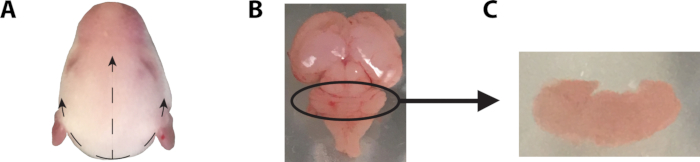
Brain dissection process; A: incision direction diagram, B-C: brain tissue sample extraction.
Figure 1: Removal of mouse brain and dissection of cerebellum. (A) To extract the brain of a 6-7 day old mouse, using a pair of forceps, grasp the head and cut the skin anteriorly along the dotted lines using a pair of microdissection scissors.......

Access restricted. Please log in or start a trial to view this content.

Disclosures

No conflicts of interest declared.

Materials

List of materials used in this article
NameCompanyCatalog NumberComments
qPCR lentivitral titration kit ABM#LV900
speedy virus purification solution ABM#LV999
pCMV-dR8.2Addgene#8455
pCMV-VS.VGAddgene#8454
Distilled water Gibco#15230162
200 mM L-Glutamine Gibco#25030081
35 mm Nunc culture dishesGibco#174913
PowerUP SYBR green master mixlife technologies#A25742
BSA V SolutionSigma Aldrich#A-8412
CaCl2 • 2H2OSigma Aldrich#C-7902
CamptothecinSigma Aldrich#C-9911
Chicken Egg White Trypsin Inhibitor Sigma Aldrich#10109878001
Cytosine beta-D-Arabino FuranosideSigma Aldrich#C-1768
D-(+)-Glucose Sigma Aldrich#G-7528
DNase1 Sigma Aldrich#11284932001
Eagle-minimal essential mediumSigma Aldrich#M-2279
GlycineSigma Aldrich#G-5417
Heat inactivated dialyzed Fetal Bovine Serum Sigma Aldrich#F-0392
Hepes Buffer Sigma Aldrich#H-0887
Hydrogen peroxideSigma Aldrich#216763
50 mg/mL Gentamycin Sigma Aldrich#G-1397
MgSO4 Sigma Aldrich#M-2643
N-Methyl-D-aspartic acidSigma Aldrich#M-3262
Phenol Red Solution Sigma Aldrich#P-0290
Trypsin Sigma Aldrich#T-4549
Lipofectamine 3000Thermo Fisher ScientificL3000-008
p3000 enhancer reagentThermo Fisher ScientificL3000-008
Opti-MEM I Reduced Serum MediumThermo Fisher Scientific31985070
KCl VWR#CABDH9258
NaCl VWR#CABDH9286
NaH2PO4H2O VWR#CABDH9298
Poly D-lysine VWR#89134-858
DMEMWisent#319-005-CL
FBSWisent#080-450

Explore More Articles

Neuronal Injury ModelMouse Cerebellar Granule NeuronsNMDA ExcitotoxicityGlycine Co-agonistCalcium InfluxMembrane DamageOxidative StressDNA DamageCell Death AnalysisPrimary Neuron Culture