A subscription to JoVE is required to view this content. Sign in or start your free trial.

Method Article

An In Vitro Model of Stretch Injury in Human Induced Pluripotent Stem Cell-Derived Neurons

713 views

July 8th, 2025

In This Article

Abstract

Source: Phillips, J. K. et al. Method for High Speed Stretch Injury of Human Induced Pluripotent Stem Cell-derived Neurons in a 96-well Format. J. Vis. Exp. (2018)

This video demonstrates the process of inducing stretch injury on human induced pluripotent stem cell-derived neurons (hiPSCNs). The cells are taken in a bottomless multi-well plate with a silicone membrane attached. Controlled mechanical stress is applied on the membrane to induce cytoskeletal disruption and cell membrane damage, inducing a stretch injury phenotype in the cells.
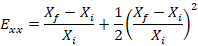
Protocol

1. Plate Fabrication

  1. Plasma-treat a 96-well plate top with a 200 W plasma cleaner (see Table of Materials) for 60 s on high power, placing it bottom-side-up inside the plasma cleaner. Check for a purple glow visible through the window of the chamber, which indicates that an effective plasma has formed. This bonding technique is adapted from Sunkara et al.
  2. Within 60 s, place the plate top in 200 mL of 1.5% (3-Aminopropyl) triethoxysilane (APTES) in deionized (DI) water for 20 min, bottom-side-down. This solution is unstable: prepare it no more than 60 s before introducing the plate.
    CAUTION:

Access restricted. Please log in or start a trial to view this content.

Results

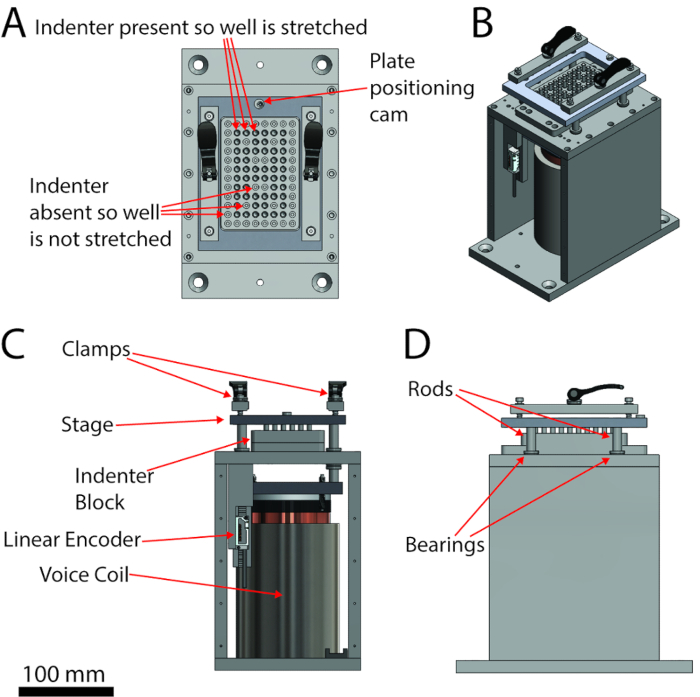
Biomechanical testing device diagrams showing indenter, encoder, coil, used in material analysis.
Figure 1: A labeled schematic of the injury device. (A) Top view, (B) isometric view, (C) front view, (D) right side view. The scale bar applies to the orthographic views (A, B and D).

....

Access restricted. Please log in or start a trial to view this content.

Disclosures

No conflicts of interest declared.

Materials

List of materials used in this article
NameCompanyCatalog NumberComments
.010" Silicone SheetSpecialty Manufacturing, Inc #70P001200010Polydimethylsiloxane (PDMS) sheet
SparkleenFisher Scientific#043204
Nunc 256665Fisher Scientific#12-565-600Bottomless 96 Well Plate
Kim WipesULINES-8115
Plasma CleanerHarrick Plasma#PDC-001-HC
(3-Aminopropyl) triethoxysilaneSigma-Aldrich#440140APTES
Parchment PaperReynoldsN/A
Dome LightCCS incLFX2-100SW
Dome Light Power SupplyCCS incPSB-1024VB
Axial Diffuse Lighting UnitSiemensNerlite DOAL-75-LEDDiffuse axial light
High Power LED ArrayCREEXLamp CXA2540High Power LED Array
LED holderMolex1807200001LED Holder
LED power supplyMean WellHLG-320H-36BConstant Current Power Supply
FastCam Viewer softwarePhotroncamera softeware
Fastcam Mini UX50PhotronN/AHigh Speed Camera
Micro-NIKKOR 105mm f/2.8Nikon#1455High Speed Camera Lens
0.1 mg/mL Poly-L-OrnithineSigma-Aldrich#P4597
iCellsCellular Dynamics International#NRC-100-010-001
iCell mediaCellular Dynamics International#NRM-100-121-001
iCell supplementCellular Dynamics International#NRM-100-031-001
LamininSigma-Aldrich#L2020
voice coil actuatorBEI KimcoLA43-67-000A
optical linear encoderRenishawT1031-30A
servo driveCopley ControlsXenus XTL
ControllerNational InstrumentscRIO 9024 Real Time PowerPC Controller
cRIO chassisNational InstrumentscRIO 9113
digital input moduleNational InstrumentsNI 9411
data acquistion chassisNational InstrumentsNI 9113
LabVIEWNational Instruments
hiPSCNsCellular Dynamics International

Tags

Mechanical Stress ApplicationCytoskeletal DisruptionCell Membrane DamageNeurite DegenerationSilicone Membrane CoatingMulti Well Bottomless PlateInjury Device OperationPosition Tracking Virtual Instrument