A subscription to JoVE is required to view this content. Sign in or start your free trial.

Method Article

A Technique to Inflict Closed-Head Traumatic Brain Injury in Drosophila Flies

722 views

⸱

July 8th, 2025

In This Article

Abstract

Source: Sun, M., et al. A Novel Method to Model Chronic Traumatic Encephalopathy in Drosophila. J. Vis. Exp. (2017).

This video demonstrates a procedure to inflict a closed-head traumatic injury in anesthetized Drosophila flies using a strike device with a gas-propelled impactor. The injury affects neuronal function and impairs walking ability.
Protocol

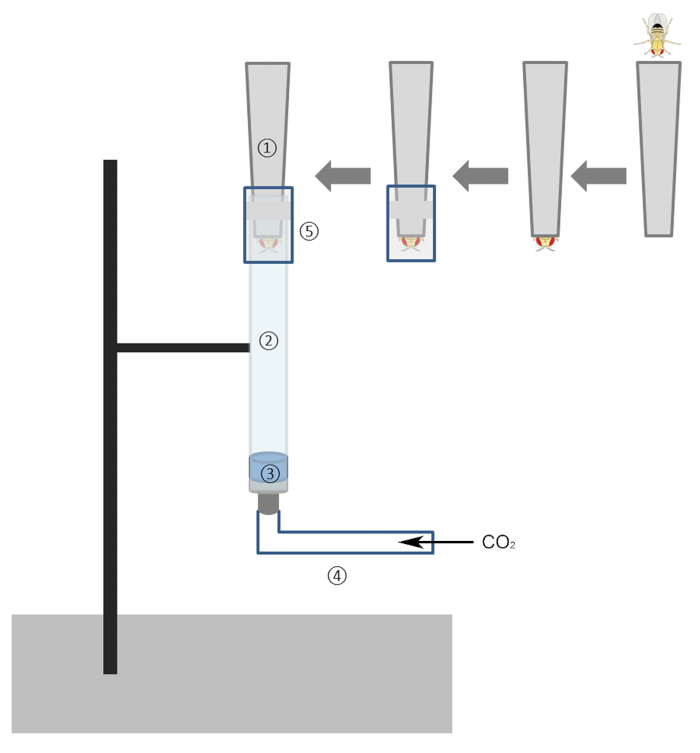
1. Assembly of the Strike Device (Figure 1)

  1. Remove the plunger from a 1 mL tuberculin syringe. Cut the barrel at the 1 mL mark.
  2. Remove an aerosol barrier (3 mm height x 4 mm diameter) from a 200 µL pipette tip and use it as an impactor. Place the impactor inside the syringe barrel. Gently tap the barrel to move the impactor to the tip end, with the flat side covering the nozzle opening.
  3. Attach the barrel tip end to plastic tubing that is connected to the carbon dioxide (CO2) flow regulator of a Drosophila anesthesia station.
  4. Hold the barrel vertically and clamp it to a standard clamp holder stand so that the impactor stays at the bottom of the barrel.
  5. Modify a 200 µL pipette tip to make the fly holder.
    1. Cut 4 mm from the tip to make a 0.8 mm-diameter opening, allowing only the fly head to be exposed.
      ​NOTE: The thorax and all the other parts of the fly body will stay inside the pipette tip.
  6. Modify a 1,000 µL pipette tip and a 1 mL syringe needle cap to make the connector.
    1. Cut off 44 mm from the opening of the tip. Take a 6 mm length of a 1 mL syringe needle cap and push it tightly into the remaining segment of the 1,000 µL pipette tip.

2. Operation of the Strike Device

  1. Anesthetize a single 2-day-old adult female fly using CO2 on a fly pad.
  2. Gently transfer it to the fly holder using a fine brush. Tap the holder gently so that the fly head is seen outside of the tip end. If the fly proboscis is exposed outside the tip, gently tuck it back inside the tip with a blunted 1 mL syringe needle.
    NOTE: Make sure to keep the fly proboscis inside the holder. Otherwise, the fly may die from a sucking proboscis injury.
  3. Tighten the fly holder to the syringe barrel with the connector so that the fly head is facing downwards.
  4. Set the gas pressure to 100 kPa. Adjust the flow rate according to the experiment design.
  5. Quickly turn the flow regulator toggle switch on and off so that the impactor strikes the fly head once.
  6. Lift the fly holder and move it over a fly pad. Reverse the fly holder and gently tap the side to let the fly out. Leave the fly in an empty vial to recover.

Access restricted. Please log in or start a trial to view this content.

Results

Fly anesthetization setup using CO2 chamber; labeled diagram for lab research and insect handling.
Figure 1. Diagram of the Strike Device. The device used materials that are readily available in a Drosophila lab: 1) 200 µL pipette tip, 2) 1 mL tuberculin syringe, 3) impactor, 4) connecting tube hooked to a Drosophila anesthesia s...

Access restricted. Please log in or start a trial to view this content.

Disclosures

No conflicts of interest declared.

Materials

List of materials used in this article
NameCompanyCatalog NumberComments
Aerosol BarrierUSA Scientific1120-8810Used as an impactor
200 ul Pipette TipUSA Scientific1111-0706Used as a fly head holder
1000 ul Pipette TipUSA Scientific1122-1830Used as a connector
1 ml Tuberculin SyringeBecton Dickinson309625
60 mm Petri DishesFisher ScientificFB0875713AUsed as a tracking arenas
Flow RegulatorGenesee Scientific59-122WC
Standard Clamp Holder/standEISCO ScientificCH0688
Fine BrushGenesee Scientific59-204
FlypadGenesee Scientific59-114

Explore More Articles

Drosophila Traumatic Brain InjuryClosed-Head Injury ModelGas-Propelled ImpactorFly Holder TechniqueAnesthetized Drosophila FliesNeuronal Function AssessmentWalking Impairment TestControlled Gas SupplyImpact Device SetupFly Recovery Protocol