All procedures involving animal models have been reviewed by the local institutional animal care committee and the JoVE veterinary review board.
1. Preparation of reagents and supplies
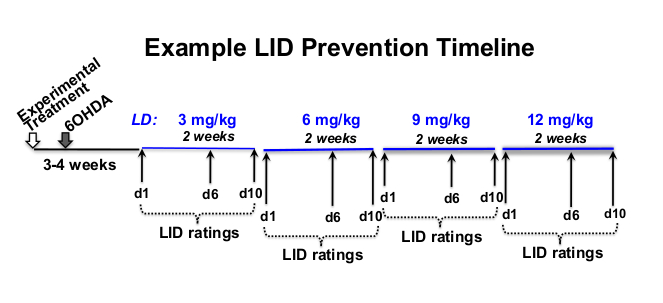
- Determine L-3,4-dihydroxyphenylalanine methyl ester hydrochloride (levodopa or L-DOPA) and benserazide hydrochloride, a peripheral decarboxylase inhibitor (see Table of Materials) dose, rating frequency, and experimental timeline that is appropriate for the investigational question (Figure 1).
NOTE: Investigational questions can be posed to seek any number of answers, ranging from asking whether a specific therapy might reduce existing L-DOPA-induced dyskinesias (LID) to preventing LID induction. They can also explore whether therapeutic efficacy is dependent on the dose of levodopa or whether LID expression and/or therapeutic efficacy varies depending on the sex, species, and age of the subject.
- Weigh rats weekly to calculate the appropriate drug quantity based on the ongoing weight changes during the study.
NOTE: Due to increased activity in LID+ rats, there is potential for weight loss with long-term L-DOPA treatments. If weight loss occurs provide rats with nutritionally complete, highly palatable treats (see Table of Materials) following L-DOPA injections.
- Calculate the amount of L-DOPA and benserazide required for each weekly concentration, weighing out lyophilized aliquots for each day of injection and storing in combination for 1–2 weeks at -20 °C in glass amber vials until the day of treatment.
NOTE: The target dose is 12 mg/kg or 12 mg L-DOPA/1000 g body weight. Supplementary Information provides an example of calculations for determining the amount of L-DOPA and saline needed for each day of a week using 12 mg L-DOPA/kg body weight at an injection volume of 1 cc/kg of rat weight.
2. Room and cage set up
- On the first day of L-DOPA treatment 3-4 weeks following 6-hydroxydopamine (6-OHDA) lesion surgery, transfer rats to single housing, including IACUC-approved enrichment.
- Maintain in single housing throughout the study to avoid peer interference with behavioral assessments.
- On LID rating days, place the home cages on a steel wire rack, turned at an approximately 45° angle for optimal viewing of the rat (Figure 2A). Flip the identification tags (Figure 2B) upward and remove water bottles, food racks, and all types of enrichment in the cage (Figure 2C) to avoid interference with behavioral assessments.
3. Levodopa injections and dyskinesia rating
- Subcutaneous injections of L-DOPA
- Immediately preceding the daily injection of L-DOPA, add the appropriate volume of sterile saline to the pre-weighed lyophilized L-DOPA and benserazide mix in the amber vial and shake well for 10 s (step 1.3).
NOTE: Target injection volume is 1 mL/1000 g body weight (with 12 mg L-DOPA per mL). The volume of the sterile saline will depend on the number of animals per study.
- Fill individual syringes (e.g., 1.0 or 0.5 mL with 26 G needle) with the required volume for each animal (1 mL/kg rat weight) and label each syringe with individual animal identification.
NOTE: Keep the filled syringes protected from light in sterile pouches until the time of injection. L-DOPA rapidly oxidizes in the presence of oxygen and light in an aqueous environment.
- Bring the first cage to the injection bench.
- Remove the rat from its cage and place it on the injection surface.
- Gently restrain the head and shoulders against the surface on which the rat is resting with the palm of the non-dominant hand.
- Gently scruff the skin on the back overlying the scapulae with the thumb and forefinger of the non-dominant hand. Then, inject L-DOPA volume with the dominant hand into the subcutaneous space between/below the fingers, keeping the needle as parallel to the body as possible to avoid intramuscular injection.
NOTE: The rats are not anesthetized before injection.
- Dispose of each used individual syringe in a sharp container.
- Replace the rat into its individual cage and add nutritionally complete treats except on LID rating days to avoid interference with behavioral assessments until after ratings are complete.
- Set the timer for 1–2 min depending on the rating time desired and the number of rats in the study on rating days. Retrieve the next cage and inject the next rat when the timer indicates.
- Repeat this, injecting one rat every 1–2 min, until all the rats are injected.
- Levodopa-induced dyskinesia rating post-injection
- Rate the intensity (Table 1) and frequency (Table 2) of dystonic and hyperkinetic dyskinesia movements at the desired number of time points, which should include the initial onset of LID behavior, peak behavior, and the phase of decline.
- For male and female adult Sprague Dawley or Fisher 344 rats, and a sample size of N = 40 rats, begin the dyskinesia ratings 20 min after the first L-DOPA injection, and then at 50 min intervals until 220 or 270 min post-injection, depending on when LID behaviors have discontinued in 90%–100% of rats.
- If using 1 min rating intervals, set a timer for 1 min. Rate the first rat for one minute. Move to the next rat and rate it for 1 min. Continue through all the rats, rating for 1 min intervals.
- Have a timer positioned next to the cage visibly so that the LID behavior intensity (Table 1) can be observed while estimating the frequency of any given behavior (Table 2) during the rating period.
- After ratings for the first time point are completed start again with the first rat at the next time point (e.g.; 70 min post-injection) and continue at the desired interval (e.g., every 50 min) until all time points are completed.
NOTE: Due to the overlap of L-DOPA injection and LID rating tasks, two persons are needed on the rating days, one for injecting and one for behavioral ratings.