This video demonstrates the measurement of auditory brainstem response (ABR) in a mouse. Electrodes are placed on the head, behind the ear, and near the tail of an anesthetized mouse. Acoustic stimuli at various intensities are delivered, and electric signals generated are recorded as waveforms.
A subscription to JoVE is required to view this content. Sign in or start your free trial.
Method Article
Measuring the Auditory Brainstem Response in Mice
2.1K views
⸱
April 28th, 2025
In This Article
Abstract
Protocol
All procedures involving animal models have been reviewed by the local institutional animal care committee and the JoVE veterinary review board.
1. Auditory brainstem response (ABR)-based assessment of hearing threshold
- Use a commercial ABR testing system specifically designed for small animals.
- Intraperitoneally inject a mixture of tiletamine and zolazepam (40 mg/kg) and xylazine (9.3 mg/kg) into the mice for general anesthesia.
NOTE: ABR assessment takes ~2 h. Make sure to provide thermal support via a heating pad and apply eye ointment to prevent dryness while the mouse is under anesthesia. - Measure the ABR in the mouse under general anesthesia. Place subdermal needle electrodes (12 mm) at the vertex, behind the pinna of the left ear, and back near the tail to measure the hearing threshold.
- Present acoustic stimuli using a speaker placed 1 cm from the animal's left ear.
- Use an oscilloscope to control the acoustic stimuli. Choose Sine Wave for the stimuli and 10 k for the window scale. Turn the Frequency knob to obtain the desired frequency of the acoustic stimuli.
- Adjust the stimulus intensity by turning the amplitude or AMLP knob on the function generator. Obtain the desired stimulus intensity by turning the AMLP knob to a suitable voltage, calculated from calibration.
- Collect the ABR measurements under a series of stimulus intensities, from 10 dB Sound Pressure Levelor SPL to 100 dB SPL, with a 10 dB step size.
NOTE: Measure the hearing threshold in a soundproof box. The minimum stimulus intensity level that could give rise to a discernable Wave V in the collected signal was assumed to be the ABR threshold (Figure 1). Post-ABR assessment, monitor the animal until it recovers from anesthesia (~1 h).
Access restricted. Please log in or start a trial to view this content.
Results
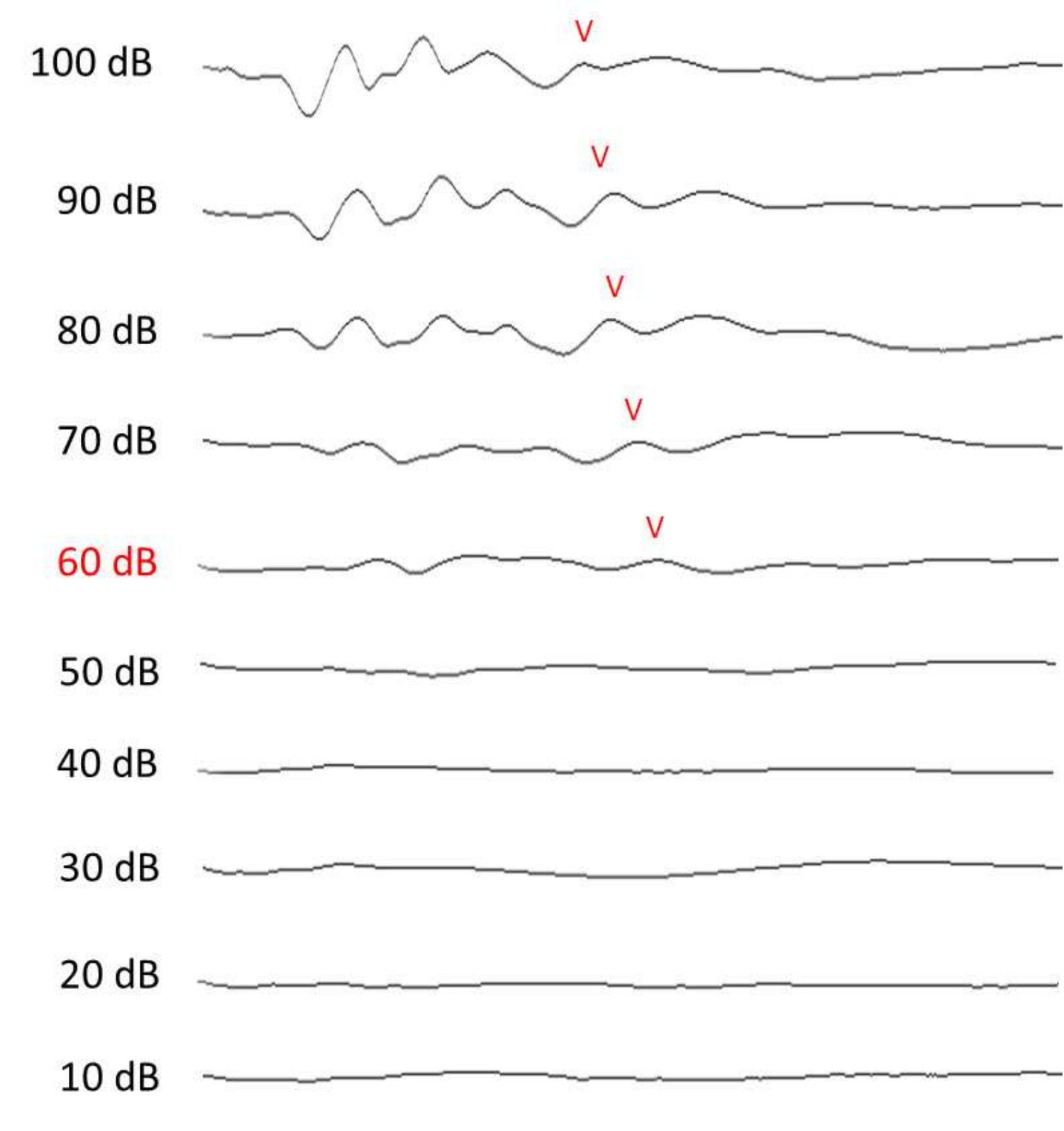
Figure 1: ABR measurement of hearing. Representative ABR results at 12 kHz, collected on the 13th day (1 we...
Access restricted. Please log in or start a trial to view this content.
Materials
| Name | Company | Catalog Number | Comments |
|---|---|---|---|
| 1/4" CCP Free-field Standard Microphone Set | GRAS | 428158 | For noise exposure |
| Amplifier Input Module, AMI100D | BIOPAC | For auditory brainstem response | |
| Bio-amplifier, BIO100C | BIOPAC | For auditory brainstem response | |
| Evoked Response Amplifier, ERS100C | BIOPAC | For auditory brainstem response | |
| High Performance Data Acquisition System, MP160 | BIOPAC | For auditory brainstem response | |
| Modular Extension Cable, MEC110C | BIOPAC | For auditory brainstem response | |
| Needle Electrode, Unipolar 12 mmTp, EL452 | BIOPAC | For auditory brainstem response | |
| ROMPUN- xylazine injection, solution | Bayer HealthCare, LLC | ||
| Sound amplifier, MT-1000 | unika | For noise exposure | |
| Sound generator/analyzer/miscellaneous, FW-02 | CLIO | 620300719 | For noise exposure |
| Soundproof chamber | IEA Electro-Acoustic Technology | For noise exposure and ABR | |
| Speaker | IEA Electro-Acoustic Technology | For noise exposure | |
| Stimulator Module, STM100C | BIOPAC | For auditory brainstem response | |
| Tubephone Set, OUT101 | BIOPAC | For auditory brainstem response | |
| Zoletil | Virbac |
