Method Article

Cell Imaging Using Total Internal Reflection Fluorescence Microscopy

June 17th, 2025

In This Article

Abstract

Loading...
$$\rightleftharpoonup{xx}$$ $$\longleftharp{xx}$$, $$\longrightharp{xx}$$,

Source: Daniele, F., et. al TIRFM and pH-sensitive GFP-probes to Evaluate Neurotransmitter Vesicle Dynamics in SH-SY5Y Neuroblastoma Cells: Cell Imaging and Data Analysis. J. Vis. Exp. (2015).

This video demonstrates the imaging of human neuroblastoma cells using a total internal reflection fluorescence (TIRF) microscope to visualize fluorophore-tagged synaptic vesicles. The cells are first focused in epifluorescence mode. Adjustments are then made to achieve total internal reflection, generating evanescent waves that selectively excite fluorophores near the membrane. Before TIRF imaging, acquisition parameters are configured, and the sampling frequency is set.

Protocol

Loading...
$$\rightleftharpoonup{xx}$$ $$\longleftharp{xx}$$, $$\longrightharp{xx}$$,

1. Cell Culture and Transfection

  1. SH-SY5Y cell culture
    NOTE: The experiments have been performed using the human neuroblastoma SH-SY5Y (ATCC# CRL-2266). SH-SY5Y cells grow as a mixture of floating clusters and adherent cells. Follow the instructions reported in the protocol (cell density, splitting ratio, etc.) to have cells that grow firmly attached to the glass cover, which is crucial for total internal reflection fluorescence microscopy (TIRFM).
    1. Before starting, under the laminar flow biosafety cabinet, make the opportune volume of sterile phosphate buffer saline (PBS) solution and culture medium.<....

Access restricted. Please log in or start a trial to view this content.

Results
Loading...
$$\rightleftharpoonup{xx}$$ $$\longleftharp{xx}$$, $$\longrightharp{xx}$$,
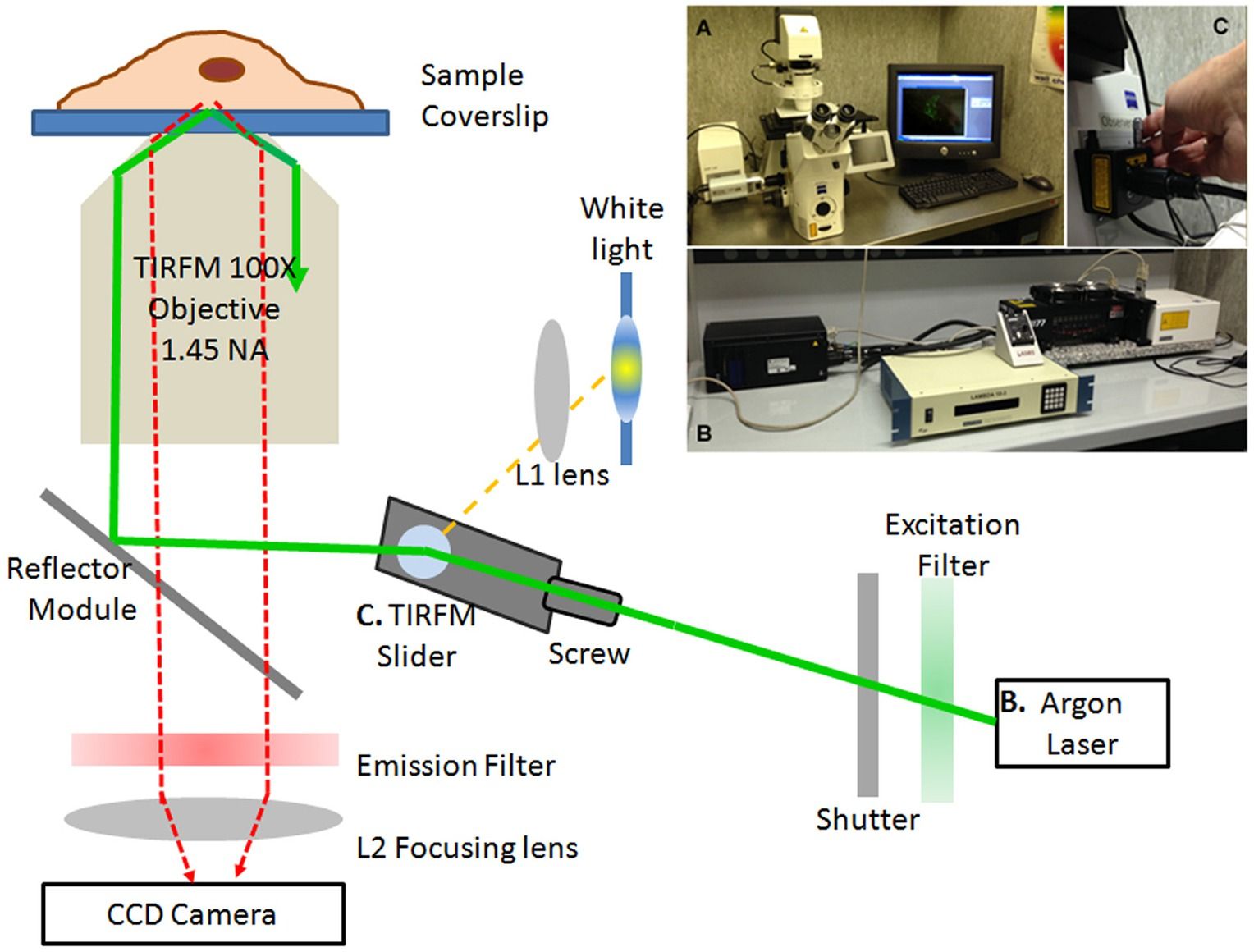
Total Internal Reflection Fluorescence Microscopy (TIRFM) setup diagram; optical excitation process.

Figure 1. TIRF microscope set up. Schematic view and image (inset) of the TIRF microscope system.

Access restricted. Please log in or start a trial to view this content.

Materials

List of materials used in this article
NameCompanyCatalog NumberComments
Equipment
Axio Observer Z1Zeiss491912-9850-000inverted microscopehttp://www.zeiss.com/microscopy/en_de/products/light-microscopes/axio-observer-for-biology.html#introduction
Multiline Argon Laser Lasos 77Lasos00000-1312-752multi-line (458/488/514 nm), 100mW argon-ion laserhttp://www.lasos.com/products/argon-ion-laser
Laser TIRF sliderZeiss423681-9901-000http://www.zeiss.com/microscopy/en_de/products/imaging-systems/single-molecular-imaging-laser-tirf-3.html
100x ObjectiveZeiss421190-9900-000Oil, NA 1.45 Alpha-Planhttps://www.micro-shop.zeiss.com/?l=en&p=us&f=o&a=v&m=a&id=421190-9900-000&ss=1
CCD Camera RetigaSRV Fast 1394QImaging http://www.qimaging.com/products/datasheets/Retiga-SRV.pdf
LAMBDA 10-3 optical filter changer with SmartShutterSutter Instrument Company http://www.sutter.com/IMAGING/lambda103.html
Software
Image ProPlus 6.3 SoftwareMedia Cybernetics spot selection, ROI selection, fluorescence intensity determinationhttp://www.mediacy.com/index.aspx?page=IPP
ExcelMicrosoft photobleaching correction, whole-cell and single-vesicle analyseshttp://office.microsoft.com/it-it/excel/
GraphPad Prism 4.00GraphPad Software, Inc. statistical analysishttp://www.graphpad.com/scientific-software/prism/

Reprints and Permissions

Request permission to reuse the text or figures of this JoVE article

Request Permission

Tags

Total Internal Reflection FluorescenceTIRF MicroscopyNeuroblastoma CellsSynaptic VesiclesEpifluorescence ModeEvanescent WaveAcquisition SettingsSampling FrequencyFluorophore tagged MembranesCritical Angle Adjustment

Related Articles