Intracellular Ca2+ dynamics are very important in sperm physiology and Ca2+-sensitive fluorescent dyes constitute a versatile tool to study them. Population experiments (fluorometry and stopped flow fluorometry) and single cell experiments (flow cytometry and single cell imaging) are used to track spatio-temporal [Ca2+] changes in human sperm cells.
A subscription to JoVE is required to view this content. Sign in or start your free trial.
Method Article
Measuring Intracellular Ca2+ Changes in Human Sperm using Four Techniques: Conventional Fluorometry, Stopped Flow Fluorometry, Flow Cytometry and Single Cell Imaging
In This Article
Summary
Abstract
Spermatozoa are male reproductive cells especially designed to reach, recognize and fuse with the egg. To perform these tasks, sperm cells must be prepared to face a constantly changing environment and to overcome several physical barriers. Being in essence transcriptionally and translationally silent, these motile cells rely profoundly on diverse signaling mechanisms to orient themselves and swim in a directed fashion, and to contend with challenging environmental conditions during their journey to find the egg. In particular, Ca2+-mediated signaling is pivotal for several sperm functions: activation of motility, capacitation (a complex process that prepares sperm for the acrosome reaction) and the acrosome reaction (an exocytotic event that allows sperm-egg fusion). The use of fluorescent dyes to track intracellular fluctuations of this ion is of remarkable importance due to their ease of application, sensitivity, and versatility of detection. Using one single dye-loading protocol we utilize four different fluorometric techniques to monitor sperm Ca2+ dynamics. Each technique provides distinct information that enables spatial and/or temporal resolution, generating data both at single cell and cell population levels.
Introduction
Ca2+ is a universal second messenger of signal transduction pathways in eukaryotic cells. Intracellular Ca2+ (Ca2+i) participates in the regulation of many fundamental physiological processes in both excitable and non-excitable cells. The importance and universality of Ca2+ as second messenger during signal transduction events is derived from its spatio-temporal versatility in the transmission of information within the cell. While Ca2+ cannot be synthesized de novo or degraded within the cell, its intracellular concentration ([Ca2+]i) is maintained within very strict limit....
Access restricted. Please log in or start a trial to view this content.
Protocol
In this paper we report the use of the four aforementioned techniques to measure [Ca2+]i changes in human sperm cells. We used progesterone to trigger a Ca2+ response, as it is well established that this steroid produces a transient [Ca2+]i increase in spermatozoa. Particularly, in human sperm, progesterone directly activates a Ca2+ channel (namely CatSper) expressed exclusively in the plasma membrane of sperm cells 10,11. We also measured resting [Ca2+]i before and after capacitation given that it is also widely accepted that an increase in [Ca2+]i....
Access restricted. Please log in or start a trial to view this content.
Results
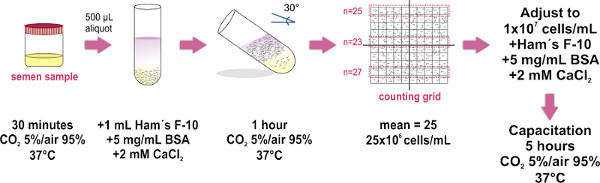
Figure 1. Schematic diagram of the experimental protocol for sperm sample preparation by the swim-up method. The major steps for separation of motile sperm and for adjustment of.......
Access restricted. Please log in or start a trial to view this content.
Discussion
Intracellular signaling is vital for most cellular activities; Ca2+ is a ubiquitous messenger that accompanies mammalian cells throughout their entire lifespan, from their origin at fertilization, to the end of their life cycle. In response to different stimuli, [Ca2+]i increases, oscillates and decreases with spatio-temporal codification; accordingly, diverse processes are activated, modulated or terminated by Ca2+-encoded messages. Intracellular Ca2+ dynamics are very .......
Access restricted. Please log in or start a trial to view this content.
Disclosures
We have nothing to disclose.
Acknowledgements
The authors thank Jose Luis De la Vega, Erika Melchy and Dr. Takuya Nishigaki for technical assistance. This work was supported by Consejo Nacional de Ciencia y Tecnología (CONACyT-Mexico) (99333 and 128566 to CT); Dirección General de Asuntos del Personal Académico/ Universidad Nacional Autónoma de México (IN202212-3 to CT).
....Access restricted. Please log in or start a trial to view this content.
Materials
| Name | Company | Catalog Number | Comments |
|---|---|---|---|
| Ham's F-10 | Sigma-Aldrich | N-6013 | |
| Bovine Serum Albumin | Sigma-Aldrich | A-7906 | |
| Calcium Chloride Dihydrate approx. 99% | Sigma-Aldrich | C-3881 | |
| Makler Counting Chamber | SEFI Medical Insruments LTD | SEF-MAKL | |
| Fluo-3 AM | Invitrogen | F-1242 | 20 vials/50 μg each |
| Ionomycin | Alomone | I-700 | |
| Progesterone | Sigma-Aldrich | P0130 | |
| Sodium chloride | Sigma-Aldrich | S-9888 | Reagents for human sperm medium (HSM) |
| Potassium chloride | Sigma-Aldrich | P-3911 | Reagents for human sperm medium (HSM) |
| Sodium bicarbonate | JT Baker | 3506 | Reagents for human sperm medium (HSM) |
| Magnesium chloride | Sigma-Aldrich | M-2670 | Reagents for human sperm medium (HSM) |
| Calcium chloride anhydrous | Sigma-Aldrich | C-1016 | Reagents for human sperm medium (HSM) |
| HEPES | Sigma-Aldrich | H-3125 | Reagents for human sperm medium (HSM) |
| D-Glucose | JT Baker | 1906-01 | Reagents for human sperm medium (HSM) |
| Sodium pyruvate | Sigma-Aldrich | P-2256 | Reagents for human sperm medium (HSM) |
| Sodium L-lactate (aprox. 99%) | Sigma-Aldrich | L- 7022 | Reagents for human sperm medium (HSM) |
| Propidium Iodide | Invitrogen | L-7011 | Component B |
| Triton X-100 (t-Octylphenoxypolyethoxyethanol) | Sigma- Aldrich | X-100 | 2.4 mM solution in water |
| Round coverslip | VWR | 48380 080 | 25 mm diameter |
| Poly-L-lysine solution | Sigma-Aldrich | P8920 | |
| Manganese chloride | Sigma-Aldrich | M-3634 | |
| Attofluor; Cell Chamber, for microscopy | Life technologies | A-7816 | |
| Dimethyl Sulphoxide | Sigma-Aldrich | D2650 | 5x5 ml |
References
- Bouschet, T., Henley, J. M. Calcium as an extracellular signalling molecule: perspectives on the Calcium Sensing Receptor in the brain. Comptes Rendus Biologies. 328, 691-700 (2005).
- Darszon, A., Nishigaki, T., Beltran, C., Trevino, C. L.
Access restricted. Please log in or start a trial to view this content.
Reprints and Permissions
