We describe the reliable generation of non-Gaussian states of traveling optical fields, including single-photon states and coherent state superpositions, using a conditional preparation method operated on the non-classical light emitted by optical parametric oscillators. Type-I and type-II phase-matched oscillators are considered and common procedures, such as the required frequency filtering or the high-efficiency quantum state characterization by homodyning, are detailed.
A subscription to JoVE is required to view this content. Sign in or start your free trial.
Method Article
Quantum State Engineering of Light with Continuous-wave Optical Parametric Oscillators
In This Article
Summary
Abstract
Engineering non-classical states of the electromagnetic field is a central quest for quantum optics1,2. Beyond their fundamental significance, such states are indeed the resources for implementing various protocols, ranging from enhanced metrology to quantum communication and computing. A variety of devices can be used to generate non-classical states, such as single emitters, light-matter interfaces or non-linear systems3. We focus here on the use of a continuous-wave optical parametric oscillator3,4. This system is based on a non-linear χ2 crystal inserted inside an optical cavity and it is now well-known as a very efficient source of non-classical light, such as single-mode or two-mode squeezed vacuum depending on the crystal phase matching.
Squeezed vacuum is a Gaussian state as its quadrature distributions follow a Gaussian statistics. However, it has been shown that number of protocols require non-Gaussian states5. Generating directly such states is a difficult task and would require strong χ3 non-linearities. Another procedure, probabilistic but heralded, consists in using a measurement-induced non-linearity via a conditional preparation technique operated on Gaussian states. Here, we detail this generation protocol for two non-Gaussian states, the single-photon state and a superposition of coherent states, using two differently phase-matched parametric oscillators as primary resources. This technique enables achievement of a high fidelity with the targeted state and generation of the state in a well-controlled spatiotemporal mode.
Introduction
The ability to engineer the quantum state of traveling optical fields is a central requirement for quantum information science and technology1, including quantum communication, computing and metrology. Here, we discuss the preparation and characterization of some specific quantum states using as a primary resource the light emitted by continuous-wave optical parametric oscillators3,4 operated below threshold. Specifically, two systems will be considered – a type-II phase-matched OPO and a type-I OPO – enabling respectively the reliable generation of heralded single-photons and of optical coherent state superpositions (CSS), i.e. states of the form |α> - |-α>. These states are important resources for the implementation of a variety of quantum information protocols, ranging from linear optical quantum computation6 to optical hybrid protocols5,7. Significantly, the method presented here permits obtaining a low admixture of vacuum and the emission into a well-controlled spatiotemporal mode.
Generally speaking, quantum states can be classified as Gaussian states and non-Gaussian states according to the shape of the quasi-probability distribution in phase space called the Wigner function W(x, p)8. For non-Gaussian states, the Wigner function can take negative values, a strong signature of non-classicality. Single-photon or coherent state superpositions are indeed non-Gaussian states.
An efficient procedure for generating such states is known as the conditional preparation technique, where an initial Gaussian resource is combined with a so-called non-Gaussian measurement such as photon counting9,10,11,12,13. This general scheme, probabilistic but heralded, is sketched on Figure 1a.
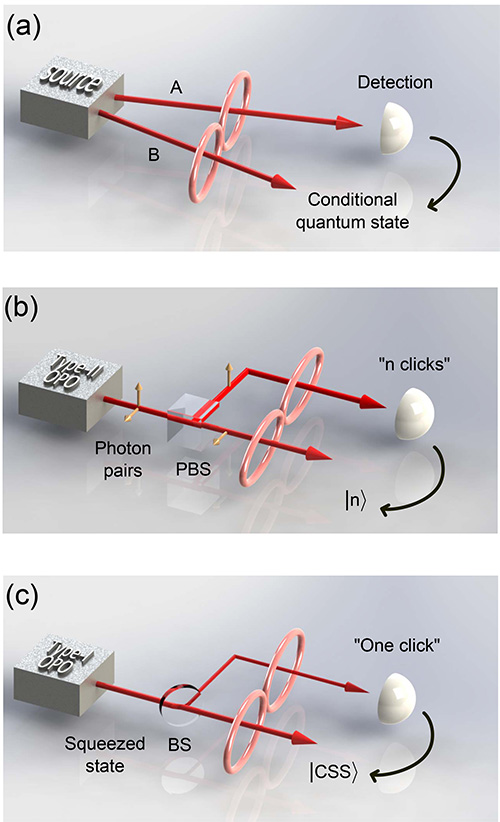
Figure 1. (a) Conceptual scheme of the conditional preparation technique. (b) Conditional preparation of single-photon state from orthogonally-polarized photon pairs (type-II OPO) separated on a polarizing beam splitter. (c) Conditional preparation of a coherent state superposition by subtracting a single-photon from a squeezed vacuum state (type-I OPO).
By measuring one mode of a bipartite entangled state, the other mode is projected into a state that will depend on this measurement and on the initial entangled resource12,13.
What are the required resource and heralding detector needed to generate the aforementioned states? Single-photon states can be generated using twin beams, i.e. photon-number correlated beams. The detection of a single-photon on one mode then heralds the generation of a single-photon on the other mode9,10,14,15. A frequency-degenerate type-II OPO16,17,18,19 is indeed a well-suited source for this purpose. Signal and idler photons are photon-number correlated and emitted with orthogonal polarizations. Detecting a single-photon on one polarization mode projects the other one into a single-photon state, as shown in Figure 1b.
Concerning coherent state superpositions, they can be generated by subtracting a single-photon from a squeezed vacuum state20 obtained either by pulsed single-pass parametric down-conversion11,21 or by a type-I OPO22,23. The subtraction is performed by tapping a small fraction of the light on a beam-splitter and detecting a single-photon in this mode (Figure 1c). A squeezed vacuum is a superposition of even photon-number states, thus subtracting a single-photon leads to a superposition of odd photon-number states, which has a high fidelity with a linear superposition of two coherent states of equal and small amplitude. For this reason, the name ‘Schrödinger kitten’ has sometimes been given to this state.
The general procedure for generating these states is thus similar, but differs by the primary light source. Filtering of the heralding path and detection techniques are the same whatever the type of OPO used. The present series of protocols detail how to generate these two non-Gaussian states from continuous-wave optical parametric oscillators and how to characterize them with high efficiency.
Access restricted. Please log in or start a trial to view this content.
Protocol
1. Optical Parametric Oscillator
- Build a 4 cm long semimonolithic linear cavity (for improved mechanical stability and reduced intracavity losses). The input mirror is directly coated on one face of the nonlinear crystal.
- Choose an input coupler reflection of 95% for the pump at 532 nm and high-reflection for the signal and idler at 1,064 nm. Inversely, choose the output coupler to be highly reflective for the pump and of transmittance T=10% for the infrared. The free spectral range of the OPO is equal to Δω = 4.3 GHz and the bandwidth is around 60 MHz. Make the cavity triply resonant, i.e. for the pump and for the down-converted fields.
- Use a KTP crystal for the type-II OPO system or a PPKTP crystal for the type-I OPO. Temperature-stabilize the crystals at their phase-matching temperatures.
- Use as laser source a continuous-wave frequency doubled Nd:YAG laser. Pump the OPO at 532 nm and use the infrared light, after spatial filtering by a high-finesse cavity (mode cleaner), as a local oscillator (LO) for the homodyne detection.
- Achieve the mode-matching between the pump and the cavity mode.
- Lock the cavity length on the pump resonance by the Pound–Drever–Hall technique. For this purpose, apply a 12 MHz electro-optic modulation to the pump and detect the light back-reflected from the cavity with an optical isolator.
2. Conditional Preparation: Filtering the Heralding Path
- Separate the OPO output into two modes. One corresponds to the heralding mode, while the other one is the heralded state that will be detected by the homodyne detection.
- Guide the heralding mode towards the single-photon detector. Specifically, for the type-II OPO, separate the orthogonal signal and idler modes by a polarized beam splitter (PBS). For the type-I OPO, tap out a small fraction (3%) of the squeezed vacuum by a beam splitter (BS).
- Filter the heralding mode to remove the frequency non-degenerate modes due to the OPO cavity. For an OPO, the output indeed contains many pairwise correlated but spectrally separated modes, ω0+nΔω and ω0-nΔω where n is an integer. To generate a heralded state at the carrier frequency, it is necessary to filter out all of these non-degenerate modes.
- Use first an interferential filter with a bandwidth of 0.5 nm.
- Add a homemade linear Fabry–Perot cavity with a free spectral range of 330 GHz and a bandwidth of 300 MHz (length around 0.4 mm and finesse around 1,000). The cavity bandwidth is chosen to be larger than the one of the OPO and the free spectral range to be larger than the frequency window of the interferential filter.
- Achieve at least an overall 25 dB rejection of the non-degenerate modes.
- Lock the filtering Fabry-Perot cavity by the dither-and-lock technique.
- For this purpose, inject a backward propagating auxiliary beam via an optical switch and reject it at the entrance of the filtering cavity by an optical isolator. Detect the light at the output.
- Lock the cavity during 10 msec and start after the measurement period for 90 msec with the auxiliary-beam off.
- Detect the filtered heralding mode by a single-photon detector during the measurement period. A superconducting single-photon detector (SSPD) is used to limit the amount of dark noise (few Hz), which otherwise would degrade the fidelity of the conditional state.
3. Quantum State Tomography by Homodyne Detection
- Detect the heralded state with a balanced homodyne detection composed of a 50/50 beam splitter where the field to characterize and a strong continuous-wave local oscillator (LO, 6 mW) are brought to interfere, and a pair of high quantum efficiency InGaAs photodiodes.
- In order to align the detection, inject into the OPO cavity a bright auxiliary beam at 1,064 nm and mode match this mode with the LO mode. Achieve a fringe visibility close to unity. Any mode mismatch quadratically translates into detection losses.
- Check the homodyne detection properties. With a LO power of 6 mW, the shot noise limit (SNL) is flat up to 50 MHz. It is more than 20 dB above the electronic noise at low analysis frequency (MHz), 16 dB above at the analysis frequency of 50 MHz. This distance is a critical parameter as it translates into losses in the detection (a 10 dB (20 dB) distance translates into a 10% (1%) effective loss)24.
- For every detection event from the single-photon detector, record the homodyne photocurrent with an oscilloscope with a sampling rate of 5 Gs/sec during 100 nsec. Sweep the LO phase with a PZT-mounted mirror during the measurement.
- Filter each recorded segment with a given temporal mode function to obtain at each successful preparation a single quadrature value of the conditional state. The optimal mode function for low gain is close to a double-sided exponential function25 with a decay constant equal to the inverse of the OPO bandwidth. The optimal mode can also be found by using a eigenfunction expansion of the autocorrelation function26.
- Accumulate measurements (50,000 are required for the tomography) and post-process the data with a maximum-likelihood algorithm27. This procedure enables reconstruction of the density matrix of the heralded state and the corresponding Wigner function8.
4. Conditional Preparation of Single Photon State with a Type-II OPO
- Pump the type-II OPO far below threshold (1 mW here for a 80 mW threshold) to have a very low probability of multiphoton pairs.
5. Conditional Preparation of Coherent State Superposition with a Type-I OPO
- Check the squeezed vacuum generated by the OPO close to threshold with a spectrum analyzer. The measured noise spectra are shown in Figure 3.
- Operate the OPO at a pump power enabling observation of around 3 dB of squeezing at low sideband frequencies (few MHz).
- In the homodyne measurement, the phase information is important for phase-dependent states such as the CSS state. Scan the LO phase with a 10 Hz sawtooth wave with a duty cycle of 90% (corresponding to the 90 msec of measurement period and 10 msec of locking period.) Synchronize the sweep to make sure that during the measurement period, there is a single one-directional sweep of the PZT-mounted mirror.
- Use the homodyne signal to measure the variance and then infer the phase of the measured quadrature.
Access restricted. Please log in or start a trial to view this content.
Results
For the type-II OPO and the generation of high-fidelity single photon state:
The tomographic reconstruction of the heralded state is shown in Figure 2, where the diagonal elements of the reconstructed density matrix and the corresponding Wigner function are displayed. Without any loss corrections, the heralded state exhibits a single-photon component as high as 78%. By taking into account the overall detection losses (15%), the state reaches a fidelity of 91% with a single-photon state. The two-photo...
Access restricted. Please log in or start a trial to view this content.
Discussion
The conditional preparation technique presented here is always an interplay between the initial bipartite resource and the measurement performed by the heralding detector. These two components strongly influence the quantum properties of the generated state.
First, the purity of the prepared states strongly depends on the one of the initial resource, thus a ‘good’ OPO is required. What is a ‘good’ OPO? It is a device for which the escape efficiency η is close to un...
Access restricted. Please log in or start a trial to view this content.
Disclosures
The authors declare that they have no competing financial interests.
Acknowledgements
This work is supported by the ERA-NET CHIST-ERA (‘QScale’ project) and by the ERC starting grant ‘HybridNet’. F. Barbosa acknowledges the support from CNR and FAPESP, and K. Huang the support from the Foundation for the Author of National Excellent Doctoral Dissertation of China (PY2012004) and the China Scholarship Council. C. Fabre and J. Laurat are members of the Institut Universitaire de France.
Access restricted. Please log in or start a trial to view this content.
Materials
| Name | Company | Catalog Number | Comments |
|---|---|---|---|
| Pump laser | Innolight | Diabolo | Dual output, IR and 532 nm |
| KTP and PPKTP crystal | Raicol | Available from other vendors | |
| Interferential filters | Barr associates | ||
| High efficiency photodiodes | Fermionics | Quantum efficiency above 97% | |
| Oscilloscope | Lecroy | Wave runner 610 Zi | Used for data acquisition |
| Spectrum analyser | Agilent | N9000A | Available from other vendors |
| Faraday rotator | Qioptic | FR-1060-5SC | Available from other vendors |
| PZT | PI | P-016.00H | Available from other vendors |
| Superconducting single-photon detectors | Scontel | SSPD | low dark counts |
| Optical switch | Thorlabs | OSW12-980E | Available from other vendors |
References
- Dell'Anno, F., et al. Multiphoton quantum optics and quantum state engineering. Phys. Reports. 428, 53-168 (2006).
- O'Brien, J. L., et al. Photonic quantum technologies. Nature Photon. 3, 687-695 (2009).
- Bachor, H. -A., Ralph, T. C. A guide to experiments in quantum optics. , Wiley VCH. (2004).
- Reid, M. D., et al. The Einstein-Podolsky-Rosen paradox: from concepts to applications. Rev. Mod. Phys. 81, 1727-1751 (2009).
- Van Loock, P. Optical hybrid approaches to quantum information. Laser & Photonics Review. 5, 167-200 (2011).
- Knill, E., et al. A scheme for efficient quantum computation with linear optics. Nature. 409, 46-52 (2001).
- Ralph, T. C., et al. Quantum computation with optical coherent states. Phys. Rev. A. 68, 042319(2003).
- Leonhardt, U. Measuring the quantum state of light. , Cambridge University Press. Cambridge. (1997).
- Hong, C. K., Mandel, L. Experimental realization of a localized one-photon state. Phys. Rev. Lett. 56, 58-60 (1986).
- Lvovsky, A. I., et al. Quantum state reconstruction of the single-photon Fock state. Phys. Rev. Lett. 87, (2001).
- Ourjoumtsev, A., et al. Generating optical Schrödinger kittens for quantum information processing. Science. 312, 83-86 (2006).
- D'Auria, V., et al. Effect of the heralding detector properties on the conditional generation of single-photon states. Eur. Phys. Journ. D. 66, 249(2012).
- D'Auria, V., et al. Quantum decoherence of single-photon counters. Phys. Rev. Lett. 107, (2011).
- Huisman, S. R., et al. Instant single-photon Fock state tomography. Opt. Lett. 34, 2739-2741 (2009).
- Morin, O., et al. High-fidelity single-photon source based on a Type II optical parametric oscillator. Opt. Lett. 37, 3738-3740 (2012).
- Ou, Z. Y., et al. Realization of the Einstein-Podolski-Rosen paradox for continuous variables. Phys. Rev. Lett. 68, 3663-3666 (1992).
- Laurat, J., et al. Type-II Optical Parametric Oscillator: a versatile source of quantum correlations and entanglement in Quantum information with continuous-variables of atoms and light. , Imperial College Press. (2005).
- Laurat, J., et al. Compact source of Einstein-Podolski-Rosen entanglement and squeezing at very low noise frequencies. Phys. Rev. A. 70, (2004).
- D'Auria, V., et al. Full characterization of Gaussian bipartite entangled states by a single homodyne detector. Phys. Rev. Lett. 102, (2009).
- Dakna, M., et al. Generating Schrödinger-cat-like states by means of conditional measurements on a beam splitter. Phys. Rev. A. 55, 3184-3194 (1997).
- Gerrits, T., et al. Generation of optical coherent-state superpositions by number-resolved photon subtraction from the squeezed vacuum. Phys. Rev. A. 82, (2010).
- Neergaard-Nielsen, J. S., et al. Generation of a Superposition of Odd Photon Number States for Quantum Information Networks. Phys. Rev. Lett. 97, (2006).
- Wakui, K., et al. Photon subtracted squeezed states generated with periodically poled KTiOPO4. Opt. Express. 15, 3568-3574 (2007).
- Kumar, R., et al. Versatile wideband balanced detector for quantum optical homodyne tomography. Optics Com. 285, 5259-5267 (2012).
- Nielsen, A. E. B., Mølmer, K. Single-photon-state generation from a continuous-wave nondegenerate optical parametric oscillator. Phys. Rev. A. 75, (2007).
- Morin, O., et al. Experimentally accessing the optimal temporal mode of traveling quantum light states. Phys. Rev. Lett. 111, 213-602 (2013).
- Lvovsky, A. I., Raymer, M. G. Continuous-variable optical quantum-state tomography. Rev. Mod. Phys. 81, 299-332 (2009).
- Marek, P., Fiurasek, J. Elementary gates for quantum information with superposed coherent states. Phys. Rev. A. 82, (2010).
- Morin, O., et al. Remote creation of hybrid entanglement between particle-like and wave-like optical qubits. Nat. Photonics. Eprint. , (2013).
Access restricted. Please log in or start a trial to view this content.
Reprints and Permissions
