Plant biomass offers a renewable resource for multiple products, including fuel, feed, food, and a variety of materials. In this paper we investigate the properties of tobacco tree (Nicotiana glauca) and poplar as suitable sources for a biorefinery pipeline.
Method Article
Transcript and Metabolite Profiling for the Evaluation of Tobacco Tree and Poplar as Feedstock for the Bio-based Industry
In This Article
Erratum Notice
Important: There has been an erratum issued for this article. View Erratum Notice
Summary
Abstract
The global demand for food, feed, energy, and water poses extraordinary challenges for future generations. It is evident that robust platforms for the exploration of renewable resources are necessary to overcome these challenges. Within the multinational framework MultiBioPro we are developing biorefinery pipelines to maximize the use of plant biomass. More specifically, we use poplar and tobacco tree (Nicotiana glauca) as target crop species for improving saccharification, isoprenoid, long chain hydrocarbon contents, fiber quality, and suberin and lignin contents. The methods used to obtain these outputs include GC-MS, LC-MS and RNA sequencing platforms. The metabolite pipelines are well established tools to generate these types of data, but also have the limitations in that only well characterized metabolites can be used. The deep sequencing will allow us to include all transcripts present during the developmental stages of the tobacco tree leaf, but has to be mapped back to the sequence of Nicotiana tabacum. With these set-ups, we aim at a basic understanding for underlying processes and at establishing an industrial framework to exploit the outcomes. In a more long term perspective, we believe that data generated here will provide means for a sustainable biorefinery process using poplar and tobacco tree as raw material. To date the basal level of metabolites in the samples have been analyzed and the protocols utilized are provided in this article.
Introduction
Population and economic growth have caused an increasing demand for food, water and fuels. Much of these supplies are produced, processed and transported using finite fossil-based means, such as petroleum. It is, however, clear that this practice is not sustainable, and the development of alternative resources will therefore be of great importance1. Many renewable resources are, to varying degrees, currently being exploited, including wind, water motion, solar, geothermal, and wave based energy sources. Another sustainable and largely untapped resource is the biomass from plants. This resource also offers a very cost efficient way to convert solar derived energy into fuels2. Apart from providing bio-based fuel, the plant biomass also offers unique opportunities for alternative products, including plastics, detergents, and valuable chemicals.
The plant cell wall, which largely consists of sugar based polymers, makes up the main bulk of the plant's biomass and much effort is currently being invested in its efficient conversion into bioethanol. The remaining biomass may subsequently be processed into biogas and oil related products3. Much of the perennial plant species, including grasses and trees, that produce large amounts of cellulosic biomass typically grow best in the temperate zones. However, approximately 20% of the land area is semi-arid, and is therefore also prone to droughts4. Obviously, it would be of interest to also cultivate these arid lands with plants that could effectively contribute to the sustainable production of energy and material. These plants need to have an optimal water use efficiency and drought resistance and would include the tobacco tree (Nicotiana glauca) and species from the Agave genus.
The MultiBioPro consortium aims to implement an integrated biorefinery pipeline, using the two important crop species, poplar and tobacco tree. Poplar has emerged as a promising biofuel crop as it is fast growing, easily clonally propagated and highly adaptable to a wide range of climatic and soil conditions. It also provides a wide range of wood, fiber, fuel wood, and other forest products5. The tobacco tree has also emerged as a suitable plant for biofuel and biorefinery purposes. It typically produces substantial quantities of biomass, contains high amounts of nonstructural carbohydrates6, and also has the rare ability to accumulate large quantities of readily extractable nonfood oils (including long chain C29-C31 saturated hydrocarbons and triterpenoids) that are suitable for biodiesel production. The tobacco tree is, moreover, amenable to genetic improvement, has high sprouting capacity, and grows happily on semi-arid soils not used for food production. It therefore appears that both poplar and tobacco tree have intrinsic potential for multipurpose crops, i.e. as new high value feedstocks for an integrative bio-based industry. In this paper we focus on diverse set of approaches to discern how tobacco tree deposits long chain hydrocarbons.
In an attempt to identify the underlying molecular machinery responsible for the production and secretion of the saturated long-chain hydrocarbons on tobacco leaves, we apply modern “omics” based technologies. This includes RNA seq of a developmental leaf series (ten stages), and multiplatform metabolite profiling approaches using LC- and GC-MS (for polar and nonpolar metabolites and lipidomics). These data will be used to mine for gene expression that correlates with, or precedes, the onset of biosynthesis of the molecules indicated above. Genes and pathways that appear promising from these endeavors will be used for functional testing in the model species Arabidopsis and could ultimately be amenable for biotechnological engineering in tobacco tree.
Protocol
1. Plant Material
Grow Nicotiana glauca plants in 30 cm diameter pots containing M2 professional growing medium. Grow plants in glasshouse, with a daytime temperature of 20-25 °C and nocturnal temperature of 15 °C. Use a 16 hr light and 8 hr darkness cycle as supplementary light regime.
2. Sample Preparation
- For primary metabolites:
- Harvest plant materials (leaves and stems of N. glauca) and freeze material immediately.
- Lyophilize frozen plant materials by freeze-drying for three days.
- Grind lyophilized samples by mixer mill with metal balls.
- Aliquot fine ground dry materials into a 2 ml centrifuge tube or glass vial.
- For secondary metabolites:
- Harvest plant tissues and freeze material immediately.
- Grind frozen plant tissues by mixer mill with stainless steel ball or by mortar and pestle.
- Aliquot fine ground tissues into 2 ml centrifuge tube (approximately 20 mg wet weight).
3. Extraction Protocol for Metabolite Profiling for Primary Metabolites by GC-MS
- Aliquot ground dry plant material (10 mg of leaf and 20 mg of stem materials) in 2 ml, screw cap, round bottom tubes.
- Add 1,400 µl of 100% methanol and vortex for 10 sec.
- Add 60 µl of Ribitol (0.2 mg/ml stock in H2O) as an internal quantitative standard and vortex for 10 sec.
- Add one stainless steel (or zirconia) ball and homogenize material with a Mixer Mill for 2 min at 25 Hz.
- Centrifuge the mix for 10 min at 11,000 x g.
- Transfer the supernatant to a glass vial.
- Add 750 µl of chloroform.
- Add 1,500 µl of H2O and vortex the mix for 10 sec.
- Transfer 150 µl from the upper phase (polar phase) into a fresh 1.5 ml centrifuge tube.
- Dry samples using a speed vac. It is imperative that the samples are reduced to dryness for between 3 and 24 hr until no residual liquid is present.
- Add 40 µl of methoxyamine hydrochloride (20 mg/ml in pyridine).
- Shake the mix in a horizontal heat block shaker for 2 hr at 37 °C.
- Add 70 µl N-methyl-N-(trimethylsilyl)-trifluoroacetamide MSTFA mix.
- Shake the mix for 2 hr at 37 °C.
- Spin down the drops on the cover by a short centrifugation ~ 1 min at 11,000 x g.
- Transfer the liquid into glass vials suitable for GC-MS analysis.
4. Extraction for Metabolite Profiling for Secondary Metabolites by LC-MS
- Add 500 µl methanol to the frozen ground samples.
- Shake with a thermomixer for 15 min at 70 °C (1,000 sec-1).
- Centrifuge the samples (5 min, 20,000 x g) and the liquid phase transferred to a 1.5 ml centrifuge tube.
- Lyophilize the liquid phase with a centrifugal evaporator (speedvac).
- Add 100 µl cyclohexane and 100 µl milliQ water to the dry pellet.
- Shake the samples for 5 min at room temperature (use vortex).
- Centrifuge the samples (5 min, 20,000 x g).
- Transfer 80 µl of the water phase (lower phase) to LC-MS injection vials with conical bottom for LC-MS analysis.
5. Data Analysis
- Configure Xcalibur, MarkerLynx, Metalign7 or XCMS8 and select the data analysis to be processed.
- Prepare a table of detected peaks of your interest in accordance with compound class in Table 1.
- Identify peaks by co-elution of standard compounds.
- Subsequently annotate detected peaks using MSn analysis, structural characterization algorithms9,10, literature survey and metabolite database search11,12.
6. Hydrocarbon Extraction13
- Submerge freshly harvested N. glauca leaves (~200 mg) in solvent (methanol, ethanol, chloroform, hexane or petroleum ether (boiling point 40-60 °C or 60-80 °C) (5 ml; HPLC grade) for 2 to 20 min.
- Remove leaves and dry off solvents completely by rotary evaporation.
- Resuspend samples in hexane (1 ml; HPLC grade).
- Perform GC-MS analysis using gas chromatography and hyphenated to a 5973MSD. Operating conditions should be as follows; carrier gas, helium with a flow rate of 0.9 ml min-1/11 psi. Inject samples (1 µl) with a splitless injector at 280 °C. Hold the gas chromatography oven at 70 °C for 5 min before ramping at 4 °C/min to 320 °C. Hold the final temperature for a further 10 min, making a total time of 67.5 min. Set the interface with the MS at 280 °C and perform MS in full scan mode using 70 eV EI+ and scanned from 10 to 800 D.
- Initially process the chromatogram components by automated MS deconvolution and identification system, and those that are identified using the NIST 98 MS library.
- Confirm the identification of saturated long chain alkane hydrocarbons (hexacosenol, nonacosane, triacontane, octacosenol, nonacosonal, hentriacontane, dotriacontane and tritriacontane) by comparing retention times and classical fragmentation patterns to known authentic standards.
- Determine quantitatively hydrocarbons by comparing integrated peak areas with dose response curves (0.07 to 2.5 mg), constructed from authentic standards.
- Calculate means and standard error of the means (SEM) using Excel software.
7. Analysis of Isoprenoids14
- Perform homogenization as described in section 2. Weigh in 10 mg of homogenized freeze dried powder into a centrifuge tube.
- Add sequentially 250 ml methanol onto the powder, mix it, then add 500 ml chloroform (laboratory reagent grade), and mix it by vortexing.
- Leave the samples on ice in darkness for 20 min.
- Add 250 ml Tris-HCl buffer (100 mM, pH 7.5) or water (HPLC grade) to the suspension and mix by vortexing.
- Centrifuge the mixture at 12,000 rpm (13,523 x g) for 5 min to separate the nonpolar from aqueous phases. The nonpolar chloroform phase containing isoprenoid extracts is at the bottom.
- Transfer the phase to a new centrifuge tube.
- Add an additional 500 ml chloroform to the aqueous phase, and conduct a second extraction by vortex and centrifugation as described above.
- Combine the chloroform extracts and bring the samples to dryness using the evaporator and store at -20 °C until analysis.
- Add 50 ml ethyl acetate (HPLC grade) to the dried isoprenoid extract to redissolve the material.
- Inject 3 ml onto a C18 column using a UPLC Acquity separation module. The gradient used to separate the pigments should include; A: methanol/H20 (50:50) and B: acetonitrile/ethyl acetate (75:25), and initial conditions should be A 30% (v/v) and B 70% (v/v) going to 100% B over 6 min. Use a flow rate of 0.6 ml/min.
- Monitor the eluate continuously with a Photo Diode Array (PDA) detector from 250 to 600 nm.
- Identify components by co-chromatography and spectral comparisons between authentic standards, Beta carotene (provitamin A), phytoene, lycopene, lutein and zeaxanthin.
- Perform quantification from dose response curves.
- Confirm compounds using LC-MS; use similar chromatographic conditions. Detection should be done using APCI ionisation in positive mode with a Q-Tof instrument.
- Do the modifications for tocopherol determination with 25 mg freeze dried material that has been extracted and saponification in 6% KOH at 50 °C for 1.5 hr.
8. RNA Extraction for RNA Seq
This protocol combines Trizol RNA extraction with a RNeasy Kit to obtain high quality RNA.
- Grind 100 mg of frozen plant material in 2 ml centrifuge tubes with a metal ball by a mixer mill.
- Add 1 ml Trizol.
- Centrifuge the material for 10 min at 12,000 x g at 4 °C.
- Transfer the supernatant into a new reaction tube.
- Add 200 µl chloroform, invert the tube several times, and incubate 3 min at room temperature.
- Centrifuge the mix for 15 min at 12,000 x g at 4 °C.
- Transfer the upper aqueous phase (approximately 700 µl) into a new reaction tube.
- Add approximately 2.5 volumes of ethanol (100%), invert the tube several times, and incubate for 30 min at -80 °C.
- Move the sample including any precipitate to the spin column from kit.
- Centrifuge the column for 15 sec at 8,000 x g, and discard the flow through.
- Add 700 µl Buffer RW1 to the spin column and centrifuge for 15 sec at 8,000 x g. Discard the flow through.
- Add 500 µl Buffer RPE to the spin column and centrifuge the column for 15 sec at 8,000 x g. Discard the flow through.
- Add 500 µl Buffer RPE to the spin column and centrifuge for 2 min at 8,000 x g.
- Place the spin column into a new 1.5 ml reaction tube and add 50 µl RNase-free water.
- Centrifuge the column for 1 min at 8,000 x g to elute the RNA.
- Remove residual DNA using an Ambion DNA-free Kit according to manufacturer's instructions.
- Determine the quality of the RNA. The RNA should have RNA integrity numbers (RIN) above 8.
- Send off the RNA for next generation sequencing.
Results
The HPLC profile in Figure 1 shows a representative result of the isoprenoid analysis of N. glauca leaf extracts. The different isoprenoids of C40 and above were detected using a Photo Diode Array (PDA) detector. The peaks were annotated based on co-chromatography and spectral comparison between authentic standards, Beta carotene (provitamin A), phytoene, lycopene, lutein and zeaxanthin. The two MS chromatograms in Figure 2 show the result of primary metabolite analysis from N. glauca leaf and stem material, respectively. The MS spectrum of a peak corresponding to serine (indicated by an arrow) is also given as an example. Figure 3 shows the Bioanalyzer used for determining the quality of the RNA and a representative output from the device. The two main peaks in the chromatogram corresponding to 18 S and 25 S ribosomal RNA, indicating intact RNA in the sample. Additional peaks of fragmented ribosomal RNA would appear in case of partially or heavily degraded RNA.
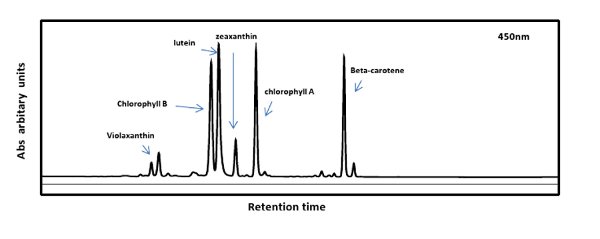
Figure 1. HPLC profile showing isoprenoids present in leaf extracts from N. glauca. Most isoprenoids of C40 and above are not amenable to GC-MS analysis. We therefore used HPLC separations with photodiode array detection. A typical chromatogram recorded at 450 nm is shown. The carotenoid pigments are typical of photosynthetic tissues with lutein predominating. Also present is zeaxanthin, which is rarely found in leaf tissue unless placed under high light stress. The levels of zeaxanthin make it a good source of this high-value compound. Please click here to view a larger version of this figure.
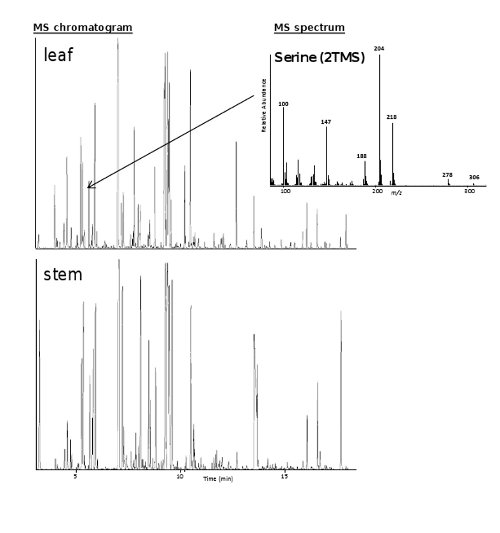
Figure 2. MS chromatogram and spectrum of N. glauca tissue extracts. Total ion MS chromatogram (TIC) of leaf and stem extracts measured by GC-MS is presented (70-600 m/z). GC-MS analysis was performed as described previously in15. Detected peaks were annotated using the mass spectral tags library. MS spectrum of serine (2TMS) is shown as an example. MS chromatogram: X axis and Y axis indicate retention time (min) and the intensity (abundance) of the signal, MS spectrum: X axis and Y axis indicate the M/Z ratios and the intensity (abundance) of the signal, respectively. Click here to view larger image.
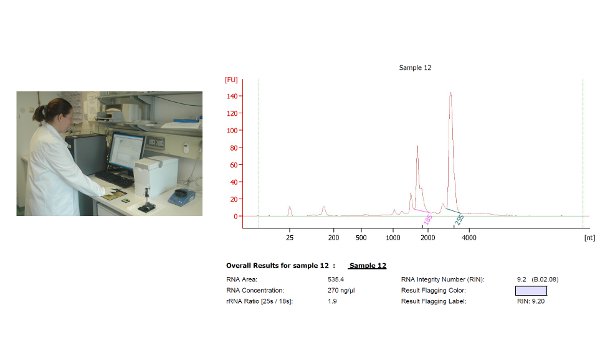
Figure 3. Bioanalyzer measurement of RNA prepared for RNA seq of N. glauca leaf material. To obtain highly pure RNA needed for RNA seq we extracted RNA using Trizol reagent and subsequently purified the RNA using the columns from the RNeasy Mini Kit (Qiagen, Hilden, Germany). We determined the RNA quality using the Bioanalyzer (Agilent, Waldbronn, Germany) displayed on the left. An example of a Bioanalyzer output is given on the right. The two main peaks in the sample represent 18 S and 25 S ribosomal RNA. Our sample showed a RNA integrity number (RIN) of 9.2, which is well above the required value of 8. Click here to view larger image.
Discussion
The protocols presented here provide a comprehensive framework to analyze tobacco tree leaves for metabolites and transcripts. It is envisaged that these combined efforts should provide us with new insights into the processes underlying the synthesis and extrusion of the hydrocarbons and the high value compounds present in this tissue. These approaches should therefore give us a better understanding for how the compounds are being synthesized. In addition to the tobacco tree aspects of the work, it is also aimed to improve poplar biomass, especially targeting lignification of the secondary wall structure, but also to explore whether we can use the bark for extraction of valuable compounds.
The methods presented in this paper are slight modifications of standardized methods for metabolite profiling. These methods are of course limited to known metabolic profiles, and it is possible that several new metabolic peaks may be obtained for which no compound is known. We hope to put these compounds in context to other metabolites by combining the behavior of metabolites and transcripts over the developmental time series.
None of the methods presented here are significantly changed from methods typically used for plant materials. The interesting aspect lies in the combination of methods to understand the underlying framework for mainly long chain hydrocarbon production and modification in the tobacco tree leaves. One of the critical steps for obtaining this information is the subsequent combination of the different data types. We envision that the data as a first evaluation will be divided into different clusters based on the behavior of the metabolites/transcripts over the development and that these data will be used to infer transcript vs metabolite behaviors, and also to potentially assign certain metabolites to pathways. In addition, more elaborate network-based analyses are then envisioned to exploit causal relationships.
The analytical protocols presented here will also provide a basis for field-trials and industrial exploitation of the biomass. To accomplish this, the MultiBioPro consortium contains several industrial partners that have the abilities to further explore the biomass, with the aim to deliver biodiesel, bioethanol and other high-value compounds. These types of biomass exploitation will be assessed based on; (1) testing the robustness and quality of the bio products produced (typical industry standard tests will be carried out to ensure the products generated have good market value), (2), an economic, social and environmental evaluation of the technologies will be performed using literature sources, interviews and material that is generated during field trials and pilot plant biorefinery assessments. These activities will include cost benefit and life cycle analysis, the generation of an environmental dossier and market and business strategies. We believe that this pipeline will become a useful blend of academia, applied science and industrial exploitation to further poplar and tobacco tree biomass for consumer end-products.
Disclosures
The research leading to these results has received funding from the European Seventh Framework Programme ([FP7/2007-2013]) under grant agreement number 311804.
Acknowledgements
MultiBioPro would like to thank the following people who also contribute to the project: Dominic Swinton (Green Fuels), Thomas Lowery (Green Fuels), Sam Buekenhout (Capax), and Sylvia Drouven (Capax).
Materials
| Name | Company | Catalog Number | Comments |
|---|---|---|---|
| Trizol reagent | Invitrogen | 15596-026 | |
| Chloroform | Merck | 102445 | |
| Ethanol | Merck | 101986 | |
| Rneasy Mini Kit | Qiagen | 74104 | |
| TURBO Dnase | Invitrogen | AM2238 | |
| RNA 6000 Nano Kit | Agilent | G2938-90034 | |
| 2100 Electrophoresis Bioanalyzer | Agilent | G2939AA | |
| 1.5 ml and 2 ml safe-lock tubes | Eppendorf | 0030 120.086, 0030 120.094 | |
| Steel balls | Geyer Berlin GmbH | VA2mm | |
| Mixer mill MM 300 | Retsch | YO-04182-09 | |
| Microcentrifuge | Eppendorf | 5424 |
References
- Clark, J. H., et al. chemistry, biofuels, and biorefinery. Annu Rev Chem Biomol Eng. 3, 183-207 (2012).
- Carroll, A., Somerville, C. Cellulosic biofuels. Annu Rev Plant Biol. 60, 165-182 (1146).
- Vanholme, B., et al. Towards a carbon-negative sustainable bio-economy. Front Plant Sci. 4, (2013).
- United Nations Environment Programme (UNEP). Global Environment Outlook: Environment for Development. 4, UNEP. New York. (2007).
- Boerjan, W. Biotechnology and the domestication of forest trees. Curr Opin Biotechnol. 16 (2), 159-166 (2005).
- Curt, M. D., Fernández, J. Production of Nicotiana glauca R.C. Graham aerial biomass in relation to irrigation regime. Biomass. 23 (2), 103-115 (1990).
- De Vos, R. C. H., et al. Untargeted large-scale plant metabolomics using liquid chromatography coupled to mass spectrometry. Nat Protoc. 2 (4), 778-791 (2007).
- Smith, C. A., et al. XCMS: Processing mass spectrometry data for metabolite profiling using Nonlinear peak alignment, matching, and identification. Anal Chem. 78 (3), 779-787 (2006).
- Morreel, K., et al. Mass spectrometry-based fragmentation as an identification tool in lignomics. Anal Chem. 82 (19), 8095-8105 (2010).
- Morreel, K., et al. Mass spectrometry-based sequencing of lignin oligomers. Plant Physiol. 153 (4), 1464-1478 (1104).
- Tohge, T., Fernie, A. R. Web-based resources for mass-spectrometry-based metabolomics: A user's guide. Phytochemistry. 70 (4), 450-456 (2009).
- Tohge, T., Fernie, A. R. Combining genetic diversity, informatics and metabolomics to facilitate annotation of plant gene function. Nat Protoc. 5 (6), 1210-1227 (2010).
- Mortimer, C. L., et al. The identification and rapid extraction of hydrocarbons from Nicotiana glauca: a potential advanced renewable biofuel source. Phytochem Lett. 5 (3), 455-458 (2012).
- Fraser, P. D., et al. Application of high-performance liquid chromatography with photodiode array detection to the metabolic profiling of plant isoprenoids. Plant J. 24 (4), 551-558 (2000).
- Lisec, J., et al. Gas chromatography mass spectrometry-based metabolite profiling in plants. Nat Protoc. 1 (1), 387-396 (2006).
Reprints and Permissions
Erratum
Formal Correction: Erratum: Transcript and Metabolite Profiling for the Evaluation of Tobacco Tree and Poplar as Feedstock for the Bio-based Industry
Posted by JoVE Editors on 6/30/2016. Citeable Link.
A correction was made to: Transcript and Metabolite Profiling for the Evaluation of Tobacco Tree and Poplar as Feedstock for the Bio-based Industry.
There was a spelling error in one of the authors' surname. The author's name was corrected from:
Juan Pedro Navarro
to:
Juan Navarro-Aviñó
