Dichloro{bis[1,1',1''-(phosphinetriyl)tripiperidine]}palladium [(P(NC5H10)3)2Pd(Cl)2] (1) is an easy accessible, cheap, and air stable, but highly active Heck catalyst with an excellent functional group tolerance that efficiently operates under mild reaction conditions to give the coupling products in very high yields.
Method Article
Mizoroki-Heck Cross-coupling Reactions Catalyzed by Dichloro{bis[1,1',1''-(phosphinetriyl)tripiperidine]}palladium Under Mild Reaction Conditions
Opens in a new tab
In This Article
Summary
Loading...
$$\rightleftharpoonup{xx}$$
$$\longleftharp{xx}$$,
$$\longrightharp{xx}$$,
Abstract
Loading...
$$\rightleftharpoonup{xx}$$
$$\longleftharp{xx}$$,
$$\longrightharp{xx}$$,
Dichloro-bis(aminophosphine) complexes of palladium with the general formula of [(P{(NC5H10)3-n(C6H11)n})2Pd(Cl)2] (where n = 0-2), belong to a new family of easy accessible, very cheap, and air stable, but highly active and universally applicable C-C cross-coupling catalysts with an excellent functional group tolerance. Dichloro{bis[1,1',1''-(phosphinetriyl)tripiperidine]}palladium [(P(NC5H10)3)2Pd(Cl)2] (1), the least stable complex within this series towards protons; e.g. in the form of water, allows an eased nanoparticle formation and hence, proved to be the most active Heck catalyst within this series at 100 °C and is a very rare example of an effective and versatile catalyst system that efficiently operates under mild reaction conditions. Rapid and complete catalyst degradation under work-up conditions into phosphonates, piperidinium salts and other, palladium-containing decomposition products assure an easy separation of the coupling products from catalyst and ligands. The facile, cheap, and rapid synthesis of 1,1',1"-(phosphinetriyl)tripiperidine and 1 respectively, the simple and convenient use as well as its excellent catalytic performance in the Heck reaction at 100 °C make 1 to one of the most attractive and greenest Heck catalysts available.
We provide here the visualized protocols for the ligand and catalyst syntheses as well as the reaction protocol for Heck reactions performed at 10 mmol scale at 100 °C and show that this catalyst is suitable for its use in organic syntheses.
Introduction
Loading...
$$\rightleftharpoonup{xx}$$
$$\longleftharp{xx}$$,
$$\longrightharp{xx}$$,
Palladium-catalyzed C-C cross-coupling reactions, which were acknowledged by the award of the Nobel Prize in chemistry in December 2010, nowadays belong to an indispensable tool for the target oriented synthesis of complex organic molecules across all research fields and industrial segments. The Mizoroki-Heck reaction for example, allows the coupling of olefins with aryl halides in the presence of a base and is nowadays the most popular method for the preparation of vinylbenzenes (Figure 1). The Heck reaction has been demonstrated to find wide utility in both, total syntheses of natural products in academia and synthesis in pharmaceutical and agrochemical industry1-10.

Figure 1. General Heck cross-coupling reaction between an aryl bromide and an olefin. Click here to view larger image.
Taxol, a mitotic inhibitor used in cancer chemotherapy, Singulair, an asthma drug and the herbicide prosulfuron as well as Cyclotene, a monomer for high performance electronic resins are examples that have been successfully prepared including a Heck-Mizoroki cross-coupling step in their syntheses (Figure 2)11-14.

Figure 2. Examples of industrially relevant organic compounds involving a palladium-catalyzed Heck cross-coupling reaction as key step in their synthesis. Click here to view larger image.
Even though recent developments have considerably increased the activity of Heck catalysts15-29, a typical reaction protocol with aryl bromides as substrates still requires high reaction temperatures (140 °C), catalyst loadings in the range of 1 mol% and reaction times of up to 24 hr. Moreover, modified reaction conditions, including the reaction temperature, catalyst loadings, bases, solvents, and additives, e.g. are often reported, implying that these protocols will rarely find their application in organic syntheses due to lack of generality. Furthermore, most catalysts require multiple reaction steps for their synthesis and hence, are time-consuming and low-yielding. Additionally, inert-atmosphere techniques and expensive starting materials of poor stability are often used for their preparation. This refers to the need of new and improved, cheap and easy accessible, stable and green but reactive and general applicable Heck catalysts with high functional group tolerance that efficiently and reliably operates at low catalyst loadings with general applicable reaction protocols.
Dichloro-bis(aminophosphine) complexes of palladium were recently introduced as easy accessible, cheap and air stable but highly active C-C cross-coupling catalysts with excellent functional group tolerance30-34, of which dichloro{bis[1,1',1''-(phosphinetriyl)tripiperidine]}palladium [(P(NC5H10)3)2Pd(Cl)2] (1) proved to be a highly efficient, reliable, and versatile Heck catalyst that efficiently operates at 100 °C35. 1 was quantitatively prepared within only a few minutes by treatment of THF suspensions of [Pd(Cl)2(cod)] (cod = cycloocta-1,5-diene) with 1,1',1''-(phosphinetriyl)tripiperidine under air atmosphere at 25 °C. 1,1',1''-(phosphinetriyl)tripiperidine, the respective ligand system was achieved in one step by the dropwise addition of an excess of piperidine to cooled diethyl ether solutions of PCl3. The substrate costs for the preparation of 1,1',1''-(phosphinetriyl)tripiperidine for 1 g of palladium precursor is less than 1€ (estimated from catalogue prices of a chemical supplier) and hence, very cheap.

Figure 3. Synthesis of dichloro{bis[1,1',1''-(phosphinetriyl)tripiperidine]}palladium [(P(NC5H10)3)2Pd(Cl)2] (1). Click here to view larger image.
Moreover, despite the simple and cheap synthesis of 1 and its excellent catalytic performance, the addition of aqueous hydrochloric acid (work-up conditions), lead to a rapid and complete catalyst degradation, accompanied by the formation of phosphonate, piperidinium salt, and insoluble palladium-containing decomposition products, which are easily separated from the coupling products. This is an often ignored, but very important issue to be considered (from ecologic and economic points of view) and is of particular importance for the preparation of pharmaceutically relevant compounds.
Protocol
Loading...
$$\rightleftharpoonup{xx}$$
$$\longleftharp{xx}$$,
$$\longrightharp{xx}$$,
1. Ligand Synthesis (1,1',1''-(Phosphinetriyl)tripiperidine)
- Add 150 ml of dry diethyl ether and 5 ml of phosphorous trichloride (57.3 mmol) in an oven-dried 500 ml round bottomed flask. Put a stir bar in the round bottomed flask and attach a 250 ml dropping funnel and cover the flask with septa.
- Cool down the solution to 0 °C by placing the round-bottomed flask in an ice bath.
- Prepare a solution of 42.5 ml of piperidine (429.8 mmol, 7.5 equiv. rel. to PCl3) and 100 ml of diethyl ether and add this solution slowly via the dropping funnel into the stirred diethyl ether solution, containing phosphorous trichloride. The piperidine addition is accompanied by the precipitation of piperidinium chloride.
- After complete addition, warm up the reaction mixture to RT. In order to ensure full conversion, stir the solution for additional 30 min at RT.
- Filter the reaction mixture over a glass frit and collect the filtrate in a 500 ml round bottomed flask. In order to increase the yield of 1,1',1''-(phosphinetriyl)tripiperidine wash the filter cake with additional 100 ml of dry diethyl ether.
- Evaporate the solvent of the filtrate on a rotary evaporator to obtain the pure ligand (1,1',1''-(phosphinetriyl)tripiperidine) in >80% yield as an off-white oil, which solidifies with time. Check the product purity by 31P{1H} NMR spectroscopy (δ at 117.3 ppm in C6D6)8a.
2. Catalyst Synthesis (Dichloro{bis[1,1',1''-(phosphinetriyl)tripiperidine]}palladium)
- Weigh out [Pd(cod)Cl2] (0.35 mmol, 100 mg) and add to a clean, oven-dried 50 ml round bottomed flask containing 10 ml of dry THF. Add a stir bar, cover the flask with a septum and stir the suspension.
- Weigh out 1,1',1''-(phosphinetriyl)tripiperidine (0.875 mmol, 248 mg) and add to a clean, dry vial containing 10 ml of dry THF. Add the 1,1',1''-(phosphinetriyl)tripiperidine solution via a syringe through the septum to the THF suspension of [Pd(cod)Cl2]. The suspension turns immediately into a dark yellow solution while addition, indicating completion of the reaction.
- In order to remove insoluble solids pass the reaction mixture quickly through an oven-dried glass frit and collect the filtrate in a 25 ml round bottomed flask. Remove the volatiles under reduced pressure. Wash the palladium complex three times with 5 ml of pentane.
- Remove the pentane by decantation. Dry the yellow powder under reduced pressure to quantitatively obtain the analytically pure palladium complex [(P(C5H10N)3)2PdCl2] (1). Check the purity of 1 by 31P{1H} NMR spectroscopy (δ at 92.5 ppm in C6D6)30.
3. Heck Reaction Catalyzed by [(P(C5H10N)3)2PdCl2] (1)
- Weight out [(P(C5H10N)3)2PdCl2] (0.05 mmol, 37.15 mg) and add to an oven-dried 25 ml Schlenk. Cover the Schlenk with a septum; evacuate the Schlenk and backfill with dinitrogen. Add 10 ml of dry and degassed THF via syringe through the septum into the flask.
- Weight out tetrabutylammonium bromide (1.0 mmol, 322.4 mg) and potassium carbonate (20 mmol, 2.77 g) and add them in a clean, oven-dried 25 ml round-bottomed Schlenk flask. Add 20 ml of N-methyl-2-pyrrolidone (NMP) through a syringe into the Schlenk flask36, 37. Add a stir bar and cover the flask with septa. Evacuate and backfill the Schlenk flask with dinitrogen.
- Dissolve 1-bromo-4-phenoxybenzene (10 mmol, 1.75 ml) and styrene (15 mmol, 1.72 ml) in 5 ml of NMP and add this solution via syringe into the Schlenk flask. Attach a reflux condenser by applying a dinitrogen stream. Connect the reflux condenser with an oil bubbler and set a slight overpressure of dinitrogen.
- Heat up the reaction solution to 100 °C and stir the solution for 5 min on this temperature. Add the catalyst solution (0.05 mol%, 0.005 mmol, 1 ml of THF) to the hot reaction mixture via syringe and stir it vigorously for the indicated time (3 hr in this example). Check the product formation by GC/MS.
- Remove the Schlenk from the oil bath, expose the reaction mixture to air and quench with 50 ml of 1 M hydrochloric acid. Add the cooled reaction mixture into a 500 ml separation funnel and add ethyl acetate (50 ml). Separate the Heck product by extraction and combine all organic phases in an Erlenmeyer flask. Add magnesium sulfate to soak up any last amount of water present in the solution.
- Filter the combined organic layers over a paper filter into a round bottomed flask. Wash the filter cake with additional 50 ml ethyl acetate. Concentrate the solution on a rotary evaporator to obtain the crude coupling product.
- Separate the Heck product via column chromatography, using a mixture of hexane and diethyl ether (5:1) as eluent. Evaporate the solvent on a rotatory evaporator. Check the product purity by 1H and 13C{1H} NMR spectroscopy35.
Results
Loading...
$$\rightleftharpoonup{xx}$$
$$\longleftharp{xx}$$,
$$\longrightharp{xx}$$,
The above described reaction protocol was successfully applied with styrene (a), 1-ethenyl-3-nitrobenzene (b), 1-chloro-3-ethenylbenzene (c), 1-ethenyl-4-methoxybenzene (d) and 4-ethenylpyridine (e) as well as N,N-dimethylacrylamide (f), 4-acryloylmorpholine (g), and butyl acrylate (h) as coupling partners. Table 1 shows a selection of recently prepared cross-coupling products and gives an impression about the scope of this protocol.35 The coupling products are cleanly formed (Figure 4) and typically obtained in excellent yields within reasonable reaction times. The E-isomer of the arylated olefins is often exclusively formed.
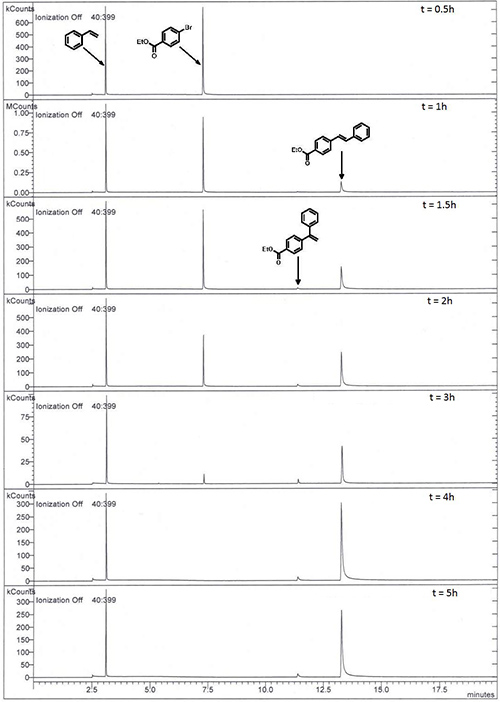
Figure 4. Gas chromatograms recorded from reaction mixtures of the Heck reaction of ethyl 4-bromobenzoate and styrene at 100 °C in DMF in the presence of ~10 mol% of tetrabutylammonium bromide and 0.05 mol% of catalyst, showing the time-dependent product formation. Note that the reaction time is slightly prolonged when compared to the data given in Table 1. This is due to periodical sampling. Click here to view larger image.
Accordingly, 1 is a cheap, easy accessible and green, stable and hence, convenient but highly reactive Heck catalyst with high functional group tolerance, which efficiently and reliably operates at low catalyst loadings (0.05 mol%) with an easy adaptable and robust reaction protocol.

Table 1. Heck cross-coupling products derived by reactions between aryl bromides and different olefins, catalyzed by 1. Reaction conditions: 1.0 mmol aryl bromide, 1.5 mmol olefin, 2.0 mmol K2CO3, 2.5 ml NMP, tetrabutylammonium bromide (10 mol%), catalyst (0.05 mol%) added in solution (THF), reaction performed at 100 °C under N2 atmosphere. The conversions and product ratios (trans/gem/cis) are determined by GC/MS and are based on aryl bromide. Isolated yields are given in brackets. [a] DMF was used as solvent. Click here to view larger image.
Palladium nanoparticles are the catalytically active form of 1 in the Heck reaction. Hence, increasing amounts of catalyst do not improve but can lower the catalyst’s performance due to formation of inactive palladium black.
Tetrabutylammonium bromide is known to stabilize nanoparticles and was (in contrast to the Heck reactions performed at 140 °C) found to be essential as additive for the reliable conversion of the substrates into the cross-coupling products with 1 at 100 °C35.
Best results were achieved with DMF when electronically activated or nonactivated aryl bromides were applied to give a2, a5, a6, a7, a13, a17, a18, b1, and h4, for example (Table 1). NMP, however, was found to be the solvent of choice when electronically deactivated and sterically hindered or heterocyclic aryl bromides were coupled with alkenes. Examples include the preparation of a9, a12, a14, c3, d3, d4,e2, e3, f2, f4, g3, g4, h5, and h6 (Table 1).
Discussion
Loading...
$$\rightleftharpoonup{xx}$$
$$\longleftharp{xx}$$,
$$\longrightharp{xx}$$,
Dichloro{bis[1,1',1''-(phosphinetriyl)tripiperidine]}palladium (1) is a very cheap and easy accessible, air stable and highly active Heck catalyst with an excellent functional group tolerance that efficiently operates under mild reaction conditions to give the coupling products cleanly in very high yields. The excellent catalytic activity (and general applicability) of 1 is due to the unique properties of aminophosphines: while the steric bulk as well as the σ-donor strength of aminophosphines is essentially the same when compared to their phosphine-based analogues, comparable levels of activity were found for complexes of type [(P{(NC5H10)3-n(C6H11)n})2Pd(Cl)2] (where n = 0-3; Figure 3) in cross-coupling reactions where molecular mechanisms are operative. On the other hand, the labile character of P-N bonds in aminophosphines (sensitivity towards protons; in form of water e.g.) offers the possibility to effectively control the formation of palladium nanoparticles: increasing numbers of P-N bonds in the ligands successively eases their water-induced degradation and consequently the formation of nanoparticles from the respective complexes. Accordingly, since palladium nanoparticles are the catalytically active form of 1 in the Heck reaction35, as indicated by sigmoidal-shaped kinetics36, 37 or the efficient inhibition of catalysis after addition of a large excess of metallic mercury to reaction mixtures of aryl bromide, olefin and catalyst, for example38, as well as their detection by analysis of reaction mixtures of exemplary Heck cross-coupling reactions by a transmission electron microscopy (TEM) equipped with an energy dispersive X-ray (EDX) analysator35, substitution of 1,1',1''-(phosphinetriyl)tripiperidine by 1,1'-(cyclohexylphosphinediyl)dipiperidine), 1-(dicyclohexylphosphinyl)piperidine) or tricyclohexylphosphine, which successively increases the complex stability and hence, retards the (water-induced) formation of nanoparticles thereof. As a consequence, while dichloro-bis(1-(dicyclohexylphosphinyl)piperidine)palladium, is the catalyst of choice in the Heck reaction performed at 140 °C, the highest catalytic activity was obtained for dichloro{bis[1,1',1''-(phosphinetriyl)tripiperidine]}palladium [(P(NC5H10)3)2Pd(Cl)2] (1) at 100 °C, the least stable complex within this series.

Figure 5. The effect of ligand composition of dichloro{bis(aminophosphine)}palladium with the general formula of [(P{(NC5H10)3-n(C6H11)n})2Pd(Cl)2] (where n = 0-2) on the complex stability and hence, on the ease of (water-induced) nanoparticle formation and hence, their catalytic performance under mild reaction conditions in the Heck cross-coupling reaction. Click here to view larger image.
Even though the above described syntheses as well as the Heck reaction protocols are straight forward, some of the common troubleshooting procedures are: (a) make sure that the tetrabutylammonium bromide is newly purchased or properly stored (tetrabutylammonium bromide is hygroscopic), (b) make sure that dry solvents are used for the ligand synthesis when small amounts of ligand were prepared, (c) make sure that 1 is either freshly prepared or stored under an inert atmosphere, (d) make sure that the NMP or DMF are newly purchased, (e) make sure that the chemicals are either newly purchased or properly stored, (f) oven-dry all glassware and cool under vacuum.
Disclosures
Loading...
$$\rightleftharpoonup{xx}$$
$$\longleftharp{xx}$$,
$$\longrightharp{xx}$$,
The authors have nothing to disclose.
Acknowledgements
Loading...
$$\rightleftharpoonup{xx}$$
$$\longleftharp{xx}$$,
$$\longrightharp{xx}$$,
Financial support by the Zürich University of Applied Sciences as well as the Swiss National Science Foundation (SNSF) is acknowledged.
Materials
| Name | Company | Catalog Number | Comments |
|---|---|---|---|
| Phosphorous trichloride | Sigma-Aldrich | 157791 | Reagent Plus, 99% |
| Piperidine | Sigma-Aldrich | 104094 | Reagent Plus, 99% |
| Dichloro(1,5-cyclooctadiene)palladium(II) | Sigma-Aldrich | 275891 | 99% |
| Styrene | Sigma-Aldrich | S4972 | Reagent Plus, contains 4-tert-butylcatechol as stabilizer, ≥99% |
| 1-Bromo-4-phenoxybenzene | Sigma-Aldrich | B65209 | 99% |
| Tetrabutylammonium bromide | Acros Organics | 185680025 | +99% |
| Potassium carbonate | Sigma-Aldrich | 347825 | Reagent grade, ≥98%, powder, -325 mesh |
| Silica gel | Merck | 107734 | Silica gel 60 (0.063-0.2 mm), for column chromatoraphy |
| Diethyl ether | Sigma-Aldrich | 673811 | Anhydrous, ACS reagent, ≥99.0%, contains BHT as inhibitor |
| Tetrahydrofuran (THF) | Sigma-Aldrich | 186562 | anhydrous, contains 250 ppm BHT as inhibitor, ≥99.9% |
| Pentane | Sigma-Aldrich | 158941 | reagent grade, 98% |
| N-Methyl-2-pyrrolidone (NMP) | Sigma-Aldrich | M79603 | Reagent Plus, 99% |
References
Loading...
$$\rightleftharpoonup{xx}$$
$$\longleftharp{xx}$$,
$$\longrightharp{xx}$$,
- Heck, R. F. Palladium Reagents in Organic Syntheses. Volume 2. Katritzky, A. R., Meth-Cohn, O., Rees, C. W. , Academic Press. London. (1985).
- Heck, R. F. Chapter 4.3, Vinyl Substitution with Organopalladium Intermediates. Comprehensive Organic Synthesis. Trost, B. M., Fleming, I. 4, Pergamon, Oxford. 833 (1991).
- Malleron, J. -L., Fiaud, J. -C., Legros, J. -Y. Handbook of Palladium-Catalysed Organic Reactions. , Academic Press. London. (1997).
- Reetz, M. T. Transition Metal Catalysed Reactions. Davies, S. G., Murahashi, S. I. , Blackwell, Oxford. (1999).
- Link, J. T., Overman, L. E. Chapter 6. Metal-Catalyzed Cross-Coupling Reactions. Diederich, F., Stang, P. J. , Wiley-VCH. New York. (1998).
- Bräse, S., de Meijere, A. Chapter 3.6. Metal-Catalyzed Cross-Coupling Reactions. Diederich, F., Stang, P. J. , Wiley. New York. (1998).
- Nicolaou, K. C., Sorensen, E. J. Chapter 31. Classics in Total Synthesis. , VCH. New York. (1996).
- de Vries, R. A., Vosejpka, P. C., Ash, M. L. Chapter 37. Catalysis of Organic Reactions. Herkes, F. E., Dekker, M. , New York. (1998).
- Tietze, L. F., Kettschau, G., Heuschert, U., Nordmann, G. Highly Efficient Synthesis of Linear Pyrrole Oligomers by Twofold Heck Reactions. Chem. Eur. J. 7, 368-373 (2001).
- Brase, S., et al. Chapters IV.1, IV2.1, IV.2.2, and IV.2.3. Handbook of Organopalladium Chemistry for Organic Synthesis. Negishi, E. , Wiley. New York. 1123-1315 (2002).
- Danishefsky, S. J., et al. Total Synthesis of Baccatin III and Taxol. J. Am. Chem. Soc. 118, 2843-2859 (1996).
- Higgs, G. Chem Ind. 827, (1997).
- Baumeister, P., et al. Heterogeneous catalysis and fine chemicals. Blaser, H. U., Baiker, A., Prins, R. , Elsevier Science Bv. Amsterdam, 37. (1997).
- Polyorganosiloxane-bridged bisbenzocyclobutene monomers. US patent. , US4812588 (1989).
- Amatore, C., Carre, E., Jutand, A. Evidence for the Ligation of Palladium(0) Complexes by Acetate Ions: Consequences on the Mechanism of Their Oxidative Addition with Phenyl Iodide and PhPd(OAc)(PPh3)2 as Intermediate in the Heck Reaction. Organometallics. 14, 5605-5614 (1995).
- Fauvarque, J. F., Pflüger, F., Troupel, M. Kinetics of oxidative addition of zerovalent palladium to aromatic iodides. J. Organomet. Chem. 208, 419-427 (1981).
- de Vries, G. J. A unifying mechanism for all high-temperature Heck reactions. The role of palladium colloids and anionic species. Dalton Trans. , 421-429 (2006).
- Ohff, M., Ohff, A., van der Boom, A. M. E., Milstein, D. Highly Active Pd(II) PCP-Type Catalysts for the Heck Reaction. J. Am. Chem. Soc. 119, 11687-11688 (1997).
- Morales-Morales, D., Redon, R., Yung, C., Jensen, C. M. High yield olefination of a wide scope of aryl chlorides catalyzed by the phosphinito palladium PCP pincer complex: PdCl{C6H3(OPPri2)2-2,6}]. Chem. Commun. , 1619-1620 (2000).
- Peris, E., Loch, J. A., Mata, J., Crabtree, R. H. A Pd complex of a tridentate pincer CNC bis-carbene ligand as a robust homogenous Heck catalyst. Chem. Commun. , 201-202 (2001).
- Herrmann, W. A., Böhm, V. P. W., Gstöttmayr, C. W. K., Grosche, M., Reisinger, C. -P., Weskamp, T. Synthesis, structure and catalytic application of palladium(II) complexes bearing N-heterocyclic carbenes and phosphines. J. Organomet. Chem. , 617-628 (2001).
- Benito-Garagorri, D., Bocokic, V., Mereiter, K., Kirchner, K. A Modular Approach to Achiral and Chiral Nickel(II), Palladium(II), and Platinum(II) PCP Pincer Complexes Based on Diaminobenzenes. Organometallics. 25, 3817-3823 (2006).
- Miyazaki, F., Yamaguchi, K., Shibasaki, M. The synthesis of a new palladacycle catalyst. Development of a high performance catalyst for Heck reactions. Tetrahedron Lett. 40, 7379-7383 (1999).
- Eberhard, M. R. Insights into the Heck Reaction with PCP Pincer Palladium(II) Complexes. Org. Lett. , 2125-2128 (2004).
- Bolliger, J. L., Blacque, O., Frech, C. M. Short, facile, and high-yielding synthesis of extremely efficient pincer-type Suzuki catalysts bearing aminophosphine substituents. Angew. Chem. Int. Ed. 46, 6514-6517 (2007).
- Bolliger, J. L., Frech, C. M. Rationally designed pincer-type Heck catalysts bearing aminophosphine substituents: PdIV intermediates and palladium nanoparticles. Chem. Eur. J. 14, 7969-7977 (2008).
- For a computational study about the thermal accessibility of PdII/PdIV cycles in the Heck reaction, catalyzed by pincer-type catalysts, see Blacque, O., Frech, C. M. Pincer-type Heck Catalysts and Mechanisms Based on PdIV Intermediates – A Computational Study. Chem. Eur. J. 16, 1521-1531 (2010).
- Vicente, J., Arcas, A., Julia-Hernandez, F., Bautista, D. For the synthesis and separation of the first pincer-type PdIV complex, see. Chem. Commun. 46, 7253-7255 (2010).
- Bolliger, J. L., Frech, C. M. Dichloro-Bis(aminophosphine) Complexes of Palladium - Highly Convenient, Reliable and Extremely Active Suzuki Catalysts with outstanding functional group tolerance. Chem. Eur. J. 16, 4075-4081 (2010).
- Bolliger, J. L., Frech, C. M. Dichloro{bis[1-(dicyclohexylphosphanyl)piperidine]}palladium - A Highly Effective and Extremely Versatile Palladium-based Negishi Catalyst, that Efficiently and Reliably Operates at Low Catalyst Loadings. Chem. Eur. J. 16, 11072-11081 (2010).
- Gerber, R., Oberholzer, M., Frech, C. M. Cyanation of aryl bromides with K4[Fe(CN)6] catalyzed by dichloro{bis[1-(dicyclohexyl-phosphanyl)-piperidine]}palladium – a molecular source of nanoparticles. Reactions involved in catalyst deactivation processes. Chem. Eur. J. 18, 2978-2986 (2012).
- Bolliger, J. L., Oberholzer, M., Frech, C. M. Access to 2-aminopyridines – compounds of great biological and chemical significance. Adv. Synth. Catal. 353, 945-954 (2011).
- Oberholzer, M., Gerber, R., Frech, C. M. Mizoroki-Heck reactions catalyzed by dichloro{bis[1-(dicyclohexylphosphanyl)piperidine]}palladium. Palladium nanoparticle formation promoted by (water induced) ligand degradation. Adv. Synth. Catal. 354, 627-641 (2012).
- Oberholzer, M., Frech, C. M. Mizoroki-Heck Reactions Catalyzed by Palladium Dichloro-bis(aminophosphine) Complexes Under Mild Reaction Conditions. The Importance of Ligand Composition on the Catalytic Activity. Green Chem. 15, 1678-1686 (2013).
- Watzky, M. A., Finke, R. G. Transition Metal Nanocluster Formation Kinetic and Mechanistic Studies. A New Mechanism When Hydrogen Is the Reductant: Slow, Continuous Nucleation and Fast Autocatalytic Surface Growth. J. Am. Chem. Soc. 119, 10382-10400 (1997).
- Widegren, J. A., Bennett, M. A., Finke, R. G. Is It Homogeneous or Heterogeneous Catalysis? Identification of Bulk Ruthenium Metal as the True Catalyst in Benzene Hydrogenations Starting with the Monometallic Precursor, Ru(II)(η6-C6Me6)(OAc)2, Plus Kinetic Characterization of the Heterogeneous Nucleation, Then Autocatalytic Surface-Growth Mechanism of Metal Film Formation. 125, 10301-10310 (2003).
- Widegren, J. A., Finke, R. G. A review of the problem of distinguishing true homogeneous catalysis from soluble or other metal-particle heterogeneous catalysis under reducing conditions. J. Mol. Catal. A. 198, 317-341 (2003).
Reprints and Permissions
Request permission to reuse the text or figures of this JoVE article
Request Permission