We present a simple and efficient protocol for the generation of human macrophages. Buffy coats are processed by double density gradient centrifugation and isolated monocytes are then differentiated to macrophages in Teflon-coated cell culture bags. This maximizes macrophage yields and facilitates cell harvesting for subsequent experiments.
Method Article
Isolation of Human Monocytes by Double Gradient Centrifugation and Their Differentiation to Macrophages in Teflon-coated Cell Culture Bags
In This Article
Summary
Abstract
Human macrophages are involved in a plethora of pathologic processes ranging from infectious diseases to cancer. Thus they pose a valuable tool to understand the underlying mechanisms of these diseases. We therefore present a straightforward protocol for the isolation of human monocytes from buffy coats, followed by a differentiation procedure which results in high macrophage yields. The technique relies mostly on commonly available lab equipment and thus provides a cost and time effective way to obtain large quantities of human macrophages. Briefly, buffy coats from healthy blood donors are subjected to a double density gradient centrifugation to harvest monocytes from the peripheral blood. These monocytes are then cultured in fluorinated ethylene propylene (FEP) Teflon-coated cell culture bags in the presence of macrophage colony-stimulating factor (M-CSF). The differentiated macrophages can be easily harvested and used for subsequent studies and functional assays. Important methods for quality control and validation of the isolation and differentiation steps will be highlighted within the protocol. In summary, the protocol described here enables scientists to routinely and reproducibly isolate human macrophages without the need for cost intensive tools. Furthermore, disease models can be studied in a syngeneic human system circumventing the use of murine macrophages.
Introduction
Cells from the monocytic lineage and their terminally differentiated derivative - macrophages - exhibit a striking plasticity in regard to their biological function, leading to their involvement in such diverse processes as development, tissue repair, and immunity1. The latter is due to their phagocytic and antigen-presenting ability which places macrophages at the crossroads between the innate and adaptive immune response2. However, their capability to secrete cytokines, chemokines, growth factors, and other signaling molecules1 not only augments their immune-modulatory function but also serves as a basis for their additional functions. Attempts to mirror these diverse activation steps in the context of non-microbial mediated conditions have resulted in the M1 and M2 categories3. While this classification is not complete, it allows for a basic understanding of macrophage biology.
Due to these multifaceted capabilities it comes as no surprise that macrophages are associated with many conditions that in some way involve tissue remodeling or inflammation. Next to their fundamental role in the recognition and clearance of invading pathogens4-6, macrophages have increasingly come into focus in atherosclerosis, fibrosis, obesity, and cancer7-10. A reproducible method for the generation of human macrophages is therefore crucial for an understanding of these pathologies. Here we present a method based on the isolation of human monocytes from the peripheral blood of healthy donors by a double density gradient centrifugation technique as described previously11. In order to facilitate differentiation towards macrophages, the isolated monocytic cells are incubated in the presence of low concentrations of M-CSF and normal human serum12. To ease further handling and cell harvest, differentiation is carried out in gas permeable FEP Teflon-coated cell culture bags with a hydrophobic surface12-15. The resulting resting macrophages can be subjected to a wide range of assays as they are still capable of responding in either an M1 or M2-like fashion. Alternative methods of monocyte isolation and subsequent differentiation such as magnetic activated cell sorting (MACS) or counterflow centrifugal elutriation (CCE) have some limitations regarding the yield, cost, and time required. The protocol described herein offers the advantage that it can be carried out with standard laboratory equipment without the need for special reagents (e.g., MACS magnetic beads) or devices (e.g., CCE apparatus) and allows for the processing of large quantities of cells.
Protocol
1. Preparation of Sterile Human AB Serum
- Collect 4-5 bags of fresh frozen plasma (FFP). Store bags at -20 °C until enough bags have been collected.
- Thaw bags and incubate for 30 min at 56 °C in a water bath to inactivate complement and remove fibrin.
- Thoroughly disinfect the outside of the bags and transfer the plasma to 50 ml tubes.
- Centrifuge at 3,000 x g for 15 min at room temperature to get rid of precipitates and residual platelets.
- Pool all supernatants and discard the pellets.
- Aliquot serum samples in 15 ml tubes and store at -20 °C.
NOTE: Alternatively, commercially available heat-inactivated normal human AB serum can be used.
2. Isolation of Monocytes
To facilitate balancing of the centrifuge, it is recommended to process two buffy coats in parallel. However, take care to use separate materials for each donor and not to mix the cells. In case buffy coats cannot be obtained easily, 400 ml of heparinized peripheral blood can be used instead.
- Carefully disinfect the plastic bags containing the buffy coats and transfer the contents of each buffy coat to two 50 ml tubes.
- For each buffy coat fill three 50 ml tubes with 15 ml Ficoll solution (1.077 g/ml). The Ficoll should be at room temperature for the preparation.
- Layer 30-35 ml of the buffy coat blood on top of the Ficoll solution for the first density gradient. Be careful to do this slowly and carefully in order to prevent mixing both layers.
- Centrifuge at 400 x g without brake for 30 min at room temperature.
- For each gradient collect the white ring of peripheral blood mononuclear cells (PBMCs) which is located between the two phases with a plastic Pasteur pipette and transfer to a 50 ml tube.
- Fill each tube with PBS-EDTA (1 mM) up to 40 ml in total.
- Centrifuge at 300 x g for 10 min without brake at room temperature.
- Aspirate supernatant and wash pellet again with 40 ml PBS-EDTA (1 mM).
- For each donor pool the pellets in 20 ml RPMI-1640 without phenol red + 10% FCS.
- Prepare the iso-osmotic Percoll solution for the second density gradient: For two donors mix 23.13 ml Percoll solution (density: 1.131 g/ml) in a 50 ml tube with 1.87 ml 10-fold PBS. Then transfer 23 ml of this solution to a new 50 ml tube and add 27 ml RPMI-1640 with phenol red + 10% FCS to obtain a 46% iso-osmotic Percoll solution. The Percoll should be at room temperature for the preparation.
- For each donor transfer 25 ml of the prepared Percoll solution to a 50 ml tube and layer the PBMC solution prepared in 2.9) on top of the Percoll solution. Be careful to do this very slowly and carefully, both layers tend to mix easily. If done correctly the two phases can be distinguished due to their difference in color.
- Centrifuge at 550 x g without brake for 30 min at room temperature.
- For each gradient collect the white ring of monocytes which is located between the two phases with a plastic Pasteur pipette and transfer to a 50 ml tube.
- Fill each tube with PBS-EDTA (1 mM) up to 50 ml in total.
- Centrifuge at 400 x g for 10 min without brake at room temperature.
- Aspirate the supernatant and resuspend the pellets in 20 ml RPMI-1640 with phenol red + 10% FCS.
3. Differentiation of Monocytes to Macrophages
- Determine the number of isolated monocytes in a 1:10 dilution in trypan blue. Only count the large, often irregular-shaped cells, which are monocytes. Do not count the smaller, round-shaped cells which are lymphocytes.
NOTE: Monocyte numbers do not have to be determined too accurately because they only give a hint about how many and which FEP Teflon-coated bags (small or large) have to be used for the differentiation of the cells. - For 1.0-1.5 x 10⁸ monocytes from one donor, seed the cells in a large FEP Teflon-coated cell culture bag. For each bag prepare the culture medium consisting of 174 ml RPMI-1640, 2% human AB serum (as prepared in Section 1), 1% penicillin/streptomycin, and 2.5 ng/ml M-CSF (total volume: 180 ml).
- For 3.0-5.0 x 10⁷ monocytes from one donor, seed the cells in a small Teflon-coated cell culture bag. For each bag prepare the culture medium consisting of 28.5 ml RPMI-1640, 2% human AB serum (as prepared in Section 1), 1% penicillin/streptomycin, and 2.5 ng/ml M-CSF (total volume: 30 ml).
NOTE: If e.g., 8.0 x 10⁷ monocytes are obtained, we recommend to seed them in two smaller volume bags with 4.0 x 10⁷ cells each. Instead of M-CSF, monocytes can alternatively be differentiated with granulocyte macrophage colony-stimulating factor (GM-CSF) at the same concentration (2.5 ng/ml).
- For 3.0-5.0 x 10⁷ monocytes from one donor, seed the cells in a small Teflon-coated cell culture bag. For each bag prepare the culture medium consisting of 28.5 ml RPMI-1640, 2% human AB serum (as prepared in Section 1), 1% penicillin/streptomycin, and 2.5 ng/ml M-CSF (total volume: 30 ml).
- Add the cell suspension (20 ml) to the prepared medium and mix carefully. If two bags are prepared from one donor, add 20 ml RPMI-1640 to the cell suspension and then add half of the suspension to each medium preparation.
- Optional: To determine if the monocyte preparation has remained sterile, tear one drop of the cell suspension on a blood agar plate and incubate over night at 37 °C.
- Tighten the sheath of a 50 ml perfusor syringe onto the plug of the FEP Teflon-coated cell culture bag and fill it with the prepared cell suspension.
- Unplug the syringe and push the remaining air out of the bag. Close the bag with a closing cone.
- Incubate the bags for 6-7 days at 37 °C with 5% CO2.
4. Macrophage Harvest
- Place the FEP Teflon-coated cell culture bags with the differentiated macrophages on ice for at least 1 hr to facilitate detachment of the cells (an incubation of up to 3 hr is possible). Make sure that the whole surface of the bag is covered with ice.
- Pull the bag with minimal pressure 10x over the edge of a desk/board.
- Carefully disinfect the outside of the bag and remove the closing cone.
- Tighten a 50 ml syringe on the plug of the bag, remove the cell suspension, and transfer it to 50 ml tubes.
- Centrifuge at 400 x g for 10 min at room temperature to spin down the cells.
- Aspirate the supernatant and pool the pellets from one bag in 10 ml RPMI-1640 + 10% FCS in total.
- Determine the cell number in a hemocytometer (1:4-1:10 dilution in trypan blue). Only count the large round cells.
NOTE: After differentiating the macrophages in the FEP Teflon-coated bags, there can be residual cells e.g., lymphocytes, depending on the donor and on the quality of the monocyte isolation. - To reuse the FEP Teflon-coated bags, wash them twice with 70% ethanol to remove residual cells. Fill them with 50 ml 70% ethanol and incubate overnight. Wash the bags 3x with sterile PBS, wrap them in sterilization paper, and sterilize in an autoclave using standard procedures.
NOTE: The cell culture bags can be reused several times without any loss in macrophage yields. However, we decided to discard the bags after 10 uses before they start to leak. - For subsequent experiments culture macrophages in RPMI-1640 + 10% FCS. If lower serum concentrations are required, cultivation in RPMI-1640 with 1% FCS is also possible. Seed and incubate cells for 3-4 hr. After this period, note that macrophages attach to the surface of the cell culture dish while any contaminating cells (i.e. erythrocytes, lymphocytes, and dendritic cells) stay in suspension. Wash cells at least twice with PBS to remove non-adherent cells.
- To detach cultured macrophages from the cell culture dish for further experiments, carefully scrape them off the surface. Alternatively, incubate dishes for 20 min on ice, aspirate the culture medium, and add 1 ml enzyme-free cell dissociation buffer. After 5 min incubation at 37 °C, add 4 ml PBS, and detach cells by pipetting up and down for at least 3 min.
Results
The first density gradient centrifugation using Ficoll yields a white interphase containing the PBMCs (Figure 1A) i.e. lymphocytes and monocytes. This can be confirmed through a May-Gruenwald staining (Figures 1B and C) of the collected cells which shows both a high nucleus/cytoplasm ratio (typical of lymphocytes) and bean- or ring-shaped nuclei (typical of monocytes). When these cells are then loaded onto a second density gradient using Percoll, the monocytes can be further separated from the lymphocytes and again appear as a white interphase (Figures 1D-F). For each buffy coat the described double density gradient centrifugation routinely yields 150 ± 40 x 106 monocytes which can be differentiated to 70 ± 30 x 106 macrophages (Figure 2) per buffy coat. The mean macrophage yield from 20 independent preparations was 47 ± 14% of total isolated monocytes.
After the Percoll gradient centrifugation there might still be some residual non-monocytic cells present in the preparation which is dependent on the blood donor as well as on the accuracy of the isolation process. However, after the differentiation phase of 6-7 days, the preparation mainly consists of mature macrophages (Figure 3) which can be further enriched due to their adherence to plastic surfaces, a feature that is not shared by the random contaminating cells (Figures 4A and B). Once plated, the majority of the macrophages show a classical “fried egg” morphology while there are also cells with a stretched spindle-like phenotype (Figures 4C and D). This is mirrored by their F-actin distribution within the cytoplasm and adhesion clusters. The differentiated cells are characterized by the expression of CD45, CD14, CD16, CD206 (mannose receptor), CD11b and CD11c which are typical markers for mature macrophages (Figure 5). The presence of CD11b argues against a predominantly dendritic differentiation which is supported by the fact that the cells are negative for the dendritic cell marker CD209 (DC-SIGN).
After the differentiation process the cells remain functionally and metabolically active for approximately 5-7 days (Figure 6) as it can be visualized by calcein AM staining and their ability to take up extracellular vesicles shed from tumor cells. Additionally, the cells can still be activated as shown e.g., for the stimulation with lipopolysaccharide (LPS) which results in the expression of several pro-inflammatory genes (Figure 7).

Figure 1. Appearance and composition of the PBMC- and monocyte-layer after double density gradient centrifugation. Photograph illustrating (A) the PBMC-band after the Ficoll gradient and (D) the monocyte-phase after the iso-osmotic Percoll centrifugation. May-Gruenwald stainings of cytospin preparations of the (B, C) PBMC fraction and the remaining (E, F) monocytes. Scale bar = 200 µm in B and E, = 50 µm in C and F.
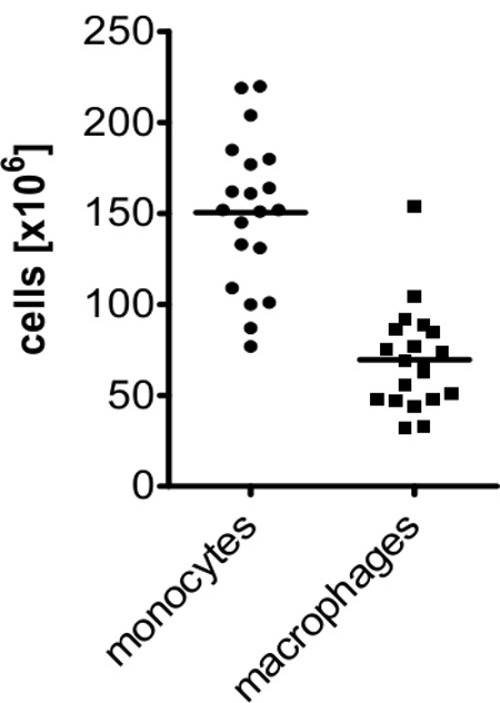
Figure 2. Yield of monocytes and macrophages. Representative cell countings of isolated monocytes and macrophages of 20 buffy coat preparations.
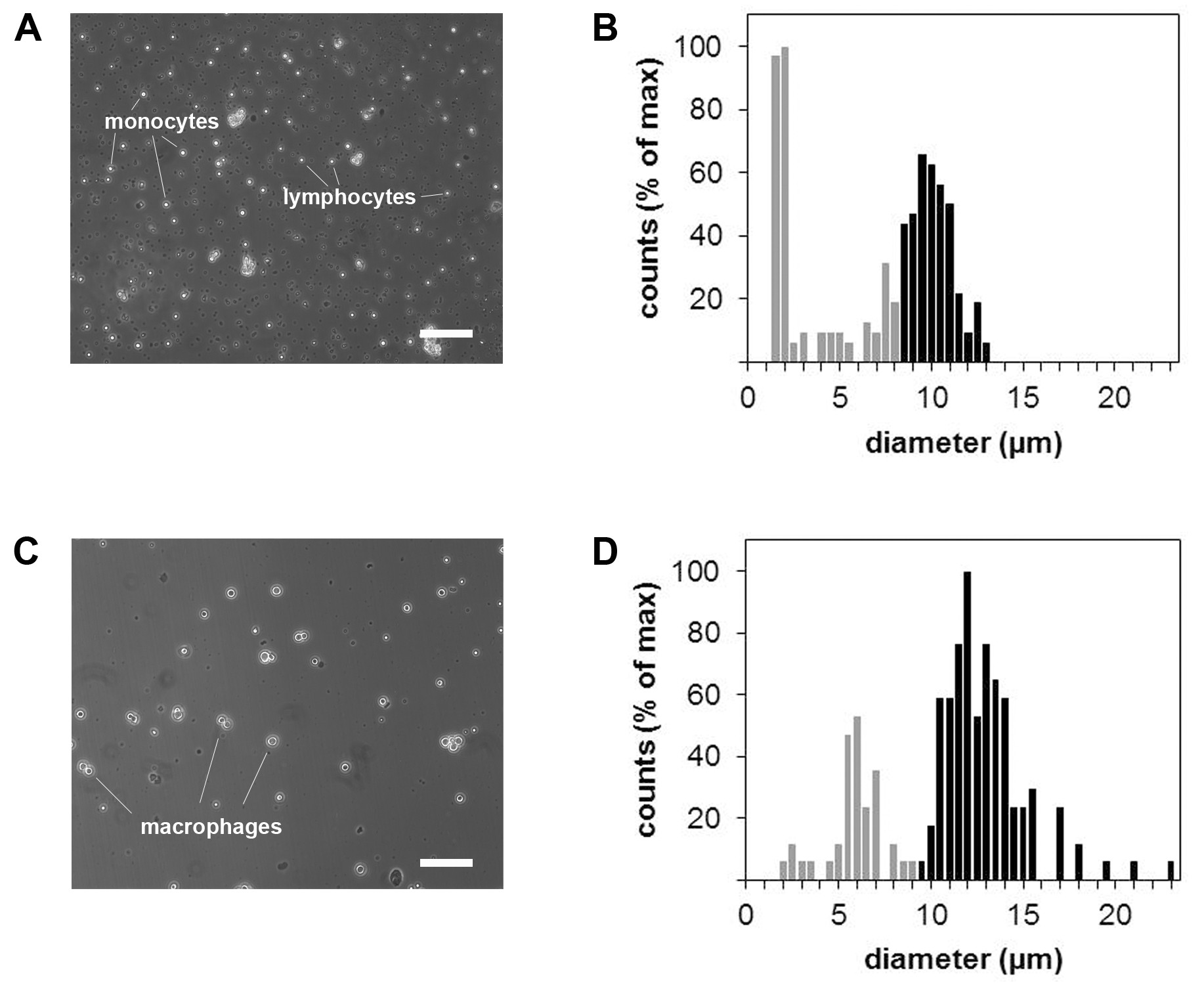
Figure 3. Micrographs and cell size measurements of monocytes and macrophages. Phase contrast microscopy of monocytic cell suspension before (A) and after (B) macrophage differentiation. Corresponding cell size histograms of monocytes (C) and macrophages (D). Scale bar = 100 µm.

Figure 4. Morphology and cytoskeletal organization of adherent macrophages. Phase contrast microscopy of adherent macrophages before (A) and after (B) removal of non-adherent cells. (C, D) Phalloidin-TRITC staining of filamentous actin in adherent, non-stimulated macrophages. Scale bar = 100 µm in A-C, 20 µm in D. Please click here to view a larger version of this figure.
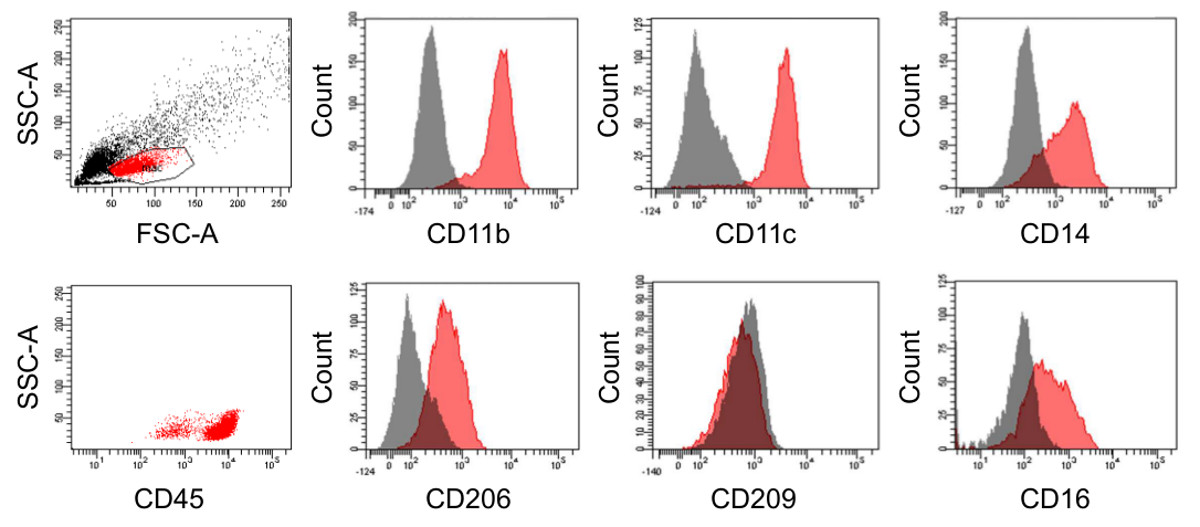
Figure 5. Immunophenotype of differentiated macrophages. Flow cytometry analysis of macrophages after 6 days of differentiation in FEP Teflon-coated cell culture bags (indicated in red). The corresponding isotype controls are shown in grey. Please click here to view a larger version of this figure.
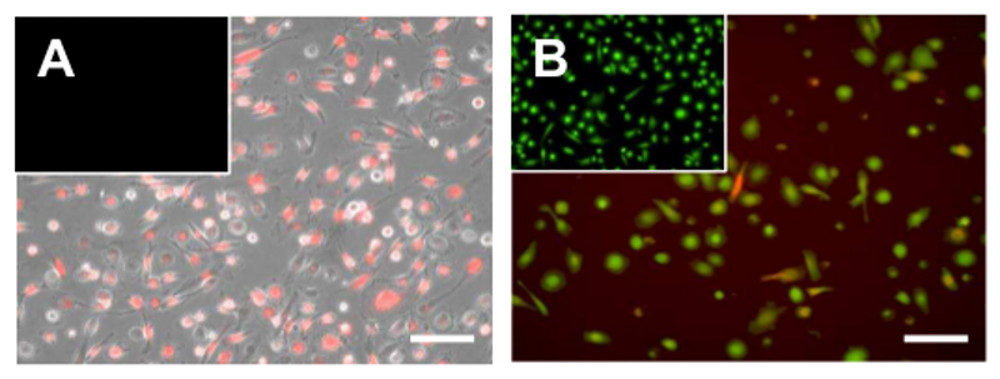
Figure 6. Uptake of tumor cell microvesicles by macrophages. Micrographs of adherent macrophages after exposition to PKH26-labeled (red fluorescent) tumor cell-derived microvesicles. Images are overlayed to the corresponding (A) brightfield or (B) cytosolic staining with the viability dye calcein AM. Scale bars = 100 µm. Please click here to view a larger version of this figure.

Figure 7. Upregulation of IL-1β, Wnt5a, TNFα, IL-6, MMP-2, MMP-7, and MT1-MMP after stimulation of macrophages with LPS (100 ng/ml) for 24 hr. Gene expression was measured by quantitative RT-PCR from total RNA samples (A) and normalized on HPRT1 and GNB2L1 expression. The values shown are fold changes in comparison to the untreated control (means ± SD, n=5, *p<0.05, **p<0.01, ***p<0.001). TNFα and IL-6 induction under LPS stimulation were further confirmed by ELISA (B) (means ± SD, *p<0.05).
Discussion
Macrophages are important effector cells of the innate immune system and display important functions in immunomodulation, antigen presentation and tissue homeostasis. Due to their remarkable plasticity, they are able to respond to different stimuli with changes of their phenotype. However, so far a lot of data regarding macrophage polarization are obtained in the murine system, although there are reports showing that only around 50% of macrophage polarization markers can be directly translated from mouse to human16. Therefore, we present here a method to obtain primary human macrophages in sufficient number and purity without the need for expensive materials, e.g., MACS magnetic beads or a counterflow centrifugal elutriation device.
Our method is based on the isolation of monocytes from PBMCs and their subsequent differentiation to macrophages in FEP Teflon-coated cell culture bags in the presence of low concentrations of M-CSF11-13. While monocytes make up less than 5 to 10% of peripheral blood leukocytes in humans, upon stimulation they are recruited to peripheral sites where they differentiate to resident tissue macrophages or dendritic cells17. The cytokine M-CSF is important for monocyte survival and drives their differentiation to macrophages18,19. So far, the M-CSF concentrations which were chosen for monocyte differentiation ranged up to 100 ng/ml, however, in our protocol we are able to obtain sufficient numbers of mature macrophages with a M-CSF concentration of only 2.5 ng/ml12,20. In addition, cells are cultured in FEP Teflon-coated cell culture bags which facilitate the detachment of the macrophages and their subsequent seeding in defined cell numbers. Since the bags can be reused several times, this further decreases the costs for the isolation process.
The macrophages obtained by this procedure are highly positive for CD45, CD14, CD11b, CD11c and show expression of the mannose receptor CD206 which argues for a population of pure, mature macrophages21,22. Especially high CD14 expression is typical for macrophages differentiated in the presence of M-CSF23. After seeding of the cells, they display a fast adherence to plastic surfaces with some cells showing a typical spindle-like morphology, while others exhibit a fried egg phenotype. This is in accordance with the observations from other authors18,22,24.
It was reported that monocyte differentiation in the presence of M-CSF leads to M2-polarized macrophages16,25. However, the macrophages isolated by our protocol are still able to respond to a wide range of stimuli including exposure to tumor cell-derived microvesicles and co-culture with tumor cells26,27 or exposure to LPS to which they react with induction of pro-inflammatory genes such as IL-1β, TNFα, Wnt5a, or various matrix metalloproteinases which are considered typical for M1-polarized macrophages3,5,28.
In conclusion, the isolation of monocytes by double density gradient centrifugation and subsequent differentiation towards macrophages in FEP Teflon-coated cell culture bags results in high numbers of macrophages without the need for technically difficult or expensive procedures. The obtained macrophages can be utilized for subsequent analysis ranging from classical activation through LPS to the co-culture with tumor cells.
Disclosures
The authors have nothing to disclose as no conflict of interests exists.
Acknowledgements
The authors would like to thank Mrs. Meike Schaffrinski for her always excellent technical assistance during the last few years.
This work was funded through the German Research Council (DFG) within the joint research group 942 (FOR942) and by the Research Program of the Faculty of Medicine, Georg-August-University Göttingen.
Materials
| Name | Company | Catalog Number | Comments |
|---|---|---|---|
| Antibodies for immunophenotyping | Beckman Coulter | for example: CD11c-PE (IM1760), CD45-FITC (7782), IgG1-PE isotype control (A07796), IgG1-FITC isotype control (A07795) | |
| BioLegends | for example: CD14-FITC (325603), CD206-PE (321105) | ||
| Axiovert 200M microscope | Zeiss | ||
| Calcein AM | AnaSpec | 89201 | |
| Combi-stopper closing cones | Braun | 4495101 | |
| 1x PBS, w/o Ca and Mg | Pan biotech | P04-36500 | for PBS-EDTA (1 mM) add 1 ml 0.5 M EDTA per 500 ml PBS |
| 10x PBS, w/o Ca and Mg | Invitrogen | 14200-067 | |
| EDTA (Titriplex III) | Merck | 1084211000 | prepare a 0.5 M solution in H2O, use a sterile filter |
| Cell dissociation buffer (enzyme-free, PBS-based) | Gibco | 13151-014 | |
| Fetal calf serum (FCS) | Invitrogen | 10091148 | heat-inactivated |
| Ficoll (density 1.077 g/ml) | Biochrom AG | L6115 | |
| FACSCanto II | BD Biosciences | ||
| Goat anti-mouse FITC | santa cruz | sc-2010 | |
| LPS from E.coli | Sigma | L8274 | final conc: 100 ng/ml |
| Multifuge 3 L-R | Heraeus | ||
| Penicillin/streptomycin | Biochrom AG | A2213 | |
| Percoll (density 1.131 g/ml) | GE Healthcare | 17-0891-02 | |
| Perfusor syringe 50 ml | Braun | 8728844F | |
| Phalloidin-TRITC | Sigma | P1951 | resuspend in methanol (c = 0.1 mg/ml) |
| [header] | |||
| Plastic disposable Pasteur pipettes | LVL technologies | 2655181 | |
| rh M-CSF | ImmunoTools | 11343117 | Resuspend in 500 µl sterile H2O (c = 100 ng/µl), aliquot |
| RPMI-1640 with phenol red | Gibco | 21875-034 | |
| RPMI-1640 without phenol red | Gibco | 11835-063 | |
| Sterilization paper | VP group | 3KFKFS230116 | |
| Trypan blue stain (0.4% w/v) | Sigma | T8154 | |
| FEP Teflon-coated cell culture bag, small | CellGenix | 72-C | |
| FEP Teflon-coated cell culture bag, large | CellGenix | 197-C |
References
- Wynn, T. A., Chawla, A., Pollard, J. W. Macrophage biology in development, homeostasis and disease. Nature. 496, 445-455 (2013).
- Iwasaki, A., Medzhitov, R. Regulation of Adaptive Immunity by the Innate Immune System. Science. 327, 291-295 (2010).
- Sica, A., Mantovani, A. Macrophage plasticity and polarization: in vivo veritas. J Clin Invest. 122, 787-795 (2012).
- Lionakis, M. S., et al. CX(3)CR1-dependent renal macrophage survival promotes Candida control and host survival. J Clin Invest. 123 (3), 5035-5051 (2013).
- Blumenthal, A., et al. The Wingless homolog, WNT5A and its receptor Frizzled-5 regulate inflammatory responses of human mononuclear cells induced by microbial stimulation. Blood. 108, 965-973 (2006).
- Lima, D. S., et al. Inflammasome-derived IL-1 beta production induces nitric oxide-mediated resistance to Leishmania. Nat Med. 19, 909-915 (2013).
- Pollard, J. W. Tumour-educated macrophages promote tumour progression and metastasis. Nat Rev Cancer. 4, 71-78 (2004).
- Subramanian, V., Ferrante, A. W. Jr Obesity, inflammation, and macrophages. Nestle Nutrition workshop series. Paediatric programme. 63, 151-159 (2009).
- Moore, K. J., Sheedy, F. J., Fisher, E. A. Macrophages in atherosclerosis: a dynamic balance. Nat Rev Immunol. 13, 709-721 (2013).
- Pradere, J. P., et al. Hepatic macrophages but not dendritic cells contribute to liver fibrosis by promoting the survival of activated hepatic stellate cells in mice. Hepatology. 58, 1461-1473 (2013).
- Danciger, J. S., et al. Method for large scale isolation, culture and cryopreservation of human monocytes suitable for chemotaxis, cellular adhesion assays, macrophage and dendritic cell differentiation. J Immunol Methods. 288, 123-134 (2004).
- Reiling, N., Blumenthal, A., Flad, H. D., Ernst, M., Ehlers, S. Mycobacteria-induced TNF-alpha and IL-10 formation by human macrophages is differentially regulated at the level of mitogen-activated protein kinase activity. J Immunol. 167, 3339-3345 (2001).
- Andreesen, R., Picht, J., Lohr, G. W. Primary Cultures of Human Blood-Borne Macrophages Grown on Hydrophobic Teflon Membranes. J Immunol Methods. 56, 295-304 (1983).
- van der Meer, J. W., et al. Culture of human bone marrow in the teflon culture bag: identification of the human monoblast. Journal of the Reticuloendothelial Society. 32, 355-369 (1982).
- van der Meer, J. W., et al. Characteristics of human monocytes cultured in the Teflon culture bag. Immunology. 47, 617-625 (1982).
- Martinez, F. O., Gordon, S., Locati, M., Mantovani, A. Transcriptional profiling of the human monocyte-to-macrophage differentiation and polarization: New molecules and patterns of gene expression. J Immunol. 177, 7303-7311 (2006).
- Gordon, S., Taylor, P. R. Monocyte and macrophage heterogeneity. Nat Rev Immunol. 5, 953-964 (2005).
- Hashimoto, S., Yamada, M., Motoyoshi, K., Akagawa, K. S. Enhancement of macrophage colony-stimulating factor-induced growth and differentiation of human monocytes by interleukin-10. Blood. 89, 315-321 (1997).
- Tushinski, R. J., et al. Survival of Mononuclear Phagocytes Depends on a Lineage-Specific Growth-Factor That the Differentiated Cells Selectively Destroy. Cell. 28, 71-81 (1982).
- Rietkotter, E., et al. Zoledronic acid inhibits macrophage/microglia-assisted breast cancer cell invasion. Oncotarget. 4, 1449-1460 (2013).
- Pilling, D., Fan, T., Huang, D., Kaul, B., Gomer, R. H. Identification of Markers that Distinguish Monocyte-Derived Fibrocytes from Monocytes, Macrophages, and Fibroblasts. Plos One. 4, E7475(2009).
- Rey-Giraud, F., Hafner, M., Ries, C. H. In vitro generation of monocyte-derived macrophages under serum-free conditions improves their tumor promoting functions. Plos One. 7, e42656(2012).
- Waldo, S. W., et al. Heterogeneity of human macrophages in culture and in atherosclerotic plaques. Am J Pathol. 172, 1112-1126 (2008).
- Chernykh, E. R., et al. The generation and properties of human M2-like macrophages: potential candidates for CNS repair? Cell Ther Transplant. 2, (2010).
- Verreck, F. A., et al. Human IL-23-producing type 1 macrophages promote but IL-10-producing type 2 macrophages subvert immunity to (myco)bacteria. Proceedings of the National Academy of Sciences of the United States of America. 101, 4560-4565 (2004).
- Pukrop, T., et al. Wnt 5a signaling is critical for macrophage-induced invasion of breast cancer cell lines. Proceedings of the National Academy of Sciences of the United States of America. 103, 5454-5459 (2006).
- Hagemann, T., et al. Macrophages induce invasiveness of epithelial cancer cells via NF-kappa B and JNK. J Immunol. 175, 1197-1205 (2005).
- Pereira, C., Schaer, D. J., Bachli, E. B., Kurrer, M. O., Schoedon, G. Wnt5A/CaMKII signaling contributes to the inflammatory response of macrophages and is a target for the antiinflammatory action of activated protein C and interleukin-10. Arterioscl Throm Vas. 28, 504-510 (2008).
Reprints and Permissions
