Understanding the role of environmental heterogeneity in species coexistence has typically focused on types of heterogeneity that are extrinsic to the community’s species composition. We provide novel detailed methods for creating soil heterogeneity treatments using soils subject to plant-soil feedback conditioning, or heterogeneity intrinsic to the community composition.
A subscription to JoVE is required to view this content. Sign in or start your free trial.
Method Article
Experimental Protocol for Manipulating Plant-induced Soil Heterogeneity
In This Article
Summary
Abstract
Coexistence theory has often treated environmental heterogeneity as being independent of the community composition; however biotic feedbacks such as plant-soil feedbacks (PSF) have large effects on plant performance, and create environmental heterogeneity that depends on the community composition. Understanding the importance of PSF for plant community assembly necessitates understanding of the role of heterogeneity in PSF, in addition to mean PSF effects. Here, we describe a protocol for manipulating plant-induced soil heterogeneity. Two example experiments are presented: (1) a field experiment with a 6-patch grid of soils to measure plant population responses and (2) a greenhouse experiment with 2-patch soils to measure individual plant responses. Soils can be collected from the zone of root influence (soils from the rhizosphere and directly adjacent to the rhizosphere) of plants in the field from conspecific and heterospecific plant species. Replicate collections are used to avoid pseudoreplicating soil samples. These soils are then placed into separate patches for heterogeneous treatments or mixed for a homogenized treatment. Care should be taken to ensure that heterogeneous and homogenized treatments experience the same degree of soil disturbance. Plants can then be placed in these soil treatments to determine the effect of plant-induced soil heterogeneity on plant performance. We demonstrate that plant-induced heterogeneity results in different outcomes than predicted by traditional coexistence models, perhaps because of the dynamic nature of these feedbacks. Theory that incorporates environmental heterogeneity influenced by the assembling community and additional empirical work is needed to determine when heterogeneity intrinsic to the assembling community will result in different assembly outcomes compared with heterogeneity extrinsic to the community composition.
Introduction
One of the primary goals of community ecology is to explain and predict the processes governing community assembly. However, plant communities are frequently more diverse than predicted by coexistence theory1, and restoration ecologists need to understand coexistence mechanisms to successfully restore diverse native communities2. Environmental heterogeneity is a theoretically important mechanism that can help explain high levels of community diversity, but experimental manipulations of heterogeneity are infrequent3 and focus on abiotic heterogeneity (e.g. reviewed in Lundholm4). Theory that incorporates heterogeneity typically assumes that heterogeneity is extrinsic to the assembling community. Extrinsic heterogeneity is governed by factors such as landscape typology, which are independent of the community composition. Extrinsic heterogeneity can result in coexistence through niche partitioning (reviewed in Melbourne et al.3, e.g. Pacala and Tilman5 and Chesson6). However, much of the environmental heterogeneity relevant to plant communities may be intrinsic to the community, developing as the community assembles and depending on the identity of the species in the community. Intrinsic heterogeneity can result from biotic feedbacks, which can lead to coexistence through negative frequency-dependence (e.g. Bever et al.7). Here, we describe a novel method for manipulating plant-induced soil heterogeneity, a type of soil heterogeneity that is intrinsic to the community and arises from plant-soil feedbacks.
Plant-soil feedbacks (PSF) occur when plants influence the soil structure, chemistry, or biota in a manner that affects subsequent plant performance in that soil, and PSF have large mean effects on plant performance in native plant communities8. Studies of PSF have typically either collected soils from the field or conditioned soils experimentally, then asked how plants perform in conspecific soil relative to heterospecific or sterilized soil9. If plants perform better in conspecific soil relative to reference soils, then PSF are positive, while if plants perform better in reference soils, PSF are negative. Reciprocal negative PSF can lead to frequency-dependent coexistence between species7. While the mean effects of PSF are well-characterized8, the effects of spatial heterogeneity in PSF are poorly understood10.
Because PSF occur on the scale of individual plants7 and because plants are often nonrandomly distributed in space and time, PSF are likely to lead to soil heterogeneity, which we call plant-induced soil heterogeneity. Unlike many other forms of heterogeneity (e.g. landscape topology), this heterogeneity is intrinsic to the assembling community and may thus influence community assembly differently than more extrinsic forms of heterogeneity. In order to understand the influence of this form of heterogeneity on plant performance and coexistence, we need experimental methods that manipulate plant-induced soil heterogeneity. Here, we demonstrate such a method, which uses soils conditioned by two species to create a heterogeneous treatment with separate patches from two soil origins and a homogeneous treatment, which is a mixture of the two soil origins. This soil mixing could represent at least two plausible scenarios in the field: (1) disturbance (e.g. rodent, agriculture) which mixes soils of different origins or (2) plants of two species growing in close proximity, such that their zones of root influence intermingle and homogenize.
We present two example experiments that use plant-induced soil heterogeneity to answer key questions at different levels of ecological organization: (1) Do plant populations respond to plant-induced soil heterogeneity? and (2) Do individual plants respond to plant-induced soil heterogeneity? We describe a field experiment using 6 soil patches to address the first question and a greenhouse experiment using 2 soil patches to address the second question. Quantifying both population and individual plant responses to soil heterogeneity is essential to understanding how heterogeneity influences community assembly.
Access restricted. Please log in or start a trial to view this content.
Protocol
1. Collect Field Soils to Produce Heterogeneous and Homogeneous Soil Treatments
- Identify two cooccurring plant species in similar habitats and soil types for study (e.g. Figure 1a). Determine amount of soil needed based on soil patch size to use in the experiment (e.g. one-third to one-half of the focal species' primary root zone, or volume encompassed by the root ball) and the number of patches needed for the experiment (see Protocol 2 and 3, below).
- For Rumex spp. (Figure 1a), use soil patches of 10 cm x 10 cm x 18 cm (length x width x depth) for approximate root zone of 10 cm radius from base of plant to 18 cm depth (5,655 cm3 soil from this defined zone of root influence for one individual plant yields 3 soil patches of 1,800 cm3).
- Survey field site to locate adult individuals of the two focal species. Avoid individuals whose root zone likely overlaps with the other focal species (e.g. Rumex individuals located within 0.25 m of the other species). Mark the number of individuals needed to obtain the required amount of soil with pin flags.
- Mark 20 randomly chosen individuals of each Rumex spp. for 20 experimental units (2 species x 2 soil treatments x 5 replicates) that each require 3 soil patches from each focal species (as in Protocol 2, below).
- Sterilize soil collecting equipment (shovels, gloves, transporting containers) with an approximately 1:10 mixture of bleach (5-10% NaClO) and water to remove all soil particles. Dry equipment before use to avoid bleach effects on soil biota. Label each piece of equipment with laboratory tape to indicate the focal species whose soil it will collect or transport to avoid cross-contamination (e.g. label one shovel for species A and a second shovel for species B).
- Check weather and soil conditions before beginning soil collection for recent precipitation events. Avoid collecting soils that are too wet (muddy or fully saturated) or collecting soil during a precipitation event to minimize soil compaction. Avoid collecting soils that are too dry (very hard and difficult to insert a shovel into) to aid in separating soil from roots.
- Collect field soil from marked individuals of the two focal species in replicate batches to avoid pseudoreplication (e.g. a single soil sample containing a rare pathogen being subsequently mixed across experimental replicates).
- Dig up the complete root zone of an individual of species A (as defined in step 1.1) with the appropriately-labeled sterile shovel, remove visible coarse roots from the soil with the appropriately-labeled sterile gloves, and place soil in the appropriately-labeled sterile transport container (e.g. bucket). For an experiment with 4 experimental units in each block and 1 individual plant's root zone providing enough soil for 1 experimental unit (as in Section 1.2.1), repeat this procedure for 3 additional individuals of species A.
- Repeat Section 1.5.1 for species B.
- Transport the replicate soil collection from both species to the experimental site. Place soil in experimental units for block 1 of the experiment (as in Protocol 2 or 3, below), where a block contains an experimental unit from each treatment combination (i.e. each species x each soil treatment).
- Repeat Section 1.5.3.
- Repeat Sections 1.5.1-1.5.4 for the remaining blocks in the experiment. Collect soil from groups of individuals at least 1 m distant from previous collecting locations for each replicate collection to minimize pseudoreplication.

Figure 1. Example field experimental design manipulating plant-induced soil heterogeneity. (a) Soils are collected from the zone of root influence of conspecifics (α) and heterospecifics (β) in the field, following standard protocols for studying the effects of plant-soil feedbacks9. (b) Experimental treatments with heterogeneous soils composed of soils from plant A (α soils) and soils from plant B ('β' soils) are arranged in a grid, and homogenized soil treatments created with an equal mixture of soils from these two origins. In this example, grids of field soils are inserted into large-diameter pots sunken into the ground and the area around each grid is filled with coarse, sterilized sand. This figure has been modified from Brandt et al.10
2. An Example Field Experiment, Creating Grids of Heterogeneous and Homogeneous Soil to Measure Plant Population Responses
- Use soils from a replicate field soil collection (Protocol 1) to produce a heterogeneous treatment (i.e. alternating grid cells contain soil collected from species A or species B) and a homogeneous treatment (i.e. each grid cell contains a 1:1 mixture of soil from species A and B) (Figure 1b) for block 1 of the experiment in the following steps.
- Sterilize soil handling equipment (trowels, gloves, plastic grid) with an approximately 1:10 mixture of bleach (5-10% NaClO) and water to remove all soil particles. Dry equipment before use to avoid bleach effects on soil biota. Label each piece of equipment with laboratory tape to indicate the focal species whose soil it will handle to avoid cross-contamination (e.g. label one trowel for species A and a second trowel for species B) and the plastic grid to indicate whether it will be used for the heterogeneous or homogeneous soil treatment.
- Place removable plastic grid into a pot sunken into the ground [or other plot or container large enough to accommodate the grid] to be filled with field collected soil (e.g. 1,800 cm3/grid cell as in step 1.1.1). Use a custom-constructed grid of the desired dimensions, e.g. a 2 x 3 grid with 6 cells of the size determined in step 1.1 (Figure 1b).
- For the heterogeneous treatment of alternating soil patch types, place spadefuls of soil from species A into grid cells for α soil and soils from species B into cells for β soil (Figure 1b).
- For the homogeneous treatment, place alternating spadefuls of soils a and b into each grid cell, taking care to evenly distribute the two soil types and avoid the formation of layers of each soil type (Figure 1b). For the example soil patch of 1,800 cm3 (Section 1.1.1), place 900 cm3 of each soil type in each grid cell.
- Be sure to produce equal amounts of disturbance (i.e. break up soil clods to the same degree) when creating heterogeneous and homogeneous soil treatments to avoid confounding soil disturbance with soil heterogeneity.
- If any empty area remains around the outside of the grid within the large pot used (as in Figure 1b), fill this area with sterile sand. Sterilize sand using any standard method (e.g. autoclaving, gamma-irradiation).
- Lift the plastic grid vertically out of the pot, leaving the soil patches intact. This allows roots from different individuals to interact in the soil and each plant to experience multiple patches, which is essential for allowing plant roots to grow into multiple soil patches (i.e. grid cells).
- Repeat Sections 2.1.2-2.1.4 for a second pair of experimental units to produce a complete experimental block (i.e. a grid of heterogeneous soil into which to plant each focal species and a grid of homogeneous soil into which to plant each focal species, for a total of 4 experimental units).
- Repeat step 2.1 for remaining blocks in the experiment with the remaining soil replicate collections (Protocol 1). Randomize blocks, and plots within blocks, throughout the experimental area, using landscape fabric around the plots if desired, to keep shading from outside vegetation at a minimum (not shown).
- Plant seeds of focal species into each grid cell of each experimental pot (2 focal species x 2 soil treatments). Use pooled seed to avoid confounding plant genotypes or seed-surface microbial communities with the soil treatments. For example, plant seeds of each Rumex spp. into the pot for that species (Figure 1a) individually glued to plastic toothpicks with water-soluble glue in 12 planting positions (2 positions per grid cell) to clearly identify the planted individuals.
- Measure population responses of the experimental units, such as germination and survival, through a regular census of individual marked planting locations of seeds (e.g. using toothpicks as in step 2.3). Minimize disturbance of the soil for any response measured to avoid mixing soil among patches.
- Determine the appropriate census intervals based on the expected rate of population responses for the focal species. For example, conduct weekly censuses for Rumex spp. that can germinate quickly.
- Continue the experiment for an appropriate duration based on the life history of the focal species. For example, continue the experiment for at least 2 years for short-lived perennial Rumex spp. to obtain data on all life stages.
3. An Example Greenhouse Experiment, with Heterogeneous and Homogenized Soil in Pots to Measure Individual Plant Responses
- Use soils from a replicate field soil collection (Protocol 1) to produce a heterogeneous treatment (i.e. each half of a pot filled with soil collected from species A or species B) and a homogeneous treatment (i.e. pot contains a 1:1 mixture of soil from species A and B) (Figure 2a) for block 1 of the experiment in the following steps.
- In the transport container (e.g. bucket) and before potting, mix the field collected soil from each species with sterile sand to produce a 1:1 mixture. Do this to mitigate soil compaction and improve drainage in the pots, which is especially helpful for washing roots, facilitating the separation of roots from soil. Sterilize sand using any standard method (e.g. autoclaving, gamma-irradiation).
- Be sure to produce equal amounts of disturbance (i.e. break up soil clods to the same degree) when mixing each batch of field soil with sand.
- Sterilize soil handling equipment (trowels, gloves, plastic sheet) with an approximately 1:10 mixture of bleach (5-10% NaClO) and water to remove all soil particles. Dry equipment before use to avoid bleach effects on soil biota. Label each piece of equipment with laboratory tape to indicate the focal species whose soil it will handle to avoid cross-contamination (e.g. label one trowel for species A and a second trowel for species B) and each side of a stiff plastic sheet to indicate which soil type will be potted on each side of it in the heterogeneous soil treatment.
- Create a heterogeneous soil treatment using the field soil-sand mixtures from the two focal species (from Section 3.1.1).
- Place the stiff plastic sheet in the center of a pot to divide it in half (Figure 2a). Use a pot sized such that half of it is equivalent in volume to the appropriate soil patch size (step 1.1). For example, use a pot with a 15 cm diameter and 18 cm depth for the Rumex spp. in Figure 1a (total volume of 3,181 cm3).
- Have two researchers simultaneously add the field collected soil from each species to the appropriate side of the pot (e.g. α soil from species A) with appropriately-labeled trowels, to keep the sides even as the pot is filled.
- Remove the plastic divider by lifting it vertically out of the soil, leaving the soil patches intact. This allows the plants to experience both patches of soil within a pot, essential for the plants to experience heterogeneity.
- Repeat Sections 3.3.1-3.3.3 for 3 additional experimental units to produce a complete block of the heterogeneous soil treatment (2 species x 2 soil patch types in the heterogeneous treatment; Figure 2).
- Create a homogeneous soil treatment using the field soil-sand mixtures from the two focal species (from Section 3.1.1).
- Repeat Section 3.3.1. Have two researchers simultaneously add both α and β soils to both sides of the pot with appropriately-labeled trowels, evenly distributing both soil types within each patch and avoiding the creation of layers. Repeat Section 3.3.3.
- Repeat Section 3.4.1 for a second experimental unit to produce a complete block of the homogeneous soil treatment (one pot for each of the 2 focal species).
- Repeat steps 3.2-3.4 for remaining blocks in the experiment with the remaining soil replicate collections (Protocol 1). Randomize blocks, and plots within blocks, across the greenhouse bench.
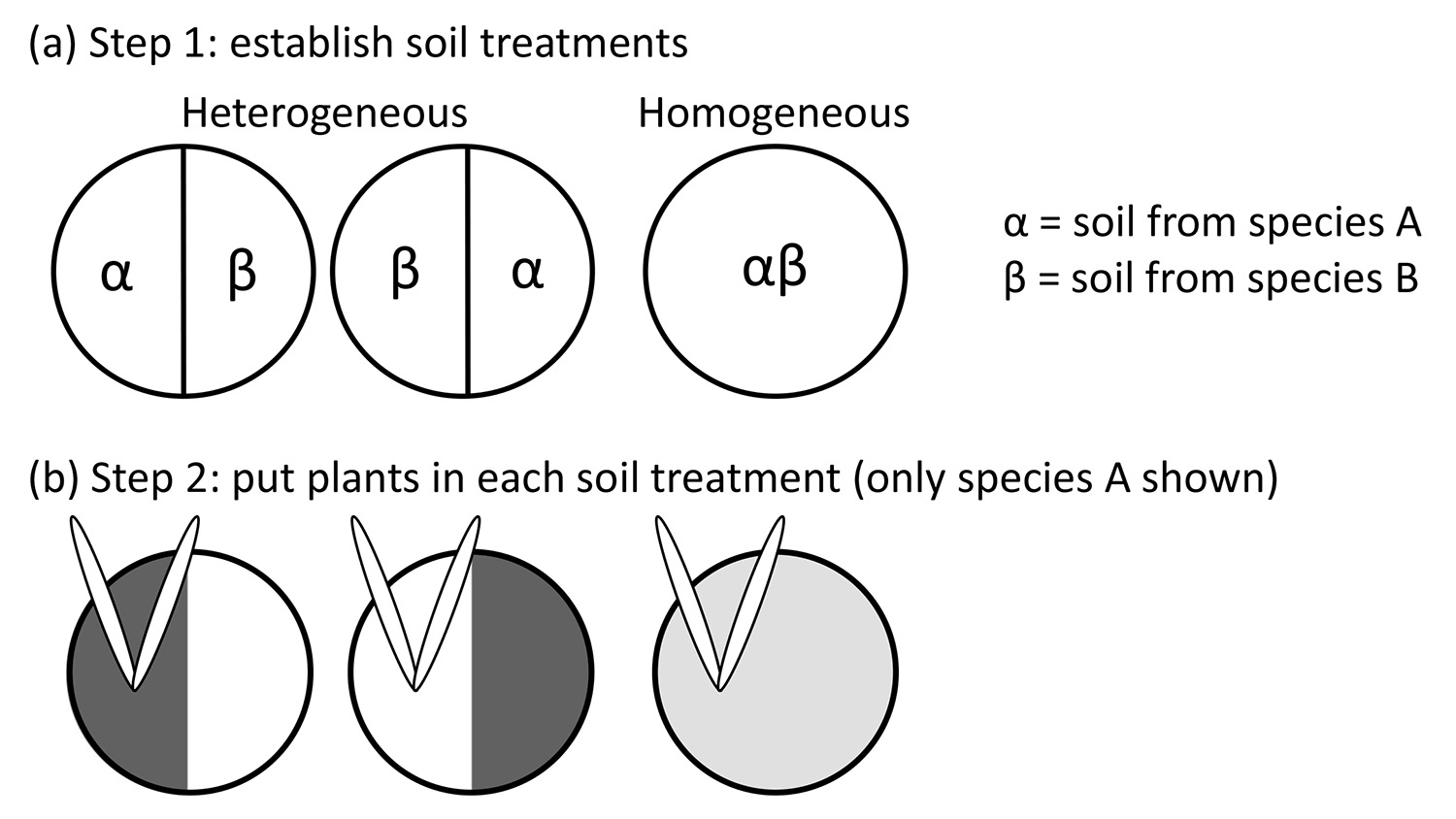
Figure 2. Example greenhouse experimental design manipulating plant-induced soil heterogeneity. (a) Soils collected from the zone of root influence of species A (α soils) and species B (β soils) in the field are placed in each half of a pot (heterogeneous treatment) or mixed throughout the pot (homogeneous treatment). (b) Plants of species A are then planted into the experiment in each soil patch type in the heterogeneous treatment and on one side of the homogeneous treatment. Here, only one species (A) is shown planted into this design. A fully reciprocal design would include plants of the second focal species (B) planted into each soil treatment and patch type within the heterogeneous treatment.
- Plant seedlings of focal species A and B into each soil patch type in a factorial design (2 species x 3 soil patch types [α soil, β soil, and a homogeneous mixture of α and β soil]; Figure 2b).
- Measure any individual plant responses that indicate plant performance, such as plant size, biomass production, or functional traits. Appropriate traits to measure will depend on the focal species and the scientific questions of interest.
- Continue the experiment until the plants appear large relative to soil patches (e.g. approximately 1.5x the width of the soil patch for rosette-forming forbs) to ensure the plant roots are growing into both soil patches. Experimental duration will thus depend on the growth rate of focal species.
- Harvest plants and/or measure responses before plants become pot-bound (i.e. root growth is limited by the confines of the pot and roots circle the bottom of the pot) if realistic responses to the soil environment are desired. For example, roots of pot-bound plants are unlikely to forage throughout the soil column in a similar manner to plants in the field.
Access restricted. Please log in or start a trial to view this content.
Results
Species responded to plant-induced soil heterogeneity in diverse ways at both the population and individual level (Figures 3 and 4), with implications for community assembly. To determine whether plant populations respond to plant-induced soil heterogeneity, a field experiment was established as in Protocol 2 using three congeneric pairs of species. Plant populations were censused weekly for three months and the total proportion of planted seeds that germinated and the total proportion o...
Access restricted. Please log in or start a trial to view this content.
Discussion
Plant-induced soil heterogeneity is highly likely in natural communities because plants have large and often species-specific effects on their soil environment and the subsequent plants that experience that soil (e.g. Petermann et al.13). However, our understanding of the role of this type of heterogeneity on plant communities is minimal10,14. Here, we present a method for manipulating plant-induced soil heterogeneity, using soil from different origins (i.e. zones of root ...
Access restricted. Please log in or start a trial to view this content.
Disclosures
The authors have nothing to disclose.
Acknowledgements
We thank Case Western Reserve University’s Squire Valleevue and Valley Ridge Farms, including A. Locci, C. Bond, and A. Alldridge, for help establishing the common garden. J. Hooks, L. Huffman, L. Gonzales, S. C. Leahy, B. Ochocki, A. Ubiles, C. Yu, X. Zhao, and N. M. Zimmerman provided field assistance. A.J.B. and J.H.B. were funded by startup funds from CWRU to J.H.B. G.A.D. was supported by a Summer Programs in Undergraduate Research grant from CWRU funded by the Howard Hughes Medical Institute. This work was also supported by National Science Foundation funding to J.H.B. (DEB 1250170).
Access restricted. Please log in or start a trial to view this content.
Materials
| Name | Company | Catalog Number | Comments |
|---|---|---|---|
| Shovel(s) | Any | NA | It is helpful to have at least two shovels, one for each species of soil origin. |
| Trowel(s) | Any | NA | It is necessary to have at least two trowels of identical size, one for each species of soil origin. |
| Gloves | Any | NA | Gardening gloves can be used. |
| Diluted bleach | Any | NA | We use an ~1:10 concentration of household bleach (containing 5-10% NaClO) to water to sterilize all equipment between soil collections. |
| Plastic grid(s) | Any | NA | CUSTOM. We used plastic sheeting from the construction of greenhouse walls to create the grid used in the field experiment. However any stiff plastic that can be manipulated can be used. It is helpful to have three grids to produce reciprocal heterogeneous treatments and a homogeneous treatment without needing to sterilize between each experimental unit. |
| Plastic dividers | Any | NA | CUSTOM. We used stiff sheets of plastic, cut to fit the pot minimum width, such that they can slide down to the bottom of the pot for the greenhouse experiment. It is helpful to have at least two dividers, one for heterogeneous and one for homogeneous treatments, if investigators want to randomize the order in which experimental units within a block are filled without needing to sterilize the divider in between each experimental unit. |
| Buckets or wheelbarrows | Any | NA | Any container for transporting soils. |
| Seeds | Any | NA | We collect seeds in the field by hand. Seeds can also be ordered from horticultural suppliers, if appropriate. |
| Plastic toothpicks | Soodhalter Plastics, Inc. | 805KP | We plant individual seeds glued on toothpick in the field experiment to facilitate monitoring germination and survival of individuals. |
| Water soluble glue | Elmer's | Elmer's Glue-all | Any water soluble glue can be used to adhere seeds to plastic toothpicks. |
| Pots | Any | NA | Pot size will depend on experimental plants used and number of soil patches desired (e.g. 2 or 6). |
| Sand | Any | NA | Coarse sand may be mixed with field soils to improve drainage in pots. |
| Lab tape | Any | NA | Tape may be used to label equipment used in handling soils with the species of origin. |
| Pin flags | Any | NA | Flags can be used to identify individuals in the field prior to soil collection. |
| Landscape fabric | Any | NA | Landscape fabric can be used in the field to minimize the growth of plants outside experimental plots. |
References
- Agrawal, A. A., et al. Filling key gaps in population and community ecology. Front. Ecol. Environ. 5, 145-152 (2007).
- Suding, K. N. Toward an era of restoration in ecology: successes, failures, and opportunities ahead. Ann. Rev. Ecol. Evol. System. 42, 465-487 (2011).
- Melbourne, B. A., et al. Invasion in a heterogeneous world: resistance, coexistence or hostile takeover. Ecol. Lett. 10, 77-94 (2007).
- Lundholm, J. T. Plant species diversity and environmental heterogeneity: spatial scale and competing hypotheses. J. Veg. Sci. 20, 377-391 (2009).
- Pacala, S. W., Tilman, D. Limiting similarity in mechanistic and spatial models of plant competition in heterogeneous environments. Am. Natural. 143, 222-257 (1994).
- Chesson, P. General theory of competitive coexistence in spatially-varying environments. Theor. Pop. Biol. 58, 211-237 (2000).
- Bever, J. D., Westover, K. M., Antonovics, J. Incorporating the soil community into plant population dynamics: the utility of the feedback approach. J. Ecol. 85, 561-573 (1997).
- Kulmatiski, A., Beard, K. H., Stevens, J. R., Cobbold, S. M. Plant-soil feedbacks: a meta-analytical review. Ecol. Lett. 11, 980-992 (2008).
- Bever, J. D., et al. Rooting theories of plant community ecology in microbial interactions. Trends. Ecol. Evol. 25, 468-478 (2010).
- Brandt, A. J., de Kroon, H., Reynolds, H. L., Burns, J. H. Soil heterogeneity generated by plant-soil feedbacks has implications for species recruitment and coexistence. J. Ecol. 101, 277-286 (2013).
- R: A language and environment for statistical computing. , Foundation for Statistical Computing. Vienna, Austria. (2012).
- Crawley, M. J. The R Book. , John Wiley & Sons, Ltd. (2007).
- Petermann, J. S., Fergus, A. J. F., Turnbull, L. A., Schmid, B. Janzen-Connell effects are widespread and strong enough to maintain diversity in grasslands. Ecology. 89, 2399-2406 (2008).
- Reynolds, H. L., Haubensak, K. A. Soil fertility, heterogeneity, and microbes: towards an integrated understanding of grassland structure and dynamics. Appl. Veg. Sci. 12, 33-44 (2009).
- Sokal, R. R., Rohlf, F. J. Biometry, 3rd edn. , W. H. Freeman. (1995).
- Klironomos, J. N. Feedback with soil biota contributes to plant rarity and invasiveness in communities. Nature. 417, 67-70 (2002).
- Mommer, L., van Ruijven, J., Jansen, C., van de Steeg, H. M., de Kroon, H. Interactive effects of nutrient heterogeneity and competition: implications for root foraging theory? Funct. Ecol. 26, 66-73 (2012).
- Felsenstein, J. Phylogenies and the comparative method. Am. Natural. 125, 1-15 (1985).
- Burns, J. H., Strauss, S. Y. More closely related species are more ecologically similar in an experimental test. Proc. Natl. Acad. Sci. U.S.A. 108, 5302-5307 (2011).
- Fukami, T., Nakajima, M. Community assembly: alternative stable states or alternative transient states. Ecol. Lett. 14, 973-984 (2011).
Access restricted. Please log in or start a trial to view this content.
Reprints and Permissions
