The goal of this protocol is to use electron paramagnetic resonance (EPR) monitored redox titrations to identify different cofactors of Saccharomyces cerevisiae Nar1. Redox titrations offer a very robust way to obtain midpoint potentials of different redox active cofactors in enzymes and proteins.
Method Article
EPR Monitored Redox Titration of the Cofactors of Saccharomyces cerevisiae Nar1
Opens in a new tab
In This Article
Summary
Loading...
$$\rightleftharpoonup{xx}$$
$$\longleftharp{xx}$$,
$$\longrightharp{xx}$$,
Abstract
Loading...
$$\rightleftharpoonup{xx}$$
$$\longleftharp{xx}$$,
$$\longrightharp{xx}$$,
Electron Paramagnetic Resonance (EPR) monitored redox titrations are a powerful method to determine the midpoint potential of cofactors in proteins and to identify and quantify the cofactors in their detectable redox state.
The technique is complementary to direct electrochemistry (voltammetry) approaches, as it does not offer information on electron transfer rates, but does establish the identity and redox state of the cofactors in the protein under study. The technique is widely applicable to any protein containing an electron paramagnetic resonance (EPR) detectable cofactor.
A typical titration requires 2 ml protein with a cofactor concentration in the range of 1-100 µM. The protein is titrated with a chemical reductant (sodium dithionite) or oxidant (potassium ferricyanide) in order to poise the sample at a certain potential. A platinum wire and a Ag/AgCl reference electrode are connected to a voltmeter to measure the potential of the protein solution. A set of 13 different redox mediators is used to equilibrate between the redox cofactors of the protein and the electrodes. Samples are drawn at different potentials and the Electron Paramagnetic Resonance spectra, characteristic for the different redox cofactors in the protein, are measured. The plot of the signal intensity versus the sample potential is analyzed using the Nernst equation in order to determine the midpoint potential of the cofactor.
Introduction
Loading...
$$\rightleftharpoonup{xx}$$
$$\longleftharp{xx}$$,
$$\longrightharp{xx}$$,
It is striking that the most fundamental chemical processes sustaining life on this planet, photosynthesis, nitrogen fixation and respiration, are catalyzed by large protein complexes containing a wide range of organic and inorganic redox cofactors. It has been estimated that approximately 30% of all proteins contain one or more metal cofactors.1,2 Identifying and characterizing the redox cofactors can be established using direct electrochemistry (e.g., protein film voltammetry) or redox titrations. The two techniques are complementary in their nature and applicability. Voltammetry offers fast determination of midpoint potentials and electron transfer kinetics of cofactors that can react with an electrode surface.3,4 Usually this works well for electron transfer proteins, such as cytochrome c or ferredoxin. And it sometimes works for more complex proteins that have been immobilized to an electrode surface. Detailed knowledge of the nature of cofactors in the protein has to be available, as the voltammogram will not give any direct information on the identity of the cofactor. Redox titrations are more laborious to execute and require mg quantities of protein. However, they offer information on the midpoint potential and the identity of the cofactor.5 Furthermore in a single titration multiple cofactors in a protein can be monitored.
The principle of a redox titration is that the redox active protein or enzyme is chemically reduced or oxidized. In order to make sure that the cofactors react with the reductant or oxidant redox mediators are used. These redox mediators also react with an electrode so that the potential of the solution can be measured. The mediators act as a redox buffer and equilibrate between the cofactors in the protein and the electrode. After chemically poising the potential to the desired value, a sample is drawn and quickly frozen in liquid nitrogen to await further analysis with spectroscopic techniques. EPR spectroscopy is particularly useful in this respect as it can be used to quantitatively measure paramagnetic metal centers or organic radicals.
The redox titration can be performed in two directions: from low to high or from high to low midpoint potential. The choice is dependent on the stability of the cofactors under study. Often it is wise to start at low potential and add oxidant to stepwise increase the potential. This is called an oxidative titration and is described here. Here we show the redox titration of the iron-sulfur cluster containing protein Nar1 from Saccharomyces cerevisiae. This protein is involved, likely as a scaffold protein, in the cytosolic iron-sulfur cluster biosynthetic machinery (CIA pathway).6,7
Access restricted. Please log in or start a trial to view this content.
Protocol
Loading...
$$\rightleftharpoonup{xx}$$
$$\longleftharp{xx}$$,
$$\longrightharp{xx}$$,
1. Preparation of Setup and Solutions
- Prepare buffer solution containing 100 mM Tris, 250 mM NaCl and 10% glycerol at pH 8.5. Deaerate the buffer by flushing with argon. Introduce the buffer into an anaerobic chamber.
- Divide the buffer in two portions. To one portion (buffer A) add 1 mM DL-dithiothreitol (DTT, Mr 154.25 g/mol) and 1 mM L-cysteine. The other portion (buffer B) does not contain reducing agents.
- Prepare oxidant and reductant solutions. Make 1 ml solutions of 2, 20, and 200 mM potassium ferricyanide (FIC, Mr 329.26 g/mol) and of sodium dithionite (SD, Mr 174.11 g/mol) in anaerobic buffer B.
- Prepare mediator mix as follows:
- Add 160 µM of each of the following redox mediators and 50 mM NaCl to buffer B: N,N,N’,N’-tetramethyl-p-phenylendediamine (TMPD, Mr 237.17 g/mol, E’0 +0.276 V), 2,6-dichlorophenol indophenol (DCIP, Mr 290.08 g/mol, E’0 +0.217 V), phenazine ethosulphate (PES, Mr 334.4 g/mol, E’0 +0.055 V), Methylene blue (Mr 319.85 g/mol, E’0 +0.011 V), Resorufin (Mr 235.17 g/mol, E’0 -0.051 V), Indigodisulphonate (Mr 466.35 g/mol, E’0 -0.125 V), 2-hydroxy-1,4-naphtaquinone (Mr 174.15 g/mol, E’0 -0.145 V), Anthraquinone-2-sulfonate (Mr 328.28 g/mol, E’0 -0.225 V), Phenosafranin (Mr 322.8 g/mol, E’0 -0.252 V), Safranin O (Mr 350.84 g/mol, E’0 -0.280 V), neutral red (Mr 288.8 g/mol, E’0 -0.340 V), Benzyl viologen (Mr 409.4 g/mol, E’0 -0.350 V), and Methyl viologen (Mr 257.16 g/mol, E’0 -0.440 V).
- Wrap the bottle in aluminum foil to protect the mediators from light.
- Prepare 10 mg/ml S. cerevisiae strep-tagged Nar1 protein (181 µM, Mr 55.2 kDa) in buffer A. Express S. cerevisiae Nar1 in E. coli as a strep-tagged protein using a pET24A expression vector. Purify the protein in an anaerobic chamber using Strep-tactin chromatography media (IBA) and purify using a protein purification system such as Akta purifier (GE Healthcare).
- Prepare the redox titration setup in an anaerobic chamber as follows:
- Connect a Ag/AgCl reference electrode and a platinum wire electrode to the titration vessel. Connect both electrodes to a voltmeter that can measure from mV up to V.
- Insert a small stirring bar.
- Place the titration vessel above a magnetic stirrer.
- Fill the titration vessel with Buffer B, mediator mix solution and protein solution to up to 2 ml, i.e. to final concentrations of 72 µM protein and 38 µM of each mediator. Note: depending on the protein concentration and the required mediator concentrations the amounts of the three solutions should be adjusted.
- Stir for 30 min and switch on the voltmeter.
- Prepare 10 clean quartz glass EPR tubes. Introduce the tubes in the anaerobic chamber.
- Fill a small (circa 200 ml) liquid nitrogen dewar with liquid nitrogen.
2. Perform Redox Titration
- Wait until the potential of the solution is stable. Note: In practice this means that the potential drifts less than 1 mV per minute.
- Note down the potential given by the voltmeter.
- Draw the first sample of 200 µl and inject into an EPR tube.
- Cap the tube with a rubber stopper and remove the tube from the anaerobic chamber.
- Freeze the tube in liquid nitrogen as follows: Caution! This has to be done slowly, otherwise the tube will break.
- First insert the tip of the tube in the liquid nitrogen.
- Wait until a hissing sound can be heard. Note: This may take up to 10 sec.
- Slowly insert the rest of the tube so that the sample part is fully submerged.
- Add a small aliquot 1-2 µl of the 2 mM SD solution to the solution in the titration vessel to lower the potential of the solution to -0.6 V.
Note: If more than 10 µl has to be added, switch to the 20 mM solution. As it is very difficult to poise to a specific potential value, the actual values recorded on the voltmeter are written down and used to construct the titration curve. - Draw a sample as described in step 2.3-2.5.
- Note down the actual potential given by the voltmeter.
- Add oxidant until the potential has increased by circa 50 mV. Start by adding a small aliquot 1-2 µl of the 2 mM FIC solution. If more than 10 µl has to be added, switch to the 20 mM solution.
- Note down how much of the solutions has been added. Note: This is necessary to correct for sample dilution during the titration.
- Draw a sample as described in the steps 2.3-2.5.
- Note down the actual potential given by the voltmeter.
- Repeat steps 2.9 and 2.12 until the potential range from -0.6 V to +0.2 V has been covered and all 10 EPR tubes are filled each with 200 µl.
Note: As the volume with every withdrawal is reduced the positioning of the electrodes may need to be adjusted have good contact with the solution without interference of the stirring. It may be difficult to measure the potential after withdrawal of the last sample and therefore the potential of that sample may be less accurate. - Optionally, store the frozen EPR samples in liquid nitrogen until the EPR measurements can take place.
3. Measure Titration Samples Using EPR Spectroscopy and Data Analysis
- Record EPR spectra of the different titration samples as follows:
- Use a high-vacuum pump to evacuate a quartz cryostat to <10-5 bar.
- Switch on the water cooling of the EPR magnet. Open the flow of dry air through the EPR cavity.
- Switch on the power supply to the magnet and the computer of the EPR.
- Run a frequency calibration program. Set the EPR measurement parameters. Connect the cryostat to the liquid helium dewar. Cool the cavity to 9-16 K.
- Introduce the EPR sample in the cavity. Record the EPR spectrum.
- Identify the different EPR species and use the best spectra to quantify the signals. Achieve EPR quantification by double integration of the spectra and comparison with the spectrum of an external copper standard solution 10 mM CuSO4/10 mM HCl/2 M NaClO4.8
- Make the titration curve as follows:
- Plot the EPR signal amplitude at a g-value that is characteristic for the paramagnetic species of interest against the potential.
- Change the EPR signal amplitude scale to a spins/molecule scale by using the EPR quantification from step 3.2.
- Correct the signal amplitude of each sample for the dilution that has occurred due to the additions of oxidizing or reducing agent.
- Correct the potential for the midpoint potential of the Ag/AgCl reference electrode.
Note: The Ag/AgCl reference electrode (with saturated KCl) has a midpoint potential of +0.194 V versus the Standard Hydrogen Electrode (SHE) at 25 °C. Therefore, if the potential on the voltmeter reads circa -0.6 V, the potential with reference to the SHE is -0.4 V.
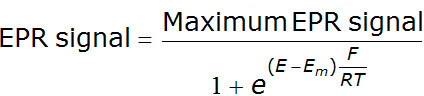
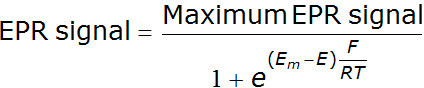
- Fit the signal to the Nernst equation as follows:
For a species that is paramagnetic in the reduced state:
For a species that is paramagnetic in the oxidized state:
For a species that is paramagnetic in an intermediate state:

These equations are valid for redox reactions in which one electron is transferred, so n = 1.
E = potential in Volt
Em = midpoint potential in Volt
F = Faraday constant = 96,480 C·mol-1
R = Gas constant = 8.314 J·K-1·mol-1
T = Temperature in Kelvin
Access restricted. Please log in or start a trial to view this content.
Results
Loading...
$$\rightleftharpoonup{xx}$$
$$\longleftharp{xx}$$,
$$\longrightharp{xx}$$,
The redox titration of the iron-sulfur cluster containing protein Nar1 from Saccharomyces cerevisiae resulted in the identification of three different cofactors: Nar1: a [3Fe-4S] cluster, a [4Fe-4S] cluster and a mononuclear Fe center (Figure 1). The EPR signals are characterized by their g-values: for the [3Fe-4S]+ gz 2.01, gcrossover 2.00 (Figure 1B); for the [4Fe-4S]+, gz 2.02 gy 1.93, gx 1.82 (
Access restricted. Please log in or start a trial to view this content.
Discussion
Loading...
$$\rightleftharpoonup{xx}$$
$$\longleftharp{xx}$$,
$$\longrightharp{xx}$$,
The series of 13 redox mediators allows a redox equilibrium in the solution in the range from -0.45 to +0.3 V versus SHE (Table 1 and Figure 3). Well above and below these potentials all mediators are either completely reduced or completely oxidized and hence no further equilibration with the redox active centers of the protein can occur. This is an important notion, as in literature sometimes redox titrations are performed with only two or three mediators, allowing only a narrow range t...
Access restricted. Please log in or start a trial to view this content.
Disclosures
Loading...
$$\rightleftharpoonup{xx}$$
$$\longleftharp{xx}$$,
$$\longrightharp{xx}$$,
The authors have nothing to disclose.
Acknowledgements
Loading...
$$\rightleftharpoonup{xx}$$
$$\longleftharp{xx}$$,
$$\longrightharp{xx}$$,
This work was financially supported by a research grant from the Dutch National Research School Combination, Catalysis Controlled by Chemical Design (NRSC-Catalysis). Dr. H.Y. Steensma and Dr. G.P.H. van Heusden from Leiden University are acknowledged for their support with the recombinant expression of S. cerevisiae Nar1.
Access restricted. Please log in or start a trial to view this content.
Materials
| Name | Company | Catalog Number | Comments |
|---|---|---|---|
| Reference electrode (Ag/AgCl) | Radiometer | ||
| Chemicals | Sigma-Aldrich | ||
| EPR spectrometer | Bruker | ||
| N,N,N’,N’-tetramethyl-p-phenylendediamine (TMPD) · (HCl)2 | 637-01-4 | ||
| 2,6-dichlorophenol indophenol (DCIP), sodium salt | 620-45-1 | ||
| Phenazine ethosulfate (PES) | 10510-77-7 | ||
| Methylene blue | 122965-43-9 | ||
| Resorufin, sodium salt | 34994-50-8 | ||
| Indigodisulfonate (indigo carmine) | 860-22-0 | ||
| 2-hydroxy-1,4-naphtaquinone | 83-72-7 | ||
| Anthraquinone-2-sulfonate Na+ H2O | 153277-35-1 | ||
| Phenosafranin | 81-93-6 | ||
| Safranin O | 477-73-6 | ||
| Neutral red | 553-24-2 | ||
| Benzyl viologen | 1102-19-8 | ||
| Methyl viologen | 1910-42-5 |
References
Loading...
$$\rightleftharpoonup{xx}$$
$$\longleftharp{xx}$$,
$$\longrightharp{xx}$$,
- Lippard, S. J., Berg, J. M. Principles of Bioinorganic Chemistry. , University Science Books. (1994).
- Bertini, I. Bioinorganic Chemistry. , University Science Books. 611(1994).
- Leger, C., et al. Enzyme Electrokinetics: Using Protein Film Voltammetry To Investigate Redox Enzymes and Their Mechanisms. Biochemistry. 42, 8653-8662 (2003).
- Hagen, W. R. Direct Electron Transfer of Redox Proteins at the Bare Glassy Carbon Electrode. Eur. J. Biochem. 182, 523-530 (1989).
- Pierik, A. J., et al. Redox Properties of the Iron-Sulfur Clusters in Activated Fe-Hydrogenase from Desulfovibrio vulgaris (Hildenborough). Eur. J. Biochem. 209, 63-72 (1992).
- Balk, J., Pierik, A. J., Netz, D. J., Muhlenhoff, U., Lill, R. The Hydrogenase-like Nar1p is Essential for Maturation of Cytosolic and Nuclear Iron-Sulphur Proteins. EMBO J. 23, 2105-2115 (2004).
- Sharma, A. K., Pallesen, L. J., Spang, R. J., Walden, W. E. Cytosolic Iron-Sulfur Cluster Assembly (CIA) System: Factors, Mechanism, and Relevance to Cellular Iron Regulation. J. Biol. Chem. 285, 26745-26751 (2010).
- Aasa, R., Vänngård, T. EPR Signal Intensity and Powder Shapes. A Reexamination. J. Magn. Reson. 19, 308-315 (1975).
- Balk, J., Pierik, A. J. A., Netz,, J, D., Mühlenhoff, U., Lill, R. Nar1p, a conserved eukaryotic protein with similarity to Fe-only hydrogenases, functions in cytosolic iron-sulphur protein biogenesis. Biochem. Soc. Trans. 33, 86-89 (2005).
- Hennessy, D. J., Reid, G. R., Smith, F. E., Thompson, S. L. Ferene - a new spectrophotometric reagent for iron. Can. J. Chem. 62, 721-724 (1984).
- Flint, D. H., Emptage, M. H., Guest, J. R. Fumarase A from Escherichia coli: purification and characterization as an iron-sulfur cluster containing enzyme. Biochemistry. 31, 10331-10337 (1992).
- Hagedoorn, P. L., Driessen, M. C., Mvd Bosch,, Landa, I., Hagen, W. R. Hyperthermophilic Redox Chemistry: a Re-evaluation. FEBS Lett. 440, 311-314 (1998).
- Tadesse, M. A., D'Annibale, A., Galli, C., Gentili, P., Sergi, F. An assessment of the relative contributions of redox and steric issues to laccase specificity towards putative substrates. Organic & biomolecular chemistry. 6, 868-878 (2008).
Access restricted. Please log in or start a trial to view this content.
Reprints and Permissions
Request permission to reuse the text or figures of this JoVE article
Request Permission