We have devised a method for low-cost and rapid prototyping of liquid elastomer rubber injection molded devices by using fused deposition modeling 3D printers for mold design and a modified desiccator as a liquid injection system.
A subscription to JoVE is required to view this content. Sign in or start your free trial.
Method Article
Rapid and Low-cost Prototyping of Medical Devices Using 3D Printed Molds for Liquid Injection Molding
In This Article
Summary
Abstract
Biologically inert elastomers such as silicone are favorable materials for medical device fabrication, but forming and curing these elastomers using traditional liquid injection molding processes can be an expensive process due to tooling and equipment costs. As a result, it has traditionally been impractical to use liquid injection molding for low-cost, rapid prototyping applications. We have devised a method for rapid and low-cost production of liquid elastomer injection molded devices that utilizes fused deposition modeling 3D printers for mold design and a modified desiccator as an injection system. Low costs and rapid turnaround time in this technique lower the barrier to iteratively designing and prototyping complex elastomer devices. Furthermore, CAD models developed in this process can be later adapted for metal mold tooling design, enabling an easy transition to a traditional injection molding process. We have used this technique to manufacture intravaginal probes involving complex geometries, as well as overmolding over metal parts, using tools commonly available within an academic research laboratory. However, this technique can be easily adapted to create liquid injection molded devices for many other applications.
Introduction
Liquid injection molding (LIM) (also known as reaction injection molding) is often used to manufacture elastomeric devices from thermosetting elastomers, but high tooling and equipment costs require a great deal of up-front capital investment1. Furthermore, LIM can be technically challenging and expensive to implement in cases with complex geometry and requirements for overmolding. As a result, it is typically impractical to use traditional LIM in ultra-low volumes or with early-stage device designs that often incur iterative revisions.
The typical procedure for injection molding elastomeric materials involves injecting liquid mo....
Access restricted. Please log in or start a trial to view this content.
Protocol
This protocol describes the use of specific terminology and features in the SolidWorks software used for Mold Design and Production steps, though other software packages may also be used to accomplish the same result.
1. Mold Design and Production
- Design a to-scale mold master using computer-aided design (CAD) software. Specific procedures in mold master design will vary depending on the specific geometry of the desired elastomer device. This and subsequent steps will illustrate key steps that result in a specific mold master and mold design that roughly resembles the intravaginal probe device depicted in the representative resu....
Access restricted. Please log in or start a trial to view this content.
Results
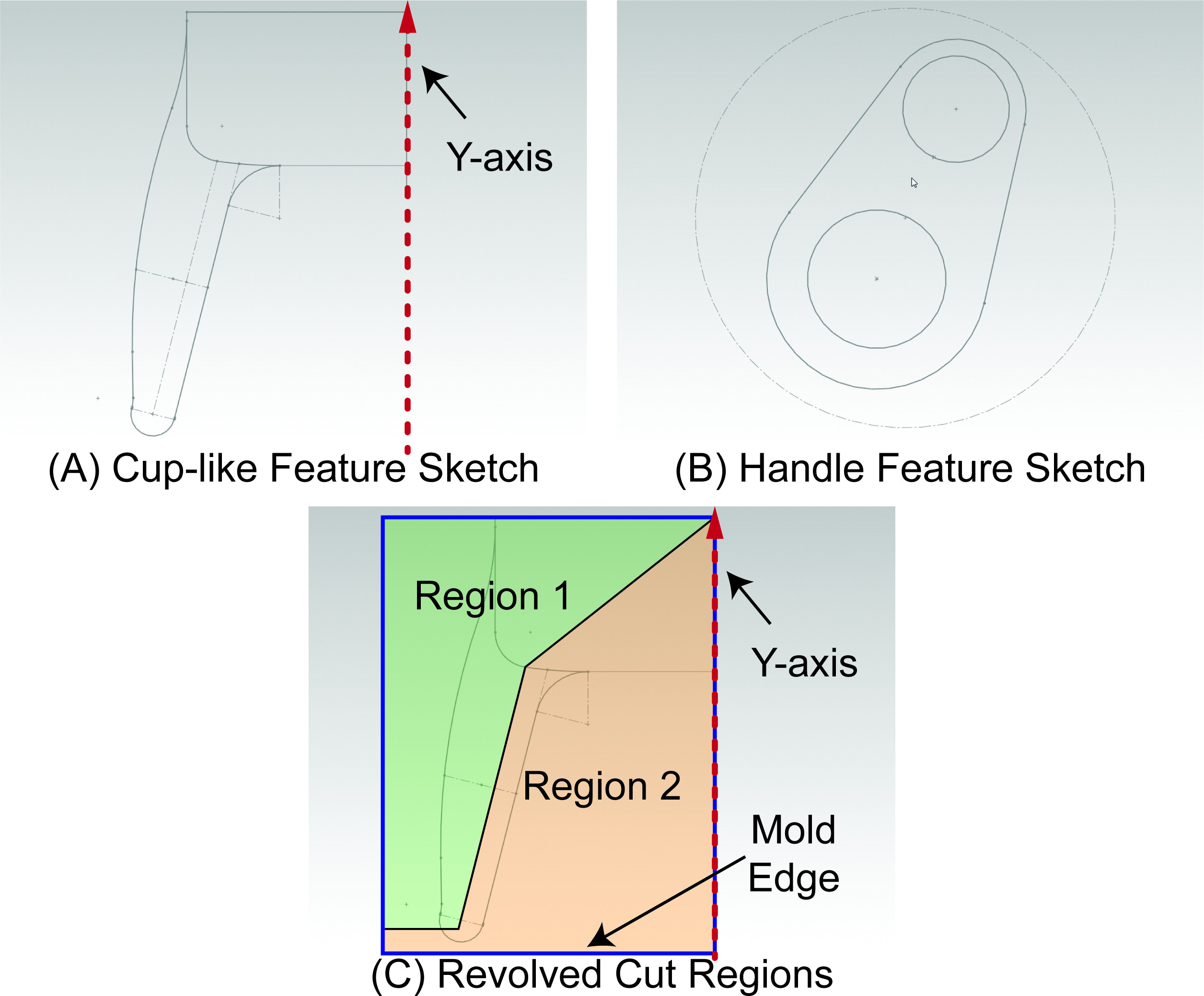
Figure 2. 2D CAD Sketches. A) 2D Sketch that can be radially revolved about the Y-axis to produce a cup-like feature similar to the one on the intravaginal probe device. B) Teardrop-shaped 2D sket.......
Access restricted. Please log in or start a trial to view this content.
Discussion
Of all the steps described, careful mold design is the most critical to success. The mold master should be created as a solid body with external geometries equal to the final device. These geometries should be adjusted to account for any material shrinkage due to the chosen elastomer as well as 3D printer resolution and tolerances. Placement of mold parting lines and through-holes for threaded rods and screws are dependent on one another. Adding parting lines increases the number of linear and rotational degrees of freed.......
Access restricted. Please log in or start a trial to view this content.
Disclosures
None of the authors have any competing financial interests with respect to the work detailed in this article.
Acknowledgements
The authors thank Sungwon Lim for intellectual contributions to device and mold design as well as Jambu Jambulingam and Rebecca Grossman-Kahn for creating intravaginal silicone probes using this process. This work is supported by the Bill and Melinda Gates Foundation, the Vodafone Americas Foundation, and the FDA (2P50FD003793).
....Access restricted. Please log in or start a trial to view this content.
Materials
| Name | Company | Catalog Number | Comments |
|---|---|---|---|
| ABS Model Material | Stratasys | P430 | Model Material for uPrint Plus SE (Step: Mold Design & Production) |
| Soluble Support Material | Stratasys | SR-30 | Support Material for uPrint Plus SE (Step: Mold Design & Production) |
| Underwater Silicone Sealant, 2.8 Oz Tube, Clear | McMaster-Carr Supply Company | 7327A21 | Silicone RTV for sealing gaps at mold parting lines (Step: Mold Assembly) |
| Tubing, 1/8" ID, 1/4" OD, 1/16" Wall Thickness, Ultra-chemical-resistant Tygon PVC, Clear | McMaster-Carr Supply Company | 5046K11 | Forms runner/sprue adapter between mold and syringe with elastomer (Step: Elastomer Mixing) |
| Coupling, Adapter, Straight, Male Quick-turn (Luer lock) X 1/8" Tube Barb, Nylon | McMaster-Carr Supply Company | 51525K123 | Connect runner/sprue between mold and syringe with elastomer (Step: Elastomer Mixing) |
| Coupling, Adapter, Staight, Female Quick-turn (Luer lock) X 1/8" Tube Barb, Nylon | McMaster-Carr Supply Company | 51525K213 | Connect runner/sprue between mold and syringe with elastomer (Step: Elastomer Mixing) |
| Cap, Female Quick-turn (Luer lock), Nylon | McMaster-Carr Supply Company | 51525K315 | Cap to prevent silicone from leaking out of mold after injection (Step: Elastomer Mixing) |
| Liquid Silicone Rubber (LSR) 30 - 10:1, Implant Grade | Applied Silicone Corporation | PN40029 | Substitute with the elastomer of your choice. This is the one used for the intravaginal probe (Step: Elastomer Mixing) |
| Syringes (BD), 1 ml Slip-Tip, non-sterile clean, bulk | Cole-Parmer | WU-07945-00 | Syringes for transfering elastomer material (Step: Elastomer Mixing) |
| Syringes (BD), 1 ml Slip-Tip, non-sterile clean, bulk | Cole-Parmer | WU-07945-04 | Syringes for transfering elastomer material (Step: Elastomer Mixing) |
| Syringe, 20 ml, Open Bore, Solid Ring Plunger and Grip | Qosina Corporation | C1200 | Syringes for transfering elastomer material. Open bore is used for very viscous elastomers. (Step: Elastomer Mixing) |
| Needle (BD), Non-sterile Clean with Shields, 18 G x 1.5" Lg., Stainless Steel, BD Bulk | Cole-Parmer | WU-07945-76 | Used for removing air column between syringe plunger and elastomer (Step: Elastomer Mixing) |
| Plastic Cups, 12 Oz., Clear | Safeway | N/A | Used for mixing silicone in THINKY Mixer (Step: Elastomer Mixing) |
| Polyethylene Bag, Open-Top, Flat, 5" Width x 6" Height, 2-MIL Thk. | McMaster-Carr Supply Company | 1928T68 | Used for mixing silicone in THINKY Mixer (Step: Elastomer Mixing) |
| Rubber Band, Latex Free, Orange, Size 64, 3-1/2" L x 1/4" W | McMaster-Carr Supply Company | 12205T96 | Used for mixing silicone in THINKY Mixer (Step: Elastomer Mixing) |
| Parafilm Wrap, 4" W | Cole-Parmer | EW-06720-40 | Used for mixing silicone in THINKY Mixer (Step: Elastomer Mixing) |
| Syringe Barrels with Stoppers, Luer Lock, Air Operated, 50 ml | EWD Solutions | JEN-JG50A-15 | Smaller syringes can be used if less elastomer is required, but make sure it is compatible with Air Operated Syringe Adapter in injection chamber (Step: Elastomer Mixing) |
| Sealant Tape, Pipe Thread, 50' Lg x 1/4" W, 0.0028" Thk, 0.5 G/CC Specific Gravity | McMaster-Carr Supply Company | 4591K11 | Teflon Tape for air-tight seals around at threads (Step: Elastomer Injection) |
| Scalpel Blades, Disposable, No. 22 | VWR | 21909-646 | Used for cutting tubing and demolding (Step: Curing & Demolding) |
| Kimwipes | VWR | 21903-005 | (Step: Curing & Demolding) |
| 2-Propanol, J. T. Baker | VWR | JT9334-3 | (Step: Curing & Demolding) |
| uPrint Plus SE 3D Printer | Stratasys | uPrint Plus SE | Other 3D printers can be used (Step: Mold Design & Production) |
| Screw, Cap, Hex Head, 1/4"-28 , 2-1/2" Lg, 18-8 Stainless Steel | McMaster-Carr Supply Company | 92198A115 | Screws used with nuts to compress mold (Step: Mold Assembly) |
| Nut, Hex, 1/4"-28, 7/16" Wd, 7/32" Height, 18-8 Stainless Steel | McMaster-Carr Supply Company | 91845A105 | Screws used with nuts to compress mold (Step: Mold Assembly) |
| Stud, Fully Threaded, 1/4"-28, 1" Lg, 18-8 Stainless Steel | McMaster-Carr Supply Company | 95412A567 | Threaded-rods can be cut to desired length and are used with nutes to compress mold (Step: Mold Assembly) |
| Planetary Centrifugal Mixer | THINKY USA Inc. | ARE-310 | Mixers are strongly recommended for fine mixing and to reduce degassing time, but hand mixing is fine (Step: Elastomer Mixing) |
| Laboratory Weigh Scale | Mettler-Toledo International Inc. | EL602 | (Step: Elastomer Mixing) |
| Desiccant Vacuum Canister, Reusable, 10-3/4" OD | McMaster-Carr Supply Company | 2204K7 | This desiccator is used for degassing the elastomer (Step: Elastomer Mixing) |
| Custom 3D-Printed Mixer-to-Cup Adapter | N/A | N/A | Modeled in Solidworks CAD and 3D printed (Step: Elastomer Mixing) |
| Tubing, Smooth Bore, 1/4" ID, 1/2" OD, 1/8" Wall Thickness, High Purity Tygon PVC, Clear | McMaster-Carr Supply Company | 5624K51 | Tubing outside of Desiccator (Step: Elastomer Injection) |
| Tubing, Smooth Bore, 3/8" ID, 5/8" OD, 1/8" Wall Thickness, High Purity Tygon PVC, Clear | McMaster-Carr Supply Company | 5624K52 | Tubing to adapt to Air/Vacuum Supply (Step: Elastomer Injection) |
| Coupling, Reducer, Straight, Vacuum Barb 3/8" Tube ID X Vacuum Barb 1/4" Tube ID, Brass | McMaster-Carr Supply Company | 44555K188 | Adapt Tubing outside Desiccator to Tubing leading to Air/Vacuum Supply (Step: Elastomer Injection) |
| Clamp, Hose & Tube, Worm-Drive, for 7/32" to 5/8" OD tube, 5/16" Wd., 316 SS | McMaster-Carr Supply Company | 5011T141 | Used on tubing to create Air/Vacuum-tight seal at junctions (Step: Elastomer Injection) |
| Clamp, Hose, Smooth-Band Worm-Drive, for 1/2" to 3/4" OD tube, 3/8" Wd., 304 SS | McMaster-Carr Supply Company | 5574K13 | Used on tubing to create Air/Vacuum-tight seal at junctions (Step: Elastomer Injection) |
| Coupling, Tee, Vacuum Barb 1/4" Tube ID, Brass | McMaster-Carr Supply Company | 44555K138 | Tee Junction between Vacuum, Three-way T-valve on Desiccator, and Three-way L-valve (Step: Elastomer Injection) |
| Coupling, Tee, 1/4 NPT Female X Female X Male, Brass | McMaster-Carr Supply Company | 50785K222 | Tee Junction between Pressure Gauge, Chamber, and Three-way L-valve (Step: Elastomer Injection) |
| Valve, Ball, Straight, T-Handle, 1/4 NPT Female X Male, Brass | McMaster-Carr Supply Company | 4082T42 | Three-way L-valve (Step: Elastomer Injection) |
| Coupling, Adapter, Straight, Vacuum Barb 1/4" ID Tube X 1/4 NPT Male, Brass | McMaster-Carr Supply Company | 44555K132 | Adapter for Three-way L-valve-to-Tubing (Step: Elastomer Injection) |
| Saw, Hole, Bimetal. 1-3/8" OD, 1-1/2" Cutting Depth | McMaster-Carr Supply Company | 4066A25 | Used to cut holes in Desiccator for throughwall fittings (Step: Elastomer Injection) |
| Arbor, 9/16" to 1-3/16" Saw, 1/4" Hex | McMaster-Carr Supply Company | 4066A76 | Used to cut holes in Desiccator for throughwall fittings (Step: Elastomer Injection) |
| Arbor Adapter for 1-1/4" Thru 6" Dia Hole Saws | McMaster-Carr Supply Company | 4066A77 | Used to cut holes in Desiccator for throughwall fittings (Step: Elastomer Injection) |
| Coupling, Straight, Through-Wall, 1/2 NPT Female, Polypropylene | McMaster-Carr Supply Company | 36895K141 | Throughwall fittings leading to Pressure/Vacuum Gauges (Step: Elastomer Injection) |
| Coupling, Adapter, Straight, Reducing, Bushing, Hex, 1/2 NPT Male X 1/4 NPT Female, Brass | McMaster-Carr Supply Company | 4429K422 | Reducing tube diameter inside the Desiccator to adapt to Air-operated Syringe System (Step: Elastomer Injection) |
| Coupling, Adapter, Straight, Reducing, Bushing, Hex, 1/4 NPT Male X 1/8 NPT Female, Brass | McMaster-Carr Supply Company | 4757T91 | Reducing tube diameter inside the Desiccator to adapt to Air-operated Syringe System (Step: Elastomer Injection) |
| Coupling, Adapter, Straight, Vacuum Barb 1/4" ID Tube X 1/8 NPT Female, Brass | McMaster-Carr Supply Company | 44555K124 | Reducing tube diameter inside the Desiccator to adapt to Air-operated Syringe System (Step: Elastomer Injection) |
| Syringe Adapters, Air Operated, 30/50 ml | EWD Solutions | JEN-JG30A-X6 | Air operated syringe adapter on the inside of the Desiccator; must be compatible with syringes used to hold elastomer (Step: Elastomer Injection) |
| Gauge, Dual-Scale Vacuum, 2-1/2" Dial, 1/4 NPT Male, Bottom Connector, 30" Hg-0, Steel Case | McMaster-Carr Supply Company | 4002K11 | Vacuum Gauge (Step: Elastomer Injection) |
| Gauge, Dual-Scale Vacuum and Compound, 3-1/2" Dial, 1/4 NPT Male, Center Back, 30" Hg-0, 100 PSI, Steel Case | McMaster-Carr Supply Company | 4004K616 | Pressure Gauge leading to Air-operated Syringe System (Step: Elastomer Injection) |
| Oven, Vacuum, Isotemp, Economy | Fisher Scientific | 280A | Standard non-vacuum oven can be used (Step: Curing & Demolding) |
| Solidworks CAD | Dassault Systèmes | Solidworks Research Subscription | Other CAD Software can be used for mold master and mold design (Step: Mold Design & Production) |
References
- Painter, P. C., Coleman, M. M. Essentials of Polymer Science and Engineering. DEStech Publications. , Lancaster, PA. (2009).
- Rosato, D. V., Rosato, M. G., Schott, N. R. Reaction Injection Molding. Plastics Technology Handbook - Volume. 2, 103-139 (2010).
- Cybulski, E. Plastic Conversion Process: A ....
Access restricted. Please log in or start a trial to view this content.
Reprints and Permissions
