The modified weight-drop technique is an easy, cost-effective procedure used for the induction of mild traumatic brain injury in juvenile rats. This novel technique produces clinically relevant symptomology that will advance the study of mild traumatic brain injury (mTBI) and concussion.
Method Article
A Novel Model of Mild Traumatic Brain Injury for Juvenile Rats
In This Article
Summary
Abstract
Despite growing evidence that childhood represents a major risk period for mild traumatic brain injury (mTBI) from sports-related concussions, motor vehicle accidents, and falls, a reliable animal model of mTBI had previously not been developed for this important aspect of development. The modified weight-drop technique employs a glancing impact to the head of a freely moving rodent transmitting acceleration, deceleration, and rotational forces upon the brain. When applied to juvenile rats, this modified weight-drop technique induced clinically relevant behavioural outcomes that were representative of post-concussion symptomology. The technique is a rapidly applied procedure with an extremely low mortality rate, rendering it ideal for high-throughput studies of therapeutics. In addition, because the procedure involves a mild injury to a closed head, it can easily be used for studies of repetitive brain injury. Owing to the simplistic nature of this technique, and the clinically relevant biomechanics of the injury pathophysiology, the modified weight-drop technique provides researchers with a reliable model of mTBI that can be used in a wide variety of behavioural, molecular, and genetic studies.
Introduction
Although there are many widely used methods for the generation of moderate-to-severe traumatic brain injury (TBI), very few techniques have been developed to induce mild, closed head injuries in rodents. Owing to the fact that mild traumatic brain injury (mTBI) is three times more common than moderate and severe brain injury combined 1, a reliable model of mTBI is needed to facilitate research regarding pathophysiology, neurobiological and behavioural outcomes, and therapeutic strategies. For example, partially due to the limitations of current animal models 2, in the past decade there have been over 200 failed clinical drug trials for the treatment of TBI 3. When modelling systems are generated for translational research studies, the applicability of the findings are dependent upon the validity of the model implemented. For the study of mTBI/concussion, a reliable animal model would not only mimic the biomechanical forces responsible for injury etiology, but would also induce symptoms consistent with those reported by the clinically relevant population. Furthermore, because children are at particularly high risk for mTBI, optimal modelling systems would be applicable to young and juvenile rodents, in addition to their adult equivalents.
Biomechanical analyses of circumstances in which athletes have sustained mTBIs or concussive brain injuries indicate that the most critical predictive factors for injury are rapid head acceleration and high velocity impacts 4. The majority of rodent models currently employed for the induction of TBI permit little or no movement of the head 5 (for review see 2). The model outlined here, delivers a high-velocity impact to the head of a physically unrestrained juvenile rat that is accompanied by an 180° rotation and free-fall that applies acceleration/deceleration forces to the subject’s head and body. There are two main advantages associated with this modified weight drop technique for the induction of mTBI. First, the model produces clinically relevant concussive like symptomology without causing any overt damage to the brain (for complete description of behavioural outcomes see 6). Also consistent with clinical reports of post-concussive syndrome, this modified weight-drop technique produces heterogeneous outcomes. Although the effects from the mTBI are significant, there is substantial variation between rodents that experienced a mTBI when examined on multiple outcome measures. Second, the method permits the study of repetitive mTBI 7. As the majority of existing TBI models inflict such severe injuries, it is often difficult to induce a second injury, and nearly impossible to study repetitive TBI without extensive damage to the entire cortex.
Therefore, the primary rationale for using the modified weight drop technique for the induction of mTBI is to produce an injury that more closely represents the pathophysiology and symptomology of concussion and repetitive TBI in juvenile populations. With the increasing incidence of mTBI related to sports, falls, and automobile accidents, especially during childhood, this unique rodent model of mTBI provides researchers with a valuable tool for the study of concussive-like brain injury that can be easily applied to multiple-hit paradigms.
Protocol
NOTE: All experiments were carried out in accordance with the Canadian Council of Animal Care and were approved by the University of Calgary, Animal Care Ethics Committee.
1. Breeding and Animal Preparation
- Order pregnant rats from standard laboratory animal suppliers or breed pups in-house according to standard breeding protocols.
- House all animals with ad libitum access to food and water, in a temperature controlled rat housing room (21 °C), that is maintained on a 12:12 hr light:dark cycle.
- When pups reach postnatal day 21 (P21), wean pups from their mothers and house in same-sex groups of 3 or 4.
2. Set-up of Mild Traumatic Brain Injury (mTBI) Apparatus
- Prior to commencement of procedure, mill weights to the desired mass (e.g. 150 g). Securely attach a metal loop to the top end of the weight allowing the fishing line to be fixed to the weight.
- Score tin foil with a sharp razor blade. Ensure that the scored tin foil supports the body weight of the rat but will not interfere with acceleration of the rat following head impact with the weight.
- Tape the scored tin foil to the U-shaped stage made of clear plastic (38 x 27 x 27 cm3) that contains a collection sponge (38 x 25 x 15 cm3) (Figure 1), so that it is taut.
- Place the U-shaped plastic stage in the correct position underneath the guide tube made of clear plastic.
- Hold the plastic guide tube (2.2 cm diameter x 1.5 m) in place with a clamp stand and position the guide tube so that it is 3.5 cm above the scored tin foil.
- Attach the fishing line through the metal loop to the weight ensuring that the bottom of the weight freely hangs 2.5 cm above the scored tin foil.
- Securely attach the fishing line to the clamp stand.
NOTE: Tethering the weight to the clamp stand at a height of 2.5 cm above the tin foil prevents re-hits while the rat is falling from the impact to the collection sponge). - Pull the weight up through the plastic guide tube with the fishing line and hold it in place with an allen key pin at 1.0 m.
3. Induction of mTBI
- When rats reach P30 move cages into the procedural room.
- Place rats in an isoflurane chamber and lightly anesthetize the rat until it is non-responsive to a paw or tail pinch.
- Quickly place the rat chest-down on the scored tin foil with its head directly in the path of the falling weight. See Figure 2. If the rat begins to move or wake-up before it can be placed on the scored tin foil, return to the isoflurane chamber until non-responsive to a paw or tail pinch and begin again.
- Pull the Allen key pin, allowing the weight to fall vertically through the plastic guide tube and strike the rat on the head. The rat will rapidly undergo an 180° rotation and land in the supine position.
- Immediately remove the rat from the collection sponge and apply topical lidocaine to the rat’s head with a cotton tipped applicator.
- Place the rat in the supine position in a clean cage that is heated by setting it upon a commercially available heating pad.
- Using a stopwatch or digital timer acquire the “time-to-right”. Time-to-right is the time taken by the rat to wake from the anesthetic and flip from the supine position to the prone position or begin walking.
- Return the rat to its home-cage after it has recovered normal behavior (grooming, walking, exploring, etc.).
- Repeat steps 3.2–3.8 for each additional rat requiring a mTBI.
- Repeat the procedure on the same rat at multiple time points for repetitive mTBI experiments.
4. Induction of the Sham Injury
- Lightly anesthetize the rat with isoflurane until it is non-responsive to a paw or tail pinch.
- Quickly place the rat chest-down on the scored tin foil with its head directly in the path of the falling weight.
- Remove the rat from the tin foil without pulling the allen key pin from the plastic guide tube and apply topical lidocaine to the head of the rat with a cotton tipped applicator.
- Place the rat in the supine position in a clean cage that is heated by setting it upon a commercially available heating pad.
- Use a stopwatch or digital timer to acquire the “time-to-right”.
- Return the rat to its home-cage after it has recovered normal behavior (grooming, walking, exploring, etc.).
5. Verification of mTBI with the Beam Walking Test 8
- 24 hr after the induction of the mTBI or sham injury return animals to the procedural room.
- Transfer the rats to a clean holding cage and place the rat’s home-cage at the narrower end of the 165 cm tapered beam such that the open-ended portion of the home-cage faces the narrower end of the beam.
NOTE: The tapered beam is 165 cm long. The center platform of the beam has a width of 6 cm at the wide end and 1.75 cm at the narrow end. The center beam has ledges (2 cm wide and 2 cm below the center beam) that provide safety when the rat’s foot slips. Place foam padding below the beam to reduce risk of injury to rats that may fall off the beam during the test. - Place a video camera at the wide end of the tapered beam and position/zoom the video camera to ensure that the investigator watching the video can clearly see the movements of the rat for the entire length of the tapered beam.
- Place the rat at the wide end of the tapered beam and encourage it to walk across the beam to its home-cage. Once the rat crosses the tapered beam, leave the rat in its home-cage for at least 60 sec to reinforce the target location. This is Trial #1 and not included in the analysis.
- Turn the video camera on and allow the rat to complete the beam-walking task 4 additional times (maintaining the 60 sec reinforcement periods in the home cage). Once the rat has completed all trials, return the rat to its home-cage.
- To score, record the number of hind leg foot-slips that occur and the time/duration to cross the beam, for each individual trial. Use this data to compute the average number of hind leg foot-slips and time to cross the beam for each rat.
Results
The modified weight-drop technique described above is a reliable method for the induction of mild traumatic brain injury (mTBI) in juvenile rats. Utilizing an impact weight of 150 g, this technique has been successfully applied to juvenile rats that range from 50–120 g. In addition, the procedure can be easily repeated in the same animals for the study of repetitive mTBI. Although animals that experience a single mTBI exhibit an increase in the time-to-right (Figure 3) and appear stunned upon waking, they rapidly resume normal activities and are visually indistinguishable from sham-injured animals. Given that the injury is mild, topical lidocaine which eliminates any pain associated with the glancing impact, is the only analgesic required. This is important for research as pain medications are known to interfere with typical inflammatory and recovery processes. Owing to the lack of overt symptomology, the beam walking task is a reliable tool that can be used to validate the induction of the mTBI. It is important to note, that not all animals that experience a mTBI will exhibit deficits on the beam walking task, but as a group, juvenile rats with a mTBI demonstrate significantly more hind leg foot-slips when compared to juvenile rats with a sham injury (Figure 4).
Another key characteristic of this modified weight-drop technique is the lack of restraint applied to the juvenile rat during injury induction. By delivering a glancing blow to the head followed by rapid rotational acceleration and deceleration, this model more closely represents the biomechanical forces attributed to mTBI and concussion. When this procedure is applied to juvenile rats or adult mice, mortality rates are extremely low (7/202 juvenile animals ~3.4% mortality rate), and skull fracture and intracranial bleeding are exceptionally rare 6,7. Additionally, the model produces clinically relevant symptomology. Juvenile rodents that experienced a single mTBI demonstrated deficits in balance and motor behaviours, along with deficits in executive function, increased depressive-like behaviours, and altered social interactions 6,9. Similarly, adult mice also display mild balance and coordination deficits that recover with time 7. Finally, induction of mTBI using this model requires minimal anesthetic and does not involve surgical preparation or burrowing into the skull. Results are therefore not biased by confounding inflammatory or immunological effects triggered by the surgery or anesthetic. Furthermore, the rapid recovery time and lack of open wounds enables the commencement of additional testing paradigms to occur shortly after rodents experience the mTBI.

Figure 1: Cartoon representation of the U-shaped plastic stage and collection sponge with all pertinent dimensions. A distance of 10 cm must be maintained between the collection sponge and the top of the plastic stage to ensure the juvenile rat has enough time to complete the 180° rotation.

Figure 2: (A) Photographic representation of the injury induction platform. The juvenile rat is placed chest-down on the scored tin foil so that the head is directly below the falling weight. (B) Side view of the injury induction platform. (C) Photographic demonstration of the weight used in the induction of the mTBI.
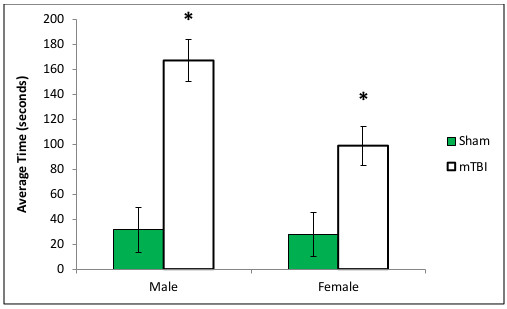
Figure 3: Graphical representation of the average differences in time-to-right between juvenile rats that experienced a single mTBI and juvenile rats that experienced a sham injury (* p <0.01). Rats that have received a mTBI exhibit a significant increase in the duration of time needed to right themselves from the supine position.

Figure 4: Graphical representation of the average number of hind leg foot-slips exhibited on the Beam Walking task by juvenile rats that experienced a single mTBI and juvenile rats that experienced a sham injury (* p <0.05).
Discussion
Reliable modelling systems are needed to effectively cultivate basic science research that has significant translational validity. In response to rising occurrences and popular media, the investigation of mTBI and concussion has become a priority in many disciplines. However, despite increased research, there have been only incremental improvements in therapeutic strategies and treatment options 3. This lack of progress may be partially due to a discrepancy between the modeling systems employed and actual injury etiology. The majority of studies utilized rodent models that failed to reproduce the important biomechanical forces and appropriate post-injury symptomology. The current human definition of mTBI specifies that the injury results from acceleration and deceleration forces associated with a blunt trauma 10. The modified weight drop technique described here is therefore an ideal model for the study of mTBI and concussion because it uses a glancing impact to cause rapid rotational acceleration and deceleration to the head of an unrestrained animal, mimicking the biomechanical forces identified in sports-related injuries and automobile accidents. In addition, this model is easily adapted to examine repetitive mTBI, a phenomena that is emerging as a serious medical and socioeconomic issue. Studies indicate that rodents may be exposed to a series of 10 distinct mTBIs with minimal mortality 7. Finally, the method is inexpensive and can be carried out rapidly, allowing for high-throughput examination of a many therapeutic compounds and treatment regiments.
Just as with any procedural technique, certain aspects of the protocol are particularly important to the generation of reliable results. First, the tin foil needs to be scored effectively. If the tin foil is not properly scored, the force imparted by the weight during the glancing impact will not be enough to propel the juvenile rat through the tin foil onto the collection sponge. In these situations, the rat will remain in the starting position (chest down on the tin foil) and the mTBI will result from the blunt trauma from the weight impacting the stationary head, not the rotational acceleration and deceleration desired. Second, during the induction of the mTBI and the sham injury, the level of anesthetic applied to each rat should be consistent. Owing to the fact that time-to-right is used as marker of mTBI, the researcher should try to ensure that animals receiving a mTBI and animals receiving a sham injury are exposed to similar levels of anesthetic. A major advantage to this technique over many other TBI procedures is the low level and duration of anesthesiology. However, the juvenile rat needs to be non-responsive to a toe or tail pinch to ensure they do not wake-up on the stage before the injury is induced. Finally, in order to maintain a consistent injury etiology, the positioning of the rat’s head is particularly important. Ideally the weight should impact the center of the dorsal surface of the head. Caution should be taken to avoid positioning the path of the weight too near the caudal/posterior portion of the head, as impacting the brainstem and cerebellum is associated with increased mortality and seizure activity.
Based upon the biomechanical pathophysiology of injury induction and the behavioural outcomes examined, the modified weight-drop technique appears to be a reliable model for the investigation of paediatric mTBI and concussion. Although preliminary studies of this novel model have assessed some basic molecular and structural changes 7 future studies will be needed to ascertain how the brain responds to a mTBI with this injury etiology. An in-depth analysis of the neuroanatomical and biological changes that occur at the cellular and epigenetic level would increase model validity and translational applicability. In addition to stimulating the generation of targeted pharmacological therapies, understanding the pathophysiological changes that occur in the brain in response to mTBI and concussion would also direct the research related to clinical biomarkers that have the ability to predict outcomes following injury.
Disclosures
No competing financial interests exist.
Acknowledgements
The authors would like to thank Irene Ma, Rose Tobais, and Jong Rho for their technical assistance. Funding was provided to MJE by the Department of Pediatrics at the University of Calgary, the Alberta Children’s Hospital Foundation (ACHF) and the Alberta Children’s Hospital Research Institute (ACHRI). The Postdoctoral fellowship for RM was provided by ACHF.
Materials
| Name | Company | Catalog Number | Comments |
|---|---|---|---|
| Brass Weights | Ginsberg Scientific | 7-2500-2 | Need to have metal loop attached to base |
| Alluminum Foil | Alcan | Available at most grocery stores | |
| Masking Tape | Commercially available | ||
| U-Shaped Plastic Stand | Constructed by Laboratory | ||
| Clamp Stand | Sigma-Aldrich | Z190357 | |
| Plastic Guide Tube | Could be constructed or purchased at a hardware store | ||
| Fishing Line | Angler 10lb | Purchased from a sporting goods retailer | |
| Isoflurane | Pharmaceutical Partners of Canada | DIN 02237518 | Inhalation Anesthetic |
| Topical Lidocaine (30ml) | Astra Zeneca | DIN 0001694 | Xylocaine Jelly 2% |
| Cotton Swabs | Commercially available | ||
| Heating Pad - 3 heat setting | Commercially available | ||
| Stop Watch | Sportline | L303 | Purchased from a sporting goods retailer |
| Video Camera | Sony | HDR-CX260V | |
| Sprague Dawley Rats | Charles River Laboratories | SAS SD 40 | Male and females ordered from Charles River Laboratories and pups bred in-house |
| Balance Beam | Constructed by Laboratory |
References
- DeWitt, D., Perez-Polo, R., Hulsebosch, C., Dash, P., Robertson, C. Challenges in the development of rodent models of mild traumatic brain injury. Journal of Neurotrauma. 30, 688-701 (2013).
- Xiong, Y., Mahmood, A., Chopp, M. Animal models of traumatic brain injury. Nature Reviews Neuroscience. 14, 128-142 (2013).
- Zhang, Z., Lerner, S., Kobiessy, F., Hayes, R., Wang, K. Systems biology and the anostic approach to drug discovery and development to treat traumatic brain injury. Systems Biology in Drug Discovery and Development: Methods and Protocols, Methods in Molecular Biology. Yan, Q. , Springer Science. Forthcoming.
- Viano, D., Casson, I., Pellmen, E. Concussion in profession football: Biomechanics of the struck player - Part 14. Neurosurgery. 61, 313-327 (2007).
- Marmarou, A., et al. A new model of diffuse brain injury in rats: Part 1 - Pathophysiology and biomechanics. Journal of Neurosurgery. 80, 291-300 (1994).
- Mychasiuk, R., Farran, A., Esser, M. J. Assessment of an experimental rodent model of pediatric mild traumatic brain injury. Journal of Neurotrauma. 31 (8), (2014).
- Kane, M., et al. A mouse model of human repetitive mild traumatic brain injury. Journal of Neuroscience Methods. 203, 41-49 (2012).
- Schallert, T., Woodlee, M., Fleming, S. Disentangling multiple types of recovery from brain injury. Pharmacology of Cerebral Ischemia. Krieglstein, J., Klumpp, S. , Medpharm Scientific Publishers. Stuttgart. (2002).
- Mychasiuk, R., Hehar, H., Farran, A., Esser, M. J. Mean Girls: Sex differences in the effects of mild traumatic brain injury on the social dynamics of juvenile rat play behaviour. Behavioural Brain Research. 259, (2014).
- Centers for Disease Control and Prevention. Report to congress on mild traumatic brain injury in the United States: Steps to prevent a serious public health problem. , Centers for Disease Control and Prevention. Atlanta, GA. 1-47 (2003).
Reprints and Permissions
