This article showcases the static chamber-based method for measurement of greenhouse gas flux from soil systems. With relatively modest infrastructure investments, measurements may be obtained from multiple treatments/locations and over timeframes ranging from hours to years.
Method Article
Measurement of Greenhouse Gas Flux from Agricultural Soils Using Static Chambers
In This Article
Summary
Abstract
Measurement of greenhouse gas (GHG) fluxes between the soil and the atmosphere, in both managed and unmanaged ecosystems, is critical to understanding the biogeochemical drivers of climate change and to the development and evaluation of GHG mitigation strategies based on modulation of landscape management practices. The static chamber-based method described here is based on trapping gases emitted from the soil surface within a chamber and collecting samples from the chamber headspace at regular intervals for analysis by gas chromatography. Change in gas concentration over time is used to calculate flux. This method can be utilized to measure landscape-based flux of carbon dioxide, nitrous oxide, and methane, and to estimate differences between treatments or explore system dynamics over seasons or years. Infrastructure requirements are modest, but a comprehensive experimental design is essential. This method is easily deployed in the field, conforms to established guidelines, and produces data suitable to large-scale GHG emissions studies.
Introduction
Understanding the contributions of both human activities and natural systems to radiative properties of the atmosphere is an area of critical importance as we strive to mitigate anthropogenic contributions to the greenhouse effect. In addition to carbon dioxide (CO2), nitrous oxide (N2O) and methane (CH4) are also potent GHGs, accounting for an estimated 7% and 19% of global warming, respectively, with the majority of emissions coming from landscape sources1,2. These range from managed systems such as agricultural fields, rice paddies, and landfills, to natural systems such as forest floors, wetlands, and termite mounds. Accurate measurement, supporting well-informed modeling of such landscape-based emissions is critical in order to understand the drivers of climate change as well as to identify mitigation opportunities.
A variety of greenhouse gas measurement strategies exist, each with their own strengths and weaknesses2-5. Mass balance techniques rely on wind-based dispersion of gases and are suited to measurement of flux from small, well-defined sources such as landfills and animal paddocks. Micrometeorological approaches such as eddy covariance are based on real-time direct measurement of vertical gas flux, and can provide direct measurements over large areas. However, homogeneity in source topography is an implicit assumption (in that measurements yield a mean for the area under study), and costly infrastructure can limit deployment possibilities. Finally, chamber-based methods focus on change in gas concentration at the soil surface by sampling from a restricted above ground headspace. They allow measurements to be obtained from small areas and numerous treatments, but are subject to high coefficients of variation due to spatial variation in soil gas flux.
Here we discuss the most prevalent and easily implemented form of chamber-based measurement, utilizing the type of closed chambers without air flow-through commonly referred to as “static” or “non-steady-state non-flow-through” chambers. In this approach, gas emissions from the soil surface are trapped within a vented chamber, and rates of flux are determined by measuring the change in gas concentration over time within the chamber headspace. The static chamber technique has been widely deployed across both managed and natural landscapes and underpins the bulk of data reporting soil-based flux of greenhouse gases, particularly N2O6,7. It is ideally suited to the study of small experimental plots, diverse sites over variable terrain, or in other situations where multiple distinct locations must be studied without significant infrastructure investments. Typical experimental uses might include the exploration of alternative landscape management practices and their impact on soil-based CO2, N2O, and/or CH4 emissions, examination of landscape-based flux dynamics under artificially induced climate change scenarios such as warming and rainfall exclusion/supplementation, or the descriptive study of natural and agricultural ecosystems and subsystems.
As a critical tool in GHG measurement and flux estimation, the static chamber method has been thoroughly evaluated, and significant efforts have been made towards standardization of techniques and harmonization of data reporting4,6,8,9. Of particular note are the detailed reviews and guidelines produced by the U.S. Department of Agriculture – Agricultural Research Service’s Greenhouse gas Reduction through Agricultural Carbon Enhancement network (GRACEnet)8 and by the Global Research Alliance on Agricultural Greenhouse Gases (GRA)9. Such guidelines provide an invaluable resource and platform for coordination, as ultimately the interoperability of data from a myriad of studies is critical for scaling up local findings to global modeling, and for translating research results into viable mitigation strategies.
GRACEnet, GRA, and other reviews also highlight the fact that specific techniques in static chamber-based greenhouse gas flux measurement are extremely diverse, with significant methodological variations possible at nearly every step of the way, including chamber design, temporal and spatial deployment, sampling volumes, sample analysis, and flux calculations. The method described here presents one possible variant, while showcasing best practices and highlighting critical considerations for the generation of high quality, broadly transferrable data. It is intended to provide an accessible overview of this standardized procedure, and a platform from which to explore further nuances and variations described in the literature.
Protocol
1. Chamber Construction and Anchor Installation
- Design and construct chambers – each consisting of an anchor that is inserted into the soil and a lid that is placed on top of the anchor during flux measurement – to meet experimental needs.
- In designing chamber shape and size, consider spatial factors such as crop row spacing, fertilizer or manure banding, and plant height. Because protrusion of anchors above the soil surface can contribute to microclimate effects and water ponding, consider having the lids sit as low to the soil surface as possible. Because tradeoffs exist between chamber height and detection sensitivity, design lids to be as short as is feasible for the system under study.
- Build chambers of sturdy, nonreactive material such as stainless steel or PVC, and include a mechanism for sealing the lid onto the anchor. Insulate lids and cover with light-colored or reflective material to prevent heat buildup during measurement. Include a septum to allow sample collection and a vent tube to prevent pressure perturbations during chamber deployment and sample removal. For additional details refer to the Materials table, Parkin and Venterea8, and Clough et al10.
- At least 1 day prior to sampling, install chamber anchors in the soil at desired sites. The installation method will depend on chamber design, but in general, apply even pressure across all points so that the anchor does not warp or distort the soil structure. Sink the anchor to a depth of 2.5-13 cm depending on soil type, deployment time, and chamber volume6,11. Leave as little as possible (no more than 5 cm) protruding above the soil surface.
2. Calibration and Experimental Design
Note: Prior to beginning the experiment, follow these steps to determine an appropriate sampling time course that will allow data to be fit to an appropriate linear or non-linear flux model (see Parkin et al.12). This will require the use of techniques described in steps 3-5 (Field Sampling, Sample Analysis, and Data Analysis). Optimal timing is a function of both the system under study and the dimensions of chambers being used. Some trial and error may be involved. See Venterea13 for alternate approaches.
- Calibration Sampling and Analysis
- Under environmental or management conditions expected to generate relatively high trace gas fluxes, conduct intensive sampling following techniques described in section 3. Using tightly spaced sampling time points, populate a time series of longer duration than would be considered typical. Begin by sampling from several representative chambers at 5-10 evenly spaced time points over the course of an hour.
- Analyze samples by gas chromatography following section 4.
- Calibration Interpretation
- For each calibration time series and each gas of interest, plot time-by-concentration.
- Verify that flux rates are on the high end of the expected range. See section 5 for flux calculation. Refer to section 2.3 for troubleshooting tips.
- Inspect graphs for signs of non-linearity, or more specifically, plateauing of gas concentrations over time.
Note: The point at which concentration begins to plateau differs by gas type, and is a function of the rate of gas production or consumption within the soil, the concentration of the gas in the chamber headspace, and diffusion between the two zones. It is therefore strongly affected by chamber height, with shorter chambers yielding shorter time before plateau. - Use the calibration sets to determine optimal chamber deployment time for the experimental system. If linear regression will be used in data analysis (as described here in section 5), select timing that maintains as close to a linear relationship as possible between time and concentration for all gases / systems of interest, while allowing for a minimum of three, preferably four, sampling times within the time series6. For chambers 10-30 cm high used for CO2 and N2O measurements, time series typically range from 20-60 min8,14.
- Calibration Troubleshooting
- If there is poor differentiation and/or difficulty discerning linearity or plateau, use tighter calibration time points or longer calibration time series, and check that concentrations are within detection limits. For low rates of flux, a reduction in rate of accumulation may not be observed within the tested timeframe. This should not cause concern.
- If the fluxes are not at the high end of the expected experimental range, repeat calibration, altering treatment or environmental conditions to induce higher flux (by applying fertilizer or irrigation, for example). Alternately, use at least four time points in experimental design, so that if experimental fluxes are significantly higher than those observed during calibration and plateauing does occur, later time points can be excluded while retaining at least three time points for linear regression. Curvilinear regression approaches may also be employed.
- Experimental Design
- Based on the optimal timing determined in section 2.2.4, devise an overall sampling scheme that captures all relevant sites, treatments, and/or replicates, and allows personnel to move through chamber sites efficiently. If necessary, divide the chamber sites into several “rounds” to be sampled one after the other.
- If measurements are to be taken as representative of a whole day, sample at a time of day when temperatures are moderate relative to daily extremes. In typical temperate cropping systems, the ideal window is mid- to late-morning.
- If samples are to be collected in consecutive rounds, be careful not to introduce a bias by repeatedly sampling the same treatments at the same time of day. Construct rounds out of blocks of replicates rather than treatment-by-treatment.
- Include time for any necessary ancillary measures to be taken either within rounds or before/after, as appropriate. (See section 3.3 for typical ancillary measures.)
- Optionally, include time for collection of ambient air samples for use in non-linear flux models, or as an approximation of starting (time zero, “T0”) concentration (not described here).
- Optionally, include time for loading reference gas into vials at the time of sampling to assess possible sample degradation between sampling and analysis. See Parkin and Venterea8 for sample storage considerations.
- Determine the frequency of flux measurements that is appropriate for research goals. This may range from a single measurement to daily, weekly, or periodic measurements over the course of months or years. Refer to Rochette et al.14 for a thorough discussion of experimental design considerations.
- If samples are to be collected in cold conditions, plan for inclusion of a warming device such as a hot pack with vials to prevent septa from becoming brittle.
- Based on the optimal timing determined in section 2.2.4, devise an overall sampling scheme that captures all relevant sites, treatments, and/or replicates, and allows personnel to move through chamber sites efficiently. If necessary, divide the chamber sites into several “rounds” to be sampled one after the other.
3. Field Sampling
Note: On each sampling date, follow the sampling scheme established in section 2.4, using the techniques described below. Equipment and sample volume can vary depending on the collection and transfer methods being employed and the amount of sample required for GC analysis8. This protocol utilizes 5.9 ml collection vials and 30 ml syringes, with a flushing method of sample transfer. See Discussion for alternate approaches.
- Preparation
- If sampling from multiple chambers per round, prepare a time point reference grid (see Figure 2) to easily track where and when to sample. Alternately, make arrangements to record each time point during sampling.
- Pre-label and arrange collection vials for maximal efficiency and minimal likelihood of confusion during sampling.
- In order to save time during sampling, prepare all materials and equipment beforehand. Include extras of anything that may break or is easily lost (needles, syringes, stopcocks, etc.), and place in a carry tote, bucket, or other container.
- Be prepared to record any delayed time points which can happen due to equipment malfunction or other unforeseen circumstances, and which can be easily corrected during data analysis by adjusting the time associated with a certain sample.
- Sample Collection
- Attach and seal the chamber lid to the pre-installed chamber anchor, and start a stopwatch. This is T0.
- Immediately after sealing the lid collect a sample of ambient air from a location adjacent to the chamber, at the approximate height of the chamber top: with an empty 30 ml syringe fitted with a needle and a stopcock in the open position, draw a 30 ml air sample and close the stopcock. This is the T0 sample. Alternatively, take the T0 sample from the chamber6.
Note: Tradeoffs exist between the two approaches – evaluate spatial (distance from site or external microclimate for outside samples) vs. timing (delay between lid closure and sample collection for inside samples) considerations and determine the most appropriate technique for the equipment being used and the system under study. - With the syringe needle, pierce the septum of a 5.9 ml collection vial that already has another needle poked through near the edge of the septum.
- Open the syringe stopcock and inject approximately 20 ml of the sample into the vial (this causes the previous contents of the vial to be expelled through the extra needle, replaced by sample).
- In a smooth motion, remove the extra needle while continuing to inject as much of the remaining sample (approximately 10 ml) as possible, slightly over-pressurizing the vial to ensure sample integrity and allow analysis of multiple samples if necessary8.
- Close the stopcock and withdraw the syringe needle from the septum. Turn the filled vial upside-down to distinguish from unfilled vials.
- Proceed to the next chamber, repeat steps 3.2.1-3.2.6, sealing the lid on the correct pre-determined T0 time point.
- Continue to repeat steps 3.2.1-3.2.7 until all chambers in the round have been sealed and T0 samples have been collected.
- Return to the first chamber.
- As the time approaches 10 seconds until T1, pierce the septum in the chamber top with the syringe needle.
- Within a 10 second range of T1, withdraw a 30 ml sample of air from inside the chamber and close the stopcock. Remove the syringe needle from the chamber septum.
- Transfer the sample to a collection vial following steps 3.2.3-3.2.6.
- Continue to collect samples following steps 3.2.10-3.2.12, according to the sampling scheme established in section 2.4.
- Ancillary Measures
- In order to convert gas concentration to mass, measure the air temperature at the time of sampling. Depending on research goals, record or perform other ancillary measures such as soil temperature and soil moisture content at each location and/or time, daily rainfall, soil bulk density, soil nitrate and ammonium concentrations, etc. Various means exist to obtain these measures – follow standard protocols.
- Optionally, collect ambient air samples and/or load field standards of known concentrations into vials to assess ambient GHG concentrations and potential storage-vial degradation in the period between sampling and analysis (see sections 2.4.1.4 and 2.4.1.5).
4. Sample Analysis
- Determine the concentration of gases of interest for each sample by gas chromatography, using equipment fitted with an electron capture detector for N2O, an infrared gas analyzer or thermal conductivity detector for CO2, and a flame ionization detector for CH4.
Note: It is essential to obtain access to an instrument that is properly configured for GHG analysis and has sufficient run time available. Principles and methods of gas chromatography are described elsewhere5,15,16. - Convert trace gas concentration from volumetric to mass using the Ideal Gas Law:
PV = nRT
Where P = pressure, V = volume, n = moles of gas, R = gas law constant, and T = temperature. Thus:

5. Data Analysis
- For each time series, plot time-by-concentration and evaluate for linearity. Evaluate using goodness of fit or by visual inspection, excluding later time points showing signs of plateau from further analysis. Use a minimum of three time points including T0 for flux calculation (T0, T1, T2 …). Establish a consistent protocol, and reject any time series that fail to meet that protocol’s standards for linearity. See Parkin and Venterea8 for a thorough discussion of error, bias, and variance in flux calculation.
- Perform linear regression.
- Use the slope of the regression to calculate flux:
F = S • V • A-1
Where F = flux, S = slope of the regression, V = chamber volume, and A = chamber area. Thus:

Note: Refer to the Discussion and Parkin et al.12 for non-linear approaches to flux calculation.
Results
Prior to beginning a research project with static chambers, it is important to understand the overall workflow, and the organization of in silico, field- and laboratory-based elements (Figure 1). Provided careful experimental design and system calibration (Figure 2), data analysis will generally be relatively straightforward. A rate of flux is determined for each chamber and sampling time by regression of time by concentration using a pre-determined flux model appropriate to the system (Figure 3). However, even following best practices, difficulties may be encountered, and quality control of raw data is critical. For example, failure of a chamber seal or leaky sample vials can result in anomalous concentration values. These are readily identified through visual inspection of time series concentration plots (Figure 4), with CO2 time series often serving as a particularly useful indicator due to the typically more robust and continuous flux of CO2 compared to sometimes negligible, near-detection-limit, or even negative fluxes of N2O or CH4. Once data quality has been confirmed, results may be used to compare gas flux dynamics between treatments or over the course of a season (Figure 5). As can be seen from May and June flux values and error bars, the variation caused by spatial heterogeneity of flux may be significant, and more pronounced under conditions producing high rates of flux. Such variability is not unusual, and underscores the importance of sufficient replication in this technique.

Figure 1. Workflow overview. Various elements of this protocol will be carried out in the planning stage, in the field, in the laboratory, and in silico. Arrows indicate the sequence of workflow, beginning with chamber design (and construction if necessary), and concluding with data analysis. Multiple boxes/arrows between field sampling and sample analysis represent the possibility of multiple sampling dates over the course of an experiment.

Figure 2. Sample timing. An example timing scheme for the collection of samples from multiple chambers simultaneously. Chamber numbers are indicated at left and time points at top, with sampling times listed in whole minutes within the grid. In this example, four separate time series of 36 min each (one for each chamber) are carried out within the space of 46 min, with 12 min spacing between time points within a series, and 2 min walking time between chambers. For this hypothetical example, the suitability of 36-min time series would have been determined by prior calibration. While evenly spaced timing is not necessary, it often simplifies the sampling scheme. Alternately, researchers may individually record each sampling timepoint to determine sampling intervals.

Figure 3. Flux calculation. A typical static chamber time series, consisting of N2O concentrations measured at four time points over the course of a 36-min sampling period. The linear regression is displayed, the slope of which yields flux rate.
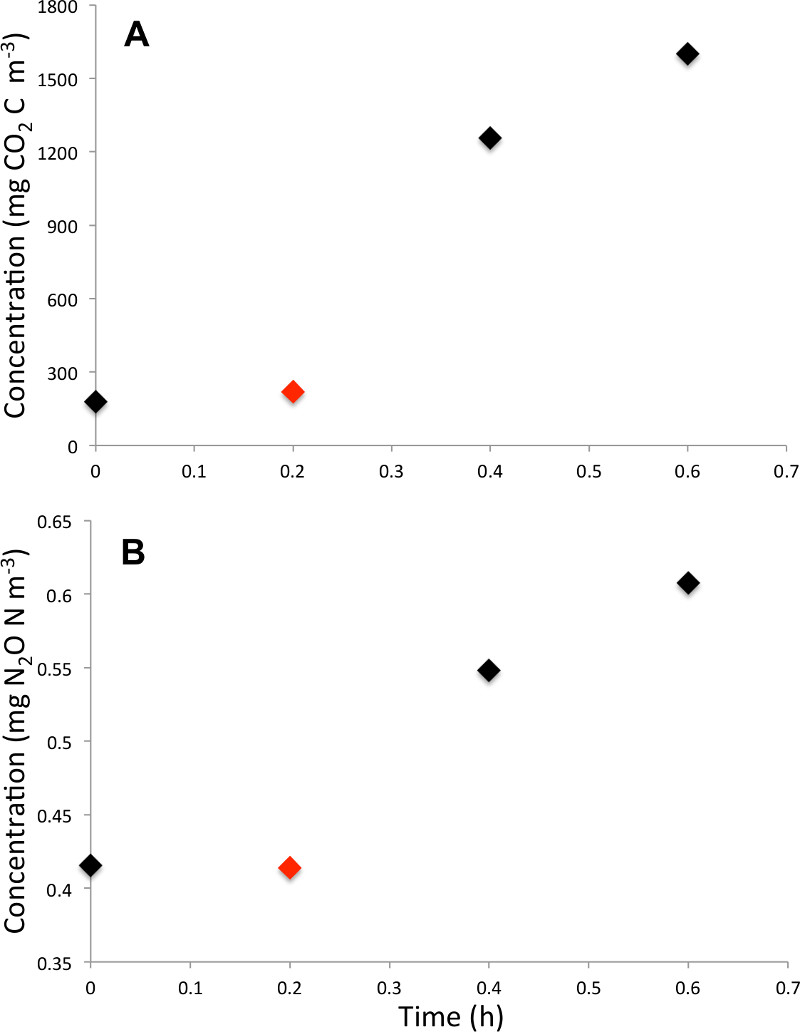
Figure 4. Quality control. Paired time series from the same set of samples but different gases are shown in which vial leakage has been identified by visual inspection (red point). A) CO2 concentration over time. B) N2O concentration over time.
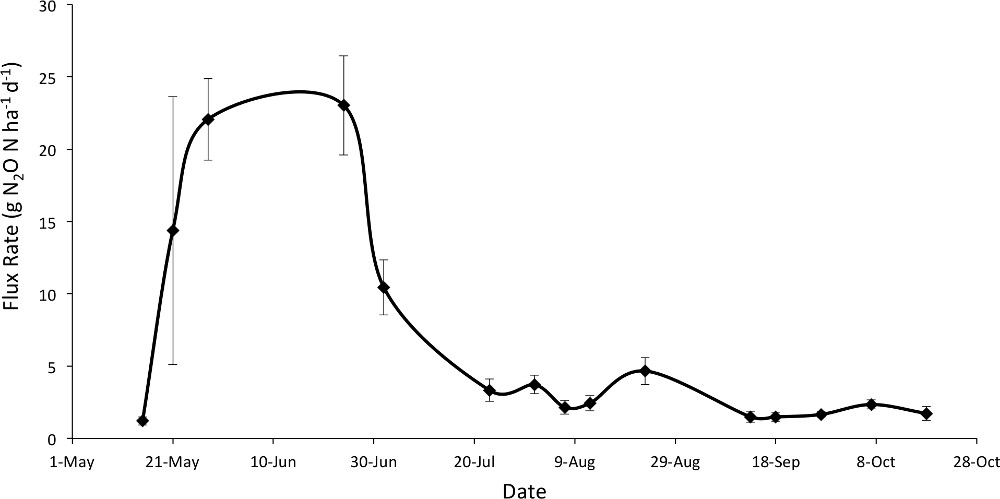
Figure 5. Synthesis results. N2O flux rate from an agricultural field over the course of a single growing season. Flux values represent the mean of six chambers, using four-point time series. Error bars are standard error.
Discussion
The static chamber-based approach described here is an efficient method for measurement of GHG flux from soil systems. The relative simplicity of its components makes it especially well suited to conditions or systems in which more infrastructure-intensive methods are infeasible. In order to generate high quality data, however, the static chamber approach must be carried out with strict attention to experimental design6. One notable consideration that must be taken into account is the spatial variability of soil gas fluxes, which can result in high variability among replicate chamber-based measurements. In designing experiments, therefore, it is important to include enough replicates to provide adequate power for statistical analysis. Tradeoffs may exist between the number of treatments which can be studied while maintaining sufficient replication, and a minimum of four replicates per treatment is a general guideline14.
If measured fluxes will be used to estimate daily emissions, diurnal variations in air temperature, soil temperature, and gas emissions must be taken into account. If research goals require measurements to be obtained in mid-morning when temperatures reflect daily averages, the restricted window for sampling may affect the number of chambers that can feasibly be monitored. An additional consideration to be evaluated is the impact that inclusion or exclusion of plant roots and above ground biomass will have on gas fluxes. Chamber placement relative to plant tissue will impact the interpretation of flux data, particularly in the case of CO2 where not only microbial respiration but also root and shoot respiration and photosynthesis must be appropriately balanced. For additional discussion of these factors, see Parkin and Venterea8.
As noted previously, many variations on this methodology exist, including chamber design and sampling volume. One such variation is in the method employed to transfer samples between the syringe and collection vial. The technique described here first flushes the collection vial with sample before filling the vial to positive pressure5. A more commonly used technique is the transfer of samples from syringes to vials that have been pre-evacuated using a vacuum pump, and the use of non-evacuated vials without flushing has also been reported8,17. Another significant point where a range of approaches exists is in data analysis and the selection of the flux model most appropriate to the system under study. In addition to the linear regression method described here, non-linear models may also be employed, particularly when longer deployment times are used. These models include the algorithm developed by Hutchinson and Mosier18 and derivations thereof19,20, the quadratic procedure described by Wagner et al.21, and the non-steady-state diffusive flux estimator described by Livingston et al22. For a thorough discussion of non-linear flux models, refer to Parkin et al.12 and Venterea et al23.
Methods similar to the static chamber approach include the use of flow-through measurement systems with Fourier transfer infrared (FTIR) spectrometry as an alternate to syringe sampling and gas chromatography, as well as automation of chamber closure and sampling through various means. Automated systems enable more frequent measurements with reduced personnel, but also require additional infrastructure investments. Grace et al.24 provide an extensive summary of options and tradeoffs in automated chamber-based N2O measurement.
Characterization of greenhouse gas flux from both managed and natural systems is important to inform process-based models, understand the impacts of management practices and inform mitigation strategies, and to support global accounting and climate change modeling. Thus while individual studies are informative at the local scale, much additional value is derived through contributing to, and drawing from, a global body of knowledge on gas exchange between the landscape and the atmosphere. It is key, therefore, that data be collected and reported in a way that ensures longevity and interoperability with the broader knowledge base. This includes following best practices to ensure data quality, as well as collection of ancillary measures and comprehensive reporting of metadata to allow extension of findings beyond discrete studies. Excellent guidelines for data reporting are available from the GRACEnet project and the GRA25.
Disclosures
The authors have nothing to disclose.
Acknowledgements
This material is based upon work supported by the National Science Foundation under Grant Number 1215858, by the US Department of Agriculture under Grant Number 2013-68002-20525, and by the US Department of Energy Great Lakes Bioenergy Research Center – DOE BER Office of Science (DE-FC02-07ER64494) and DOE OBP Office of Energy Efficiency and Renewable Energy (DE-AC05-76RL01830). In-field video and images were recorded at the Wisconsin Integrated Cropping System Trial project of the University of Wisconsin–Madison. The authors are grateful to Ryan Curtin for skillful videography and editing.
Materials
| Name | Company | Catalog Number | Comments |
|---|---|---|---|
| 5.9 ml soda glass flat bottom 55 x 15.5 mm | Labco Limited | 719W | Collection vials |
| 16.5 mm screw caps with pierceable rubber septum | Labco Limited | VC309 | Caps for vials |
| 90-well plastic vial rack, 17.1 mm well I.D. | Wheaton | 868810 | Rack for organizing vials |
| Regular bevel needles 23 G x 1" | BD | 305193 | Needles for sample collection |
| Stopcocks with luer connections, 1-way, male slip | Cole-Parmer | EW-30600-01 | Stopcocks for syringes |
| 30 ml syringe, slip tip | BD | 309651 | Syringes for sample collection |
| Stopwatch or timer | Various | N/A | For timing field sampling |
| Stainless steel or galvanized utility pans with rim, or fabricated stainless steel or PVC chambers and lids, dimensions as appropriate to experimental system | Various | N/A | Chamber anchor and lid - bottom cut out of anchor, holes for septum and vent tubing bored in lid |
| Gray butyl stoppers 20 mm | Wheaton | W224100-173 | Chamber septa for syringe sampling - insert into hole bored in lid top |
| Tygon tubing 4.0 mm I.D. x 5.6 mm O.D. | Sigma-Aldrich | Z685623 | Chamber vent tubing - insert in hole bored in lid side, flush with exterior, approximately 25 cm coiled in lid interior (a 1 ml syringe tip may be used as an attachment mechanism) |
| Adhesive foam rubber tape or HDPE O-ring | Various | N/A | Chamber sealing mechanism - fastened to underside of lid rim |
| Reflective insulation, 0.3125" thickness | Lowe's | 409818 | Insulating and reflective coating - affix to exterior of chamber lid |
| Large metal binder clips, 2" size with 1" capacity, or manufactured draw latch as appropriate | Staples / McMaster | 831610 (Staples) / 1863A21 (McMaster) | Lid attachment mechanism - for clamping lid to anchor during sampling |
| Gas chromatography equipment fitted with electron capture detector for nitrous oxide, infrared gas analyzer or thermal conductivity detector for carbon dioxide, flame ionization detector for methane | Various | N/A | For sample analysis |
References
- Myhre, G., et al. Anthropogenic and Natural Radiative Forcing. In: Climate Change 2013: The Physical Science Basis. Contribution of Working Group I to the Fifth Assessment Report of the Intergovernmental Panel on Climate Change. Stocker, T. F. , 8, Cambridge University Press. Cambridge, UK. (2013).
- Denmead, O. T. Approaches to measuring fluxes of methane and nitrous oxide between landscapes and the atmosphere. Plant and Soil. 309 (1-2), 5-24 (2008).
- Smith, K. A., et al. Micrometeorological and chamber methods for measurement of nitrous oxide fluxes between soils and the atmosphere: Overview and conclusions. Journal of Geophysical Research: Atmospheres. 99 (1984-2012), 16541-16548 (1984).
- Bouwman, A. F., Boumans, L. J. M., Batjes, N. H. Emissions of N2O and NO from fertilized fields: Summary of available measurement data. Global Biogeochemical Cycles. 16 (4), 1058(2002).
- Hensen, A., Skiba, U., Famulari, D. Low cost and state of the art methods to measure nitrous oxide emissions. Environmental Research Letters. 8 (2), 025022(2013).
- Rochette, P., Eriksen-Hamel, N. S. Chamber Measurements of Soil Nitrous Oxide Flux: Are Absolute Values Reliable. Soil Science Society of America Journal. 72 (2), 331(2008).
- Robertson, G. P. Greenhouse Gases in Intensive Agriculture: Contributions of Individual Gases to the Radiative Forcing of the Atmosphere. Science. 289 (5486), 1922-1925 (2000).
- Parkin, T. B., Venterea, R. T. Chamber-Based Trace Gas Flux Measurements. In: Sampling Protocols. http://www.ars.usda.gov/research/GRACEnet. Follet, R. F. 3 (1), 3-39 (2010).
- Klein, C., Harvey, M. Nitrous Oxide Chamber Methodology Guidelines. Ministry for Primary Industries. , Wellington, UK. 1-146 (2013).
- Clough, T. J., Rochette, P., Thomas, S. M., Pihlatie, M., Christiansen, J. R., Thorman, R. E. Chamber Design. In: Nitrous Oxide Chamber Methodology Guidelines. Ministry for Primary Industries. deKlein, C., Harvey, M. , 2, Wellington, UK. (2013).
- Hutchinson, G. L., Livingston, G. P. Vents and seals in non-steady-state chambers used for measuring gas exchange between soil and the atmosphere. European Journal of Soil Science. 52 (4), 675-682 (2001).
- Parkin, T. B., Venterea, R. T., Hargreaves, S. K. Calculating the Detection Limits of Chamber-based Soil Greenhouse Gas Flux Measurements. Journal of Environment Quality. 41 (3), 705(2012).
- Venterea, R. T. Simplified Method for Quantifying Theoretical Underestimation of Chamber-Based Trace Gas Fluxes. Journal of Environment Quality. 39 (1), 126(2010).
- Rochette, P., Chadwick, D. R., de Klein, C. Deployment Protocol. In: Nitrous Oxide Chamber Methodolog Guidelines. Ministry for Primary Industries. deKlein, C., Harvey, M. (3), Wellington, UK. (2013).
- Fundamentals of Gas Chromatography. Agilent Technologies, Inc. , 1-60 (2002).
- Holland, E. A., Robertson, G. P., Greenberg, J., Groffman, P. M., Boone, R. D., Gosz, J. R. Soil CO2, N2O, and CH4 Exchange. Standard Soil Methods for Long-Term Ecological Research. Robertson, G. P., Coleman, D. C., Bledsoe, C. S. , Oxford University Press. New York, NY. (1999).
- Venterea, R. T., Burger, M., Spokas, K. A. Nitrogen Oxide and Methane Emissions under Varying Tillage and Fertilizer Management. Journal of Environment Quality. 34 (5), 1467(2005).
- Hutchinson, G. L., Mosier, A. R. Improved soil cover method for field measurement of nitrous oxide fluxes. Soil Science Society of America Journal. 45 (2), 311-316 (1981).
- Pedersen, A. R., Petersen, S. O., Vinther, F. P. Stochastic diffusion model for estimating trace gas emissions with static chambers. Soil Science Society of America Journal. 65, 49-58 (2001).
- Pedersen, A. R., Peterson, S. O., Schelde, K. A comprehensive approach to soil-atmosphere trace-gas flux estimation with static chambers. European Journal of Soil Science. 61, 888-902 (2010).
- Wagner, S. W., Reicosky, D. C., Alessi, R. S. Regression models for calculating gas fluxes measured with a closed chamber. Agronomy Journal. 89, 279-284 (1997).
- Livingston, G. P., Hutchinson, G. L., Spartalian, K. Trace gas emission in chambers. Soil Science Society of America Journal. 70, 1459-1469 (2006).
- Venterea, R. T., Parkin, T. B., Cardenas, L., Petersen, S. O., Pedersen, A. R. Data Analysis Considerations. In: Nitrous Oxide Chamber Methodology Guidelines. Ministry for Primary Industries. deKlein, C., Harvey, M. (6), Wellington, UK. (2013).
- Grace, P., van der Weerden, T. J., Kelly, K., Rees, R. M., Skiba, U. M. Automated Greenhouse Gas Measurement in the Field. In: Nitrous Oxide Chamber Methodology Guidelines. Ministry for Primary Industries. deKlein, C., Harvey, M. , 5, Wellington, UK. (2013).
- Alfaro, M. A., Giltrap, D., Topp, C. F. E., de Klein, C. How to Report Your Experimental Data. In: Nitrous Oxide Chamber Methodology Guidelines. Ministry for Primary Industries. deKlein, C., Harvey, M. , 7, Wellington, UK. (2013).
Reprints and Permissions
