Here, we present a protocol for the synthesis of two carbonyl-decorated carbenes. The protocol makes these interesting compounds readily available to chemists of all skill levels. In addition to the synthesis of these two carbenes, their use in the activation of white phosphorus is also described.
A subscription to JoVE is required to view this content. Sign in or start your free trial.
Method Article
Preparation and Use of Carbonyl-decorated Carbenes in the Activation of White Phosphorus
In This Article
Summary
Abstract
Here we present a protocol for the synthesis of two distinct carbonyl-decorated carbenes. Both carbenes can be prepared using nearly identical procedures in multi-gram scale quantities. The goal of this manuscript is to clearly detail how to handle and prepare these unique carbenes such that a synthetic chemist of any skill level can work with them. The two carbenes described are a diamidocarbene (DAC, carbene 1) and a monoamidoaminocarbene (MAAC 2). These carbenes are highly electron-deficient and as such display reactivity profiles that are atypical of more traditional N-heterocyclic carbenes. Additionally, these two carbenes only differ in their electrophilic character and not their steric parameters, making them ideal for studying how carbene electronics influence reactivity. To demonstrate this phenomenon, we are also describing the activation of white phosphorus (P4) using these carbenes. Depending on the carbene used, two very different phosphorus-containing compounds can be isolated. When the DAC 1 is used, a tris(phosphaalkenyl)phosphane can be isolated as the exclusive product. Remarkably however, when MAAC 2 is added to P4 under identical reaction conditions, an unexpected carbene-supported P8 allotrope of phosphorus is isolated exclusively. Mechanistic studies demonstrate that this carbene-supported P8allotrope forms via a [2+2] cycloaddition dimerization of a transient diphosphene which has been trapped by treatment with 2,3-dimethyl-1,3-butadiene.
Introduction
Stable carbenes have emerged as ubiquitous reagents in homogeneous catalysis1, organocatalysis2, materials science3,4, and more recently main group chemistry5-9. In the context of the latter, stable carbenes have recently been used in the activation and functionalization of white phosphorus (P4)5-9. The ability to directly convert P4 into organophosphorus compounds has become a topical research objective in an effort to develop “greener” methods that circumvent the use of chlorinated or oxychlorinated phosphorus precursors. Despite their widespread use, the preparation and handling of carbenes and reactive compounds such as P4 can be a daunting task. For this reason, we have written this manuscript to provide a clear and concise protocol that will allow synthetic chemists of all skill levels to synthesize and manipulate two very unique stable carbenes. Additionally, the activation of P4 using the described carbenes is detailed.
Herein we detail a protocol for the synthesis of two electron-deficient carbonyl decorated carbenes. We have chosen these carbenes because they differ only in their electrophilic properties, and not their steric parameters, making them ideal for studying the effects of carbene electronics on reactivity. The importance of carbene electronics with regard reactivity is exemplified by two similar compounds of the general formula carbene-P2-carbene that have been reported by Bertrand and Robinson5,8. Bertrand’s P2 derivative is supported by two cyclic alkyl amino carbene (CAAC) ligands, and is structurally, photophysically, and electrochemically different than Robinson’s compound which is a P2 fragment supported by two N-heterocyclic carbenes (NHCs)5,8. Indeed, Bertrand’s P2 complex is characterized as a yellow solid that features carbene-to-phosphorus double bonds in the solid state, whereas the derivative reported by Robinson is a dark red solid that contains NHC→P dative bonds. This structural difference also manifests itself electrochemically such that Robinson’s compound contains more electron-rich phosphorus centers that can undergo reversible 1- or 2-electron oxidations in contrast to Bertrand’s compound which can only undergo a single reversible oxidation10.
Based on the studies described above, we became interested in studying the activation of P4 using the highly electrophilic diamido- and monoamidoamino carbenes to determine if novel carbene-stabilized allotropes of phosphorus could be prepared. We focused on diamidocarbene (DAC) 1, and monoamidoamino carbene (MAAC) 2 which differ only in their respective electrophilicities to interrogate what role carbene electronics play in P4 activation. Interestingly when the more electrophilic DAC is used, a tris(phosphaalkenyl)phosphane (3) could be isolated as the exclusive product, whereas when a MAAC is used, a carbene-stabilized P8 allotrope (4) can be obtained11. We also interrogated the mechanism for the formation (4), and found that it is formed via a [2+2] cylcoaddition dimerization reaction of a transient diphosphene. The existence of this diphosphene was confirmed by trapping it with 2,3-dimethyl-1,3-butadiene to furnish the [4+2] cycloaddition adduct 5. The protocol for synthesizing these carbonyl-decorated carbenes and their corresponding P4 activated compounds is described herein.
Access restricted. Please log in or start a trial to view this content.
Protocol
1. Synthesis of Diamidocarbene (Compound 1)
- Connect an oven-dried 100 ml Schlenk flask to a high performance vacuum manifold, evacuate it and flush with nitrogen. Add a stir bar to the flask and cap with a rubber septum. Weigh out N,N’-dimesitylformamidine12 (1.5 g, 5.35 mmol) and add it to the flask while flushing with nitrogen.
- Add (via dry, deoxygenated syringes) 30 ml of dry, degassed dichloromethane (DCM) followed by triethylamine (1.1 ml, 8.0 mmol, 1.5 equiv.). Cool the resulting solution to 0 °C in an ice bath.
- Add dropwise (via a dry, deoxygenated syringe) dimethylmalonyl dichloride (0.75 ml, 5.60 mmol, 1.05 equiv.) to the cooled solution. Upon addition, allow the solution to stir at 0 °C for 1 hr under an atmosphere of nitrogen. Once the solution has stirred for 1 hr, remove all the volatile materials under vacuum.
- Add a solvent mixture of dry, degassed hexanes:DCM (2:1 by volume, 24 ml total volume) to the residue in the reaction flask. Let the mixture triturate for 10 min.
- Meanwhile, attach a filter tube equipped with a medium porosity glass frit to the top of an oven-dried 100 ml Schlenk flask (see Figure 1). To the filter tube, add enough oven-dried Celite to create a filter plug approximately 2 inches tall. Seal the filter tube with a rubber septum, and pull vacuum, on the system by attaching the Schlenk flask to the vacuum manifold.
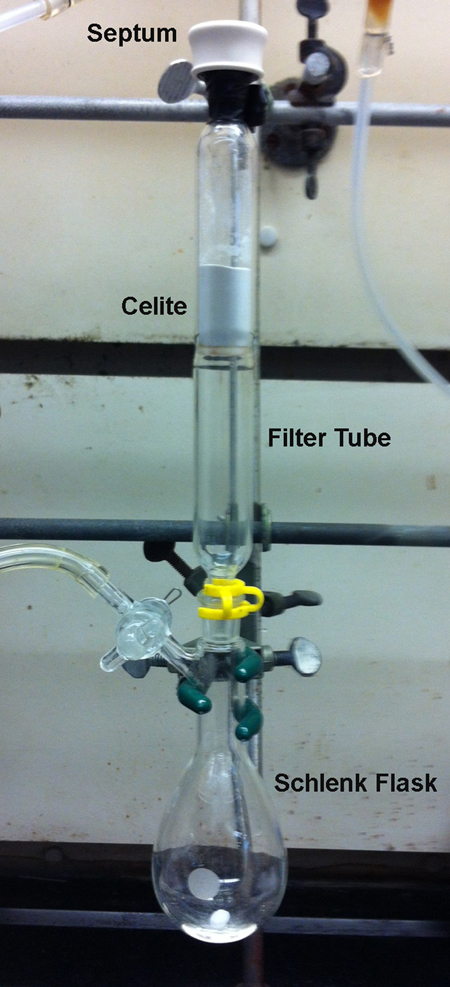
Figure 1. Filtration apparatus assembly for removal of [HNEt3][Cl] from carbene precursors 1-HCl and 2-HCl. This apparatus is also used to remove NaCl formed during the synthesis of carbenes 1 and 2. - Filtration apparatus assembly for removal of [HNEt3][Cl] from carbene precursors 1-HCl and 2-HCl. This apparatus is also used to remove NaCl formed during the synthesis of carbenes 1 and 2.
- Once the filtration apparatus has been assembled and is under vacuum, transfer the white suspension in the reaction flask via cannula into the filter tube. Be sure to periodically pull vacuum on the collection Schlenk flask to ensure that all of the solution filters through the Celite.
- Wash the Celite by adding a solvent mixture of dry, degassed hexanes:DCM (2:1, volume, 18 ml total volume) using a syringe through the rubber septum. Again, periodically pull vacuum on the collection Schlenk flask to ensure that all of the solution filters through the Celite.
- Disconnect the collection Schlenk flask from the filter tube under a flush of nitrogen, then seal the collection Schlenk flask with a glass stopper. Remove all of the solvent from the collection Schlenk flask under vacuum to afford the precursor for diamidocarbene 1 (1-HCl) as an air/moisture sensitive white powder in approximately 92% yield (2.04 g). The product can be verified by 1H and 13C NMR spectroscopy (CDCl3)13,14. Transfer compound 1-HCl into a glove box for storage prior to the next step.
- To prepare the diamidocarbene 1, first transfer an oven-dried 100 ml Schlenk flask equipped with a stir bar and a glass stopper into a nitrogen-filled glove box.
- Weigh out carbene precursor 1-HCl (0.600 g, 1.45 mmol) and sodium hexamethyldisilazide (NaHMDS, 0.267 g, 1.46 mmol) and place both solids into the Schlenk flask.
- Add dry, degassed benzene (25 ml) to the two solids in the Schlenk flask and then stopper the flask. At this point, the Schlenk flask can be removed from the glove box.
- Stir the solution of the carbene at RT for 30 min. Throughout the reaction, the solution will become a turbid yellow-orange color. During this time, set up a filtering apparatus similar to the one described above (using a 1 inch plug of Celite) for the synthesis of 1-HCl.
- Filter the carbene solution (to remove precipitated NaCl) as described for the precursor 1-HCl. Once the solution has been filtered, remove all of the volatiles using vacuum to afford the crude carbene 1 as a yellow-orange powder. Further purify carbene 1 by washing the solid with cold hexanes (~10 ml) to afford analytically pure compound as an air/moisture sensitive white powder in approximately 85% yield (0.462 g). Verify the product by 1H and 13C NMR spectroscopy (C6D6)13.
2. Synthesis of Monoamidocarbene (Compound 2)
- Connect an oven-dried 250 ml Schlenk flask to a high performance vacuum manifold, evacuate it and flush with nitrogen. Add a stir bar to the flask and cap with a rubber septum. Weigh out N,N’-dimesitylformamidine (3.00 g, 10.70 mmol) and add it to the flask while flushing with nitrogen.
- Add (via dry, deoxygenated syringes) 125 ml of dry, degassed DCM followed by triethylamine (2.25 ml, 16.05 mmol, 1.5 equiv.). Cool the resulting solution to 0 °C in an ice bath.
- Add dropwise (via a dry, deoxygenated syringe) 3-chloropivaloyl chloride (1.54 ml, 11.77 mmol, 1.1 equiv.) to the cooled solution. Upon addition, allow the solution to stir at 0 °C for 30 min under an atmosphere of nitrogen. Then gradually warm the solution to RT, and then remove all the volatile materials under vacuum. After the solvent is removed, a white solid residue will remain.
- Add toluene (200 ml) to the white solid and allow the suspension to triturate for 1 hr. Then filter the mixture over a 1 inch plug of Celite using a medium porosity glass fritted Büchner funnel.
- Transfer the toluene solution to a 500 ml round bottom flask equipped with a stir bar. Connect a reflux condenser to the flask and heat the solution to reflux (110 °C) for 16 hr. Over the course of the reaction, a white precipitate will form.
- After 16 hr allow the suspension to cool to RT. During this time, more solid will precipitate from the solution. Collect the solid via vacuum filtration and wash the solid with cold toluene (3 x 20 ml).
- Dry the obtained white solid using vacuum to afford the precursor for monoamidocarbene 2 (2-HCl) as an air stable white powder in approximately 91% yield (3.32 g). The product can be verified by 1H and 13C NMR spectroscopy (CDCl3)15. Transfer compound 2-HCl into a glove box for storage prior to the next step.
- To prepare the monoamidocarbene 2, first transfer an oven-dried 100 ml Schlenk flask equipped with a stir bar and a glass stopper into a nitrogen-filled glove box.
- Weigh out carbene precursor 2-HCl (0.500 g, 1.25 mmol) and NaHMDS (0.241 g, 1.32 mmol) and place both solids into the Schlenk flask.
- Add dry, degassed benzene (45 ml) to the two solids in the Schlenk flask and then stopper the flask. At this point, the Schlenk flask can be removed from the glove box.
- Stir the solution of the carbene at RT for 30 min. During the reaction, the solution will become a turbid yellow color. Meanwhile, set up a filtering apparatus similar to the one described above for the synthesis of 1-HCl using a 1 inch plug of Celite.
- Filter the carbene solution (to remove precipitated NaCl) as described for carbene 1. Once the solution has been filtered, remove all of the volatiles using vacuum to afford the crude carbene 2 as a tan powder. Further purify carbene 2 by washing the solid repeatedly with pentane to afford analytically pure compound as an air/moisture sensitive white powder in approximately 62% yield (0.309 g). Verify the product by 1H and 13C NMR spectroscopy (C6D6)15.
3. Synthesis of a Tris(phosphaalkenyl)phosphane (Compound 3)
Caution Statement: White phosphorus is extremely pyrophoric as well as toxic and should be handled cautiously in a glovebox whenever possible.
- To make a tris(phosphaalkenyl)phosphane (compound 3), weigh out diamidocarbene 1 (0.100 g, 0.266 mmol, 3 equiv.) and white phosphorus (P4, 0.011 g, 0.089 mmol, 1 equiv.) inside of a nitrogen-filled glove box with the lights turned off. Turn off as many lights in the lab during these first few steps as P4 is light sensitive.
- Add the two solids to a 20 ml glass vial that is wrapped in aluminum foil. Add dry, degassed diethyl ether (Et2O, 10 ml) to the solids and then cap the vial. Stir the slurry in the dark for 2 hr. During the course of the reaction, a bright red-orange precipitate will form.
- Isolate the red solid via filtration using a 10 ml medium porosity glass fritted Büchner funnel. Wash the red solid with Et2O (4 x 5 ml) and then dry it under vacuum to afford compound 3 as an analytically pure air stable compound in approximately 82% yield, 0.092 grams (based on P4). Verify the product by 1H and 31P NMR spectroscopy (C6D6)11.
4. Synthesis of a Carbene-stabilized P8 Allotrope (Compound 4)
- Method A
- To make a carbene-stabilized P8 allotrope (compound 4), weigh out monoamidocarbene 2 (0.100 g, 0.276 mmol, 3 equiv.) and P4 (11.4 mg, 0.092 mmol, 1 equiv.) inside of a nitrogen-filled glove box with the lights turned off. Turn off as many lights in the lab during these first few steps as P4 is light sensitive.
- Add the two solids to a 20 ml glass vial that is wrapped in aluminum foil. Add dry, degassed diethyl ether (Et2O, 10 ml) to the solids and then cap the vial. Upon addition of the ether, the fleeting dark green color rapidly changes to bright orange. Stir the slurry in the dark for 2 hr. During the course of the reaction, a bright orange precipitate will form.
- Isolate the orange solid via filtration using a 10 ml medium porosity glass fritted Büchner funnel. Wash the orange solid with Et2O (4 x 2 ml) and then dry it under vacuum to afford compound 4 as and analytically pure air stable compound in approximately 51% yield, 39.5 mg (based on P4). Verify the product by 1H and 31P NMR spectroscopy (THF-D8)11.
- Method B
- Weigh out monoamidocarbene 2 (0.100 g, 0.276 mmol, 2 equiv.) and P4 (17.1 mg, 0.138 mmol, 1 equiv.) inside of a nitrogen-filled glove box with the lights turned off. Turn off as many lights in the lab during these first few steps as P4 is light sensitive.
- Add the two solids to a 20 ml glass vial that is wrapped in aluminum foil. Add dry, degassed hexanes (10 ml) to the solids and then cap the vial. Upon addition of the ether, the fleeting dark green color rapidly changes to bright orange. Stir the slurry in the dark for 2 hr. During the course of the reaction, a bright orange precipitate will form.
- Isolate the orange solid via filtration using a 10 ml medium porosity glass fritted Büchner funnel, and then dry it under vacuum to afford compound 4 as and analytically pure air stable compound in approximately 75% yield, 87.7 mg (based on P4). Verify the product by 1H and 31P NMR spectroscopy (THF-D8).11
5. Trapping a Transient E-1,2-bis(phosphaalkenyl)diphosphene via [4+2] Cycloaddition: Synthesis of Compound 5
- To prepare compound 5, weigh out monoamidocarbene 2 (0.300 g, 0.828 mmol, 2 equiv.) and P4 (51.3 mg, 0.414 mmol, 1 equiv.) separately inside of a nitrogen-filled glove box with the lights turned off. Turn off as many lights in the lab during these first few steps as P4 is light sensitive.
- Add the P4 to a 20 ml glass vial, and then add dry, degassed hexanes (18 ml) to the vial. Next, add 2,3-dimethyl-1,3-butadiene (2 ml) to the P4 suspension in hexanes.
- While the hexane/P4 suspension is rapidly stirring, add the carbene 2 as a solid in one portion. The suspension will instantly become bright yellow. Over a period of about 10 min, all of the solids will dissolve followed by the precipitation of a bright yellow solid. At this point, let the suspension stir for 4 hr.
- After 4 hr, isolate the yellow solid via filtration using a 10 ml medium porosity glass fritted Büchner funnel. This yellow solid is compound 5 (> 90% purity by both 1H and 31P NMR). Concentrate the yellow supernatant solution to dryness and combine the yellow residue with the filtered yellow solid.
- To purify compound 5, recrystallize the combined yellow solids from a 1:3 (by volume) DCM:hexanes solution (12 ml total volume) in a -30 °C freezer in the glovebox O/N. This procedure will afford 5 as analytically pure air stable yellow crystals in approximately 71% yield, 0.301 grams (based on P4). Verify the product by 1H and 31P NMR spectroscopy (C6D6)11.
Access restricted. Please log in or start a trial to view this content.
Results
The ability to isolate a tris(phosphaalkenyl)phosphane such as 3 or the P8-allotrope (4) from white phosphorus relies on the use of an electrophilic carbene to activate the P4 tetrahedron11,16. Therefore, it is critical to prepare carbenes with enhanced π-acidity, and by extension electrophilicity. Figure 2 illustrates the synthesis of carbene precursor 1-HCl and its subsequent deprotonation to afford the diamidocarbene <...
Access restricted. Please log in or start a trial to view this content.
Discussion
A straightforward procedure for generating carbonyl-decorated carbenes and their application in the activation of white phosphorus is presented here. The critical steps in the protocol for synthesizing the carbenes are: (a) make sure all solvents are properly dried before use, (b) make sure the addition of acid chlorides to the formamidine is done very slowly, (c) if the Celite is not oven-dried for a minimum of 12 hr at 180 °C, hydrolysis of the 1-HCl as well as carbenes 1
Access restricted. Please log in or start a trial to view this content.
Disclosures
The authors have nothing to disclose.
Acknowledgements
We are grateful to the Research Corporation for Science Advancement (20092), the National Science Foundation (CHE-1362140), and Texas State University for their generous support.
Access restricted. Please log in or start a trial to view this content.
Materials
| Name | Company | Catalog Number | Comments |
|---|---|---|---|
| 2,4,6-Trimethylaniline | Alfa Aesar | AAA13049-0E | 98% |
| Triethylorthoformate | Alfa Aesar | AAA13587 | 98% |
| Dimethylmalonyl dichloride | TCI | D2723 | >98% |
| 3-Chloro-pivaloyl chloride | Aldrich | 225703-25G | 98% |
| Triethylamine | Alfa Aesar | AAA12646 | Stored over dried, activated 3 Å molecular sieves |
| Celite™ 545 | EMD | CX0574-3D | Oven-dried at 180 °C for a minimum of 12 hr |
| Sodium hexamethyldisilazide | Across | 200014-462 | 95+% |
| 2,3-Dimethyl-1,3-butadiene | Alfa Aesar | AAAL04207-09 | 98% |
| Dichloromethane | EMD | DX0835-5 | Purified through solvent purification system, or standard methods |
| Tetrahydrofuran | Mallinckrodt | 8498-09 | Purified through solvent purification system, or standard methods |
| Hexanes | EMD | HX0299-3 | Purified through solvent purification system, or standard methods |
| Benzene | EMD | BX0220-5 | Purified through solvent purification system, or standard methods |
| Toluene | BDH | 1151-19L | Purified through solvent purification system, or standard methods |
| White phosphorus | Generously donated from the Texas A&M chemistry store room. | Purified through sublimation and transferred directly into a glovebox while under vacuum in the sublimator |
References
- Díez-González, S., Marion, N., Nolan, S. P. N-Heterocyclic Carbenes in Late Transition Metal Catalysis. Chem. Rev. 109, 3612-3676 (2009).
- Enders, D., Niemeier, O., Henseler, A. Organocatalysis by N-Heterocyclic Carbenes. Chem. Rev. 107, 5606-5655 (2007).
- Boydston, A. J., Williams, K. A., Bielawski, C. W. A Modular Approach to Main-Chain Organometallic Polymers. J. Am. Chem. Soc. 127, 12496-12497 (2005).
- Kamplain, J. W., Bielawski, C. W. Dynamic covalent polymers based upon carbene dimerization. Chem. Commun. , 1727-1729 (2006).
- Back, O., Kuchenbeiser, G., Donnadieu, B., Bertrand, G. Nonmetal-Mediated Fragmentation of P4: Isolation of P1and P2Bis(carbene). 48, Int. Ed, Adducts. Angew. Chem.. 5530-5533 (2009).
- Masuda, J. D., Schoeller, W. W., Donnadieu, B., Bertrand, G. Carbene Activation of P4 and Subsequent Derivatization. 46, Int. ed, Angew. Chem.. 7052-7055 (2007).
- Masuda, J. D., Schoeller, W. W., Donnadieu, B., Bertrand, G. NHC-Mediated Aggregation of P4: Isolation of a P12 Cluster. J. Am. Chem. Soc. 129, 14180-14181 (2007).
- Wang, Y., et al. Carbene-Stabilized Diphosphorus. J. Am. Chem. Soc. 130, 14970-14971 (1021).
- Wang, Y., et al. Carbene-Stabilized Parent Phosphinidene Organometallics. 29, 4778-4780 (2010).
- Back, O., Donnadieu, B., Parameswaran, P., Frenking, G., Bertrand, G. Isolation of crystalline carbene-stabilized P2-radical cations and P2-dications. Nature Chemistry. 2, 369-373 (2010).
- Dorsey, C. L., Squires, B. M., Hudnall, T. W. Isolation of a Neutral P8 Cluster by [2+2] Cycloaddition of a Diphosphene Facilitated by Carbene Activation of White Phosphorus. 52, Int. Ed, Angew. Chem.. 4462-4465 (2013).
- Kuhn, K. M., Grubbs, R. H. A Facile Preparation of Imidazolinium Chlorides. Org. Lett. 10, 2075-2077 (2008).
- Hudnall, T. W., Moerdyk, J. P., Bielawski, C. W. Ammonia N-H activation by a N,N'-diamidocarbene. Chem. Commun. 46, 4288-4290 (2010).
- Lugan, N., Lavigne, G. Reprogramming of a Malonic N-Heterocyclic Carbene: A Simple Backbone Modification with Dramatic Consequences on the Ligand's Donor Properties. Eur. J. Inorg. Chem. 3, 361-365 (2010).
- Blake, G. A., Moerdyk, J. P., Bielawski, C. W. Tuning the Electronic Properties of Carbenes: A Systematic Comparison of Neighboring Amino versus Amido Groups. Organometallics. 31, 3373-3378 (2012).
- Martin, C. D., Weinstein, C. M., Moore, C. E., Rheingold, A. L., Bertrand, G. Exploring the reactivity of white phosphorus with electrophilic carbenes: synthesis of a P4 cage and P8 clusters. Chem. Commun. 49, 4486-4488 (2013).
Access restricted. Please log in or start a trial to view this content.
Reprints and Permissions
