Non-coherent Xenon light was passed through narrow-band interference and neutral density filters to deliver light of varying wavelength and intensity to cultured cells. This protocol was used to assess the effects of red/near-infrared light therapy on production of reactive species in vitro: no effects were observed using the tested parameters.
Method Article
Method for the Assessment of Effects of a Range of Wavelengths and Intensities of Red/near-infrared Light Therapy on Oxidative Stress In Vitro
In This Article
Summary
Loading...
Abstract
Loading...
Introduction
Loading...
Access restricted. Please log in or start a trial to view this content.
Protocol
Loading...
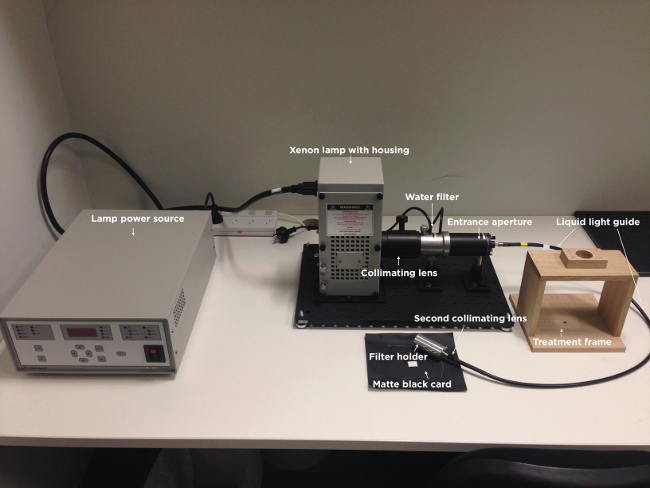
Access restricted. Please log in or start a trial to view this content.
Results
Loading...
Access restricted. Please log in or start a trial to view this content.
Discussion
Loading...
Access restricted. Please log in or start a trial to view this content.
Disclosures
Loading...
Acknowledgements
Loading...
Access restricted. Please log in or start a trial to view this content.
Materials
| Name | Company | Catalog Number | Comments |
|---|---|---|---|
| OxiSelect Intracellular ROS Assay Kit (Green Fluorescence) | Cell Biolabs | STA-342 | |
| Amplex UltraRed Reagent | Molecular Probes | A36006 | |
| 300 Watt Xenon Arc Lamp | Newport Corporation | 6258 | Very intense light source, do not look directly into the lamp. Ensure there is sufficient cooling to the lamp whilst it is switched on |
| USB4000-FL Fluorescence Spectrometer | Ocean Optics | ||
| CC-3-UV Cosine Corrector for Emission Collection | Ocean Optics | ||
| 200μm diameter quartz fibre optic | Ocean Optics | ||
| SpectraSuite Spectroscopy Platform | Ocean Optics | ||
| 2300 EnSpire Multimode Plate Reader | Perkin Elmer | ||
| Pierce BCA Protein Assay Kit | Thermo Scientific | 23225 | |
| Triton X-100 | Sigma-Aldrich | 9002-93-1 | Acute toxicity, wear gloves when handling. |
| L-Glutamic acid monosodium salt hydrate | Sigma-Aldrich | 142-47-2 (anhydrous) | |
| Pheochromocytoma rat adrenal medulla (PC12) cells | American Type Culture Collection | CRL-2522 | |
| Roswell Park Memorial Institute (RPMI1640) Media | Gibco | 11875-119 | |
| Fetal Bovine Serum, certified, heat inactivated, US origin | Gibco | 10082-147 | Warm to 37 °C in water bath before use |
| Horse Serum, New Zealand origin | Gibco | 16050-122 | Warm to 37 °C in water bath before use |
| GlutaMAX Supplement | Gibco | 35050-061 | Warm to 37 °C in water bath before use |
| 100 mM Sodium Pyruvate | Gibco | 11360-070 | Warm to 37 °C in water bath before use |
| Penicillin-Streptomycin (10,000 U/mL) | Gibco | 15140-122 | Warm to 37 °C in water bath before use |
| 100X MEM Non-Essential Amino Acids Solution | Gibco | 11140-050 | Warm to 37 °C in water bath before use |
| Retinal Muller (rMC1) cells | University of California, San Diego | ||
| Dulbecco's Modified Eagle Medium (DMEM) | Gibco | 11965-118 | Warm to 37 °C in water bath before use |
| 75 cm2 Flasks | BD Biosciences | B4-BE-353136 | |
| Poly-L-lysine hydrobromide | Sigma-Aldrich | 25988-63-0 | Aliquot and store at -20 °C |
| Hank's Balanced Salt Solution (HBSS) | Gibco | 14025-134 | Warm to 37 °C in water bath before use |
| Phosphate-Buffered Saline (PBS) | Gibco | 10010-049 | Warm to 37 °C in water bath before use |
| Laminin Mouse Protein, Natural | Gibco | 23017-015 | Aliquot and store at -20 °C |
| 1X Neurobasal Medium | Gibco | 21103-049 | Warm to 37 °C in water bath before use |
| Trypan Blue Solution, 0.4% | Gibco | 15250-061 | |
| 165U Papain | Worthington | ||
| L-Cysteine | Sigma-Aldrich | W326305 | |
| Corning 96 well plates, clear bottom, black | Corning | CLS3603-48EA | |
| Costar Clear Polystyrene 96-Well Plates Untreated; Well shape: Round; Sterile. | Costar | 07-200-103 | |
| Seesaw Rocker | Standard lab epuipment | ||
| Centrifuge | Standard lab epuipment | ||
| Neutral Density Filter Paper (0.3) | THORLABS | ||
| 442 nm Bandpass Filter | THORLABS | FL441.6-10 | |
| 550 nm Bandpass Filter | THORLABS | FB550-10 | |
| 670 nm Bandpass Filter | THORLABS | FB670-10 | |
| 810 nm Bandpass Filter | THORLABS | FB810-10e | |
| Unmounted Ø25 mm Absorptive Neutral Density Filters (0.1) | THORLABS | NE01B | |
| Unmounted Ø25 mm Absorptive Neutral Density Filters (0.2) | THORLABS | NE02B | |
| Unmounted Ø25 mm Absorptive Neutral Density Filters (0.3) | THORLABS | NE03B | |
| Unmounted Ø25 mm Absorptive Neutral Density Filters (0.5) | THORLABS | NE05B | |
| Unmounted Ø25 mm Absorptive Neutral Density Filters (0.6) | THORLABS | NE06B | |
| Unmounted Ø25 mm Absorptive Neutral Density Filters (1.0) | THORLABS | NE10B |
References
Loading...
Access restricted. Please log in or start a trial to view this content.
Reprints and Permissions
Request permission to reuse the text or figures of this JoVE article
Request Permission