Previous research on the social dimension of stress has focused on two important variables: social identity and social support. This protocol introduces an effective experimental manipulation of these two social variables and describes their implementation in a standard stress induction paradigm (Trier Social Stress Test).
Method Article
The Social Dimension of Stress: Experimental Manipulations of Social Support and Social Identity in the Trier Social Stress Test
In This Article
Summary
Loading...
Abstract
Loading...
Introduction
Loading...
Access restricted. Please log in or start a trial to view this content.
Protocol
Loading...
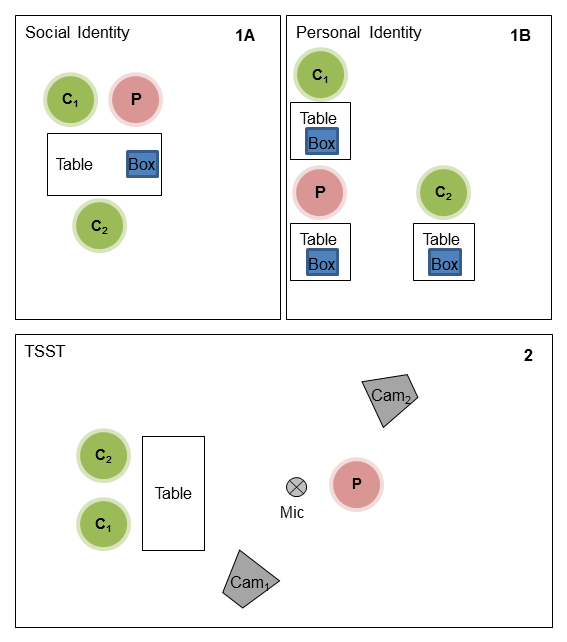
Access restricted. Please log in or start a trial to view this content.
Results
Loading...
Access restricted. Please log in or start a trial to view this content.
Discussion
Loading...
Access restricted. Please log in or start a trial to view this content.
Disclosures
Loading...
Acknowledgements
Loading...
Access restricted. Please log in or start a trial to view this content.
Materials
| Name | Company | Catalog Number | Comments |
|---|---|---|---|
| 9 T-shirts in 3 colors (i.e., 3 in each color) | any brand/manufacturer is suitable | Social/personal identity manipulation. | |
| 3 stick-on labels | any brand/manufacturer is suitable | Social/personal identity manipulation. | |
| 3 boxes (e.g., made of cardboard) | any brand/manufacturer is suitable | Social/personal identity manipulation (task 1). | |
| a little pouch | any brand/manufacturer is suitable | Bogus lot drawing procedure (entails three lots: two neatly folded lots labeled with with “committee” and one crumpled-up lot labeled with “applicant”). | |
| 2 stopwatches | any brand/manufacturer is suitable | Place them on the table in Room 2 (for the TSST-committee). | |
| 2 video cameras | any brand/manufacturer is suitable | Place in Room 2 (one for allegedly filming the participant, one for filming the behavior of the committee). | |
| 2 tripods | any brand/manufacturer is suitable | Place in Room 2. | |
| 1 microphone | any brand/manufacturer is suitable | Place in Room 2 (for allegedly recording the speech and the answers of the participant). | |
| 1 microphone stand | any brand/manufacturer is suitable | Place in Room 2. | |
| several pens | any brand/manufacturer is suitable | ||
| Furniture | |||
| 3 chairs | any brand/manufacturer is suitable | Room 1 A and B (social/ personal identity manipulation). | |
| 1 big table | any brand/manufacturer is suitable | Room 1A (social identity manipulation). | |
| 3 small tables | any brand/manufacturer is suitable | Room 1B (personal identity manipulation). | |
| 1 big table | any brand/manufacturer is suitable | Room 2 (TSST-committee). | |
| 2 chairs | any brand/manufacturer is suitable | Room 2 (TSST-committee). | |
| Questionnaires/ instructions | |||
| 3 informed consents | Use the informed consent of your institution (for all participants, i.e., the two confederates and the real participant). | ||
| 3 manipulation checks of identity salience | Items of Frisch et al. (2014), Häusser et al. (2012) or Doosje et al. (1995) | Hand out after the identity salience manipulation (for all participants, i.e., the two confederates and the real participant). | |
| 2 "instructions" for the TSST-committee | Hand out to the committee members (i.e., the confederates) at the end of the bogus lot drawing procedure. These "instructions" are part of the cover story so that the real participant believes that the two confederates are real participants as well and need to be informed about their roles in the TSST. However, since the confederates are of course already familiar with the TSST procedure, it is not important what these instructions actually entail (e.g., as a reminder for the confederates they may entail the exact wording of the verbal instructions of the committee). | ||
| 2 solutions to the mental arithmetic task | Place them on the table in Room 2 (for the TSST-committee). | ||
| 1 (or 3) manipulation check(s) of committee behavior | Items of Frisch et al. (2014) | Hand out after the TSST (for the real participant only). (However, in order to keep up the role of the confederates as real participants, a similar questionnaire can be handed out to the confederates asking them how they evaluate their own behavior during the TSST.) | |
| several sheets of blank paper | any brand/manufacturer is suitable | Hand out for task 1, task 2, preparation time of TSST (for the real participant), notes during the TSST (for the TSST-committee). |
References
Loading...
Access restricted. Please log in or start a trial to view this content.
Reprints and Permissions
Request permission to reuse the text or figures of this JoVE article
Request Permission