This protocol describes the procedure of measuring the temperature dependence of the full set material constants of piezoelectric materials using resonant ultrasound spectroscopy (RUS).
A subscription to JoVE is required to view this content. Sign in or start your free trial.
Method Article
Characterization of Full Set Material Constants and Their Temperature Dependence for Piezoelectric Materials Using Resonant Ultrasound Spectroscopy
In This Article
Summary
Abstract
During the operation of high power electromechanical devices, a temperature rise is unavoidable due to mechanical and electrical losses, causing the degradation of device performance. In order to evaluate such degradations using computer simulations, full matrix material properties at elevated temperatures are needed as inputs. It is extremely difficult to measure such data for ferroelectric materials due to their strong anisotropic nature and property variation among samples of different geometries. Because the degree of depolarization is boundary condition dependent, data obtained by the IEEE (Institute of Electrical and Electronics Engineers) impedance resonance technique, which requires several samples with drastically different geometries, usually lack self-consistency. The resonant ultrasound spectroscopy (RUS) technique allows the full set material constants to be measured using only one sample, which can eliminate errors caused by sample to sample variation. A detailed RUS procedure is demonstrated here using a lead zirconate titanate (PZT-4) piezoceramic sample. In the example, the complete set of material constants was measured from room temperature to 120 °C. Measured free dielectric constants  and
and  were compared with calculated ones based on the measured full set data, and piezoelectric constants d15 and d33 were also calculated using different formulas. Excellent agreement was found in the entire range of temperatures, which confirmed the self-consistency of the data set obtained by the RUS.
Introduction
Lead zirconate titanate (PZT) piezoelectric ceramics, (1-x)PbZrO3-xPbTiO3, and its derivatives have been widely used in ultrasonic transducers, sensors and actuators since the 1950s1. Many of these electromechanical devices are used at high temperature ranges, such as for space vehicles and underground well logging. Moreover, high power devices, such as therapeutic ultrasonic transducers, piezoelectric transformers and sonar projectors, often heat-up during operation. Such temperature rises will change the resonance frequencies and the focal point of transducers, causing severe performance degradation. High intensity focused ultrasound (HIFU) technology, already used in clinical practice for the treatment of tumors, uses ultrasonic transducers made of PZT ceramics. During operation, the temperature of these transducers will increase, causing a change of the material constants of the PZT resonator, which in turn will change the HIFU focal point as well as the output power2,3. The shift of focal point may lead to serious unwanted results, i.e., healthy tissues being destroyed instead of cancer tissues. On the other hand, if the focal point shift can be predicted, one could use electronic designs to correct such shift. Therefore, measuring the temperature dependence of the full set material properties of piezoelectric materials is very important for the design and evaluation of many electromechanical devices, particularly high power devices.
Poled ferroelectric materials are the best piezoelectric materials known today. In fact, nearly all piezoelectric materials currently in use are ferroelectric materials, including solid solution PZT ceramics and (1-x)Pb(Mg1/3Nb2/3)O3-xPbTiO3 (PMN-PT) single crystals. The IEEE (Institute of Electrical and Electronics Engineers) impedance resonance method requires 5-7 samples with drastically different geometries in order to characterize the full set material constants4. It is nearly impossible to obtain self-consistent full set matrix data using the IEEE impedance resonance method for ferroelectric materials because the degree of poling depends on the sample geometry (boundary conditions), while sample properties depend on the level of poling. To avoid problems caused by sample to sample variations, all constants should be measured from one sample. Li et al. reported the successful measurement of all constants from one sample at room temperature by using a combination of pulse-echo ultrasound and inverse impedance spectroscopy5. Unfortunately, this technique is hard to perform at elevated temperatures because it is not possible to perform ultrasonic measurements directly inside the furnace. There are also no commercially available shear transducers that can work at high temperatures. In addition, the coupling grease that bound the transducer and the sample cannot work at high temperatures.
In principle, the RUS technique has the capability to determine the full set material constants of piezoelectric materials and their temperature dependence using only one sample6,7. But there are several critical steps for proper implementation of the RUS technique. First, the full set of tensor properties at room temperature should be accurately determined using a combination of pulse-echo and RUS techniques. Second, this room temperature data set can be used to predict the resonance frequencies and to match the measured ones in order to identify the corresponding modes. Third, for each small increment of temperature from room temperature up, one needs to perform spectrum reconstruction against the measured resonance spectrum in order to retrieve the full set constants at this new temperature from the measured resonance spectrum. Then, using the new data set as the new starting point, we can increase the temperature by another small temperature step to get the full set constants at the next temperature. Continuing this process will allow us to obtain the temperature dependence of the full set material constants.
Here, a PZT-4 piezoceramic sample is used to illustrate the measurement procedure of the RUS technique. The poled PZT-4 ceramic has ∞m symmetry with 10 independent material constants: 5 elastic constants, 3 piezoelectric constants and 2 dielectric constants. Because the dielectric constants are insensitive to the change of resonance frequencies, they were measured separately using the same sample. The temperature dependence of clamped dielectric constants  and
and  were measured directly from the capacitance measurements, while the free dielectric constants
  and measured at the same time were used as data consistency checks. The temperature dependence of elastic stiffness constants at a constant electric field
  ,
,  ,
,  ,
,  and
and  , and piezoelectric stress constants e15, e31 and e33 were determined by the RUS technique using the same sample.
Access restricted. Please log in or start a trial to view this content.
Protocol
1. Sample Preparation
Note: PZT-4 ceramic samples of the desired size can be directly ordered from many PZT ceramic manufacturers. One may also cut the sample from a larger PZT ceramic block using a diamond cutting machine, then repole the sample to restore depoling caused by cutting and polishing. Here, the sample shape is a parallelepiped with each dimension between 3 mm and 10 mm. Larger size samples are not necessary but accuracy might be compromised if samples are too small.
- Polish the Surfaces of a Rectangular Parallelepiped Sample on a Plexiglas Disk Using Al2O3 Powders.
- First, glue the sample to the bottom surface of a metal rod using a very thin layer of wax by heating the rod and sample to 60 °C. Then cool down to room temperature. Tightly fit the rod into a metal cylinder with a larger outer diameter, so that the bottom surface of the cylinder and sample can be polished together to guarantee the flatness of the polished sample surface.
- Wet the glass plate using a water bottle then sprinkle 6 micron Al2O3 powders onto the wet surface. Place the sample holder with the sample glued to it onto the plate and make circular motion to grind the sample surface flat. Wash the Plexiglas plate and the sample holder thoroughly.
- Sprinkle 3 micron Al2O3 powders onto the wet glass plate and repeat the grinding again so that the sample surface will be smoother. Wash everything clean.
- Lift the sample off of the holder by heating the assembly to 60 °C to melt the wax. Clean the remaining wax on the sample surface using acetone.
- Polish all 6 surfaces of the sample using the same procedure.
- Measure the dimensions of the sample using a µm and record the results. Here, the PZT-4 sample shown in Figure 1 has the following dimensions: lx = 4.461 mm, ly = 6.073 mm, and lz = 4.914 mm.
- Measure the sample mass using a digital analytic balance.
- Divide the mass by the volume to get the mass density ρ.
2. Pulse-echo Ultrasound Measurement
Note: In this paper,  and
and  represent the ith row jth column element of elastic stiffness tensors at constant electric field and constant electric displacement, respectively;
  and
and  represent the ith row jth column element of elastic compliance tensors at constant electric field and constant electric displacement, respectively; dij represents the ith row jth column element of piezoelectric strain tensor; eij represents the ith row jth column element of piezoelectric stress tensor;
  and
and  represent the ith row jth column element of clamped and free dielectric constants, respectively. All matrix material constants are in Voigt notation.
- Turn on the Pulser-Receiver. Set the Mode to P/E for the pulse-echo measurement.
- Connect a longitudinal wave transducer (15 MHz) and a digital oscilloscope to the Pulser-Receiver.
- Put the transducer onto the sample surface along the x-direction with some coupling grease in-between. Note that the polarization direction is defined as the z-axis.
- Press the CURSOR key on the control panel of the digital oscilloscope; press the side-menu button V Bars, then rotate the General Purpose knob to move one cursor line to the highest peak of the first echo signal.
- Press the SELECT key, then rotate the General Purpose knob to move the other cursor line to the corresponding peak in the second echo signal.
- Read the numerical value at the place marked with Δ: on the screen, which is the round trip time of flight,
 of the longitudinal wave pulse along the x-axis.
 - Calculate the longitudinal wave velocity along the x-direction,
 , by dividing twice the thickness of the sample (round trip distance) by
  , and then determine the elastic constant
  using the formula:
  , where ρ is the sample density.
 - Repeat 2.3-2.5 using a shear wave transducer (5 MHz) and determine the shear wave velocity using the formula
 , where
  is the time of flight for the shear wave round trip along the x-direction. Determine the shear elastic constant
  using the formula
  .
. - Calculate the elastic constant
 using the formula:
  . This is the formula for the PZT sample with ∞m symmetry.
 - Place a shear transducer (5 MHz) onto the z-surface of the sample. Record the round trip time of flight,
 for the shear wave along the z-direction using the digital oscilloscope. Calculate the sound velocity
  using the formula:
  , and determine the elastic constant
  using the formula:
  .
.
3. Measure the Temperature Dependence of Dielectric Constants
- Apply a thin layer of conductive silver paint onto the two surfaces of the sample in the x-direction using a brush. The paint can be wiped off easily so that the same sample can be used for the RUS measurement later in open circuit condition.
- Connect the impedance analyzer to the control computer and turn on both.
- Set the start and stop frequencies of the impedance analyzer to 10 MHz and 40 MHz, respectively, for the frequency scan. Because the dielectric constant is >> 1 for this PZT sample, calculate its dielectric constant
 using the parallel plate approximation
  , where the capacitance
  is measured at 35 MHz, A is the electrode area and t is the thickness of the sample.
 - Connect the 16048A adapter to the four-terminal pair port of the impedance analyzer.
- Press the CAL key of the impedance analyzer to display the calibration menu.
- Press the ADAPTER key to display the Adapter Set in the starting Menu, and select 4TP 1M.
- Connect the Lcur and Lpot terminals on the 16048A to the Hpot and Hcur terminals of 04294-61001. Other terminals remain in open circuit condition.
- Press the SET OFUP key to display the Adapter Setup Menu.
- Press the PHASE COMP [-] key to start the phase compensation data measurement. When the phase compensation data measurement is completed, the soft key label changes to PHASE COMP [DONE].
- Connect the Lcur, Lpot, Hpot and Hcur terminals on the 16048A to the Lcur, Lpot, Hpot and Hcur terminals on the 04294-61001.
- Press the LOAD [-] key to start the measurement. When the load data measurement is completed, the soft key label changes to LOAD [DONE].
- Connect a fixture to the impedance analyzer, and keep it in an open circuit condition.
- Press the CAL key, then press the soft key FIXTURE COMPEN to display the Fixture Compensation Menu.
- Press the OPEN [-] key to start the open circuit data measurement. When the load data measurement is completed, the soft key label changes to OPEN [ON].
- Short the fixture by placing a copper wire between the positive and negative leads.
- Press the Short [-] key to start the short circuit data measurement. When the load data measurement is completed, the soft key label changes to Short [ON].
- Fix a 100 Ω resistor to the fixture. Press the soft keys LOAD RESIST then DEFINE VALUE, enter 100 then press the key X1.
- Press the LOAD key. When the load data measurement is completed, the soft key label changes to LOAD [ON]. Now calibration is completed.
- Put the sample in the fixture then put the whole assembly into a temperature chamber and close the door.
- Press the key MEAS on the impedance analyzer panel, and select
 .
. - Set the chamber temperature to 20 °C using the controlling computer.
- Open the spreadsheet software installed in the computer connected to the impedance analyzer to read and record data from the impedance analyzer.
- Read the capacitance data using a software in the computer and save the measured results into a file.
- Change the chamber temperature with a temperature step of 5 °C by pressing the UP key on the control panel of the chamber. Repeat step 3.23 in each temperature increment after the chamber temperature becomes stable.
- Determine the temperature dependence of the clamped dielectric constant based on the parallel capacitance formula using the capacitance value at 35 MHz, at which the capacitance becomes nearly frequency independent.
- Reset the start and stop frequencies to 1 kHz and 10 kHz, respectively.
- Repeat steps 3.21-3.24 to measure the temperature dependence of the low frequency capacitance of the sample. Save the measured result.
- Determine the temperature dependence of the free dielectric constant
 using the low frequency capacitance at 1 kHz.
 - Remove the conductive silver paint on the sample surface using acetone.
- Apply conductive silver paint to the two sample surfaces along the poling z-direction.
- Repeat steps 3.3-3.28. Determine the temperature dependence of the clamped and free dielectric constants,
 and
and  .
.
4. Resonance Frequencies Measurement at Room Temperature and Mode Identification
- Measure the Resonance Frequencies.
- Put the sample in between the transmitting and receiving transducers of the RUS system with contacts only at the opposite corners of the sample (Figure 2). Note that the contacts are soft-spring loaded and the applied pressure is very light, just enough to hold the sample in place. Hence, no damages are caused by the contacts.
- Turn on the dynamic resonance system (Figure 2) and the computer connected to it.
- Run the control interface of the dynamic resonance system. Set the start frequency f1, the stop frequency f2, and the total number of data points N to be collected. Choose N so that (f1 - f2)/N is less than 0.1 kHz to ensure frequency resolution. For this sample, set f1 = 200 kHz, f2 = 450 kHz and N = 8,192.
- Measure the resonance spectrum of the sample in this frequency range at room temperature and save the spectrum into a file.
- Export ASCII data of the measured result to a file.
- Open the ASCII data with a data plotting software. The first and second columns of the data matrix represent the real and imaginary parts of the response, respectively.
- Identify Corresponding Modes for Measured Resonance Frequencies.
- Plot the frequency-amplitude curve (Figure 3). The peaks correspond to resonance frequencies of the sample.
- Calculate resonance frequencies using the measured room temperature full set tensor constants. The values of , , were determined in steps 2.4-2.8. The values of and were determined in steps 3.25 and 3.31. Determine the shear piezoelectric constant e15 by the formula:
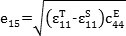 . Estimate the initial input values of
  ,
,  , e31 and e33, based on materials constants measured using the combined technique from several samples. The equations for calculating the resonance frequency of to each mode are been given in Ref. 6.
 - Compare the calculated resonance frequencies with those measured ones to identify corresponding modes for the measured resonance frequencies.
- Vary the guessed values of
 , , e31 and e33 iteratively to minimize the total global error between the calculated and measured resonant frequencies. The iteration stops when desired accuracy is reached.
5. Resonance Spectrum Measurement at Higher Temperatures and the Determination of Temperature Dependence of Full Set Material Constants
- Measure Resonance Frequencies of the Sample at Higher Temperatures.
- Put the sample holder assembly into an air furnace (Figure 4). Use two high temperature coaxial cable wires through a hole on the furnace wall to connect the assembly to the RUS system.
- Put the sample in between the transmitting and receiving transducers that are already in the furnace, with contacts only at opposite corners of the sample.
- Put a thermocouple near the sample for actual temperature reading. Connect the thermocouple to a thermometer outside of the furnace.
- Close the furnace door.
- Turn on the control interface of the RUS system. Set the start and stop frequencies to 200 kHz and 450 kHz, respectively, and the number of data points to 8,192.
- Run the RUS system measuring software, measure the resonance frequencies of the sample and save the results into a file.
- Increase the temperature of the sample with a step of ΔT = 5 °C. Repeat 5.1.6 until desired temperature is reached. Give each file saved a different name.
Note: The upper temperature limit is determined by the connection wires and transducers. Here, the RUS unit has an upper temperature limit of 200 °C.
- Determine the Temperature Dependence of the Full Set Material Constants.
- Repeat steps 4.1.5, 4.1.6 and 4.2.1 for every data set at different temperatures.
- Identify the mode of each resonance frequency. Use modes identified at temperature T as a reference for the next temperature T+ΔT.
- Fit the temperature dependence of the measured resonance frequency corresponding to each mode into a simple function (for example, a linear or a quadratic function) using plotting software.
- Determine the full set material constants from the fitted resonance frequencies at each temperature using a self-written computer program that solves the RUS backward problem (Figure 5, Figure 6).
Note: Resonance frequencies of identified modes serve as input parameters to the numerical calculations. The procedure of determining material constants from resonance frequencies is a nonlinear least squares problem of finding a local minimizer of the deviation function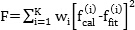 , where
  is the calculated resonance frequency,
  is the fitted resonance frequency from measured results, and wi is the weighting factor. The computer code for the calculation of unknown material constants from measured resonance frequencies was written based on the Levenberg-Mauquardt (LM) algorithm8 and some FORTRAN subroutines in the MINPACK9 were called when implementing the LM algorithm.
- Check the Self-consistency of the Full Set Material Constants.
- Calculate the free dielectric constants and from the inversion results and compare them with directly measured ones (Figure 7)10.
- Check the obtained data set to see whether they obey the condition of thermodynamic stability, for example,
 for the PZT case.
 - Compare the values of d15 calculated using
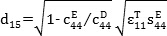 , and
, and  , and the values of d33 calculated using
  and
and 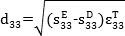 .
.
Note: These relationships will differ for different symmetries, but the principle is the same. Generally, if the relative error is less than 5% between predicted and measured quantities, the results will be considered self-consistent11. In some published data, even the sign would be wrong when a quantity is calculated using different formulas4,11.
- Calculate the free dielectric constants
Access restricted. Please log in or start a trial to view this content.
Results
The LM algorism used in the inversion is a local minimum finder. Therefore, the initial values of elastic stiffness constants ,
Access restricted. Please log in or start a trial to view this content.
Discussion
The RUS technique described here can measure the full set material constants using only one sample, which eliminates errors caused by property variation from sample to sample so that self-consistency can be guaranteed. The method can be used for any solid material with a high quality factor Q, no matter if they are piezoelectric or not. All other standard characterization techniques require several samples to get the full set data and are difficult to achieve self-consistent data.
It is import...
Access restricted. Please log in or start a trial to view this content.
Disclosures
Authors have nothing to disclose.
Acknowledgements
This work was supported by the National Natural Science Foundation of China (Grant No. 11374245), the NIH under Grant No. P41-EB2182, the Natural Science Foundation of Fujian Province, China (Grant No. 2013J01163), and the Open Research Fund of the State Key Laboratory of Acoustics, Chinese Academy of Science (Grant No. SKLA201306).
Access restricted. Please log in or start a trial to view this content.
Materials
| Name | Company | Catalog Number | Comments |
|---|---|---|---|
| PZT-4 | TRS | ||
| paraffin | MTI Corporation | 8002-74-2 | |
| conductive silver paint | MG Chemicals | 842-20G | |
| Al2O3 Powder | MTI Corporation | ||
| coupling grease | Panametrics |
References
- Jaffe, B., Cook, W. R., Jaffe, H. Piezoelectric Ceramics. , Academic Press. (1971).
- Chaussy, C., Thuroff, S., Rebillard, X., Gelet, A. Technology insight: High-intensity focused ultrasound for urologic cancers. Nat. Clin. Pract. Urol. 2, 191-198 (2005).
- Haar, G. T., Coussios, C. High intensity focused ultrasound: physical principles and devices. Int. J. Hyperthermia. 23, 89-104 (2007).
- Topolov, V. Y. Comment on "Complete sets of elastic, dielectric, and piezoelectric properties of flux-grown [011]-poled Pb(Mg1/3Nb2/3)O3-(28-32)% PbTiO3 single crystals". Appl. Phys. Lett. 96, 196101(2010).
- Li, S. Y., et al. Characterization of full set material constants of piezoelectric materials based on ultrasonic method and inverse impedance spectroscopy using only one sample. J. Appl. Phys. 114, 104505(2013).
- Ohno, I. Rectangular parallellepiped resonance method for piezoelectric crystals and elastic constants of alpha-quartz. Phys. Chem. Miner. 17, 371-378 (1990).
- Ogi, H., Kawasaki, Y., Hirao, M., Ledbetter, H. Acoustic spectroscopy of lithium niobate: Elastic and piezoelectric coefficients. J. Appl. Phys. 92, 2451(2002).
- Pujol, J. The solution of nonlinear inverse problems and the Levenberg-Manquardt method. Geophysics. 72, 1-16 (2007).
- Moré, J. J., Garbow, B. S., Hillstrom, K. E. User Guide for MINPACK-1. Argonne National Laboratories Report ANL-80-74. , (1980).
- Tang, L. G., Cao, W. W. Temperature dependence of self-consistent full matrix material constants of lead zirconate titanate ceramics. Appl. Phys. Lett. 106, 052902(2015).
- Topolov, V. Y., Bowen, C. R. Inconsistencies of the complete sets of electromechanical constants of relaxor-ferroelectric single crystals. J. Appl. Phys. 109, 094107(2011).
- Berlincourt, D., Krueger, H. H. A. Properties of Morgan Electroceramic ceramics. Technique publication TP-226. , Morgan Electroceramics. (2000).
- Migliori, A., Sarrao, J. L. Resonant ultrasound spectroscopy. , Wiley Press. (1997).
- Zadler, B. J., Le Rousseau, J. H. L., Scales, J. A., Smith, M. L. Resonant ultrasound spectroscopy: Theory and application. Geophys. J. Int. 156, 154-169 (2004).
Access restricted. Please log in or start a trial to view this content.
Reprints and Permissions
