Delay discounting refers to a decline in the value of a reward when it is delayed relative to when it is immediately available. We outline a computer-based delay discounting task that is easy to implement and allows for the quantification of the degree of delay discounting in human participants.
A subscription to JoVE is required to view this content. Sign in or start your free trial.
Method Article
Measuring Delay Discounting in Humans Using an Adjusting Amount Task
In This Article
Summary
Abstract
Delay discounting refers to a decline in the value of a reward when it is delayed relative to when it is immediately available. Delay discounting tasks are used to identify indifference points, which reflect equal preference for two dichotomous reward alternatives differing in both delay and magnitude. Indifference points are key to assessing the shape of a delay-discounting gradient because they allow us to isolate the effect of delay on value. For example, if at a 1 week delay and a maximum of $1,000, the indifference point is at $700 we know that, for that participant, a 1-week delay corresponds to a 30% reduction in value. This video outlines an adjusting amount delay-discounting task that identifies indifference points relatively quickly and is inexpensive and easy to administer. Once data have been collected, non-linear regression techniques are typically used to generate discounting curves. The steepness of the discounting curve reflects the degree of impulsive choice of a group or individual. These techniques have been used with a wide range of commodities and have identified populations that are relatively impulsive. For example, people with substance abuse problems discount delayed rewards more steeply than control participants. Although degree of discounting varies as a function of the commodity examined, discounting of one commodity correlates with discounting of other commodities, which suggests that discounting may be a persistent pattern of behavior1.
Introduction
Delay discounting is a behavioral phenomenon that affects many situations people encounter Delay discounting refers to the fact that temporally proximal rewards are more highly valued than temporally distal rewards. That is, the value of rewards decline with delays. This is an important process because many choices that people make involve a tradeoff between immediate low quality outcomes (e.g., a piece of cheesecake after dinner) and delayed high quality outcomes (e.g., long-term health). Delay discounting has also been observed in a variety of species in addition to humans2,3, including monkeys4,5, rats6,7, and pigeons8.
Individual differences in degree of discounting have been linked to various maladaptive behaviors9. The value of rewards declines as a function of delay according to a hyperbolic decay function8. With hyperbolic decay, value decreases extensively with relatively short delays, but decreases proportionally less so across relatively long delays. Mazur's finding that value degrades hyperbolically as a function of delay is important, because the hyperbolic function is able to predict preference reversals where other theoretical functions cannot without additional assumptions. Preference reversals are a well-documented finding10-12 that preference for a small reward available relatively soon (SSR) over a larger reward available at a relatively distal point in the future (LLR) will reverse if a common delay is added to both alternatives. For example, if, while driving home from work, a feeling of hunger suddenly hits, a person may be inclined to stop at the first fast food restaurant in sight for a relatively unhealthy snack as opposed to waiting until they get home for a piece of fruit or some other high quality snack. If, however, the hunger hits while still at work, when the person still has to walk to their car and drive down the road before approaching the fast food restaurant, they are more likely to decide to wait until they get home for the fruit.
The steepness with which rewards decline in value as a function of delay can be considered a measure of an organism's choice impulsivity. Choice impulsivity can be defined as a preference for SSR over LLR13,14.Higher degrees of impulsive choice are linked to use and abuse of various drugs such as alcohol15,16, cigarettes17,18, cocaine19, heroin20,21, and methamphetamine22. Higher degrees of impulsive choice are also linked to problematic gambling23, obesity24,25, and poor health and personal safety choices26.
Various tasks can be used to assess delay discounting in humans. For instance, participants could be asked to make decisions between alternatives and experience some or all of the consequences associated with their choice (real reward task27,28) or they could be asked to make decisions between hypothetical alternatives, in which case they would not actually experience the consequences associated with their choice (hypothetical reward task1-3,9,15-19,25,29). Similar degrees of discounting are generally observed regardless of whether the reward and delays are real or hypothetical30. The method of administering delay-discounting tasks differs across studies. For example, various laboratories have administered the task using a fill-in-the-blank questionnaire31, a multiple-choice questionnaire32, an adjusting amount procedure33, and a monetary choice questionnaire34. The adjusting amount task, originally developed by Du, Green, and Myerson33, and used extensively in our laboratory, provides several benefits. Once the task is programmed data collection is automated, limiting human error throughout the process. Due to the adjusting nature of the task, indifference points are reached with relatively few questions, which minimizes the time participants are required to be in the and laboratory and limits boredom. Importantly, the task provides detailed and reliable data. The adjusting amount task will be detailed below.
Access restricted. Please log in or start a trial to view this content.
Protocol
The protocol was approved by the Institutional Review Board at Utah State University. The steps outlined below should serve as a guide for programming and conducting a delay discounting task.
1. Setting up a Delay Discounting Task
- Choose the range of delays for which discounting will be assessed.
NOTE: For example, a typical scenario would use delays that range from 1 week to 25 years. The selected delays should follow, by convention, an approximately exponential progression (e.g., 1 week, 2 weeks, 1 month, 2 months, 6 months, 1 year, 5 years, and 25 years) - Choose the maximum amount of money that will be used in the task. For example, typical amounts of money used in the task are $100 or $1,000.
- Choose the number of trials that must be completed to determine an indifference point at each delay.
NOTE: For example, a typical number of trials for each delay should be between 6 to 8 trials to balance data resolution and participant fatigue.
2. Obtain Informed Consent and Login Participant
- Have the participant sit in an isolated room in front of a computer. Ask the participant to turn off their cell phone and/or any other electronic devices.
- Provide the participant with an informed consent form to review and sign if they agree to participate in the task.
- Start the program by clicking the icon associated with the task on the computer.
- Observe the dialogue box and enter a unique participant ID tag that will be attached to the participant's data.
NOTE: Because the task must be programmed by experimenters, this step could be automated by having the program assign a participant tag automatically.
3. Provide Instructions and Practice Trials
- Give the participant instructions about what he or she will experience in the task.
- Provide practice trials that will not be included in data analysis.
NOTE: The practice trials are designed to familiarize participants with the task design and provide participants the opportunity to ask questions if they fail to understand what is expected of them without threatening the integrity of the data collected at the beginning of the task. Practice trials should not use the adjusting procedure outlined below. Instead, practice trials should simply consist of a series of choices between immediate outcomes and delayed outcomes.- For example, begin the practice trials by showing a question on the computer screen and asking the participant to choose between $10 available immediately and $100 available in 1 month. Observe the choice made on the screen.
- Ask the same question on the next screen but for subsequent choices increase the immediate alternative by an increment of $10 on each trial (regardless of the choices made by the participant) until the immediate and delayed alternatives are equal to $100.
- Carry out ten practice trials to allow the participant to acclimate to the task.
4. Assess a Single Indifference Point
NOTE: Indifference points serve as the major dependent variable from delay discounting tasks and represent a point at which the present value of the delayed alternative is equal to that of the immediate alternative.
- Display the starting amounts for the delayed and immediate alternatives to participants. For the first trial, display the maximum amount as the amount for the delayed alternative. Simultaneously display the immediate amount as ½ of the maximum amount. Set the mouse cursor to the center of the screen (equidistant from each of the choice alternatives) at the beginning of the trial.
NOTE: The side (right or left side of the screen) on which an alternative is presented should be randomly determined on each trial. - Observe the participant's choice.
- Adjust the amount of the immediate alternative by ¼ of the maximum for the second trial based on the participants choice.
- Decrease the amount of the immediate alternative for the second trial if the participant chose the immediate alternative on the first trial. For example, if the immediate amount was $50 and it was chosen on the first trial, then on the second trial display the immediate amount as $25.
- Increase the amount of the immediate alternative for the second trial if the participant chose the delayed alternative on the first trial. For example, if the immediate amount was $50, but the delayed amount was chosen on the first trial, then on the second trial display the immediate amount as $75.
- Display the new amount of the immediate alternative and the constant delayed alternative to the participant and allow them to make their next choice.
- Observe the participant's choice and adjust the amount of the immediate alternative by ½ of the previous adjustment.
- Decrease the amount of the immediate alternative for the next trial if the participant chose the immediate alternative on the current trial. For example, if the immediate amount was $25 on the second trial and it was chosen, then on the third trial display the immediate amount as $12.50.
- Increase the amount of the immediate alternative for the next trial if the participant chose the delayed alternative on the current trial. For example, if the immediate amount was $25 on the second trial and it was chosen, then on the third trial display the immediate amount as $37.50.
- Repeat steps 4.4 and 4.5 until the participant has made the required number of choices
NOTE: The number of choices is up to the discretion of the experimenter; see discussion for further detail.
NOTE: The adjustment for the upcoming trial should always be equal to the maximum amount multiplied by 2-n, where n is the trial number for the current adjustment (see Figure 1). - Make the final adjustment to the immediate amount based on the participant's choice. Use this new amount as the indifference point for that delay.
5. Determine Indifference Points at Each Delay
- Fully repeat Step 4 for each of the chosen delays, resetting the amount of the immediate outcome and the amount of the adjustment for the first trial at each delay.
6. Assess Delay Discounting of Qualitatively Different Outcomes (Optional)
- Ask the participant to provide an example of the chosen outcome. For example, if the chosen outcome is food then ask the participant "What is your favorite food?"
- Observe the participant's response and ask the participant how much a unit of the outcome costs (e.g., "What is the cost of the preferred food?").
NOTE: If experimenters are interested in assessing differences in discounting across commodities, this step will equalize commodities in terms of value so that any differences in discounting are not due to differences in the amount being discounted. - Display the values of the immediate and delayed starting values based on the price reported by the participant. Set the delayed amount of the outcome to be equal to the maximum value divided by the per unit price that was provided by the participant and then set the immediate alternative to ½ of that amount.
NOTE: For example, if 1 serving of ice cream costs $5 and the maximum is $100 then there are 20 servings of ice cream in $100. Use this calculated value as the delayed alternative (e.g., "20 servings of ice cream in 1 week") and ½ of that amount as the immediate alternative (e.g., "10 servings of ice cream now"). - Repeat all of Steps 4 and 5 with the recalculated value of each outcome.
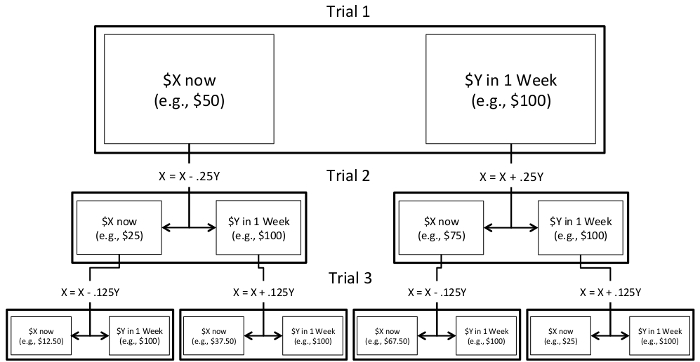
Figure 1. Trial Structure of the Adjusting Amount Task. The starting value for the delayed alternative, Y, should equal the maximum. The starting value for the immediate alternative, X, should equal .5Y. If X is chosen then the value of X should be decreased on the next trial. If Y is chosen then the value of X should be increased on the next trial. The amount of the adjustment is .25Y on Trial 1 and is .5 of the previous adjustment on each subsequent trial. Please click here to view a larger version of this figure.
7. Data Analysis
- Import data into any preferred data analysis program. Isolate the indifference point for each delay for each participant. Calculate the median indifference point for each delay for each group.
NOTE: Calculation of median indifference points is only necessary if a group design is used. - Choose a curvilinear regression model (see representative results for examples). Use curvilinear regression to fit the model to the (median) indifference points. This will generate relevant parameter estimates for the selected model (see below for an explanation of the parameters).
NOTE: We have provided code to conduct curvilinear regression in Supplemental Materials for the statistical program R to aid the reader with Step 7.
Access restricted. Please log in or start a trial to view this content.
Results
Delay discounting results are commonly analyzed by fitting curvilinear regression models to both the median indifference points from the groups and indifference points from individual participants for each outcome. Median group indifference points are used because the indifference points for a sample are usually not normally distributed. Three non-linear regression models are commonly used: those suggested by Mazur (Equation 1)8, Myerson and Green (Equation 2)35, and...
Access restricted. Please log in or start a trial to view this content.
Discussion
This video describes the steps that should be taken to conduct a delay discounting experiment using the adjusting amount task. The adjusting amount task is relatively quick to conduct (10 - 15 min per participant) and produces reliable data. The adjusting nature of the task provides a fine-tuned analysis of an individual participant's degree of discounting. Since the task is computer-based data collection is automated, which limits human-error and influence during the data collection process. Typically the task is us...
Access restricted. Please log in or start a trial to view this content.
Disclosures
The authors have nothing to disclose.
Acknowledgements
Preparation of this manuscript was supported in part by grant R01DA029100 from the National Institute on Drug Abuse.
Access restricted. Please log in or start a trial to view this content.
Materials
| Name | Company | Catalog Number | Comments |
|---|---|---|---|
| Computer | any | Mac or Windows | |
| Programming Software | Visual Studios | https://www.visualstudio.com | |
| Data Analysis Software | The R Foundation | http://www.r-project.org | |
| Informed Consent Form |
References
- Friedel, J. E., DeHart, W. B., Madden, G. J., Odum, A. L. Impulsivity and cigarette smoking: discounting of monetary and consumable outcomes in current and non-smokers. Psychopharmacology. 231 (23), 4517-4526 (2014).
- Bickel, W. K., Odum, A. L., Madden, G. J. Impulsivity and cigarette smoking: delay discounting in current, never, and ex-smokers. Psychopharmacology. 146 (4), 447-454 (1999).
- Rachlin, H., Raineri, A., Cross, D. Subjective probability and delay. J Exp Anal Behav. 55 (2), 233-244 (1991).
- Addessi, E., et al. Delay choice versus delay maintenance: Different measures of delayed gratification in capuchin monkeys (Cebus apella). J Comp Psychol. 127 (4), 392-398 (2013).
- Woolverton, W. L., Myerson, J., Green, L. Delay discounting of cocaine by rhesus monkeys. Exp Clin Psychopharm. 15 (3), 238-244 (2007).
- Evenden, J. L., Ryan, C. N. The pharmacology of impulsive behaviour in rats: the effects of drugs on response choice with varying delays of reinforcement. Psychopharm. 128 (2), 161-170 (1996).
- Perry, J. L., Larson, E. B., German, J. P., Madden, G. J., Carroll, M. E. Impulsivity (delay discounting) as a predictor of acquisition of IV cocaine self-administration in female rats. Psychopharmacology. 178 (2-3), 193-201 (2005).
- Mazur, J. E. An adjusting procedure for studying delayed reinforcement. In: . Quantitative Analysis of Behavior: Vol. 5 the Effect of Delay and Intervening Events on Reinforcement Value. Commons, M. L., Mazur, J., Nevin, J. A., Rachlin, H. , Erlbaum. Hillsdale, NJ. 55-73 (1987).
- Bickel, W. K., Jarmolowicz, D. P., Mueller, E. T., Koffarnus, M. N., Gatchalian, K. M. Excessive discounting of delayed reinforcers as a trans-disease process contributing to addiction and other disease-related vulnerabilities: Emerging evidence. Pharmacol Thera. 134 (3), 287-297 (2012).
- Rachlin, H., Green, L. Commitment, choice, and self-control. J Exp Anal Behav. 17 (1), 15-22 (1972).
- Ainslie, G. W. Impulse control in pigeons. J Exp Anal Behav. 21 (3), 485-489 (1974).
- Ainslie, G., Herrnstein, R. J. Preference reversal and delayed reinforcement. Anim Learn Behav. 9 (4), 476-482 (1981).
- Odum, A. L. Delay discounting: I'm a k, you're a k. J Exp Anal Behav. 96 (3), 427-439 (2011).
- Reynolds, B., Ortengren, A., Richards, J. B., de Wit, H. Dimensions of impulsive behavior: Personality and behavioral measures. Pers Indiv Differ. 40 (2), 305-315 (2006).
- Petry, N. M. Delay discounting of money and alcohol in actively using alcoholics, currently abstinent alcoholics, and controls. Psychopharmacology. 154 (3), 243-250 (2001).
- Vuchinich, R. E., Simpson, C. A. Hyperbolic temporal discounting in social drinkers and problem drinkers. Exp Clin Psychopharm. 6 (3), 292-305 (1998).
- Bickel, W. K., Odum, A. L., Madden, G. J. Impulsivity and cigarette smoking: delay discounting in current, never, and ex-smokers. Psychopharmacology. 146 (4), 447-454 (1999).
- Mitchell, S. H. Measures of impulsivity in cigarette smokers and non-smokers. Psychopharmacology. 146 (4), 455-464 (1999).
- Coffey, S. F., Gudleski, G. D., Saladin, M. E., Brady, K. T. Impulsivity and rapid discounting of delayed hypothetical rewards in cocaine-dependent individuals. Exp Clin Psychopharm. 11 (1), 18-25 (2003).
- Madden, G. J., Petry, N. M., Badger, G. J., Bickel, W. K. Impulsive and self-control choices in opioid-dependent patients and non-drug-using control patients: Drug and monetary rewards. Exp Clin Psychopharm. 5 (3), 256-262 (1997).
- Odum, A. L., Madden, G. J., Badger, G. J., Bickel, W. K. Needle sharing in opioid-dependent outpatients: psychological processes underlying risk. Drug Alcohol Depen. 60 (3), 259-266 (2000).
- Hoffman, W. F., Moore, M., Templin, R., McFarland, B., Hitzemann, R. J., Mitchell, S. H. Neuropsychological function and delay discounting in methamphetamine-dependent individuals. Psychopharmacology. 188 (2), 162-170 (2006).
- Dixon, M. R., Marley, J., Jacobs, E. A. Delay discounting by pathological gamblers. J Appl Behav Anal. 36 (4), 449-458 (2003).
- Weller, R. E., Cook, E. W., Avsar, K. B., Cox, J. E. Obese women show greater delay discounting than healthy-weight women. Appetite. 51 (3), 563-569 (2008).
- Rasmussen, E. B., Lawyer, S. R., Reilly, W. Percent body fat is related to delay and probability discounting for food in humans. Behav Process. 83 (1), 23-30 (2010).
- Daugherty, J. R., Brase, G. L. Taking time to be healthy: Predicting health behaviors with delay discounting and time perspective. Pers Indiv Differ. 48 (2), 202-207 (2010).
- Reynolds, B., Schiffbauer, R. Measuring state changes in human delay discounting: an experiential discounting task. Behav Process. 67 (3), 343-356 (2004).
- Jimura, K., Myerson, J., Hilgard, J., Braver, T. S., Green, L. Are people really more patient than other animals? Evidence from human discounting of real liquid rewards. Psychon B. Rev. 16 (6), 1071-1075 (2009).
- Odum, A. L., Rainaud, C. P. Discounting of delayed hypothetical money, alcohol, and food. Behav Process. 64 (3), 305-313 (2003).
- Madden, G. J., Begotka, A. M., Raiff, B. R., Kastern, L. L. Delay discounting of real and hypothetical rewards. Exp Clin Psychopharm. 11 (2), 139-145 (2003).
- Beck, R. C., Triplett, M. F. Test-retest reliability of a group-administered paper-pencil measure of delay discounting. Exp Clin Psychopharm. 17 (5), 345-355 (2009).
- Chapman, G. B. Temporal discounting and utility for health and money. J EXP Psychol Learn. 22 (3), 771-791 (1996).
- Du, W., Green, L., Myerson, J. Cross-cultural comparisons of discounting delayed and probabilistic rewards. Psychol Rec. 52 (4), 479-492 (2002).
- Kirby, K. N., Petry, N. M., Bickel, W. K. Heroin addicts have higher discount rates for delayed rewards than non-drug-using controls. J Exp.Psychol Gen. 128 (1), 78-87 (1999).
- Myerson, J., Green, L. Discounting of delayed rewards: Models of individual choice. J Exp Anal Behav. 64 (3), 263-276 (1995).
- Rachlin, H. Notes on discounting. J Exp Anal Behav. 85 (3), 425-435 (2006).
- Odum, A. L. Delay discounting: Trait variable. Behav Process. 87 (1), 1-9 (2011).
- Koffarnus, M. N., Jarmolowicz, D. P., Mueller, E. T., Bickel, W. K. Changing delay discounting in the light of the competing neurobehavioral decision systems theory: a review. J Exp Anal Behav. 99 (1), 32-57 (2013).
- Green, L., Myerson, J., Ostaszewski, P. Amount of reward has opposite effects on the discounting of delayed and probabilistic outcomes. J Exp Psychol Learn Mem Cogn. 25 (2), 418-427 (1999).
- Myerson, J., Green, L., Warusawitharana, M. Area under the curve as a measure of discounting. J Exp Anal Behav. 76 (2), 235-243 (2001).
- Reynolds, B. A review of delay-discounting research with humans: relations to drug use and gambling. Behav Pharmacol. 17 (8), 651-667 (2006).
- Anokhin, A. P., Golosheykin, S., Grant, J. D., Heath, A. C. Heritability of delay discounting in adolescence: A longitudinal twin study. Behav Gen. 41 (2), 175-183 (2011).
- Morrison, K. L., Madden, G. J., Odum, A. L., Friedel, J. E., Twohig, M. P. Altering impulsive decision making with an acceptance-based procedure. Behav Ther. 45 (5), 630-639 (2014).
Access restricted. Please log in or start a trial to view this content.
Reprints and Permissions
