This paper describes a method for the measurement of fuel oxidation in Drosophila melanogaster in which trace amounts of specific radiolabeled metabolic substrates are fed to flies. The exhaled radiolabeled CO2 that is a produced from fuel oxidation is collected and measured.
Method Article
Measurement of Carbon Dioxide Production from Radiolabeled Substrates in Drosophila melanogaster
In This Article
Summary
Abstract
The power of Drosophila genetics is increasingly being applied to questions of hormone signaling and metabolism and to the development of models of human disease in this organism. Sensitive methods for measurements of parameters such as metabolic rates are needed to drive the understanding of physiology and disease in small animals such as the fruit fly. The method described here assesses fuel oxidation in small numbers of adult flies fed food containing trace amounts of 14C-labeled substrates such as glucose or fatty acid. After the feeding period and any additional experimental manipulations, flies are transferred to short tubes capped with mesh, which are then placed in glass vials containing KOH-saturated filter paper that traps exhaled, radiolabeled CO2 generated from oxidation of radiolabeled substrates as potassium bicarbonate, KHCO3. This radiolabeled bicarbonate is measured by scintillation counting. This is a quantitative, reproducible, and simple approach for the study of fuel oxidation. The use of radiolabeled glucose, fatty acids, or amino acids allows determination of the contribution of these different fuel sources to energy metabolism under different conditions such as feeding and fasting and in different genetic backgrounds. This complements other approaches used to measure in vivo energy metabolism and should further the understanding of metabolic regulation.
Introduction
Work in the model organism Drosophila melanogaster has contributed greatly to the understanding of genetic principles, developmental processes, growth, aging, behavior, immunity and human disease1,2. A myriad of genetic and cell biological approaches in Drosophila has driven progress in these areas. However, the study of metabolism in the fruit fly has developed more slowly, due in large part to difficulties in measuring metabolic parameters in such a small animal. The interest in using Drosophila as a model for studying human diseases such as diabetes and for understanding the contributions of metabolism to growth and various pathologies has pushed the field to develop and adapt metabolic techniques for this organism3,4.
Reliable methods are now available for the measurement of a number of metabolic parameters in the fruit fly. For example, it is straightforward to assess food intake5, levels of stored triglycerides and glycogen, as well as circulating hemolymph levels of glucose and the major circulating sugar in the fly, trehalose, which is a disaccharide composed of two molecules of glucose4. Use of metabolic tracers has enabled the study of nutrient absorption from the diet and the conversion of absorbed nutrients such as glucose to the storage forms glycogen and triglycerides6. Metabolic rates can be assessed in the fruit fly through the measurement of oxygen consumption7,8 and carbon dioxide (CO2) production. The citric acid cycle oxidizes two-carbon units that can enter the cycle as acetyl coenzyme A (CoA), which is derived from metabolism of dietary and stored carbohydrates and fatty acids. Each turn of the cycle generates one molecule each of GTP (or ATP) and the electron donor FADH2, three molecules of NADH, and two molecules of the waste product CO2. CO2 production can be used to estimate basal metabolic rate. Total CO2 production can be quantified in Drosophila through the use of commercially-available or handmade respirometers9-10,11.
The measurement of total CO2 production, especially when coupled with measurement of O2 consumption, provides valuable insight into whole-body energy metabolism. However, this measure does not identify the nutrient being oxidized for adenosine triphosphate (ATP) production. Three major classes of nutrients can enter the citric acid cycle following conversion to acetyl CoA: carbohydrates, fatty acids, and proteins. Glucose-6-phosphate, derived from dietary glucose or stored glycogen, can be converted to pyruvate that is decarboxylated by pyruvate dehydrogenase to form acetyl CoA. Breakdown of fatty acids derived from the diet or from stored triglycerides by ß-oxidation yields acetyl CoA that then enters the citric acid cycle. Finally, a majority of amino acids can enter the citric acid cycle following conversion to pyruvate, acetyl CoA or citric acid cycle intermediates such as alpha-ketoglutarate.
Nutrient-specific contribution to energy metabolism during basal and stimulated conditions can be monitored through the use of radioactive tracers. The protocol presented here is adapted for use in Drosophila from a protocol used to assess oxidation in cells grown in culture12,13. In this approach, fruit flies are fed 14C-radiolabeled metabolic substrates (carbohydrates, fatty acids, or amino acids) in the diet for a short (hours) or long (days) pulse, chased on unlabeled food, and then exposed to a chamber containing potassium hydroxide (KOH)-saturated filter paper for trapping exhaled CO2 as bicarbonate. Radiolabeled bicarbonate can be quantified by scintillation counting. Differences in radiolabeled-CO2 production between experimental groups of flies may reflect use of different fuels for ATP production over the course of a prolonged fast or intrinsic differences in fuel metabolism between genotypes, for example.
Protocol
1. Preparation of Fly Food Containing Radiolabeled Metabolic Substrates
- In a microfuge tube, mix 1 - 2 µCi radiolabeled substrate (D-[6-14C]-glucose, D-[1-14C]-glucose or [1-14C]-palmitic acid, 40 - 60 mCi/mmol) with 15 µl FD&C No. 1 blue food dye and H2O to equal a total volume of 25 µl.
CAUTION: Carbon-14 is a low-energy beta emitter and has a short range in air. However, take care to prevent spilling of radiolabeled molecules or accidental ingestion by the experimenter. Fly food vials tip over easily; be sure to house them in a container that will prevent them from tipping, especially when radiolabel is in liquid form (step 1.2) or in unsolidified food (step 1.4). Flies that are being fed or have been fed radiolabeled substrates will begin to exhale small amounts of radiolabeled CO2. These flies should be kept in acrylic boxes in fume hoods, and a small dish of KOH can be set in the box for use as a CO2 scrubber. - Pipet all of the radiolabeled substrate and blue dye mix into the bottom of an empty fly food vial (height: 9.4 cm, width: 2.2 cm).
- Heat standard fly food in a microwave oven until food is just liquefied (15 - 20 sec at power level high for one vial containing 10 ml of food).
- Add 975 µl molten food to the radiolabeled substrate/blue dye mix and quickly swirl, monitoring uniformity of blue color to ensure complete mixing.
- Allow food to cool and solidify completely at RT for 20 - 30 min.
2. Feeding Radiolabeled Metabolic Substrates to Adult Fruit Flies
- Anesthetize adult flies using a CO2 anesthetizing apparatus consisting of porous polyethylene fused to an acrylic base and connected to a CO2 tank with a pressure regulator. Flow CO2 into the anesthetizing apparatus at 5 L/min.
- Transfer anesthetized flies to vials containing radiolabeled, blue-dyed food (n = 15 - 30 flies per vial). Cap vials with a foam stopper, and rest horizontally until flies wake up. Transfer vials to a lidded acrylic container (180 cm x 180 cm x 240 cm high).
- For short-term feeding, starve flies for 18 - 24 hr before transferring flies to the radiolabeled food for a 2 - 3 hr feeding step. The starvation step is important because fed flies will not reliably eat a new source of food presented to them. For long-term feeding over the course of 5 - 7 days, flies need not be starved, but the experimenter should monitor the water content of the radiolabeled food in the vials flies are housed in and use a needle and syringe to add water to vials with dry food.
- Transfer flies to unlabeled food by "tapping" them into a new vial. An initial chase period of 2 - 4 hr allows flies to clean radiolabeled food particles from their cuticles and permits digestion of radiolabeled food remaining in the gut. Monitor progress of food through the gut by visual inspection of flies to look for blue abdomens.
- Subsequently, transfer flies to different food types (12 - 24 hr on standard food or 1% agar for measurement of effects of fed versus fasted state on respiration) or ambient temperatures (12 - 96 hr at 18 ˚C or 30 ˚C for genetic manipulations using temperature-sensitive GAL80 (GAL80ts), for e.g).
Note: The length of this chase period will vary with the experiment being performed. For e.g., a 96 hr chase at 30 ˚C may be necessary in experiments using GAL80ts in order to fully activate GAL4-dependent transgene expression.
3. Preparation of the CO2-Collection Apparatus
- Assemble materials to construct "fly pods", mesh-capped tubes that will contain flies labeled with 14C-glucose or 14C-palmitic acid and that will remain open to the atmosphere. Cut off the top 50 mm of 12 mm x 75 mm polypropylene tubes, leaving 25 mm-long, round-bottomed tubes. Prepare 35 mm x 35 mm squares of 130 µm nylon mesh. Also, obtain transparent tape in a tape dispenser.
- Assemble materials for the CO2-collection apparatuses. For each fly pod, assemble a 20 ml glass scintillation vial, a rubber top stopper with an off-center hole, a center well to be inserted through the hole in the top stopper, grade GF/B glass microfiber filter paper (2.1 cm diameter circle, 1 µm pore). GF/B filter paper is used because of its high wet strength and high loading capacity.
- Prepare 5% KOH fresh on the day of use. Just before step 3.4, fold and place the circular GF/B filter paper into the center well that is threaded through the hole of the rubber top stopper and saturate it with 100 µl of 5% KOH. Refer to Figure 1.
- Following incubation(s) on unlabeled media, anesthetize flies with CO2. Brush flies into the cutoff polypropylene tube, cap with nylon mesh, and use transparent tape to adhere mesh to tube. Work quickly to avoid flies waking up and escaping before the mesh has been securely affixed to the tube. An equal number of flies should be used in each fly pod for a particular experiment; 10 - 20 flies per fly pod produce sufficient radiolabeled-CO2 for measurement by scintillation counting (step 4.1 below).
- Transfer the fly pod to a 20 ml glass scintillation vial. Cap the glass vial with the rubber top stopper holding a center well containing KOH-saturated GF/B filter paper. Fold the wide top of the rubber top stopper over the lip of the glass scintillation vial. Refer to Figure 1.
- Set glass vials containing flies in a lidded, acrylic container, and incubate for varying periods of time (2 to 12 hr works well).
4. Analysis of Results
- At the end of the incubation, uncap glass vials, and transfer KOH-saturated GF/B filter paper to a 6 ml plastic scintillation vial containing 4 ml scintillation cocktail.
- If needed, freeze flies in fly pods on dry ice and store at -80 ˚C for later determination of stored substrates. Note that these samples are radioactive and must be stored accordingly.
- Prepare additional scintillation vials: one containing unused GF/B filter paper to serve as background and one to two others containing 0.1 - 0.5 µCi radiolabeled substrate to determine cpm/µCi.
- Measure cpm for each sample using a scintillation counter according to manufacturer's protocol.
- Calculate pmol 14CO2/cpm and pmol 14CO2 per fly per hour. Subtract the background cpm from the cpm value for each sample. From the neat radiolabeled substrate data, calculate the background-corrected cpm/µCi of sample counted.
- Use the manufacturer-provided specific activity and radiochemical concentration of the radiolabeled substrate (for example, 50 µCi/µmol and 0.1 µCi/µl, respectively) to calculate pmol/cpm. Use this factor to convert background-corrected fly pod data from cpm 14CO2/sample to pmol 14CO2/sample. Then divide by the number of flies and the number of hr in the fly pod.
Results
The quantity of exhaled and trapped radiolabeled CO2 that is produced from the metabolism of a radioactive substrate should correlate with the number of flies in a fly pod as well as the amount of time the animals spend in the CO2 collection apparatus. To test this, flies that were fasted for 18 hr were fed radiolabeled palmitic acid (0.02 µCi/µl food) for 2 hr and then tested for radiolabeled CO2 production in groups of 12 or 25 animals for 3 or 6 hr incubations. The amount of CO2 produced by 25 flies was nearly double the amount produced by 12 flies, and the amount for each group doubled when the incubation time was increased from 3 hr to 6 hr (Figure 2A). The pmol 14CO2 / fly / hr was nearly equivalent in each group.
Fasting stimulates the breakdown of fatty acids by ß oxidation; therefore CO2 production from fatty acid oxidation should be elevated in fasted animals compared with fed animals. To determine whether this was the case, 18-hr fasted flies were fed radiolabeled palmitic acid for 2 hr. Following this short feeding pulse, flies were divided into two groups and transferred to unlabeled fly food or 1% agar for 3 hr and then transferred to fly pods for 2 hr. In two separate experiments, flies chased on agar produced significantly more radiolabeled CO2 compared with flies chased on food (Figure 2B), indicating that ß oxidation was increased in the fasted animals.

Figure 1.The Apparatus for Collecting Exhaled, Radiolabeled CO2.
Flies that have consumed radiolabeled metabolic substrates are placed into a "fly pod" (FP), a cutoff centrifuge tube capped with mesh (M). The fly pod is placed into a 20 ml glass scintillation vial and capped with a rubber top stopper (S) containing an off-center hole, through which is placed a center well (CW) that contains GF/B filter paper saturated with 100 µl 5% KOH. Exhaled CO2 reacts with the KOH and is trapped on the filter paper as bicarbonate. Trapped, radiolabeled CO2 can be quantified by scintillation counting of the saturated filter paper. Please click here to view a larger version of this figure.
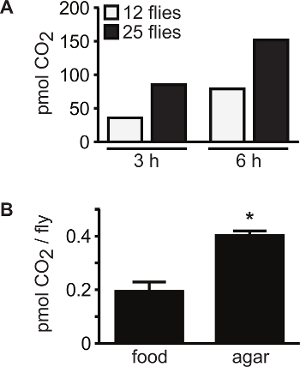
Figure 2. 14CO2 Production Correlates with Time and the Number of Flies in a Fly Pod and Responds to Fed and Fasted Conditions.
(A) The amount of 14CO2 produced in flies fed radiolabeled palmitate correlates with the number of flies tested (n = 12 (open bars) or 25 (closed bars)) and the time spent in a fly pod (3 or 6 hr). On a per-fly basis, flies produced 0.99, 1.13, 1.10 and 1.01 pmol 14CO2 / hr (data listed in the same left to right order as graph data).
(B) Flies that were chased on agar oxidized more radiolabeled palmitate than flies that were chased on food. Data are from two experiments and are reported as means standard deviation, n = 16 - 17 flies/group (experiment 1); n = 10 flies/group (experiment 2). * p = 0.017, Student's t-test. Please click here to view a larger version of this figure.
Discussion
This protocol describes a method for measuring the oxidation of specific radiolabeled substrates in adult Drosophila melanogaster. This technique is straightforward, quantitative, reproducible and sensitive, and it complements existing methods that measure total CO2 production and O2 consumption because it can be used to identify the nutrient(s) being oxidized for ATP production.
Measurement of CO2 liberated from the oxidation of specific radiolabeled substrates using the method described here is complementary to techniques that measure total CO2 production. Total CO2 production (VCO2) allows estimation of metabolic rate and, when total O2 consumption (VO2) is known, the metabolic rate can be calculated and the fuel source for oxidation can be estimated based on the respiratory exchange ratio (VCO2 / VO2 = RER). When carbohydrates are the exclusive substrate, RER = 1, but when fatty acids are the exclusive source, RER = 0.7, owing to the stoichiometry of the reactions of glucose and lipid oxidation. In the absence of equipment to measure oxygen consumption in Drosophila14, the oxidative fuel source cannot be identified. However, by labeling flies with trace amounts of one radioactive substrate or another and measuring rates of radiolabeled CO2 production, one can draw conclusions about the ability of flies to oxidize a given substrate at different time points during a stimulus or about the effects of a given mutation on fuel oxidation.
There are a number of critical steps in this protocol. First, care should be taken when using radioactive materials to avoid spills and contamination of research areas. Second, when anesthetizing flies during steps 2.1 and 3.4, the experimenter should work quickly to avoid effects of prolonged CO2 exposure on metabolism and behavior. A group of 20 flies can be anesthetized and transferred to a new vial or into a fly pod in 20 sec or less. When transferred from an anesthesia apparatus to a food vial, the vial should be rested on its side to prevent anesthetized flies from getting stuck on the food surface. When flies are fed radiolabeled food over the course of several days as in step 2.2, the experimenter should insure that the food does not dry out as flies are sensitive to dehydration.
The fed or fasted state prior to labeling, the choice of the label, the length of labeling time, the length of time in the fly pod, and the method of anesthesia are parameters that can be subjected to troubleshooting and modification when using this technique. First, flies subjected to short labeling periods (2 - 3 hr) are unlikely to consume significant quantities of radiolabeled food unless subjected to a fasting period beforehand. Second, the choice of label can affect the conclusions one is able to draw about metabolic phenotypes. For example, radiolabeled CO2 production from D-[1-14C]-glucose can reflect oxidation through the citric acid cycle or the pentose phosphate shunt, whereas radiolabeled CO2 production from D-[6-14C]-glucose reflects oxidation through the citric acid cycle only12,15,16. Feeding flies with a radiolabeled tracer for an essential amino acid17,18 would be a good strategy for assessing oxidation of amino acids derived from proteins. Finally, lengthy labeling periods with radiolabeled glucose also raise the possibility of incorporation of this precursor into other classes of molecules such as triglycerides19 and amino acids such as alanine, which readily interconverts with pyruvate. This can be assessed by measuring radioactivity incorporated into these different classes of molecules6. Indeed, separate cohorts of flies can be fed radiolabeled substrates in the same manner and then used for fly pod experiments or measurement of radiolabel that is stored and remains in glycogen and triglycerides in fed and fasted conditions6, for example. Another strategy is to use short-labeling periods that are likely to reveal oxidation of the radiolabeled dietary nutrients themselves and not storage forms of these nutrients. Third, it is also possible that two groups of flies could have identical rates of 14CO2 production over a given amount of time, but very different rates initially. Therefore, varying the amount of time that flies spend in the fly pod may be an important parameter to alter when assessing phenotypic variation. Finally, this protocol calls for the use of a short period of CO2 anesthesia when putting flies into the fly pod apparatus. It is possible that the CO2 anesthesia may affect metabolic function over the course of the fly pod experiment. An alternate approach is to use nitrogen anesthesia which does not affect metabolic rate 20.
As with any technique that measures such a complex system as fuel oxidation and metabolic rate, the method described here has limitations. First, it is possible that flies in different groups could consume different amounts of radiolabeled food and thus would enter the CO2 collection phase of the assay with different starting amounts of substrate. This can be controlled for to some extent by performing the experiment with large sample sizes and by feeding flies en masse. For short labeling periods, flies with similar blue-colored guts will have consumed the radiolabel and can be carried forward to the chase portion of the experiment. The amount of radiolabel remaining in a group of flies can also be measured at the end of the experiment and in separate cohorts of flies after the end of the feeding and initial chase period. Second, the activity levels between groups of flies in the fly pods may differ. This will have to be determined experimentally and taken into account when interpreting data. Third, this technique does not measure total CO2 production, only production from a specific dietary nutrient or the storage form(s) of that nutrient. This protocol is not a replacement for but instead is complementary to measurements of VCO2 because it provides different and additional information.
The method described here measures exhaled, radiolabeled CO2 that is a product of the oxidation of trace amounts of specific metabolic substrates. By varying the label used - glucose, fatty acid, or amino acid - one can design increasingly sophisticated experiments to assess the contributions of different substrates to metabolism under different physiological conditions such as starvation and on different genetic backgrounds. Future applications of this technique include measurement of metabolism in the larval and pupal stages of development, two stages of the Drosophila life cycle that are characterized by extremes of nutrient storage and breakdown, respectively.
Disclosures
The author declares no competing financial interests.
Acknowledgements
The author thanks Drs. Mingjian Lu and Morris Birnbaum for helpful advice and funding support from NIDDK (R21DK089391).
Materials
| Name | Company | Catalog Number | Comments |
|---|---|---|---|
| PALMITIC ACID, [1-14C]-, 50 µCi | PerkinElmer | NEC075H050UC | |
| GLUCOSE, D-[6-14C]-, 50 µCi | PerkinElmer | NEC045X050UC | |
| Glucose, D-[1-14C]-, 50µCi | PerkinElmer | NEC043X050UC | |
| Drosophila Vials, Narrow, Polystyrene | Genesee Scientific | 32-116 | |
| Round-Bottom Polypropylene Tubes, 12 x 75 mm | Fisher Scientific | 14-959AA | |
| Mesh, nitex nylon, 120 µm | Genesee Scientific | 57-102 | |
| 20 ml borosilicate glass scintillation vials | Fisher Scientific | 03-337-15 | |
| Flask top stopper with off-center hole | Fisher Scientific | K882310-0000 | |
| Polypropylene center well | Fisher Scientific | K882320-0000 | |
| Whatman GF/B glass microfiber filter paper, circle, 2.1cm diameter | Fisher Scientific | 09-874-20 | |
| Ecoscint A | National Diagnostics | LS-273 | |
| 6 ml Scintillation Vials with Push-On/Twist-Off Caps | National Diagnostics | SVC-06 |
References
- Wangler, M. F., Yamamoto, S., Bellen, H. J. Fruit flies in biomedical research. Genetics. 199 (3), 639-653 (2015).
- Bier, E. Drosophila, the golden bug, emerges as a tool for human genetics. Nat Rev Genet. 6 (1), 9-23 (2005).
- Owusu-Ansah, E., Perrimon, N. Modeling metabolic homeostasis and nutrient sensing in Drosophila: implications for aging and metabolic diseases. Dis Model Mech. 7 (3), 343-350 (2014).
- Tennessen, J. M., Barry, W. E., Cox, J., Thummel, C. S. Methods for studying metabolism in Drosophila. Methods. 68 (1), 105-115 (2014).
- Deshpande, S. A., Carvalho, G. B., et al. Quantifying Drosophila food intake: comparative analysis of current methodology. Nat methods. 11 (5), 535-540 (2014).
- Bland, M. L., Lee, R. J., Magallanes, J. M., Foskett, J. K., Birnbaum, M. J. AMPK supports growth in Drosophila by regulating muscle activity and nutrient uptake in the gut. Dev biol. 344 (1), 293-303 (2010).
- Hulbert, A. J., Clancy, D. J., Mair, W., Braeckman, B. P., Gems, D., Partridge, L. Metabolic rate is not reduced by dietary-restriction or by lowered insulin/IGF-1 signalling and is not correlated with individual lifespan in Drosophila melanogaster. Exp Geront. 39 (8), 1137-1143 (2004).
- Van Voorhies, W. A. Metabolic function in Drosophila melanogaster in response to hypoxia and pure oxygen. J. Exp. Biol. 212 (19), 3132-3141 (2009).
- Montooth, K. L., Marden, J. H., Clark, A. G. Mapping determinants of variation in energy metabolism, respiration and flight in Drosophila. Genetics. 165 (2), 623-635 (2003).
- Yatsenko, A. S., Marrone, A. K., Kucherenko, M. M., Shcherbata, H. R. Measurement of metabolic rate in Drosophila using respirometry. JoVE. (88), e51681(2014).
- Icreverzi, A., de la Cruz, A. F., Van Voorhies, W. A., Edgar, B. A. Drosophila cyclin D/Cdk4 regulates mitochondrial biogenesis and aging and sensitizes animals to hypoxic stress. Cell cycle. 11 (3), 554-568 (2012).
- Tuttle, S., Muschel, R., Bernhard, E., McKenna, W. G., Biaglow, J. Decreased ability of cells overexpressing MYC proteins to reduce peroxide and hydroperoxides. Br J Cancer. 27, 140-144 (1996).
- Ontko, J. A., Jackson, D. Factors affecting the rate of oxidation of fatty acids in animal tissues. Effect of substrate concentration, pH, and coenzyme a in rat liver preparations. J Biol Chem. 239, 3674-3682 (1964).
- Vincent, A., Briggs, L., et al. parkin-induced defects in neurophysiology and locomotion are generated by metabolic dysfunction and not oxidative stress. Hum Mol Gen. 21 (8), 1760-1769 (2012).
- Katz, J., Abraham, S., Hill, R., Chaikoff, I. L. The occurrence and mechanism of the hexose monophosphate shunt in rat liver slices. J Biol Chem. 214 (2), 853-868 (1955).
- Katz, J., Wood, H. G. The use of glucose-C14 for the evaluation of the pathways of glucose metabolism. J Biol Chem. 235 (8), 2165-2177 (1960).
- Piper, M. D. W., Blanc, E., et al. A holidic medium for Drosophila melanogaster. Nat methods. 11 (1), 100-105 (2014).
- Sang, J. H., King, R. C. Nutritional Requirements of Axenically Cultured Drosophila Melanogaster Adults. J Exp Biol. , (1961).
- Chernick, S. S., Chaikoff, I. L. Insulin and hepatic utilization of glucose for lipogenesis. J Biol Chem. 186 (2), 535-542 (1950).
- Van Voorhies, W. A., Khazaeli, A. A., Curtsinger, J. W. Testing the "rate of living" model: further evidence that longevity and metabolic rate are not inversely correlated in Drosophila melanogaster. J Appl Phys. 97 (5), 1915-1922 (2004).
Reprints and Permissions
