We present a protocol to rapidly form giant polymer vesicles (pGVs). Briefly, polymer solutions are dehydrated on dried agarose films adhered to coverslips. Rehydration of the polymer films results in rapid formation of pGVs. This method greatly advances the preparation of synthetic giant vesicles for direct applications in biomimetic studies.
Method Article
Forming Giant-sized Polymersomes Using Gel-assisted Rehydration
Opens in a new tab
In This Article
Summary
Loading...
$$\rightleftharpoonup{xx}$$
$$\longleftharp{xx}$$,
$$\longrightharp{xx}$$,
Abstract
Loading...
$$\rightleftharpoonup{xx}$$
$$\longleftharp{xx}$$,
$$\longrightharp{xx}$$,
Polymer vesicles, or polymersomes, are being widely explored as synthetic analogs of lipid vesicles based on their stability, robustness, barrier properties, chemical versatility and tunable physical characteristics. Typical methods used to prepare giant-sized (> 4 µm) vesicles, however, are both time and labor intensive, yielding low numbers of intact polymersomes. Here, we present for the first time the use of gel-assisted rehydration for the rapid and high-yielding formation of giant (>4 µm) polymer vesicles (polymersomes). Using this method, polymersomes can be formed from a wide array of rehydration solutions including several different physiologically-compatible buffers and full cell culture media, making them readily useful for biomimicry studies. This technique is also capable of reliably producing polymersomes from different polymer compositions with far better yields and much less difficulty than traditional methods. Polymersome size is readily tunable by altering temperature during rehydration or adding membrane fluidizers to the polymer membrane, generating giant-sized polymersomes (>100 µm).
Introduction
Loading...
$$\rightleftharpoonup{xx}$$
$$\longleftharp{xx}$$,
$$\longrightharp{xx}$$,
Creation of synthetic cell-sized, giant unilamellar vesicles (GUVs) is of increasing interest in the in vitro reconstruction of different cellular processes to build a framework for the generation of an artificial cell-like system1,2. While GUVs composed of lipid membranes are excellent mimics of natural, biological membranes, they are unstable against environmental fluctuations and have a fairly short shelf life. Due to these limitations, amphiphilic block copolymers have been used as lipid mimics to form polymer vesicles, or polymersomes. Within this context, polymersomes are advantageous in the development of biomimetic cell systems due to their increased stability3, chemical versatility4,5 and modifiable physical traits6-8.
Current methods to form giant-sized polymersomes include electroformation9 and templated rehydration10, both of which are time-consuming, labor-intensive, require specialized equipment and produce low yields of intact giant polymersomes. A simple gel-assisted rehydration method was recently developed for the production of lipid GUVs11. Here, we describe an adaptation of the gel-assisted rehydration technique to create giant polymersomes with varying polymer compositions, controlled size, and in various buffer compositions.
Briefly, 1% w/v standard DNA gel electrophoresis agarose films are dehydrated onto a glass coverslip. Polymer solutions prepared in chloroform are then spread across the dehydrated agarose film and allowed to evaporate. Following complete solvent removal, polymer films are rehydrated in the buffer of choice with moderate heating (40-70 °C) and giant (>4 µm) sized polymersomes are formed within 30 min. This method rapidly produces hundreds of fully intact, well-formed polymersomes using standard laboratory equipment and reagents at minimal costs.
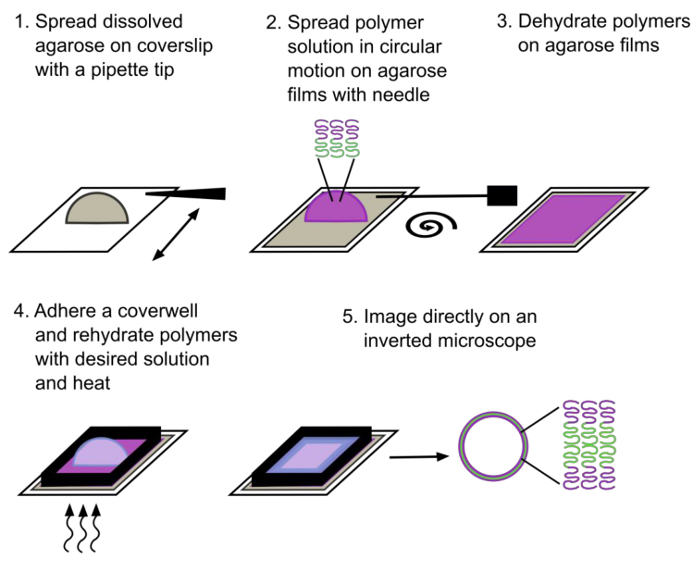
Figure 1. Schematic depicting the gel-assisted rehydration method. Giant polymersomes composed of a diblock copolymer are formed after ~30 min of rehydration. The hydrophilic block is denoted in magenta and the hydrophobic block is denoted in green. Please click here to view a larger version of this figure.
Protocol
Loading...
$$\rightleftharpoonup{xx}$$
$$\longleftharp{xx}$$,
$$\longrightharp{xx}$$,
1. Polymer and Agarose Preparation
Note: Gloves and a lab coat should be worn at all times throughout this protocol. Safety goggles are likewise required during work with any organic solvent or any step with possible splashing.
- Prepare a 5 mg/ml solution of polymer in chloroform. Add 1 ml of chloroform to 5 mg of solid poly(ethylene oxide)-b-poly(butadiene) (PEO-PBD, EO22-BD37) diblock copolymer in a glass vial and swirl to fully dissolve. Perform all steps using chloroform in a chemical fume hood.
- Mix in a fluorescently labeled lipid (purchased already dissolved in chloroform) at a 0.5 mol % final concentration in 99.5 mol % unlabeled polymer.
- For example, pipette ~12 µl of a 1 mg/ml fluorescently labeled lipid in chloroform into 997.58 µl PEO-PBD, EO22-BD37 polymer in chloroform (with a molecular weight of 2,950 Daltons) for a final concentration of 0.5 mol % labeled lipid mixed and 99.5 mol % polymer.
- Store solution in an airtight vial with a chloroform-resistant lid at -20 °C. Wrap plumbers tape on vial edge where the lid screws onto the vial and secure the lid on the vial. Wrap another piece of plumbers tape on the outside of the lid and finally wrap Parafilm on the outside of the tape to ensure minimal evaporation.
- Make a 1% w/v agarose solution by mixing 0.5 mg standard agarose in 50 ml water (or 50 ml 100 mM sucrose) in a 250 ml Erlenmeyer flask. Boil the agarose solution in a standard microwave for ~1 min (or until fully dissolved as noted by the clearing of the solution).
Note: The agarose solution can be used after a few minutes of cooling or allowed to solidify, stored and re-melted using the same procedure.
2. Agarose Film Preparation
- Cut the end off of a 1,000 µl pipette tip to prevent clogging. Using the cut tip, pipette 300 µl of melted agarose solution onto a 25 mm square glass coverslip directly from the manufacturer.
- Allow the agarose to cool to ~65-75 °C prior to deposition. If the agarose is too cool, it will begin to clump on the surface during the spreading process. Conversely, if the agarose is too hot, it will require more spreading to adhere the agarose to the surface.
- Hold just the edge of the coverslip with gloved fingers and use the long edge of another 1,000 µl pipette tip to spread the agarose evenly across the surface of the coverslip. Move the pipette tip back and forth across the coverslip until the agarose completely adheres to and covers the coverslip.
- Place the agarose-coated coverslip onto a piece of Parafilm with the agarose facing up. Once the desired number of coverslips are coated, place the Parafilm with the coverslips into a 37 °C incubator to dehydrate the agarose onto the surface for at least 1 hr.
Note: Dehydration is determined by the disappearance of the visible layer of agarose; the coverslip should look flat and clear. Once the films are fully dehydrated, store coverslips with the agarose surface facing up in a disposable plastic Petri dish.
3. Polymer Film Formation
- Pipette 30 µl prepared polymer solution onto the agarose film.
- Hold just the edge of the coverslip with gloved fingers and use the long edge of an 18 G needle to spread the solution across the agarose films using a circular spreading motion. Continue spreading until the solution is evaporated.
Note: Be careful of the sharp end of the needle. - Place the polymer films in a plastic Petri dish polymer side facing up and put the Petri dish into a standard house vacuum desiccator covered in aluminum foil (to prevent photobleaching of the labeled lipid) for at least 1 hr to fully remove any residual solvent.
4. Formation of Polymersomes
- Adhere a coverwell, either a home-made polydimethylsiloxane (PDMS) well (an ~0.5 cm thick block of cured PDMS with ~1 cm diameter of the middle punched out) or a commercially available well to the coverslip coated with the polymer film. Press the coverwell gently onto the polymer-coated coverslip with the polymer facing up until a tight seal is formed between the coverwell and the coverslip. Be careful not to press too hard and break the coverslip.
- Add 200-500 µl rehydration solution (water is fine, but an array of buffers or medias also works) to the chamber (rehydration volume depends on the size of the coverwell adhered).
- Create a humidity chamber to decrease evaporation of the rehydration solution. Place a rolled, wet Kimwipe along the edges of a glass Petri dish. Place the polymer film with the adhered coverwell into the humidity chamber and cover with a lid. Cover the Petri dish with aluminum foil to minimize photobleaching. Place the Petri dish onto a hot plate set to 40 °C for at least 30 min.
- Adjust the temperature of the hot plate during rehydration from 24-70 °C to tune the size of the vesicles formed (Figure 5). 70 °C is near the Tm of the agarose so caution should be used when proceeding beyond this temperature.
5. Characterization of Polymersomes by Fluorescence Recovery after Photobleaching (FRAP)
- Move the coverslip with the adhered coverwell directly to an inverted microscope for imaging.
- Choose the appropriate filter set based upon the fluorescent lipid included in the polymer solution. For Rhodamine-labeled lipids doped into the polymer solutions, use a 560/25 nm excitation filter and a 607/36 nm emission filter, or comparable filter sets.
- Use a 100X oil objective to focus on the top surface of the coverslip where the polymersomes will be adhered. If the polymersomes are especially large (>20 µm) or if the polymer film is too thick, a lower power objective (e.g., 40X) should be used to better visualize the polymersomes.
- Identify the polymersomes using fluorescence microscopy. Identify polymersomes by the characteristic hollow, spherical vesicle with a diameter >5 µm.
- Characterize membrane fluidity using fluorescence recovery after photobleaching (FRAP) on a fluorescence microscope containing an adjustable condenser. Due to the adherent nature and tight packing of polymersomes on the substrates, natural motion of the polymersomes is limited, increasing FRAP imaging quality.
- Focus the microscope on the polymersome of interest. Close the condenser to a small region and ensure that the edge of a polymersome is within the imaging region of interest.
- Increase the camera exposure and ensure all neutral density filters are removed to effectively photobleach the region of interest. Allow the membrane fluorescence intensity to photobleach for 30-60 sec or until the fluorescence intensity is significantly decreased.
- Turn off the lamp and fully open the condenser. Decrease the exposure back to the starting settings and begin immediately capturing images every 30 sec for 3 min.
- Calculate membrane diffusion coefficients using standard methods12. If the bleached region regains fluorescence intensity within the 3-5 min, this indicates that the membrane is fluid.
6. Characterization of Polymersome Size
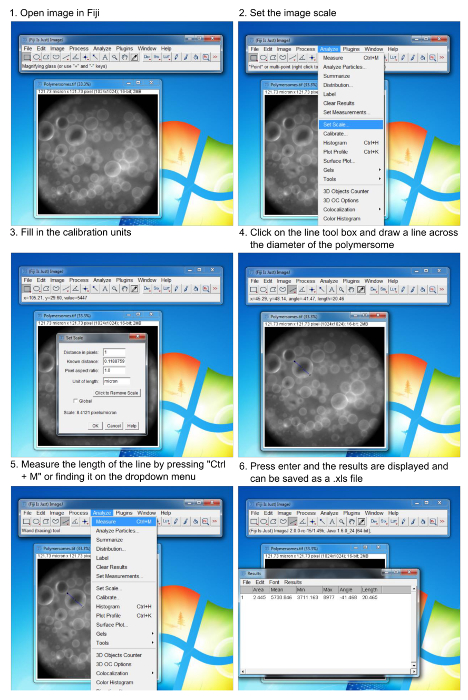
Figure 6. Process for the size analysis of polymersomes using imaging software. Step-by-step instructions on how to measure the diameter of the vesicles formed. User must know the calibration units in pixels/µm of the microscope used. Please click here to view a larger version of this figure.
- Open the acquired images of polymersomes in image analysis software13.
- Set the scale for the image by clicking on the analyze drop down box and the clicking "set scale".
- Calibrate the scale for the microscope using standard methods (i.e., a micrometer).
- Fill in the calibration units and click "ok".
- Click on the line tool box and draw a line spanning the diameter of a vesicle.
- Collect the length measurements by clicking on the analyze drop down box and clicking "measure".
- Continue measuring individual vesicles following the above procedure and each new measurement will be added to the measurements data window.
- Press "Ctrl + D" after drawing each line and measuring the length to imprint the line drawn onto the image making it easier to track which vesicles have been analyzed.
Results
Loading...
$$\rightleftharpoonup{xx}$$
$$\longleftharp{xx}$$,
$$\longrightharp{xx}$$,
Polymersomes were formed using the procedure outlined above (Figure 1) and the common laboratory equipment shown in Figure 2. Polymersomes were rehydrated with deionized water (Figure 3) and imaged on an inverted microscope in epifluorescence using a 100X oil objective. Note that if polymersomes are not visible, they might have formed at sizes too large to capture with a 100X oil objective; a lower power objective may need to be used instead. One of the advantages of using gel-assisted rehydration is the versatility of forming polymersomes in a variety of rehydration solutions. Polymersomes were successfully formed in deionized water, a full mammalian cell culture medium, sucrose solutions and two physiologically relevant buffer solutions (phosphate-buffered saline (PBS) or Tris-buffered saline (TBS)), as shown in Figure 4. Under standard conditions (rehydration with water at 40 °C for 1 hr), greater than ~70 polymersomes are typically found per 40 x 40 µm2 field of view. While the surface production of polymersomes is not homogenous, there are dozens of fields of view with this representative yield. Furthermore, polymersomes were stable in solution for at least 24 hr.
Polymersomes size was easily tuned by rehydrating polymer films at varying temperatures. Polymersomes formed in deionized water at RT had an average diameter of 2.9 ± 0.7 µm. As the temperature increases during rehydration, the average size of the polymersomes also increases (Table 1). At high temperatures (> 60 °C), polymersomes formed with sizes even greater than 100 µm (Figure 5).
All image processing was completed using open-source imaging software (Figure 6). Images collected were opened in the software program. The calibrated pixel size was entered into set scale box. Using the line tool, lines were drawn across the diameters. After each individual line was drawn, the calibrated length was measured and added to the results box. Data can then be plotted in the mathematical software of choice (e.g., Excel, Prism, Origin, etc.)
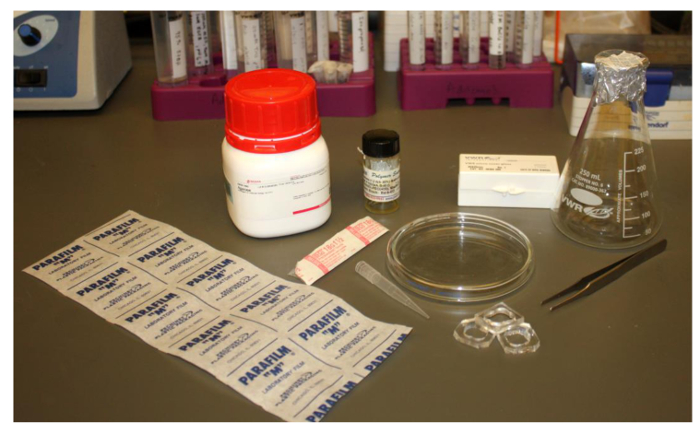
Figure 2. Picture of the common and inexpensive lab materials required for the formation of polymersomes. The items required are: Parafilm, an 18.5 G needle, polymer in chloroform or other appropriate solvent, a 1,000 µl pipette tip, an Erlenmeyer flask, tweezers, agarose, 25 mm square coverslips, PDMS imaging wells and a glass Petri dish. Please click here to view a larger version of this figure.
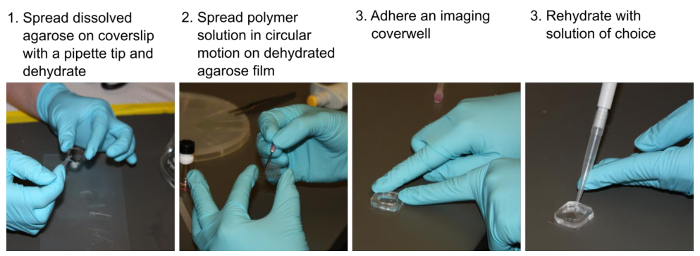
Figure 3. Pictures of the gel-assisted rehydration method. Dissolved agarose is spread on a 25 mm square coverslip until an even film coats the entire coverslip. Coverslips are then put into a 37 °C incubator and film is dehydrated. A polymer solution is deposited onto the dehydrated agarose film and spread using a needle in a circular motion. The coverslip is then place in a desiccator O/N to fully evaporate any solvent residues. Finally, and imaging chamber is adhered to the substrate and polymers are rehydrated with solution of choice and placed into a Petri dish at 40 °C for least 25 min to allow for the formation of polymersomes. Please click here to view a larger version of this figure.
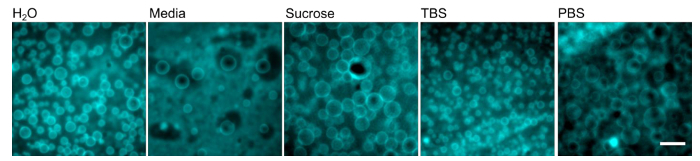
Figure 4. Polymersomes can form in a variety of different buffers. PEO-PBD polymer films were rehydrated with the indicated buffer at 40 °C for 1 hr. Scale bar = 10 µm. Please click here to view a larger version of this figure.
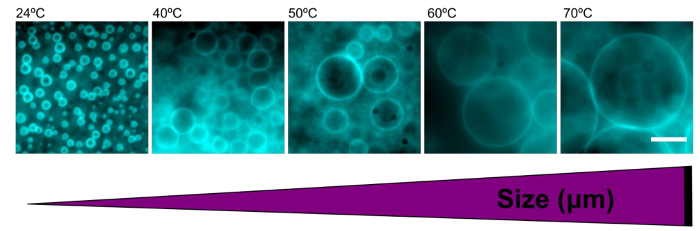
Figure 5. Increasing the temperature during rehydration increases the size of the polymersomes. Representative epifluorescence images of polymersomes formed in water at the indicated rehydration temperatures. Increasing temperature results in larger polymersomes. Scale bar = 10 µm. Please click here to view a larger version of this figure.
| Temperature (°C) | Average Size (µm) |
| 24 | 2.93 ± 0.7 |
| 40 | 5.76 ± 2.5 |
| 50 | 6.65 ± 2.4 |
| 60 | 11.46 ± 5.8 |
| 70 | 14.04 ± 7.0 |
Table 1. Increasing the temperature during rehydration results in increased polymersome size. Average diameters for greater than 100 polymersomes in water per different temperature condition were calculated and are depicted here. Error is standard deviation.
Discussion
Loading...
$$\rightleftharpoonup{xx}$$
$$\longleftharp{xx}$$,
$$\longrightharp{xx}$$,
Polymersomes are becoming widely explored as biological membrane mimics. The robust and versatile properties of polymers make them widely attractive for studies requiring membrane functionalization, longevity and tuned responsiveness. Traditional methods for forming giant-sized polymersomes9,10 (>4 µm) are labor-intensive and require expensive and specialized equipment. Here, we present for the first time, a rapid, versatile and robust method for forming giant sized polymersomes using standard inexpensive laboratory reagents and equipment.
Using gel-assisted rehydration, unilamellar polymersomes can be formed rapidly (<30 min), in a variety of rehydration solutions (including cell culture media) and with a variety of different polymers (data not shown). The formation of multilamellar or asymmetric vesicles was not observed using this technique. Throughout this work, we used poly(ethylene oxide)-b-poly(butadiene) (PEO-PBD, EO22-BD37) neutral diblock copolymer. Many different polymer compositions (including charged diblock copolymers) work well using this method (not shown). However, some commercially available triblock copolymers and higher molecular weight diblock copolymers (~ >5,000 Daltons) do not form distinct polymersomes. For all of the experiments in this manuscript, a low concentration of labeled lipid was doped into the polymer solutions for visualization purposes only. Other methods for visualization, including polymers directly functionalized with a fluorescent dye can also be used. Polymersomes can likewise be imaged with bright field microscopy, though fluorescence microscopy provides greater resolution.
Most minor modifications to the protocol typically do not alter results. For instance, small differences in concentration of the polymer solution spread onto the coverslips do not alter the formation of the polymer film formed. While the complete concentration range was not determined, polymersome formation will successfully occur with a large range of polymer film concentrations (e.g., 1-10 mg/ml). However, there are some protocol alterations that do negatively affect polymersome formation. The most notable is that round glass coverslips (instead of square) result in very poor formation of polymersomes. We attribute this to the extremely even coat of agarose on the glass which actually hinders the formation of polymersomes.
One of the most notable challenges of this technique is the ability to recover the polymersomes from the surface with a high yield. There are certain instances in which removing the polymersomes from the original surface can be advantageous. Due to the high background fluorescence from the dehydrated polymer film, removing individual polymersomes and adhering them to clean coverslips will increase imaging quality and characterization (particularly during FRAP analysis). To do this, gentle pipetting with a pipette tip in which the end has been cut off will desorb the polymersomes from the surface (though the number of vesicles recovered is significantly lower than those originally formed). Polymersomes can then be placed on modified coverslip surfaces, allowing the polymersome to interact with the new coverslip. Typically, for neutral PEO-PBD polymersomes, coverslips treated with ozone for 15 min allow the polymersomes to fall down to the surface for imaging. Different surface modification is required for different polymersome compositions (e.g., negatively or positively charged polymers).
Most materials used in this protocol are successfully stored and used for days to weeks. The solidified agarose can be reboiled and reused until the agarose begins to have aggregates even after boiling, or the solidified agarose begins to dry. Coverslips with dried agarose films can be stored and used indefinitely (e.g., months). The polymer dissolved in chloroform can be stored at -20 °C for several months. Once the polymer film is dried on the agarose films, however, the films need to be stored under house vacuum and used within two weeks (longer term storage was not directly determined, but there are noticeable differences in polymersomes formed from polymer films older than two weeks).
Using the gel-assisted rehydration protocol presented here, hundreds of uniformly-shaped polymersomes are formed rapidly with just a few hours of labor using standard equipment and inexpensive laboratory reagents. Furthermore, polymersomes can be formed in a variety of physiological buffer solutions and from different polymer compositions (not shown). Minor alterations to the method do not negatively alter the formation of polymersomes, rendering gel-assisted rehydration a versatile and accessible technique to scientists with varying technical expertise.
The ability to easily create giant polymersomes on the size scale of cells is essential for building artificial cell-like systems. The ease of use and versatility of gel-assisted rehydration to make these polymersomes offers a huge advancement in the biomimetic field for the creation of robust cell-membrane mimics. For example, using this technique, strategies for encapsulation of different intracellular components, functionalization of the polymer with cell-membrane proteins and incorporation of membrane transport proteins, just to name a few, can be designed to build polymersome-based artificial cells.
Disclosures
Loading...
$$\rightleftharpoonup{xx}$$
$$\longleftharp{xx}$$,
$$\longrightharp{xx}$$,
Sandia National Laboratories is a multi-program laboratory managed and operated by Sandia Corporation, a wholly owned subsidiary of Lockheed Martin Corporation, for the U.S. Department of Energy's National Nuclear Security Administration under contract DE-AC04-94AL85000.
Acknowledgements
Loading...
$$\rightleftharpoonup{xx}$$
$$\longleftharp{xx}$$,
$$\longrightharp{xx}$$,
We would like to gratefully acknowledge Dr. Ian M. Henderson, Andrew Gomez and Dr. Walter F. Paxton for their technical expertise, advice and help in this work. This work was supported by the U.S. Department of Energy, Office of Basic Energy Sciences, Division of Materials Sciences and Engineering (BES-MSE). ACG, DYS and GDB were supported by BES-MSE. This work was performed, in part, at the Center for Integrated Nanotechnologies, an Office of Science User Facility operated for the U.S. Department of Energy (DOE) Office of Science (user project number RA2015A0004, PI: ACG).
Materials
| Name | Company | Catalog Number | Comments |
|---|---|---|---|
| 125 ml Erlenmeyer flask | VWR | 89000-360 | |
| 18 guage needle | VWR | BD-305196 | |
| 25 mm square coverslips | VWR | 48366-089 | |
| Agarose | Sigma | A9539 | A standard agarose for DNA gel electrophoresis |
| Chloroform | Sigma | 288306-2L | |
| Commerical coverwell | Electron Microscopy Sciences | 70336 | Press-to-Seal Silicone Isolators |
| Fiji Image Analysis Software | ImageJ | Free Download: http://fiji.sc/Fiji | |
| Glass vial with Teflon Lid | VWR | 66009-556 | 1.9 ml capacity, case of 144 |
| Liss-rhodamine B PE Lipid | Avanti Polar Lipids | 810150C | 1 mg of lipid at 1 mg/ml concentration in chloroform |
| Parafilm | VWR | 52858-000 | 10.2 cm x 38.1 m |
| poly(ethylene oxide)-b-poly(butadiene) or PEO-PBD (with a molecular weight of 2,940) | Polymer Source | P2904-BdEO | http://polymersource.com/dataSheet/P2904-BdEO.pdf |
| Pastic Petri Dish | VWR | 25384-092 | |
| Teflon tape | VWR | 300001-057 | 1/2" width |
References
Loading...
$$\rightleftharpoonup{xx}$$
$$\longleftharp{xx}$$,
$$\longrightharp{xx}$$,
- Streicher, P., et al. Integrin reconstituted in GUVs: A biomimetic system to study initial steps of cell spreading. Biochim. Biophys. Acta. 1788 (10), 2291-2300 (2009).
- Paxton, W., Bouxsein, N. F., Henderson, I., Gomez, A., Bachand, G. Dynamic Assembly of Polymer Nanotube Networks via Kinesin Powered Microtubule Filaments. Nanoscale. , (2015).
- Bermudez, H., Brannan, A. K., Hammer, D. a, Bates, F. S., Discher, D. E. Molecular weight dependence of polymersome membrane structure, elasticity, and stability. Macromolecules. 35 (21), 8203-8208 (2002).
- Amos, R. C., Nazemi, A., Bonduelle, C. V., Gillies, E. R. Tuning polymersome surfaces: functionalization with dendritic groups. Soft Matter. 8 (21), 5947-5958 (2012).
- Egli, S., et al. Biocompatible functionalization of polymersome surfaces: A new approach to surface immobilization and cell targeting using polymersomes. J. Am. Chem. Soc. 133 (12), 4476-4483 (2011).
- Kim, K. T., Cornelissen, J. J. L. M., Nolte, R. J. M., Van Hest, J. C. M. A polymersome nanoreactor with controllable permeability induced by stimuli-responsive block copolymers. Adv. Mater. 21 (27), 2787-2791 (2009).
- Paxton, W. F., Price, D., Richardson, N. J. Hydroxide ion flux and pH-gradient driven ester hydrolysis in polymer vesicle reactors. Soft Matter. 9, 11295-11302 (2013).
- Henderson, I. M., Paxton, W. F. Salt, shake, fuse - Giant hybrid polymer/lipid vesicles through mechanically activated fusion. Angew. Chem. Int. Ed. 53 (13), 3372-3376 (2014).
- Discher, B. M. Polymersomes: Tough Vesicles Made from Diblock Copolymers. Science. 284 (5417), 1143-1146 (1999).
- Howse, J. R., et al. Templated formation of giant polymer vesicles with controlled size distributions. Nat Mat. 8 (6), 507-511 (2009).
- Horger, K. S., Estes, D. J., Capone, R., Mayer, M. Films of Agarose Enable Rapid Formation of Giant Liposomes in Solutions of Physiologic Ionic Strength Films of Agarose Enable Rapid Formation of Giant Liposomes in Solutions of Physiologic Ionic Strength. J. Am. Chem. Soc. , 1-24 (2009).
- Axelrod, D., Koppel, D. E., Schlessinger, J., Elson, E., Webb, W. W. Mobility measurement by analysis of fluorescence photobleaching recovery kinetics. Biophys. J. 16 (9), 1055-1069 (1976).
- Schindelin, J., et al. Fiji: an open-source platform for biological-image analysis. Nat meth. 9 (7), 676-682 (2012).
Reprints and Permissions
Request permission to reuse the text or figures of this JoVE article
Request Permission