The integration of conductive nanoparticles, such as graphene nanoplatelets, into glass fiber composite materials creates an intrinsic electrical network susceptible to strain. Here, different methods to obtain strain sensors based on the addition of graphene nanoplatelets into the epoxy matrix or as a coating on glass fabrics are proposed.
A subscription to JoVE is required to view this content. Sign in or start your free trial.
Method Article
Strain Sensing Based on Multiscale Composite Materials Reinforced with Graphene Nanoplatelets
In This Article
Summary
Abstract
The electrical response of NH2-functionalized graphene nanoplatelets composite materials under strain was studied. Two different manufacturing methods are proposed to create the electrical network in this work: (a) the incorporation of the nanoplatelets into the epoxy matrix and (b) the coating of the glass fabric with a sizing filled with the same nanoplatelets. Both types of multiscale composite materials, with an in-plane electrical conductivity of ~10-3 S/m, showed an exponential growth of the electrical resistance as the strain increases due to distancing between adjacent functionalized graphene nanoplatelets and contact loss between overlying ones. The sensitivity of the materials analyzed during this research, using the described procedures, has been shown to be higher than commercially available strain gauges. The proposed procedures for self-sensing of the structural composite material would facilitate the structural health monitoring of components in difficult to access emplacements such as offshore wind power farms. Although the sensitivity of the multiscale composite materials was considerably higher than the sensitivity of metallic foils used as strain gauges, the value reached with NH2 functionalized graphene nanoplatelets coated fabrics was nearly an order of magnitude superior. This result elucidated their potential to be used as smart fabrics to monitor human movements such as bending of fingers or knees. By using the proposed method, the smart fabric could immediately detect the bending and recover instantly. This fact permits precise monitoring of the time of bending as well as the degree of bending.
Introduction
Structural health monitoring (SHM) has become increasingly important because of the need to know the remaining life of structures1-3. Nowadays, difficult to access locations, such as offshore wind plants, lead to higher risks in maintenance operations, as well as greater costs2-4. Self-sensing materials constitute one of the possibilities in the field of SHM due to their ability of self-monitoring strain and damage5.
In the case of wind turbines, blades are generally manufactured in glass fiber/epoxy composite materials, which are electrically insulators. In order to confer self-sensing properties to this composite material, an intrinsic electrical network susceptible to strain and damage needs to be created. During the last few years, the incorporation of conductive nanoparticles such as silver nanowires6,7, carbon nanotubes (CNTs)8-10, and graphene nanoplatelets (GNPs)11-13 has been studied to create this electrical network. These nanoparticles can be incorporated into the system as filler into the polymer matrix or by coating the glass fiber fabric14. These materials can be also applied to other industrial fields, i.e., aerospace, automotive and civil engineering5, and coated fabrics can be used as smart materials in biomechanical applications7,15.
Piezoresistivity of these sensors is achieved by three different contributions. The first contribution is the intrinsic piezoresistivity of the nanoparticles; a strain of the structure changes the electrical conductivity of the nanoparticles. However, the main contributions are changes in tunnel electrical resistance, due to modifications in distances between adjacent nanoparticles, and electrical contact resistance, because of variations in the contact area between overlying ones9. This piezoresistivity is higher when 2D nanoparticles are used as a nanofiller compared to 1D nanoparticles because the electrical network presents a higher susceptibility to geometrical changes and discontinuities, usually one order of magnitude superior16.
Due to the 2D atomic character17 and the high electrical conductivity18,19, graphene nanoplatelets have been selected in this work as the nano-reinforcer of multiscale composite materials in order to obtain self-sensors with enhanced sensitivity. Two different ways to incorporate the GNPs into the composite material are studied in order to elucidate possible differences in sensing mechanisms and sensitivity.
Access restricted. Please log in or start a trial to view this content.
Protocol
1. Preparation of the Functionalized Graphene Nanoplatelet Filled Epoxy for Multiscale Composite Materials
- Disperse functionalized graphene nanoplatelets (f-GNPs) into the epoxy resin.
- Weigh 24.00 g of f-GNPs to achieve a 12 wt% of the final nanocomposite material inside a ductless fume hood.
- Add 143.09 g of the bisphenol A diglycidyl ether (DGEBA) monomer and manually mix it to achieve homogeneity.
- Disperse the f-GNPs into the monomer by a twostep method, which combines probe sonication and calendering processes20.
- Sonicate the mixture at 50% of the amplitude and a cycle of 0.5 sec for 45 min.
- Apply 3 cycles of calendering using a roller gap of 5 µm and increasing roller speed at each cycle: 250 rpm, 300 rpm and 350 rpm.
- Weigh the mixture of f-GNP/monomer after completing dispersion.
- Degas the f-GNP/monomer mixture under vacuum and magnetic stirring at 80 °C for 15 min.
- Weigh and add the hardener in a weight ratio of 100:23 (monomer:hardener) and manually stir until achieving homogeneity.
2. Coating of the Glass Fabric with Functionalized Graphene Nanoplatelet Filled Sizing (Suspension) for Multiscale Composite Materials
- Disperse functionalized graphene nanoplatelets into the sizing.
- Weigh 7.5 g of f-GNPs, the quantity needed to achieve a 5 wt%, into 142.5 g of solvent (sizing/distilled water specified in 2.1.2) inside a ductless fume hood.
- Prepare the mixture of the f-GNPs and the sizing diluted with distilled water (1:1 wt) inside the ductless fume hood. Once the distilled water has been added, perform the work outside the ductless fume hood.
- Disperse the GNPs by probe sonication for 45 min at 50% amplitude and a cycle of 0.5 sec.
- Coat the glass fabric with the f-GNP filled sizing.
- With scissors suited for fabric cutting, cut 14 layers of glass fabric with dimensions of 120 х 120 mm2 and then coat them with the mixture of f-GNPs and sizing (2.1.3) by dip coating (one immersion) using a dip coater in the f-GNP filled sizing.
- Dry the f-GNP coated glass fabric in a vacuum oven at 150 °C for 24 hr as indicated in the technical sheets provided by the manufacturer.
3. Manufacturing of Multiscale Composite Materials
- Manufacture f-GNP/epoxy composite materials.
- After degassing the mixture, keep the f-GNP filled epoxy resin under magnetic stirring at 80 °C for all the manufacturing process.
- Place the 14 layers of the glass fabric into an oven at 80 °C.
- Alternatively, place a layer of the f-GNP filled epoxy and a layer of glass fiber fabric (14 layers) sequentially by hand on a metallic plate using a de-airing roller after placing each glass fabric layer.
- Use scissors to cut and place the anti-adherent polymer film (120 х 120 mm2) on a steel plate.
- Apply a layer of the f-GNP/epoxy mixture on the anti-adherent polymer film with a brush. Place a layer of glass fiber fabric. Note the importance of covering the area of the f-GNP/epoxy region and alignment of the different fabric layers. Remove the air and compact the plies by using a de-airing roller.
- Repeat step 3.1.3.2 until completing all of the layers of the laminate.
- Apply a final layer of the f-GNP/epoxy mixture with brush and cover the laminate with another layer of anti-adherent polymer film.
- Once all the fabric layers have been piled up, cure the laminate in a hot plate press at 140 °C for 8 hr with increasing pressure up to 6 bars.
- Extract the cured laminate from the hot plate press.
- Manufacture f-GNP/glass fiber composite materials by vacuum assisted resin infusion molding (VARIM).
- Prepare the metallic plate where VARIM is going to be carried out.
- Clean the steel plate surface with acetone.
- Place anti-adherent polymer film onto the steel plate.
- Place the sequence of f-GNP coated glass fabric (14 layers with dimensions 120 х 120 mm2) onto the plate. Ensure that the layers of fabric are aligned visually and by touch.
- Seal the vacuum bag with sealant tape for the VARIM process and pre-heat the system at 80 °C in an oven.
- Degas the DGEBA monomer under vacuum and magnetic stirring at 80 °C for 15 min. Add the hardener in a weight ratio of 100:23 (monomer:hardener) and stir until achieving homogeneity.
- Add the epoxy resin at 80 °C with a vacuum pump connected to the vacuum bag with a polymeric tube until the glass fabric pile is totally filled by the epoxy resin and cure the laminate in an oven at 140 °C for 8 hr.
- Extract the cured laminate from the oven and remove the vacuum bag and auxiliary material.
- Prepare the metallic plate where VARIM is going to be carried out.
4. Preparation of the Samples for Strain Sensors Tests
- Machine samples (Computer Numerical Control - CNC milling machine) of multiscale laminates to the required dimension for flexural tests following the ASTM D790-0221 and cut glass fabric bands 10 mm in width in order to study the strain sensitivity of the f-GNP coated fabric.
NOTE: Samples are fixed onto the machining table with adhesive tape and machined using the following parameters: feed speed of 500 mm/min, idle speed of 5,000 min-1 and depth steps of 0.1 mm. - Carefully clean the surface of the machined samples with acetone to eliminate dust.
- Paint lines of silver (acrylic conductive paint) on the surface of the materials distanced 20 mm apart to minimize the electrical contact resistance and adhere copper wires to the wet silver lines as electrodes to facilitate the measurement of the electrical resistance during the tests.
NOTE: Electrical contacts are located on both surfaces: compression surfaces and tensile subjected surfaces. - Once the silver paint is dry, fix the electrical contacts with hot melt adhesive to avoid electrical contact detachment.
5. Testing the Strain Sensor
- Analyze the electrical behavior of sensors under flexural loads (three-point bending test).
- Measure the specimen's width and thickness with a caliper.
- Set the specimen in the mechanical test machine with the flexural test configuration.
- Set the test speed (controlled by strain) to 1 mm/min and the start position that defines the initial length of the specimen.
- Connect the electrical contacts to the multimeter. Measure the electrical resistance between each two adjacent electrical contacts as it is specified in Figure 1.
- Run flexural test and monitor the electrical resistance simultaneously in order to study variations due to the induced strain in the specimen.
- Repeat all steps for at least 3 specimens of f-GNP/epoxy and f-GNP/glass fiber composite materials to confirm the electrical behavior of the composite materials.
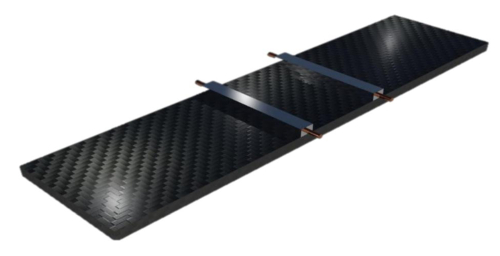
Figure 1. Electrical contacts setup in flexural tests of multiscale composite materials. Copper electrodes are attached on the surface of composite materials by using lines of silver paint (in gray) in order to minimize the electrical contact resistance. Please click here to view a larger version of this figure.
- Analyze f-GNP/glass fabric as strain sensors of human movements.
- Monitor finger bending.
- Attach glass fabric bands to each of the fingers of a nitrile glove with hot melt adhesive on the internal surface as indicated in Figure 2.
- Repeat step 5.1.4 but measure the electrical resistance of contacts placed on the same finger.
- Start the sequence of finger bending to monitor and measure the electrical resistance while fingers are bending. The sequence of finger bending in this particular case is: (1) thumb, (2) index, (3) middle finger, (4) ring finger, (5) all the fingers simultaneously and (6) sequence of bending (higher speed): (1), (2), (3), (4), (4), (3), (2) and (1).
- Monitor finger bending.
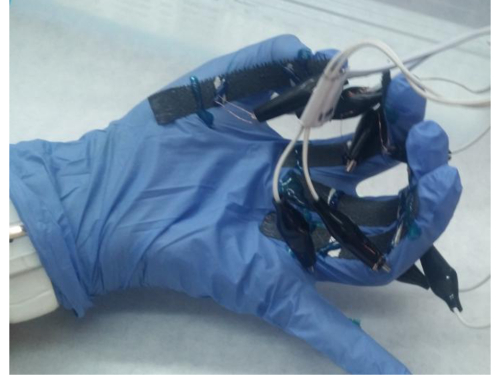
Figure 2. Location of f-GNP/glass fiber bands on the internal surface of the fingers of a nitrile glove to monitor fingers bending. Once the glass fiber fabric has been coated and dried, bands 10 mm in width are cut and attached on the different fingers of a glove with the aim of monitoring the finger bending and corroborate the viability of the protocol described above. Please click here to view a larger version of this figure.
Access restricted. Please log in or start a trial to view this content.
Results
The protocol to obtain two different materials has been described in the procedure. The difference is in the way the nanoreinforcement is incorporated in the composite material to achieve an electrical network that could be used to strain monitoring. The first method consists of the coating of a glass fiber fabric with f-GNP sizing that can be used as a smart fabric (named f-GNP/glass fiber) or as reinforcement of polymer matrix multiscale composite materials (named f-GNP/glass fiber comp...
Access restricted. Please log in or start a trial to view this content.
Discussion
Self-sensor properties of nanoreinforced composite materials are due to the electrical network created by the f-GNPs through the epoxy matrix and along the glass fibers, which is modified when strain is induced. Dispersion of the f-GNPs is then crucial because the electrical behavior of the sensors strongly depends on the microstructure of the material. Here, we present an optimized procedure to achieve a good dispersion of the GNPs into the epoxy matrix and to avoid wrinkling of the nanoparticles, which causes the detri...
Access restricted. Please log in or start a trial to view this content.
Disclosures
The authors have nothing to disclose.
Acknowledgements
The authors would like to acknowledge the Ministerio de Economía y Competitividad of Spain Government (Project MAT2013-46695-C3-1-R) and Comunidad de Madrid Government (P2013/MIT-2862).
Access restricted. Please log in or start a trial to view this content.
Materials
| Name | Company | Catalog Number | Comments |
|---|---|---|---|
| Graphene Nanoplatelets | XGScience | M25 | NA |
| Epoxy resin | Huntsman | Araldite LY556 | NA |
| XB3473 | NA | ||
| Probe sonication | Hielscher | UP400S | NA |
| Three roll mill | Exakt | Exakt 80E (Exakt GmbH) | NA |
| Glass fiber fabric | Hexcel | HexForce ® 01031 1000 TF970 E UD 4H | NA |
| Hot plate press | Fontijne | Fontijne LabEcon300 | NA |
| Sizing | Nanocyl | SizicylTM | NA |
| Multimeter | Alava Ingenieros | Agilent 34410A | NA |
| Strain Gauges | Vishay | Micro-Measurement (MM®) CEA-06-187UW-120 | NA |
| Mechanical tests machine | Zwick | Zwick/Roell 100 kN | NA |
| Conductive silver paint | Monocomp | 16062 – PELCO® Conductive Silver Paint | NA |
References
- Farrar, C. R., Worden, K. An introduction to structural health monitoring. Philos Trans Math Phys Eng Sci. 365, 303-315 (2007).
- Lorenzo, E. D., et al. Structural Health Monitoring challenges on the 10-MW offshore wind turbine model. J Phys Conf Ser. 628, 012081(2015).
- Braga, D. F. O. O., et al. Advanced design for lightweight structures: Review and prospects. Prog Aerosp Sci. 69, 29-39 (2014).
- Garcìa Márquez, F. P., Tobias, A. M., PinarPérez, J. M., Papaelias, M. Condition monitoring of wind turbines: Techniques and methods. Renew Energy. 46, 169-178 (2012).
- Chung, D. D. L. Self-monitoring structural materials. Mater Sci Eng R Reports. 22, 57-78 (1998).
- Kandare, E., et al. Improving the through-thickness thermal and electrical conductivity of carbon fibre/epoxy laminates by exploiting synergy between graphene and silver nano-inclusions. Compos Part A Appl Sci Manuf. 69, 72-82 (2015).
- Amjadi, M., Pichitpajongkit, A., Lee, S., Ryu, S., Park, I. Highly stretchable and sensitive strain sensor based on silver nanowire-elastomer nanocomposite. ACS Nano. 8, 5154-5163 (2014).
- Alamusi, H. N., Fukunaga, H., Atobe, S., Liu, Y., Li, J. Piezoresistive strain sensors made from carbon nanotubes based polymer nanocomposites. Sensors. 11, 10691-10723 (2014).
- Njuguna, M. K. K., Yan, C., Hu, N., Bell, J. M. M., Yarlagadda, P. K. D. V. Sandwiched carbon nanotube film as strain sensor. Compos Part B Eng. 43, 2711-2717 (2012).
- Liu, Y., Rajadas, A., Chattopadhyay, A. A biomimetic structural health monitoring approach using carbon nanotubes. JOM. 64, 802-807 (2012).
- Eswaraiah, V., Balasubramaniam, K., Ramaprabhu, S. Functionalized graphene reinforced thermoplastic nanocomposites as strain sensors in structural health monitoring. J Mater Chem. 21, 12626-12628 (2011).
- Chiacchiarelli, L. M., et al. The role of irreversible and reversible phenomena in the piezoresistive behavior of graphene epoxy nanocomposites applied to structural health monitoring. Compos Sci Technol. 80, 73-79 (2013).
- Le, J., Du, H., Dai, S. Use of 2D Graphene Nanoplatelets (GNP) in cement composites for structural health evaluation. Compos Part B. 67, 555-563 (2014).
- Ren, X., Burton, J., Seidel, G. D., Lafdi, K. Computational multiscale modeling and characterization of piezoresistivity in fuzzy fiber reinforced polymer composites. Int J Solids Struct. 54, 121-134 (2015).
- Park, M., Park, J., Jeong, U. Design of conductive composite elastomers for stretchable electronics. Nano Today. 9, 244-260 (2014).
- Kim, Y. J., et al. Preparation of piezoresistive nano smart hybrid material based on graphene. Curr Appl Phys. 11, S350-S352 (2011).
- Sadeghi, M. M., Pettes, M. T., Shi, L. Thermal transport in graphene. Solid State Commun. 152, 1321-1330 (2012).
- Potts, J. R., Dreyer, D. R., Bielawski, C. W., Ruoff, R. S. Graphene-based polymer nanocomposites. Polymer. 52, 5-25 (2011).
- Zaman, I., et al. A facile approach to chemically modified graphene and its polymer nanocomposites. Adv Funct Mater. 22, 2735-2743 (2012).
- Moriche, R., et al. Morphological changes on graphene nanoplatelets induced during dispersion into an epoxy resin by different methods. Compos Part B Eng. 72, 199-205 (2015).
- ASTM International. ASTM D790-15e2, Standard Test Methods for Flexural Properties of Unreinforced and Reinforced Plastics and Electrical Insulating Materials. , West Conshohocken, PA. http://www.astm.org/cgi-bin/resolver.cgi, D790(2015).
- Gong, S., Zhu, Z. H., Meguid, S. A. Carbon nanotube agglomeration effect on piezoresistivity of polymer nanocomposites. Polymer. 55, 5488-5499 (2014).
- Zhao, J., et al. Ultra-sensitive strain sensors based on piezoresistive nanographene films. Appl Phys Lett. 101, 063112(2012).
- Galpaya, D., et al. Recent advances in fabrication and characterization of graphene-polymer nanocomposites. Graphene. 1, 30-49 (2012).
- Kanoun, O., et al. Flexible Carbon Nanotube Films for High Performance Strain Sensors. Sensors. 14, 10042-10071 (2014).
- Zaman, I., et al. Epoxy/graphene platelets nanocomposites with two leves of interface strength. Polymer. 52, 1603-1611 (2011).
- Chu, K., Li, W. S., Dong, H. Role of graphene waviness on the thermal conductivity of graphene composites. Appl Phys A. 111, 221-225 (2013).
- Monti, M., et al. Morphology and electrical properties of graphene-epoxy nanocomposites obtained by different solvent assisted processing methods. Compos Part A. 46, 166-172 (2013).
- Moazzami Gudarzi, M., Sharif, F. Enhancement of dispersion and bonding of graphene-polymer through wet transfer of functionalized graphene oxide. Express Polym Lett. 6, 1017-1031 (2013).
- Fan, H., et al. Fabrication, mechanical properties and biocompatibility of graphene-reinforced chitosan composites. Biomacromolecules. 11, 2345-2351 (2010).
- Teomete, E. Transverse strain sensitivity of steel fiber reinforced cement composites tested by compression and split tensile tests. Constr Build Mater. 55, 136-145 (2014).
- Nauman, S., Cristian, I., Koncar, V. Simultaneous Application of Fibrous Piezoresistive Sensors. Sensors. 11, 9478-9498 (2011).
- Han, B., Ding, S., Yu, X. Intrinsic self-sensing concrete and structures A review. Measurement. 59, 110-128 (2015).
Access restricted. Please log in or start a trial to view this content.
Reprints and Permissions
