Method Article

Determination of Zeta Potential via Nanoparticle Translocation Velocities through a Tunable Nanopore: Using DNA-modified Particles as an Example

DOI:

10.3791/54577

October 26th, 2016

In This Article

Summary

Loading...
$$\rightleftharpoonup{xx}$$ $$\longleftharp{xx}$$, $$\longrightharp{xx}$$,

Here we use a polyurethane tunable nanopore integrated into a resistive pulse sensing technique to characterize nanoparticles surface chemistry via the measurement of particle translocation velocities, which can be used to determine the zeta potential of individual nanoparticles.

Abstract

Loading...
$$\rightleftharpoonup{xx}$$ $$\longleftharp{xx}$$, $$\longrightharp{xx}$$,

Nanopore technologies, known collectively as Resistive Pulse Sensors (RPS), are being used to detect, quantify and characterize proteins, molecules and nanoparticles. Tunable resistive pulse sensing (TRPS) is a relatively recent adaptation to RPS that incorporates a tunable pore that can be altered in real time. Here, we use TRPS to monitor the translocation times of DNA-modified nanoparticles as they traverse the tunable pore membrane as a function of DNA concentration and structure (i.e., single-stranded to double-stranded DNA).

TRPS is based on two Ag/AgCl electrodes, separated by an elastomeric pore membrane that establishes a stable ionic current upon an applied electric field. Unlike various optical-based particle characterization technologies, TRPS can characterize individual particles amongst a sample population, allowing for multimodal samples to be analyzed with ease. Here, we demonstrate zeta potential measurements via particle translocation velocities of known standards and apply these to sample analyte translocation times, thus resulting in measuring the zeta potential of those analytes.

As well as acquiring mean zeta potential values, the samples are all measured using a particle-by-particle perspective exhibiting more information on a given sample through sample population distributions, for example. Of such, this method demonstrates potential within sensing applications for both medical and environmental fields.

Introduction

Loading...
$$\rightleftharpoonup{xx}$$ $$\longleftharp{xx}$$, $$\longrightharp{xx}$$,

Functionalized nanoparticles are becoming increasingly popular as biosensors in both medical and environmental fields. The ability to alter a nanoparticle's surface chemistry, with DNA, for example, is proving useful for targeted drug delivery systems1 and monitoring DNA-protein interactions2-4. An increasingly common nanoparticle property being utilized in bioassays and in the delivery of therapeutics is superparamagnetism5. Superparamagnetic particles (SPPs) are extremely useful in identifying and removing specific analytes from complex mixtures and can do so with the simple use of a single magnet. Once removed, the analyte-bound par....

Access restricted. Please log in or start a trial to view this content.

Protocol

Loading...
$$\rightleftharpoonup{xx}$$ $$\longleftharp{xx}$$, $$\longrightharp{xx}$$,

1. Making the Phosphate Buffered Saline with Tween-20 (PBST) Buffer

  1. Dissolve one PBS tablet (0.01 M phosphate buffer, 0.0027 M Potassium Chloride, 0.137 M Sodium Chloride, pH 7.4) in 200 ml deionized water (18.2 MΩ cm).
  2. Add 100 µl (0.05 (v/v)%) Tween-20 to the 200 ml buffer solution as a surfactant.

2. Preparing the Carboxyl Polystyrene Particle Standards

  1. Vortex the calibration particles for 30 sec before sonication for 2 min at 80 watts to create monodispersity of the particles.
  2. Dilute the calibration particles 1 in 100 to a concentration of 1x10¹⁰ particles/ml in PBS....

Access restricted. Please log in or start a trial to view this content.

Results

Loading...
$$\rightleftharpoonup{xx}$$ $$\longleftharp{xx}$$, $$\longrightharp{xx}$$,

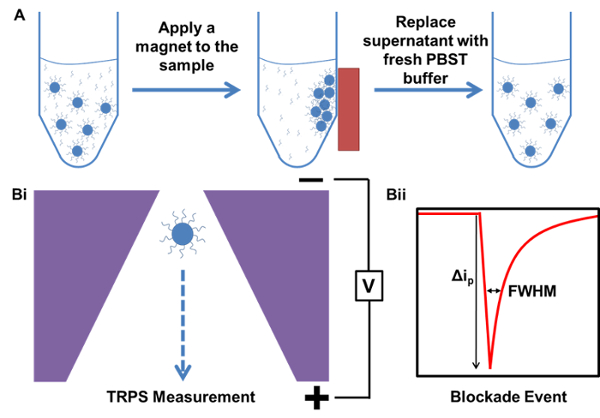
Magnetic separation and TRPS diagram for nanoparticle analysis; blockade event data graph.
Figure 1. Schematic representation of the processes of magnetic purification and a TRPS measurement. A) Example of magnetic purification of sample starting with a sample containing excess, unbound capture probe DNA. B) TRPS measurement e.......

Access restricted. Please log in or start a trial to view this content.

Discussion

Loading...
$$\rightleftharpoonup{xx}$$ $$\longleftharp{xx}$$, $$\longrightharp{xx}$$,

The calculation for the zeta potential used a calibration based method related to work by Arjmandi et al.21. The duration of the translocation of particles as they traverse a nanopore is measured as a function of applied voltage, using an average electric field and particle velocities over the entirety of a regular conical pore.  The electrophoretic mobility is the derivative of 1/T (where T is the blockade duration) with respect to voltage, multiplied by the square of the sensing zone length, l

Access restricted. Please log in or start a trial to view this content.

Disclosures

Loading...
$$\rightleftharpoonup{xx}$$ $$\longleftharp{xx}$$, $$\longrightharp{xx}$$,

E.L.C.J.B. is supported by Izon Science Ltd.

Acknowledgements

Loading...
$$\rightleftharpoonup{xx}$$ $$\longleftharp{xx}$$, $$\longrightharp{xx}$$,

The authors thank Izon Science Ltd for their support. The work was supported by the European Commission for Research (PCIG11-GA-2012-321836 Nano4Bio). 

....

Access restricted. Please log in or start a trial to view this content.

Materials

List of materials used in this article
NameCompanyCatalog NumberComments
Phosphate buffered Saline (PBS)Sigma Aldrich, UKP44171 tablet dissolved in 200 ml deionized water to make buffer solution.
Tween-20Sigma Aldrich, UKP13790.05% (v/v) in PBS buffer as a surfactant
Carboxyl polystyrene nanoparticlesBangs Laboratories, USCPC200Nominal diamter of 220 nm, raw concentration of 1 x 10¹² particles/ml, specific surface charge of 86 µeq/g (equivalent to a surface charge density of 3.2 x 10¹⁹ C/nm2.
Streptavidin coated nanoparticlesAdemtech, France3121Batch had binding capacity of 4,352 pmol/mg (188 nM theoretical DNA binding capacity) at a raw concentration of 1.1 x 10¹¹ particles/ml.
Biotinylated oligonucleotidesSigma Aldrich, UKVC00001Supplier spec: Reverse Phase 1 purification (0.05 Scale); Biotin modification at 3' end; Lyophilized powders reconstituted to 100 µM using deionized water, and diluted as required. Sequences: CP 5'ATGGTTAAACCTCACTAC GCGTGGC[Btn]3'
Standard olignonucleotidesSigma Aldrich, UKVC00001Supplier spec: Reverse Phase 1 purification (0.05 Scale); Lyophilized powders reconstituted to 100 µM using deionized water, and diluted as required. Sequences of DNA targets: Fully complementary - 5'GCCACGCGTAGTGA GGTTTAACCAT3', Middle binding - 5'GTAGTGAGGT3', End binding - 5'GTTTAACCAT3', Partially complementary overhanging - 5'GTGAGGTTTAACCAT TTTTTTTTTTTTTTT3'.
Izon qNanoIzon Science, NZInherent pressure on system of 47 Pa
Izon Variable Pressure Module (VPM)Izon Science, NZEach 'cm' of pressure is equivalent to approximately 100 Pa.
Polyurethane nanopore membranesIzon Science, NZNP150Analyte size range 60-480 nm, pore diameter of calculated to be 799 nm at a 45 mm stretch. 
Magrack 6GE Healthcare, UK28-9489-64
Sonic BathFisher Scientific, UK1069235380 Watts
VortexerIKA, Germany0003365000
Rotary Wheel Labnet International, USH5500-230 V

References

Loading...
$$\rightleftharpoonup{xx}$$ $$\longleftharp{xx}$$, $$\longrightharp{xx}$$,
  1. Alexander, C. M., Maye, M. M., Dabrowiak, J. C. DNA-capped nanoparticles designed for doxorubicin drug delivery. Chem Commun. 47 (12), 3418-3420 (2011).
  2. Billinge, E. R., Platt, M. Aptamer based dispersion assay using tunable resistive pulse sensing (TRPS). Anal Method....

Access restricted. Please log in or start a trial to view this content.

Reprints and Permissions

Request permission to reuse the text or figures of this JoVE article

Request Permission

Tags

TRPS AnalysisParticle CharacterizationResistive Pulse SensingNanopore MembraneSurface ChemistryBioassay Development

Related Articles