To reveal the pollinator effectiveness of a given plant species, multiple methods of field experiments have been developed. This study demonstrates the basic methods of field experiments for pollination ecology using the case study of Lycoris sanguinea var. sanguinea and the novel pollination mechanism, breaking-bud pollination.
Method Article
Field Experiments of Pollination Ecology: The Case of Lycoris sanguinea var. sanguinea
In This Article
Summary
Abstract
Plant-pollinator interactions have been studied for approximately one hundred years. During that time, many field methods have been developed to clarify the pollination effectiveness of each pollinator for visited flowers. Pollinator observations have been one of the most common methods to identify pollinators, and bagging and cage experiments have been conducted to show the effectiveness of specific pollinators. In a previous study of Lycoris sanguinea var. sanguinea, its effective pollinators, the visitation frequencies of each floral visitor, and its reproductive strategies were not identified. This study reports the observation that small bees visited flowers that were partially opened (breaking buds). To the best of our knowledge, this phenomenon has not been reported previously. Further, this study investigates the hypothesis that small bees can pollinate at that flowering stage. This study demonstrates the basic methods of field experiments in pollination ecology using L. sanguinea var. sanguinea. Pollinator observations and digital video showed the visitation frequencies of each floral visitor. Bagging and cage experiments revealed that these flowers could be pollinated fully and that breaking-bud pollination could be important for the pollination of this plant species. The advantages and disadvantages of each method are discussed, and recent developments, including laboratory experiments, are described.
Introduction
Plant-pollinator interactions are prime examples for the study of evolutionary biology and ecology. The mutualistic relationships between flowers and pollinators are thought to have promoted the diversification of angiosperm1,2 as a result of natural selection, although other biotic and abiotic factors have also exerted influence3,4,5. It is also thought that floral traits have changed to adapt to the most effective pollinators and to produce more fruit and seeds6. These beliefs have been constructed though large studies based on different indices, such as pollination effectiveness, that involve various interpretations7.
Flowering plants that have generalized pollination systems are visited by various types of pollinators8. Herein, a flower visitor was defined as an animal species that visited to get a floral reward, and pollinators were defined as floral visitors that pollinate. Some of these visitors carry conspecific pollen grains to the stigmata of the flowers visited and can be classified as pollinators. Other visitors may also have some intraspecific pollen; they might conduct less pollination due to behavioral or morphological mismatches between the pollinators and the flowers. These comparable differences in the contribution to plant reproduction could produce varying degrees of selective pressure on floral traits9 and could cause the adaptive divergence of flowering plants. Therefore, although the composition of the pollinator community and the relative species abundance are important10, the accurate evaluation of each visitor's effectiveness is also critical to determine the adaptive and/or evolutionary processes of the plants.
In this study, quantitative estimations of pollinator efficiencies, defined as the fruit and seed production per visitation frequency, were determined11. The species and frequency of each floral visitor were observed, and reproductive effects on the visited flowers were estimated. The recording of floral visits through human observations is a classical method in pollination ecology. However, this method imposes a large burden on observers, who are required to remain in front of the plants and to take careful, long-term measurements. Recently, the technologies of filming and recording have rapidly developed, and low-cost digital video cameras have enabled the introduction of video recording to pollinator observations12,13. These methods can facilitate the gathering of basic information on floral visitors and could help to develop an understanding of the pollination ecology of a target plant species.
However, the visitation frequencies of the pollinators are not necessarily correlated to their pollination effectiveness7,14, and it is important to evaluate the qualitative effects of each pollinator on flower fitness. Pollination effectiveness has been estimated through the number of pollen grains on the stigmata15,16, pollen tube growth17,18and fruit and/or seed production19,20. Bagging experiments, conducted using visitor-exclusive bags, are the typical methods for testing self-compatibility, autogamy21,22, and the presence of apomixes23. Additionally, the evaluation of pollination effectiveness for a certain pollinator in the visitor assemblage has been frequently conducted in environments where other floral visitors have been restricted (i.e., a wire cage, net, or bag with a mesh small enough to exclude larger pollinators that is set on flowering plants). For example, bagging experiments with small mesh bags were conducted to reveal the pollination ability of ants or thrips24,25. Moreover, bird exclusion experiments using a wire cage or net have shown the effective pollinators of the Aloe taxa26-28.
The objectives of this study were: 1) to introduce the methods used in a previous paper and 2) to improve these methods for general use in other studies on floral visitors, their visiting frequencies, and their effects on plant fitness. Lycoris sanguinea var. sanguinea is one of the species included in the genus Lycoris, which is distributed broadly throughout Japan and narrowly in Korea29and has funnel-shaped reddish-orange flowers (Figure 1a). A previous study revealed that L. sanguinea var. sanguinea was visited by multiple insect species, including an unidentified small bee species and the larger species Amegilla florea29. However, the visitation frequencies and pollination effectiveness of these visitors were not identified. Pollinator observations for the identification of floral visitors were performed first. Visitation by small bees was observed on flowers that had not completely opened yet (breaking buds; Figures 1b, c). Small bees moved hurriedly around the undehisced anthers in the breaking buds and collected pollen using their mandibles. The hypothesis was that the small bees could be pollinators at the breaking-bud stage because the gaps between the anthers and the stigmata in the flowers were smaller than the body length of the bees. Therefore, bagging experiments were conducted to test the pollination ability of small bees at the breaking-bud stage, and additionally to examine the reproductive strategies of L. sanguinea var. sanguinea. These buds were bagged after the small bees visited, which allowed an estimation of the pollination ability of the bees. The individuals were caged with unopened buds. A small-mesh cage was used, through which only small bees could pass, allowing an estimation of the pollination efficiencies of small bees throughout the entire flowering stage.
Protocol
NOTE: This article is based on our previous work30. Some parts are reprinted with permission from The Botanical Society of Japan and Springer Japan.
1 . Observation of Floral Visitors
- Selection of the Observation Fields
- Search the areas where the plant materials are distributed, and select the candidate study sites using reliable resources, such as picture books, academic journals, etc. Adjust the number of study sites to fit the research objectives (e.g., a wide range of locations for the comparison of flower visitors throughout Japan).
- Check the locations of selected candidate populations and the distances from relevant starting points, such as research institutes and accommodations, if long-term research is needed.
- Roughly estimate each population size by counting the number of plant individuals in a unit area. Select large populations for manipulated experiments using many plant individuals.
- Pre-observation of floral visitors
- Decide which target individuals in each area will be observed during the same time interval, depending on the population densities. Select 5-10 freshly-opened flowers or breaking buds as target flowers, and reject degraded ones that have already opened.
- Start the visual observation for the period of an entire day, because the flowers could be visited by various pollinators in different time ranges31,32.
- On the recording sheets, record the species name of floral visitors and the time of each visitation per hr per flower.
- Closely observe whether floral visitors touch the anthers and/or stigmata; if they do, record the visitors as pollinators. If the floral visitors only visit the flowers and do not touch the reproductive organs, record them as visitors.
- Using an insect net or hand-made aspirator, capture the floral visitors to identify and preserve them as specimens (Figure 1f). Kill the trapped visitors quickly with ethyl acetate or finger pressure to the thorax, and preserve them in a soft bag or in a plastic tube or case with 100% ethanol.
- After the observation, identify the specific names of specimens using morphological features or, in case of difficulties in identification, request the help of experts for each taxonomic group.
- Observation in the Field
- Select research sites based on their accessibility, population size, and number of floral visitors. Choose time periods that include a representative sample of floral visitors in the flowering season, and determine observation periods based on research objectives (e.g., for research on visitation-frequency fluctuations by floral visitors, long time periods should be set).
- Prepare the appropriate recording equipment, such as digital video cameras (e.g., for night recording, video cameras with an infrared function should be used).
- Select the target flowers in the same way as for 1.1.4.
- Fix the video cameras to aluminum tripods. Set the cameras with tripods in front of the target individuals, approximately 50 cm away.
- Check and modify the quantity of light and the focus of the materials on the screen displays of the cameras before filming.
- Start the visual observation and video filming at the same time for the appropriate time zones estimated by the pre-observations (in the present case, observation periods were for more than six hours on average, from approximately 05:00 am to 13:00 pm).
- Identify the species names of the visitors and pollinators, and record their names and the times of their visits on the recording sheets.
- Capture and identify the visitors and pollinators in the same way as in 1.1.4.5.
- Repeat Steps 1.2.1 to 1.2.7 for each observation period. Set the observation periods based on the research objectives and pre-observation data.
- Data Analyses After Observation
- Identify the species names of captured specimens after pollinator observation in the same way as in 1.1.4.6.
- Check the video clips and note the species names and their visit times in the same way as for the visual observation.
- Calculate the visitation frequencies per flower per hour of each floral visitor from the visual observation and video recording data. Compare these frequencies statistically between the sites and years of each visitor using appropriate statistical methods based on fundamental statistics and using suitable software, such as R, SPSS, and/or SAS33-35 (e.g., a two-way analysis of variance (ANOVA) with Tukey's honest significant difference (HSD) test in R software).
2 . Bagging and Cage Experiments
- Preparations for the Bagging and Cage Experiments
- For the bagging experiments, prepare bags that have small mesh sizes (~0.5-1 mm) and use them to completely prevent flower visitation (e.g., non-woven fabric bags were used for the bagging experiments in 2011 and 2012).
- For the cage experiments, prepare wire or plastic mesh boards with a diameter that allows the target smaller visitors to pass through but excludes the larger ones, and connect these mesh boards to form a cage. Ensure that there are no gaps larger than the mesh diameter. Adjust the size and shape of cages based on the target plant species and individual numbers.
- Bagging Experiments
- Select 30 individuals per treatment that have no damage from herbivores or from a severe environment. For treatment, choose a single flower from each individual plant, or use individual flowers on a single plant.
- Bag the target flowers in the field after labeling them with tape (serial number and alphabet; Figure 1g). Be careful not to touch the anthers or the stigmata within the bags to avoid the possibility of self-pollination.
- Carefully fix bags to the flowers using a soft string or wire (Figure 1d).
- Carefully set individual flowers upright with supports using soft string or wire to support the individuals against tilt or collapse under the weight of the bags or the wind, as necessary. Twist or wind a string or wire softly around the stalk of a target individual, so as not to create damage.
- Treatments in the bagging experiments
- For the "Control" treatment, attach the labels to the target flowers and conduct no treatment. Allow floral visitors to freely visit.
- For the "Outcrossing" treatment, cover the buds until they flower, and then remove the anthers of the bagged flowers. Put some pollen grains from multiple individuals on the stigmata.
- For the "Selfing" treatment, cover the buds until the flowers open, and put pollen from the same flowers onto their stigmata. Cover these treated flowers again.
- For the "Auto-self" treatment, cover the buds with bags until the end of the flowering season.
- For the "Breaking bud" treatment, identify the breaking buds that have been visited and observe the entrance or exit of small bees (Figures 1b, c). Remove the anthers of the breaking buds to prevent repeated pollen depositions on the same flower after visitation by small bees, and bag these buds quickly to prevent further visitations.
- For the "Flowering" treatment, bag the buds until the opening stage to avoid visitations at the breaking-bud stage. After that, remove the bags and allow the visitors to collect nectar and pollen.
- For the "Bud" treatment, remove the anthers from unopened buds and outcross them artificially. Bag these buds quickly to prevent flower visitations.
- Cage Experiments
- Cover the target plant individuals with prepared cages. Adjust the positions of caged flowers by hand to prevent contact and pollen depositions between different stigmata (Figure 1e).
- For the "Cage" treatment, select the individuals with unopened buds and put labels on them for the identification of selected flowers. Cage the individuals with labeled buds to reject the influences from before the establishment of cages (i.e., floral insects cannot visit unopened buds, and only the effects of insects that visit after the placement of cages can be estimated).
- Attach the cages firmly to the ground using iron poles to prevent entry by visitors between the cage base and the ground.
- Data Analyses After the Bagging and Cage Experiments
- Collect all of the labeled flowers at the end of the flowering season (Figure 1g) by cutting and separating them from the maternal individuals. Preserve each labeled sample separately to prevent their contamination.
- Check for the presence or absence of fruit set on each labeled flower.Record the seed numbers of each fruit in case of setting fruit.
- Calculate the ratio of fruit numbers per flower (fruit-set ratio, defined as the number of fruits divided by the number of flowers) and of seed numbers per mature fruit (seed-set ratio, defined as the number of seeds divided by the number of ovules) using all of the recorded numbers.
- Statistically compare the fruit- and seed-set ratios between the treatments using appropriate methods and software, such as those listed in 1.3.3 (e.g., one-way ANOVA with Tukey's HSD or Fisher's exact test in R software33).
- Investigations of the materials using the results of the bagging experiments
- To test the need for animal pollinators, statistically compare the results between "Control" and "Auto-self" treatments.
- To estimate the degree of pollen limitation, compare the "Control" and "Outcrossing" treatments.
- To test self-compatibility, compare the "Outcrossing" and "Selfing" treatments.
- Evaluations of the influences of breaking-bud pollination
- Compare the "Control" and "Bud" treatments to determine whether the stigmata of the breaking buds are reproductively mature and whether the value of the "Control" treatment can be used for the control at the breaking-bud stage.
- Compare the "Auto-self" and "Breaking bud" treatments to determine whether the reproductive success of flowers pollinated with small bees at the breaking-bud stage is statistically higher than that of plants performing autogamy (i.e., to test the existence of breaking-bud pollination). After that, compare these two treatments with the "Control" to estimate the pollination efficiencies of breaking-bud pollination.
- Compare the "Breaking bud," "Cage," and "Flowering" treatments to estimate the reproductive influences of breaking-bud pollination.
Results
Five populations were selected for pollinator observations. In the pre-observation phase, visitations of various insect species to opening flowers and small bees to breaking buds were confirmed. Floral visitor observations revealed that most of the visitors to all five study sites were individuals of the small bee species Lasioglossum japonicum. The total visitation record showed that the visitation ratios of this species were more than 90% at three sites (Figure 2). In contrast, the ratios of the second-most frequent visitor, Amegilla florea, were lower than 10% in these fields. These bee species also touched the stigmata of visited flowers, and they were recorded as pollinators. Other frequent flower visitors, such as Episyrphus balteatus, collected pollen without contact with the stigmata, and they were identified as visitors. At one site, the data analyses showed that the visitation frequencies of small bees recorded by visual observations were significantly higher than those recorded by video (Table 1: one-way ANOVA: Site 2: df = 1, F = 0.471, P = 0.50; Site 3: df = 1, F = 12.12, P <0.001; Site 4: df = 1, F = 1.019, P = 0.33; Site 5: df = 1, F = 1.605, P = 0.22, respectively).
Bagging and cage experiments were conducted at Site 1 in 2011 and 2012. Non-woven fabric bags, with a smaller mesh size than the body sizes of the floral visitors, and wire-mesh cages, with a larger mesh than the small bees but smaller than other visitors, were prepared. The frequent visitations of small bees to caged flowers were observed, and cages were applied. The result of the "Breaking bud" treatment showed the pollination ability of small bees visiting breaking buds. Comparisons of fruit and seed sets between the treatments described in 2.4.5 revealed the reproductive traits of Lycoris sanguinea var. sanguinea, which is predominantly animal-pollinated ("Control" vs. "Auto-self": Fisher's exact test for fruit set; P <0.001) with partially pollen-limited conditions ("Control" vs. "Outcrossing": Fisher's exact test for fruit set; P = 0.16; Fisher's exact test for seed set: P = 0.37). The comparisons also suggested that this plant has self-compatibility ("Outcrossing" vs. "Selfing": Fisher's exact test for fruit set; P = 0.48; Fisher's exact test for seed set: P = 0.32), which was consistent with previous reports36,37. Moreover, comparisons of the other treatments suggested the pollination abilities of breaking-bud pollination in L. sanguinea var. sanguinea. The stigma of this plant is mature at the bud stage ("Control" vs. "Bud": Fisher's exact test for fruit set; P = 0.80; Fisher's exact test for seed set: P = 0.41), and the value of "Control" was used for the comparisons at the breaking-bud stage. The "Breaking bud" treatment showed a higher fruit set than the "Auto-self" (Fisher's exact test for fruit set; P = 0.02), indicating the presence of pollen deposition by small bees to stigmata at the breaking-bud stage. However, it was not possible to demonstrate the advances of this pollination process. The three treatments detailed in 2.4.6.2 ("Control," "Auto-self," and "Breaking bud") showed significant differences (one-way ANOVA for fruit set; df = 2, F = 18.46, P <0.001; one-way ANOVA for seed set: df = 2, F = 3.6593, P = 0.03), but Tukey's HSD suggested that breaking-bud pollination is not very effective ("Breaking bud" vs. "Auto-self": fruit set: P = 0.10; seed set: P = 0.03). Additionally, the comparisons between the three treatments in 2.4.6.3 showed no significant differences (two-way ANOVA: df = 2, F = 0.6881, P = 0.50; two-way ANOVA for seed set: df = 2, F = 1.2376, P = 0.30).
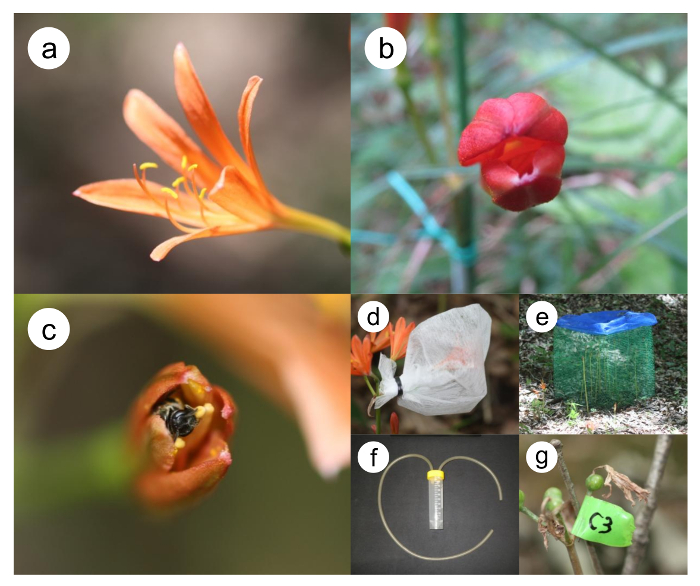
Figure 1: Plant materials and experimental equipment. (a) A flower of the target plant species, Lycoris sanguinea var. sanguinea. (b) A breaking bud. (c) A small bee visiting the breaking buds to collect pollen grains. (d) An example from the bagging experiment. (e) A wire-mesh cage covering some unopened buds. (f) An aspirator that was used mainly for the capture of small bees. (g) An example of the labeling system. "C" means that this flower was used for the bagging experiment for breaking buds. Please click here to view a larger version of this figure.
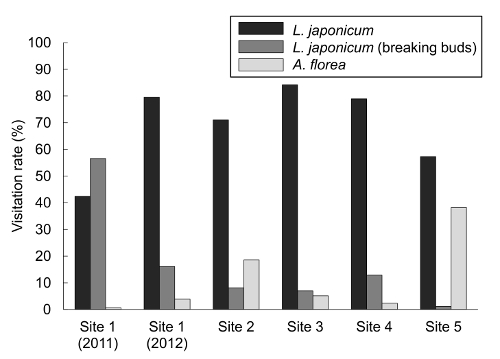
Figure 2: Visitation rates of Lasioglossum japonicum to fully-opened flowers and breaking buds and of Amegilla florea to opened flowers. The ratio of this figure is based on previous work25. The most frequent visitor was the small bee L. japonicum, and the next was the larger bee A. florea. The information for the studied sites is as follows: Site 1 = Izumi Nature Park, Chiba Pref.; Site 2 = Sonnou no Mori, Chiba Pref.; Site 3 = Sugawara Shrine, Kanagawa Pref.; Site 4 = Mannyou Nature Park, Tochigi Pref.; and Site 5 = Kogushi Katakuri no Sato, Gunma Pref. Please click here to view a larger version of this figure.
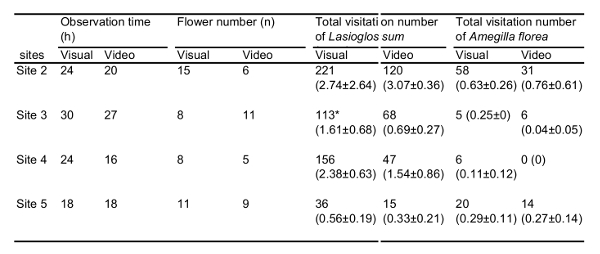
Table 1: Comparisons between the visual and video-recorded observations of floral visitors in 2013. This table shows the observation time, observed flower number, and visitation numbers of small and large bees at each site. "Visual" and "Video" are the values from visual observations and video recordings, respectively. Visitation frequencies with standard deviations are in parentheses. The value with an asterisk is significantly different compared to the other observation method by one-way ANOVA (i.e., the visitation ratio of small bees in the visual observation was significantly higher than that of the video records at Site 3).
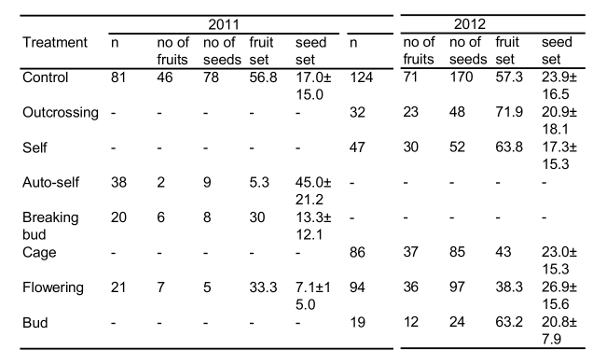
Table 2: The results of the bagging and the cage experiments in 2011 and 2012. The abbreviations are as follows: n = flower number used in each treatment; no. of fruits = fruit-set number; no. of seeds = seed-set number; fruit set = fruit-set ratio; and seed set = seed-set ratio. Seed set ratios are given with standard deviations. Dashes indicate no data.
Discussion
Flower observations and bagging experiments were employed in this study to reveal the visitation frequencies and the female reproductive success of plants, respectively. In Dafni (1992)38, the videotape method was effective because it could record the timing and duration of visitors for analysis and prevent observer bias. However, at the time, this method required expensive equipment, and the observation times were limited by battery life. Recently, the cost of equipment for producing video records has declined, and this technological method can be employed in other pollinator research. In this study, the visitation frequencies were significantly different between the visual and video observations at Site 3 (Table 2). This might have been caused by an over-observation of flower visitors, and human errors such as this can be rejected. Dafni (1992) also mentioned bagging or net experiments to study breeding systems38. Non-woven fabric bags were used, which were not pollen- or waterproof. L. sanguinea var. sanguinea is not a wind-pollinated species, but rain water could influence the reproductive success of bagged flowers. Iron stakes were used to support individuals with bagged flowers from the weight of wet bags, but these factors might have affected the reproductive abilities of the flowers. Covering the whole plant by insect-exclusive nets with supporters might be the best option to remove such methodological problems. Furthermore, cages were used for the separation of bee species, which was the first example of a plant-caged study. This study demonstrated the effectiveness of this method, and we can apply it to other studies whose objectives require the determination of the pollination effectiveness of different functional groups, such as small and large bees.
These pollinator observations revealed that most of the floral visitors of Lycoris sanguinea var. sanguinea throughout the entire flowering season were Lasioglossum japonicum. To make successful observations, pre-observations of target materials in some candidate study sites should be made, which is described in Step 1.1 in the Protocol section. For example, the identifications of some floral visitors are made based on observations or camera pictures in a field. Some floral visitors belonged to taxonomic groups that were difficult to identify at first due to their indistinguishable morphological traits or quick visiting activities, such as halictid bees or nocturnal hawkmoths, respectively. Therefore, preliminary research on floral visits could help to identify and record every visit. To fully comprehend the influence of environmental conditions, it is important to select suitable study sites for the observations. For example, rainy conditions are not suitable for pollinator observations because the appearance and patterns of pollination could change. If the selected sites had fluctuated in environmental conditions, there might not have been enough observation data collected to analyze the study objectives. Alternately, the results could have been misinterpreted due to differences in climate conditions affecting the composition of the pollinator community39.
In this study, floral visitors were examined using visual observations and video records (Table 1). These two methods have advantages and disadvantages. In visual observations, objects can be viewed from multiple angles and can be observed more specifically. However, the information available on the objectives is limited because the record remains only as field notes or digital photographs. In contrast, floral visitors can be repeatedly checked using recorded videos. Unfortunately, this method tends to produce unsuitable records for analyses, such as out-of-focus and insufficiently-lit images. In addition to these methods, some specific recording techniques have been developed in recent years. For example, in flowering plants with rare pollinators, such as some orchid plants, interval photography using digital cameras is an effective approach for pollinator identification40. A digital video camera with a video motion detection sensor can record clear images of the movement of pollinators on flowers, even quickly-moving pollinators at night41. Furthermore, a high-speed camera has also been used to observe slow pollinator movements, such as the contact of each pollinator to the stigma42. Video recording and digital photography are common methods for field observations, and it is important to understand the characteristics of each method and to select the most suitable.
The bagging experiments suggested the degrees of pollinator dependence of L. sanguinea var. sanguinea (Table 2). In these methods, the critical steps are the preparation of the bags and cages. In this case, the bags used were a suitable size for the flowers (Figure 1d); however, it may be necessary to prepare larger sizes or insect-excluding nets, which can cover whole plant individuals. The "Auto-self" treatment had few fruit but a larger seed-set ratio, and this may have been caused by the contact between the stigma and the pollen-attached bags. Such mistakes can be prevented using appropriate methods for the objectives of each experiment. Bagging for the breaking buds showed the pollination by small bees at the breaking-bud stage (Table 2). Small bees tended to handle the breaking buds to collect the pollen longer than the other insects that visited opening flowers. These behavioral differences might suggest that breaking-bud pollination does not have higher pollination efficiencies than the other pollination processes. To reveal these behavioral differences, the pollination success per single visit or pollination efficiencies of each pollinator should be evaluated43,44. By preparing the unopened, bagged buds, it was possible to estimate the single-visit effects on the reproductive aspects of breaking-bud pollination. Furthermore, in the cage experiment, the unopened buds were maintained. This method could not be used to evaluate the effectiveness of pollination by small bees at the flowering stage only. One alternative method would be to cover the cage with a cloth that has gaps smaller than the size of all floral visitors until the caged flowers fully open.
Although the present experiments provided good results, field experiments revealed only limited information on plant-pollinator interactions. For example, it was hypothesized that breaking-bud pollination by small bees could promote selfing or geitonogamous pollination. This pollination process occurs when small bees move around in the breaking buds. Some pollen grains can be easily carried from the same flower to the stigma. Additionally, the foraging ranges of small bees estimated by their body sizes were short, promoting short ranges of pollen dispersal45,46. These predictions are difficult to investigate using only field experiments, although the pollen movements between individuals can be tracked using pollen labeled with a fluorescent dye47,48. For example, amplified fragment length polymorphism or microsatellite markers can be used to estimate whether the pollen donors of each seed are derived from same or different individuals49,50. In recent years, pollen movements between conspecific plants have been followed using single pollen genotyping techniques35. This molecular method has been used to show the significances for the evaluations of pollination efficiencies36. In the present case, this molecular technique could reveal the arrival positions of the pollen grains of breaking buds, which might indicate the degrees of gene flow between breaking buds and fully-opened flowers. Therefore, a comprehensive research plan, based on both field work and molecular analyses, is necessary to reveal the effects of pollinators.
Disclosures
The authors declare that they have no competing financial interests.
Acknowledgements
The authors thank the three anonymous reviewers for their helpful comments on the manuscript. This work was partly supported by Grant-in-Aid for JSPS Fellows (26.11613).
Materials
| Name | Company | Catalog Number | Comments |
|---|---|---|---|
| recording sheet | any | NA | |
| insect net | any | NA | |
| pooter | any | NA | |
| ethyl acetate | any | NA | |
| 100% Ethanol | any | NA | |
| plastic tube | any | NA | |
| plastic case | any | NA | |
| soft bag | any | NA | |
| digital video camera(s) | any | NA | |
| tripod(s) | any | NA | |
| bags | any | NA | |
| wire or plastic mesh boards | any | NA | |
| iron wires | any | NA | |
| labeling tape | any | NA | |
| stick supporters | any | NA | |
| soft strings or wire | any | NA | |
| pincette(s) | any | NA |
References
- Dodd, M. E., Silvertown, J., Chase, M. W. Phylogenetic analysis of trait evolution and species diversity variation among angiosperm families. Evolution. 53 (3), 732-744 (1999).
- van der Niet, T., Johnson, S. D. Phylogenetic evidence for pollinator-driven diversification of angiosperms. Trends Ecol. Evol. 27, 353-361 (2012).
- Bascompte, J., Jordano, P. Plant-animal mutualistic networks: the architecture of biodiversity. Ann. Rev. Ecol. Evol Syst. 38, 567-593 (2007).
- Losos, J. B., Ricklefs, R. E. Adaptation and diversification on islands. Nature. 457, 830-836 (2009).
- Schnitzler, J., et al. Causes of plant diversification in the cape biodiversity hotspot of south africa. Syst. Biol. 60, 1-15 (2011).
- Stebbins, G. L. Adaptive radiation of reproductive characteristics in angiosperms I: pollination mechanisms. Ann. Rev. Ecol. Syst. 1, 307-326 (1970).
- Ne'eman, G., Jürgens, A., Newstrom-Lloyd, L., Potts, S. G., Dafni, A. A framework for comparing pollinator performance: effectiveness and efficiency. Biol. Rev. 85, 435-451 (2010).
- Waser, N. M., Chittka, L., Pirce, M. V., Williams, N. M., Ollerton, J. Generalization in pollination systems, and why it matters. Ecology. 77 (4), 1043-1060 (1996).
- Sahli, H. F., Conner, J. K. Visitation, effectiveness and efficiency of 15 genera of visitors to wild radish, Raphanus raphanistrum (Brassicaceae). Am. J. Bot. 94, 203-209 (2007).
- Moeller, D. A. Pollinator community structure and sources of spatial variation in plant-pollinator interactions in Clarkia xantiana. ssp. xantiana. Oecologia. 142 (1), 28-37 (2005).
- Keys, R. N., Buchmann, S. L., Smith, S. E. Pollination effectiveness and pollination efficiency of insects foraging Prosopis velutina.in south-eastern Arizona. J. Appl. Ecol. 32 (3), 519-527 (1995).
- Pedron, M., Buzatto, C. R., Singer, R. B., Batista, J. A. N., Moser, A. Pollination biology of four sympatric species of Habenaria (Orchidaceae: Orchidinae) from southern. J. Linn. Soc. 170, 141-156 (2012).
- Phillips, R. D., et al. Caught in the act: pollination of sexually deceptive trap-flowers by fungus gnats in Pterostylis (Orchidaceae). Ann. Bot. 113, 629-641 (2014).
- Mayfield, M. M., Waser, N. M., Price, M. V. Exploring the "most effective principle" with complex flowers: bumblebees and Ipomopsis aggregata. Ann. Bot. 88, 591-596 (2001).
- Herrera, C. M. Components of pollinator "quality": comparative analysis of a diverse insect assemblage. Oikos. 50, 79-90 (1987).
- Hargreaves, A. L., Weiner, J. L., Eckert, C. G. High-elevation range limit of an herb is neither caused nor reinforced by declining pollinator service. J. Ecol. 103, 572-584 (2015).
- Motten, A. F. Reproduction of Erythronium umbilicatum. (Liliaceae): pollination success and pollinator effectiveness. Oecologia. 59, 351-359 (1983).
- Betts, M. G., Hadley, A. S., Kress, W. J. Pollinator recognition by a keystone tropical plant. Proc. Natl. Acad. Sci. 112 (11), 3433-3438 (2015).
- Schemske, D. W., Horvitz, C. C. Variation among floral visitors in pollination ability: a precondition for mutualism specialization. Science. 225 (4661), 519-521 (1984).
- Spears, E. E. A direct measure of pollinator effectiveness. Oecologia. 57, 196-199 (1983).
- Sun, M., Ritland, K. Mating system of yellow starthistle (Centaurea solstitialis.), a successful colonizer in North America. Heredity. 80, 225-232 (1998).
- Suetsugu, K. Autogamous fruit set in a mycoheterotrophic orchid Cyrtosia septentrionalis. Plant Syst. Evol. 299, 481-486 (2013).
- Dupont, Y. L. Evolution of apomixis as a strategy of colonization in the dioecious species Lindera glauca. (Lauraceae). Popul. Ecol. 44, 293-297 (2002).
- Ramsey, M. Ant pollination of the perennial herb Blandfordia grandiflora (Liliaceae). Oikos. 74, 265-272 (1995).
- Moog, U., Fiala, B., Federle, W., Maschwitz, U. Thrips pollination of the dioecious ant plant Macaranga hullettii.(Euphorbiaceae) in Southeast Asia. Am. J. Bot. 89 (1), 50-59 (2002).
- Stokes, C. J., Yeaton, R. I. Population dynamics, pollination ecology and the significance of plant height in Aloe candelabrum. Afr. J. Ecol. 33, 101-113 (1995).
- Hargreaves, A. L., Harder, L. D., Johnson, S. D. Aloe inconspicua.: The first record of an exclusively insect-pollinated aloe. S. Afr. J. Bot. 74, 606-612 (2008).
- Botes, C. B., Johnson, S. D., Cowling, R. M. The birds and the bees: using selective exclusion to identify effective pollinators of African tree aloes. Int. J. Plant. Sci. 170 (2), 151-156 (2009).
- Kawano, S. Life-history monographs of Japanese plants. 13: Lycoris sanguinea.Maxim (Amaryllidaceae). Plant Spec. Biol. 24, 139-144 (2009).
- Yamaji, F., Ohsawa, A. T. Breaking-bud pollination: a new pollination process in partially opened flowers by small bees. J. Plant Res. 128 (5), 803-811 (2015).
- Sun, M., Gross, K., Schiestl, F. P. Floral adaptation to local pollinator guilds in a terrestrial orchid. Ann. Bot. 113, 289-300 (2014).
- Sletvold, N., Trunschke, J., Wimmergren, C., Ågren, J. Separating selection by diurnal and nocturnal pollinators on floral display and spur length in Gymnadenia conopsea. Ecology. 93, 1880-1891 (2012).
- R Core Team. A language and environment for statistical computing. , R Foundation for Statistical Computing. Vienna, Austria. (2014).
- IBM Statistics Version 21. , International Business Machines Corp. Boston, Mass. (2012).
- SAS Version 9.2. , SAS Institute. Cary, NC, USA. (2009).
- Ma, B., Tarumoto, I., Morikawa, T. Cytological studies on selfed plants and interspecific crosses produced in four species of genus Lycoris.(Amaryllidaceae). Sci Rep Coll Agric Osaka Pref Univ. 52, 13-18 (2000).
- Ma, B., Tarumoto, I., Nakamura, N., Kunitake, H. Production of interspecific hybrids between Lycoris incarnata.and four other Lycoris.species through embryo culture. J Japan Soc Hortic Sci. 70, 697-703 (2001).
- Dafni, A. Pollination ecology: a practical approach. , Oxford University Press. Oxford, UK. (1992).
- Abrahamczyk, S., Kluge, J., Gareca, Y., Reichle, S., Michael, K. The influence of climatic seasonality on the diversity of different tropical pollinator groups. PLoS One. 6 (11), e27115(2011).
- Suetsugu, K., Hayamizu, M. Moth floral visitors of the three rewarding Platanthera. orchids revealed by interval photography with a digital camera. J. Nat. Hist. 48, 1103-1109 (2014).
- Steen, R. Pollination of Platanthera chlorantha.(Orchidaceae): new video registration of a hawkmoth (Sphingidae). Nord. J. Bot. 30, 623-626 (2012).
- Sakamoto, R. L., Morinaga, S., Ito, M., Kawakubo, N. Fine-scale flower-visiting behavior revealed by using a high-speed camera. Behav. Ecol. Sociobiol. 66, 669-674 (2012).
- Johnson, S. D., Steiner, K. E. Generalization versus specialization in plant pollination systems. Trends Ecol. Evol. 15, 140-143 (2000).
- King, C., Ballantyne, G., Willmer, P. G. Why flower visitation is a poor proxy for pollination: measuring single-visit pollen deposition, with implications for pollination networks and conservation. Methods Ecol. Evol. 4, 811-818 (2013).
- Gathmann, A., Tscharntke, T. Foraging ranges of solitary bees. J. Anim. Ecol. 71, 757-764 (2002).
- Greenleaf, S. S., Williams, N. M., Winfree, R., Kremen, C. Bee foraging ranges and their relationship to body size. Oecologia. 153, 589-596 (2007).
- Rademaker, M. C. J., De Jong, T. J., Klinkhamer, P. G. L. Pollen dynamics of bumble-bee visitation on Echium vulgare. Func. Ecol. 11, 554-563 (1997).
- Adler, L. S., Irwin, R. E. Comparison of pollen transfer dynamics by multiple floral visitors: experiments with pollen and fluorescent. Ann. Bot. 97, 141-150 (2006).
- Krauss, S. Complete exclusion of nonsires in an analysis of paternity in a natural plant population using amplified fragment length polymorphism (AFLP). Mol. Ecol. 8, 217-226 (1999).
- Gerber, S., Mariette, S., Streiff, R., Bodenes, C., Kremer, A. Comparison of microsatellites and amplified fragment length polymorphism markers for parentage analysis. Mol. Ecol. 9, 1037-1048 (2000).
- Matsuki, Y., Isagi, Y., Suyama, Y. The determination of multiple microsatellite genotypes and DNA sequences from a single pollen grain. Mol. Ecol. 7, 194-198 (2007).
- Hirota, S. K., et al. Pollinator-mediated selection on flower color, flower scent and flower morphology of Hemerocallis.: Evidence from genotyping individual pollen grains on the stigma. PLoS One. 8 (12), e85601(2013).
Reprints and Permissions
