Here, we present a protocol to site-specifically introduce chemical probes into an antibody fragment by genetically incorporating an azide-containing amino acid, and subsequently coupling the azide with a chemical probe by strain-promoted azide-alkyne cycloaddition (SPAAC).
Method Article
Efficient and Site-specific Antibody Labeling by Strain-promoted Azide-alkyne Cycloaddition
Opens in a new tab
In This Article
Summary
Loading...
$$\rightleftharpoonup{xx}$$
$$\longleftharp{xx}$$,
$$\longrightharp{xx}$$,
Abstract
Loading...
$$\rightleftharpoonup{xx}$$
$$\longleftharp{xx}$$,
$$\longrightharp{xx}$$,
There are currently many chemical tools available to introduce chemical probes into proteins to study their structure and function. A useful method is protein conjugation by genetically introducing an unnatural amino acid containing a bioorthogonal functional group. This report describes a detailed protocol for site-specific antibody conjugation. The protocol includes experimental details for the genetic incorporation of an azide-containing amino acid, and the conjugation reaction by strain-promoted azide-alkyne cycloaddition (SPAAC). This strain-promoted reaction proceeds by simple mixing of the reacting molecules at physiological pH and temperature, and does not require additional reagents such as copper(I) ions and copper-chelating ligands. Therefore, this method would be useful for general protein conjugation and development of antibody drug conjugates (ADCs).
Introduction
Loading...
$$\rightleftharpoonup{xx}$$
$$\longleftharp{xx}$$,
$$\longrightharp{xx}$$,
Since the genetic incorporation of p-methoxyphenylalanine in Escherichia coli was reported,1 more than 100 unnatural amino acids (UAAs) have been successfully incorporated into various proteins.1-3 Among these UAAs, the amino acids containing bioorthogonal functional groups have been extensively studied and represent the largest proportion. The bioorthogonal functional groups used in the UAAs include ketone,4 azide,5 alkyne,6 cyclooctyne,7 tetrazine,8 α,β-unsaturated amide,9 norbonene,10 transcyclooctene,11 and bicyclo[6.1.0]-nonyne.11 Although each functional group has its advantages and disadvantages, the azide-containing amino acids have been most extensively used for protein conjugation. p-Azidophenylalanine (AF), one of the azido-containing amino acids, is readily available, and its incorporation efficiency is excellent. Mutant proteins containing this amino acid can be reacted with alkynes by copper-catalyzed cycloaddition or with cyclooctynes by SPAAC.12-20
Recently, biopharmaceuticals have been attracting great attention in the pharmaceutical industry. The antibody-drug conjugate (ADC) is a class of therapeutic antibodies that are advantageous due to their ability for targeted therapy for the treatment of human cancers21 and other diseases. More than 50 ADCs are currently in clinical trials, and the number is rapidly increasing. In development of ADCs, many factors need to be considered to maximize the efficacy and minimize the side effects. Among these factors, an efficient and site-specific conjugation reaction to form a covalent bond between an antibody and a drug is critical. The desired efficiency and specificity in the conjugation reaction can be achieved by conjugation with a bioorthogonal functional group in an unnatural amino acid that is specifically incorporated into an antibody.22-26 Here, we report a protocol to site-specifically incorporate AF into an antibody fragment and conjugate the mutant antibody fragment with a biochemical probe.
Protocol
Loading...
$$\rightleftharpoonup{xx}$$
$$\longleftharp{xx}$$,
$$\longrightharp{xx}$$,
1. Plasmid Construction
- Construct an expression plasmid (pBAD-HerFab-L177TAG) that would express the target antibody gene (pBAD-HerFab-WT) with a His6-tag, and replace the codon for Leucine-177 with the amber codon (TAG) 27, using conventional site-directed mutagenesis technique.
See Table of Materials. - Construct another expression plasmid (pEVOL-AFRS) containing the genes for the evolved tRNATyr and aminoacyl-tRNA synthetase (aaRS) pair. Use the specially designed plasmid vector, pEVOL, for efficient incorporation of UAAs. The detailed plasmid information and cloning protocols are described in the previous report.28
- Obtain high quality plasmid DNA by using commercially available plasmid preparation kits. The 260/280 ratio of ~1.8 is optimal for the purified DNA. If required, perform 1% agarose gel electrophoresis to check the purity of the DNA.
2. Culture Preparation
- Electroporation
- Add each 1 µL DNA of pEVOL-AFRS28 and pBAD-HerFab-L177TAG to 20 µL Escherichia coli DH10β strain. Mix gently, using a pipette. The plasmids can be transformed together or in independent reactions.
- For 0.1 cm cuvettes, set the electroporation settings to 25 µF and 2.5 kV.
- Insert the cuvette into the slide of the shocking chamber. Push the slide into the chamber until the cuvette makes firm contact with the chamber electrodes.
- Pulse once by pressing the pulse button until the electroporation machine beeps.
- Add 1 mL super optimal broth with catabolite repression (SOC) medium containing 2% (w/v) tryptone, 0.5% (w/v) yeast extract, 10 mM NaCl, 2.5 mM KCl, 10 mM MgCl2, and 20 mM glucose to the cuvette quickly and transfer the mixture to a test tube. Incubate the cells for 1 h at 37 °C with shaking.
- Spread transformed E. coli cells on Lysogeny broth (LB) agar plates containing appropriate antibiotics (35 µg/mL chloramphenicol and 100 µg/mL ampicillin for selecting pEVOL-AFRS and pBAD-HerFab-L177TAG, respectively). Incubate the plates at 37 °C for 12 h.
- Culture preparation
- Inoculate a single transformed colony in 5 mL LB medium containing antibiotics. Incubate for 12 h at 37 °C with shaking.
3. Expression and Purification of HerFab-L177AF
- Expression of HerFab-L177AF
- Transfer the primary culture (5 mL) into 200 mL LB medium containing ampicillin (100 µg/mL) and AF (1 mM), followed by incubation at 37 °C with shaking.
NOTE: 100 mM AF stock solution (10 mL) was prepared by dissolving 206 mg AF in 100 mM hydrochloric acid (10 mL, final volume). - Add 2 mL of 1.6 M arabinose (16 mM final concentration) when the culture reaches the log-phase (OD550 = 0.8, OD = Optical density). Incubate for 12 h at 30 °C with shaking.
- Harvest cells by centrifugation at 11,000 x g for 5 min. Discard supernatant and freeze the pellet at -20 °C.
- Transfer the primary culture (5 mL) into 200 mL LB medium containing ampicillin (100 µg/mL) and AF (1 mM), followed by incubation at 37 °C with shaking.
- Cell lysis
- Resuspend the cell pellets in 20 mL periplasmic lysis buffer containing 30 mM Tris (pH 8.0), 1 mM EDTA, 20% sucrose, and 0.2 mg/mL lysozyme, and incubate the mixture for 1 h at 37 °C.
- Centrifuge the cell lysate at 18,000 x g at 4 °C for 15 min. Transfer the supernatant to a fresh tube and discard the pellet.
- Ni-NTA affinity chromatography
- Add Ni-NTA resin suspension to each centrifuge tube (400 µL resin for a 200 mL culture), and mix gently at 4 °C for 1 h.
- Pour the suspension into a polypropylene column and wash the resin three times with 5 mL wash buffer containing 50 mM NaH2PO4 (pH 8.0), 20 mM imidazole, and 300 mM NaCl.
- Elute the target antibody with 300 µL elution buffer containing 50 mM NaH2PO4 (pH 8.0), 250 mM imidazole, and 300 mM NaCl.
- Determine concentration of the mutant protein by Bradford protein assay29 or by measuring the absorbance at 280 nm. Calculate the extinction coefficient (75,866 M-1cm-1) for HerFab-L177AF at 280 nm by protein extinction coefficient calculator using the extinction coefficient (2,471 M-1cm-1) for AF.
NOTE: The amino acid sequence of HerFab can be found in the NCBI website (GI:783282791 and GI:783282792).
4. Conjugation of Purified HerFab-L177AF with Alkyne Probes Using Strain-promoted Azide-alkyne Cycloaddition (SPAAC)
- Add 20 µL of Cy5.5-Azadibenzocyclooctyne(Cy5.5-ADIBO) in H2O (200 µM final concentration) to a solution of 10 µL of HerFab-L177AF (10 µM final concentration) in phosphate buffer containing 10 mM Na2HPO4 (pH 7.0) and 100 mM NaCl.
NOTE: As alternatives, difluorinated cyclooctyne (DIFO) and bicyclo[6.1.0]nonyne (BCN) derivatives are also available for the same application. - Allow the strain-promoted cycloaddition reaction to proceed for 6 h at 37 °C. If a light-sensitive probe (e.g., Cy5.5) is used, cover the reaction vessel with aluminum foil.
- Purify the labeled HerFab according to step 5.
5. Purification of Labeled HerFab
- Add 500 µL of sample to a centrifugal filter spin column.
- Centrifuge the spin column at 14,000 x g at 4 °C for 15 min.
- Discard flow-through and transfer purified sample from the spin column to a 1.5 mL microcentrifuge tube.
- As an alternative to step 5.1- 5.3, perform purification by dialysis against the same buffer.
- Store the purified labeled HerFab at 4 °C.
6. SDS-PAGE Analysis of Labeled HerFab
- Add 5 µL LDS protein sample buffer containing 106 mM Tris·HCl, 141 mM Tris base (pH 8.5), 2% LDS, 10% Glycerol, 0.51 mM EDTA, 0.22 mM SERVA Blue G250, and 0.175 mM phenol red to 13 µL of purified labeled HerFab (7.8 µM or 0.38 mg/mL) in the presence (+) or absence (−) of 2 µL dithiothreitol (DTT, 100 mM final concentration). Incubate the mixture at 95 °C for 10 min.
- Attach the 4-12% Bis-Tris SDS-PAGE gel cassette to the electrophoresis cell and add running buffer. Load the conjugated protein samples and the pre-stained molecular weight marker. Perform gel electrophoresis for 35 min at 200 V.
Note: Keep the electrophoresis cell in the dark during the entire period to minimize photo-bleaching of the fluorophore. - After electrophoresis, transfer the gel to a fluorescent gel scanner, and scan for fluorescence emission at the appropriate wavelength. For Cy5.5, use the Cy5 mode in the scanner software.
- Stain the gel with a commercial protein stain.
Results
Loading...
$$\rightleftharpoonup{xx}$$
$$\longleftharp{xx}$$,
$$\longrightharp{xx}$$,
In this study, an antibody fragment was site-specifically conjugated with a fluorophore by incorporating an azide-containing amino acid into the fragment and reacting the mutant antibody fragment with a strained cyclooctyne (Figure 1). HerFab was selected as the target antibody fragment into which AF was incorporated as an azide-containing amino acid. To choose the residue in HerFab for the replacement with AF, the X-ray crystal structure of HerFab was analyzed. 30 Important requirements for the residue include enough distance from the antibody binding site to minimize the decrease in its binding affinity and solvent accessibility for efficient conjugation reaction. Leucine at position 177 was a decent candidate because the residue is well exposed to outside of the antibody and located near the interface of two immunoglobulin domains, which is distant from the antibody binding site.
Initially, the expression plasmid for HerFab with a C-terminal His6-tag was constructed, and an amber codon was introduced at the position 177 for AF incorporation by site-directed mutagenesis. The mutant HerFab containing AF was expressed in the presence of 1 mM AF by co-expressing the evolved tRNATyr and aminoacyl-tRNA synthetase pair.27 Ni-NTA affinity purification was performed for the mutant proteins expressed in the presence and absence of AF, and the following SDS-PAGE analysis showed that the full-length antibody fragment was obtained only in the presence of AF (Figure 2). Next, the mutant antibody fragment containing AF was evaluated for conjugation reaction with a Cy5.5-linked aza-dibenzocyclooctyne derivative (Cy5.5-ADIBO). The antibody fragment and Cy5.5-ADIBO were reacted in a phosphate buffer for 6 h, and the reaction mixture was analyzed by SDS-PAGE in the presence (+) and absence (−) of DTT (Figure 3a).25 The reaction with a wild type antibody fragment was also carried out and analyzed as a control. The fluorescence images clearly showed conjugation of the mutant antibody fragment with Cy5.5-ADIBO, while no conjugation was observed in the reaction with the wild type fragment. Electron spray ionization mass spectrometric (ESI-MS) analysis showed quantitative conjugation with no detectable unconjugated fragment (Figure 3b). Overall, these results showed that the mutant HerFab containing AF can be efficiently and conveniently conjugated with strained cyclooctynes by SPAAC without any additional reagent.

Figure 1: Schematic illustration of site-specific antibody labeling by SPAAC. Please click here to view a larger version of this figure.
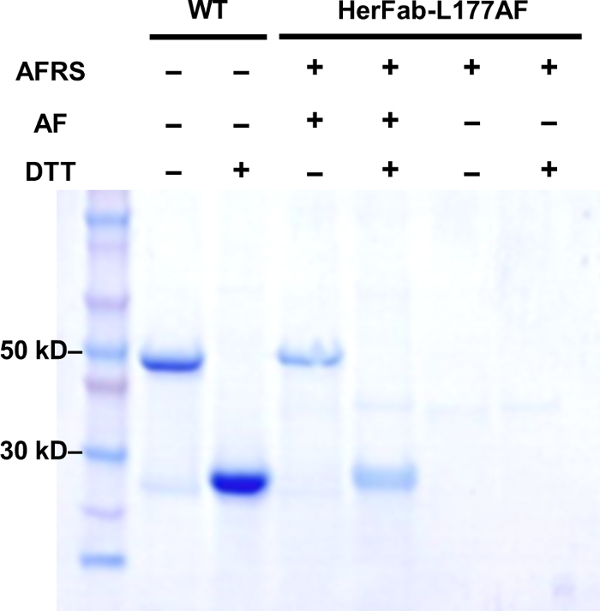
Figure 2: Expression of mutant HerFab containing AF at position 177 (L177) in the presence of the evolved tRNA/aaRS pair. Expression of HerFab-L177AF in LB medium containing the evolved tRNA/AFRS pair and 1 mM AF. Purified samples were analyzed by SDS-PAGE in the presence (+) or absence (−) of DTT, and the gel was stained with a commercial protein stain. Figure adapted from Ko, W. et al.27. Please click here to view a larger version of this figure.
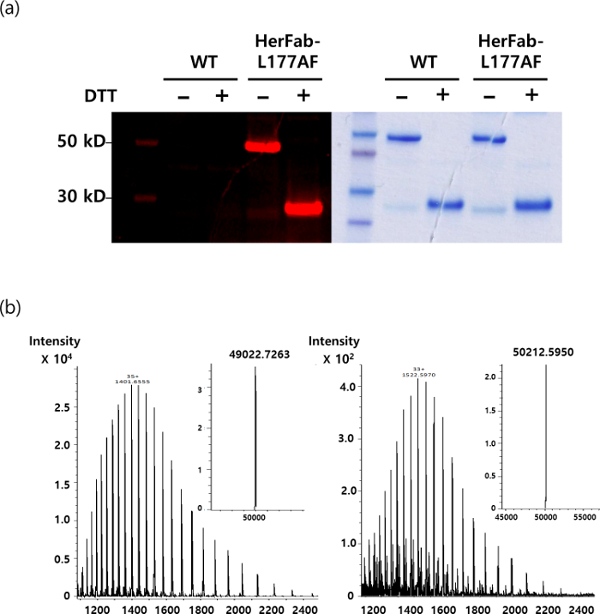
Figure 3: Conjugation reaction of HerFab-L177AF with Cy5.5-ADIBO. (a) SDS-PAGE analysis of conjugation reaction of wild type HerFab and HerFab-L177AF with Cy5.5-ADIBO. The reaction mixtures were analyzed in the presence (+) and absence (−) of DTT, and protein bands were visualized by a commercial protein stain (left) and fluorescence imaging (right). (b) ESI-MS analyses of HerFab-L177AF (left) and HerFab-L177AF labeled with Cy5.5-ADIBO (right): expected mass difference between HerFab- L177AF and the conjugated antibody = 1,190 Da, observed mass difference = 1,190 Da. Figure adapted from Ko, W. et al.27. Please click here to view a larger version of this figure.
Discussion
Loading...
$$\rightleftharpoonup{xx}$$
$$\longleftharp{xx}$$,
$$\longrightharp{xx}$$,
The genetic incorporation of unnatural amino acids into proteins has several advantages over other methods used for protein modification. 1-3 One of the important advantages is its general applicability to any kind of protein. In principle, there is no limitation in selecting a target protein and a target site of the protein. However, replacement of a structurally or functionally important residue with a UAA may result in altering the structure and function of the target protein. Generally, residues that are exposed to solvent and do not interact with other residues are chosen for incorporation of UAAs. Therefore, structural information from a high-resolution crystal structure is used in order to choose optimal sites for UAA incorporation. 30 Because the incorporation of UAAs is technically easy and requires a simple mutagenesis, multiple sites can be readily screened to select an optimal residue for a desired function of a target protein.
In this protocol, AF is genetically incorporated into an antibody fragment, and the mutant fragment is site-specifically labeled with a fluorophore, using SPAAC. The conjugation yield of this method is quantitative without any undesired reaction, which is an important improvement over the previous report. 25 This was achieved by careful structural analysis for the selection of an optimal site and an increase in the reaction time. Therefore, the choice of the site for UAA incorporation is critical for fast and quantitative conjugation. In addition, the use of efficient UAA incorporation systems (e.g., pEvol-AFRS) is also critical for protein yield and incorporation efficiency. 28
Other UAAs incorporated into proteins by genetic incorporation method for protein conjugation can also be used for the antibody conjugation. 4-11 In terms of reaction rate, copper-catalyzed cycloaddition reaction, as well as inverse electron-demand Diels-Alder reaction using tetrazines8 and strained alkenes or alkynes, 7 will be better than the SPAAC used in this study. However, the copper-catalyzed cycloaddition reaction requires copper(I) ion and ligands, 31 and the amino acids for the Diels-Alder reaction are often synthetically challenging, and not stable enough for quantitative conjugation. Ketone-hydroxyamine condensation4 can also be used for the same purpose. However, it requires moderately acidic conditions, and its reaction rate is slower than that of the SPAAC. Considering the factors such as commercial and synthetic accessibility of unnatural amino acids, the reaction rate, bio-orthogonality, biocompatibility of reaction conditions, and incorporation efficiency of unnatural amino acids, the method of using SPAAC and genetically incorporated AF would be useful for developing modified therapeutic proteins such as ADCs, as well as for general protein labeling.
Disclosures
Loading...
$$\rightleftharpoonup{xx}$$
$$\longleftharp{xx}$$,
$$\longrightharp{xx}$$,
The authors have nothing to disclose.
Materials
| Name | Company | Catalog Number | Comments |
|---|---|---|---|
| 1. Plasmid Construction | |||
| plasmid pBAD_HerFab_L177TAG | Optionally contain the amber stop codon (TAG) at a desired position. Ko, W. et al. Efficient and Site-Specific Antibody Labeling by Strain-promoted Azide-Alkyne Cycloaddition. BKCS. 36 (9), 2352-2354, doi: 10.1002/bkcs.10423, (2015) | ||
| plasmid pEvol-AFRS | Young, T. S., Ahmad, I., Yin, J. A., and Schultz, P. G. An enhanced system for unnatural amino acid mutagenesis in E. coli. J. Mol. Biol. 395 (2), 361-374, doi: 10.1016/j.jmb.2009.10.030, (2010) | ||
| DH10B | Invitrogen | C6400-03 | Expression Host |
| Plasmid Mini-prep kit | Nucleogen | 5112 | 200/pack |
| Agarose | Intron biotechnology | 32034 | 500 g |
| Ethidium bromide | Alfa Aesar | L07482 | 1 g |
| LB Broth | BD Difco | 244620 | 500 g |
| 2. Culture Preparation | |||
| 2.1 Electroporation | |||
| Micro pulser | BIO-RAD | 165-2100 | |
| Micro pulser cuvette | BIO-RAD | 165-2089 | 0.1 cm electrode gap, pkg. of 50 |
| Ampicillin Sodium | Wako | 018-10372 | 25 g |
| Chloramphenicol | Alfa Aesar | B20841 | 25 g |
| Agar | SAMCHUN | 214230 | 500 g |
| SOC medium | Sigma | S1797 | 100 mL |
| 3. Expression and Purification of HerFab-L177AF | |||
| 3.1 Expression of Herfab-L177AF | |||
| p-azido-L-phenylalanine (AF) | Bachem | F-3075.0001 | 1 g |
| L(+)-Arabinose, 99% | Acros | 104981000 | 100 g |
| Hydrochloric acid, 35~37% | SAMCHUN | H0256 | 500 mL |
| 3.2 Cell Lysis | |||
| Tris(hydroxymethyl)aminomethane, 99% | SAMCHUN | T1351 | 500 g |
| EDTA disodium salt dihydrate, 99.5% | SAMCHUN | E0064 | 1 kg |
| Sucrose | Sigma | S9378 | 500 g |
| Lysozyme | Siyaku | 126-0671 | 1 g |
| 3.3 Ni-NTA Affinity Chromatography | |||
| Ni-NTA resin | QIAGEN | 30210 | 25 mL |
| Polypropylene column | QIAGEN | 34924 | 50/pack, 1 mL capacity |
| Imidazole, 99% | SAMCHUN | I0578 | 1 kg |
| Sodium phosphate monobasic, 98% | SAMCHUN | S0919 | 1 kg |
| Sodium Chloride, 99% | SAMCHUN | S2907 | 1 kg |
| 4. Conjugation of Purified HerFab-L177AF with Alkyne Probes Using Strain-promoted Azide-alkyne Cycloaddition (SPAAC) | |||
| Cy5.5-ADIBO | FutureChem | FC-6119 | 1 mg |
| 5. Purification of Labeled HerFab | |||
| Amicon Ultra 0.5 mL Centrifugal Filters | MILLIPORE | UFC500396 | 96/pack, 500 μL capacity |
| 6. SDS-PAGE Analysis of Labeled HerFab and Fluorescent Gel Scanning | |||
| 1,4-Dithio-DL-threitol, DTT, 99.5% | Sigma | 10708984001 | 10 g |
| NuPAGE LDS Sample Buffer, 4x | Thermofisher | NP0007 | 10 mL |
| MES running buffer | Thermofisher | NP0002 | 500 mL |
| Nupage Novex 4-12% SDS PAGE gels | Thermofisher | NO0321 | 12-well |
| Coomassie Brilliant Blue R-250 | Wako | 031-17922 | 25 g |
| Typhoon 9210 variable mode imager | Amersham Biosciences | ||
References
Loading...
$$\rightleftharpoonup{xx}$$
$$\longleftharp{xx}$$,
$$\longrightharp{xx}$$,
- Expanding the genetic code. Angew. Chem. Int. Ed. 44 (1), 34-66 (2004).">Wang, L., Schultz, P. G. Expanding the genetic code. Angew. Chem. Int. Ed. 44 (1), 34-66 (2004).
- Synthesis at the interface of chemistry and biology. J. Am. Chem. Soc. 131 (35), 12497-12515 (2009).">Wu, X., Schultz, P. G. Synthesis at the interface of chemistry and biology. J. Am. Chem. Soc. 131 (35), 12497-12515 (2009).
- Adding new chemistries to the genetic code. Annu. Rev. Biochem. 79, 413-444 (2010).">Liu, C. C., Schultz, P. G. Adding new chemistries to the genetic code. Annu. Rev. Biochem. 79, 413-444 (2010).
- Addition of the keto functional groupto the genetic code of Escherichia coli. proc. Natl. Acad. Sci. U.S.A. 100 (1), 56-61 (2003).">Wang, L., Zhang, Z., Brock, A., Schultz, P. G. Addition of the keto functional groupto the genetic code of Escherichia coli. proc. Natl. Acad. Sci. U.S.A. 100 (1), 56-61 (2003).
- Addition of p-azido-L-phenylalanine to the genetic code of Escherichia coli. J. Am. Chem. Soc. 124 (31), 9026-9027 (2002).">Chin, J. W., et al. Addition of p-azido-L-phenylalanine to the genetic code of Escherichia coli. J. Am. Chem. Soc. 124 (31), 9026-9027 (2002).
- In vivo incorporation of an alkyne into proteins in Esshcerichia coli. Bioorg. Med. Chem. Lett. 15 (5), 1521-1524 (2005).">Deiters, A., Schultz, P. G. In vivo incorporation of an alkyne into proteins in Esshcerichia coli. Bioorg. Med. Chem. Lett. 15 (5), 1521-1524 (2005).
- Genetically encoded copper-free click chemistry. Angew. Chem. Int. Ed. 50 (17), 3878-3881 (2011).">Plass, T., Milles, S., Koehler, C., Schultz, C., Lemke, E. A. Genetically encoded copper-free click chemistry. Angew. Chem. Int. Ed. 50 (17), 3878-3881 (2011).
- Genetically encoded tetrazine amino acid directs rapid site-specific in vivo bioorthogonal ligation with transcyclooctenes. J. Am. Chem. Soc. 134 (6), 2898-2901 (2014).">Seitchik, J. L., et al. Genetically encoded tetrazine amino acid directs rapid site-specific in vivo bioorthogonal ligation with transcyclooctenes. J. Am. Chem. Soc. 134 (6), 2898-2901 (2014).
- A genetically encoded acrylamide fuctionality. ACS Chem. Biol. 8 (8), 1664-1670 (2013).">Lee, Y. -J., et al. A genetically encoded acrylamide fuctionality. ACS Chem. Biol. 8 (8), 1664-1670 (2013).
- Genetically encoded norbornene directs site-specific cellular protein labelling via a rapid bioorthogonal raction. Nat Chem. 4 (4), 298-304 (2012).">Lang, K., et al. Genetically encoded norbornene directs site-specific cellular protein labelling via a rapid bioorthogonal raction. Nat Chem. 4 (4), 298-304 (2012).
- Genetic encoding of bicyclononynes and trans-cyclooctenes for site-specific protein labeling in vitro and in live mammalian cells via rapid fluorogenic Diels-Alder reactions. J. Am. Chem. Soc. 134 (25), 10317-10320 (2012).">Lang, K., et al. Genetic encoding of bicyclononynes and trans-cyclooctenes for site-specific protein labeling in vitro and in live mammalian cells via rapid fluorogenic Diels-Alder reactions. J. Am. Chem. Soc. 134 (25), 10317-10320 (2012).
- Rapid Cu-free click chemistry with readily synthesized biarylazacyclooctynones. J. Am. Chem. Soc. 132 (11), 3688-3690 (2010).">Jewett, J. C., Sletten, E. M., Bertozzi, C. R. Rapid Cu-free click chemistry with readily synthesized biarylazacyclooctynones. J. Am. Chem. Soc. 132 (11), 3688-3690 (2010).
- Azadibenzocyclooctynes for fast and efficient enzyme PEGylation via copper-free (3 + 2) cycloaddition. Chem. Commun. 46 (1), 97-99 (2010).">Debets, M. F., et al. Azadibenzocyclooctynes for fast and efficient enzyme PEGylation via copper-free (3 + 2) cycloaddition. Chem. Commun. 46 (1), 97-99 (2010).
- From mechanism to mouse: a tale of two bioorthogonal reactions. Acc. Chem. Res. 44 (9), 666-676 (2011).">Sletten, E. M., Bertozzi, C. R. From mechanism to mouse: a tale of two bioorthogonal reactions. Acc. Chem. Res. 44 (9), 666-676 (2011).
- Bioconjugation with strained alkenes and alkynes. Acc. Chem. Res. 44 (9), 805-815 (2011).">Debets, M. F., et al. Bioconjugation with strained alkenes and alkynes. Acc. Chem. Res. 44 (9), 805-815 (2011).
- Strain-promoted alkyne−azide cycloadditions (SPAAC) reveal new features of glycoconjugate biosynthesis. ChemBioChem. 12 (12), 1912-1921 (2011).">Mbua, N. E., Guo, J., Wolfert, M. A., Steet, R., Boons, G. -J. Strain-promoted alkyne−azide cycloadditions (SPAAC) reveal new features of glycoconjugate biosynthesis. ChemBioChem. 12 (12), 1912-1921 (2011).
- Surface functionalization using catalyst-free azide-alkyne cycloaddition. Bioconjug. Chem. 21 (11), 2076-2085 (2011).">Kuzmin, A., Poloukhtine, A., Wolfert, M. A., Popik, V. V. Surface functionalization using catalyst-free azide-alkyne cycloaddition. Bioconjug. Chem. 21 (11), 2076-2085 (2011).
- Fluorophore targeting to cellular proteins via enzymemediated azide ligation and strain-promoted cycloaddition. J. Am. Chem. Soc. 134 (8), 3720-3728 (2012).">Yao, J. Z., et al. Fluorophore targeting to cellular proteins via enzymemediated azide ligation and strain-promoted cycloaddition. J. Am. Chem. Soc. 134 (8), 3720-3728 (2012).
- Introducing bioorthogonal functionalities into proteins in living cells. Acc. Chem. Res. 44 (9), 742-751 (2011).">Hao, Z., Hong, S., Chen, X., Chen, P. R. Introducing bioorthogonal functionalities into proteins in living cells. Acc. Chem. Res. 44 (9), 742-751 (2011).
- Residue choice defines efficiency and influence of bioorthogonal protein modification via genetically encoded strain promoted Click chemistry. Chem. Commun. 48 (9), 8419-8421 (2012).">Reddington, S. C., Tippmann, E. M., Jones, D. D. Residue choice defines efficiency and influence of bioorthogonal protein modification via genetically encoded strain promoted Click chemistry. Chem. Commun. 48 (9), 8419-8421 (2012).
- Antibody-drug conjugates: an emerging concept in cancer therapy. Angew. Chem. Int. Ed. 53 (15), 3751-4005 (2014).">Chari, R. V. J., Miller, M. L., Widdison, W. C. Antibody-drug conjugates: an emerging concept in cancer therapy. Angew. Chem. Int. Ed. 53 (15), 3751-4005 (2014).
- Selective staudinger modification of proteins containing p-Azidophenylalanine. ChemBioChem. 6 (12), 2147-2149 (2005).">Tsao, M., Tian, F., Schultz, P. G. Selective staudinger modification of proteins containing p-Azidophenylalanine. ChemBioChem. 6 (12), 2147-2149 (2005).
- A general and efficient method for the site-specific dual-labeling of proteins for single molecule fluorescence resonance energy transfer. J. Am. Chem. Soc. 130 (52), 17664-17665 (2008).">Brustad, E. M., Lemke, E. A., Schultz, P. G., Deniz, A. A. A general and efficient method for the site-specific dual-labeling of proteins for single molecule fluorescence resonance energy transfer. J. Am. Chem. Soc. 130 (52), 17664-17665 (2008).
- Click strategies for single-molecule protein fluorescence. J. Am. Chem. Soc. 134 (11), 5187-5195 (2012).">Milles, S., et al. Click strategies for single-molecule protein fluorescence. J. Am. Chem. Soc. 134 (11), 5187-5195 (2012).
- Development of a simple method for protein conjugation by copper-free click reaction and its application to antibody-free Western blot analysis. Bioconjug. Chem. 23 (11), 2256-2261 (2012).">Jang, S., Sachin, K., Lee, hJ., Kim, D. W., Lee, hS. Development of a simple method for protein conjugation by copper-free click reaction and its application to antibody-free Western blot analysis. Bioconjug. Chem. 23 (11), 2256-2261 (2012).
- Self-assembled antibody multimers through peptide nucleic acid conjugation. J. Am. Chem. Soc. 135 (1), 340-346 (2012).">Kazane, S. A., et al. Self-assembled antibody multimers through peptide nucleic acid conjugation. J. Am. Chem. Soc. 135 (1), 340-346 (2012).
- Efficient and site-specific antibody labeling by strain-promoted azide-alkyne cycloaddition. Bull. Korean Chem. Soc. 36 (9), 2352-2354 (2015).">Ko, W., et al. Efficient and site-specific antibody labeling by strain-promoted azide-alkyne cycloaddition. Bull. Korean Chem. Soc. 36 (9), 2352-2354 (2015).
- An enhanced system for unnatural amino acid mutagenesis in E. coli. J. Mol. Biol. 395 (2), 361-374 (2010).">Young, T. S., Ahmad, I., Yin, J. A., Schultz, P. G. An enhanced system for unnatural amino acid mutagenesis in E. coli. J. Mol. Biol. 395 (2), 361-374 (2010).
- A rapid and sensitive method for the quantitation of microgram quantities of protein utilizing the principle of protein-dye binding. Anal. Biochem. 72, 248-254 (1976).">Bradford, M. M. A rapid and sensitive method for the quantitation of microgram quantities of protein utilizing the principle of protein-dye binding. Anal. Biochem. 72, 248-254 (1976).
- Structure of the extracellular region of HER2 alone and in complex with the Herceptin Fab. Nature. 421 (6924), 756-760 (2003).">Cho, H. S., et al. Structure of the extracellular region of HER2 alone and in complex with the Herceptin Fab. Nature. 421 (6924), 756-760 (2003).
- Click chemistry : Diverse chemical function from a few good reactions. Angew. Chem. Int. Ed. 40 (11), 2004-2021 (2001).">Kolb, H. C., Finn, M. G., Sharpless, K. Click chemistry : Diverse chemical function from a few good reactions. Angew. Chem. Int. Ed. 40 (11), 2004-2021 (2001).
Reprints and Permissions
Request permission to reuse the text or figures of this JoVE article
Request Permission