Transferable pesticide residue experiments in turfgrass systems are integral components of human risk exposure assessments. Experimental approaches to measure transferable residues should be adjusted to the human interaction of interest and turfgrass system dynamics. Three transferable pesticide residue protocols are presented and the suitability across three turfgrass systems is discussed.
A subscription to JoVE is required to view this content. Sign in or start your free trial.
Method Article
Protocols for Quantifying Transferable Pesticide Residues in Turfgrass Systems
In This Article
Summary
Abstract
Plant canopies in established turfgrass systems can intercept an appreciable amount of sprayed pesticides, which can be transferred through various routes onto humans. For this reason, transferable pesticide residue experiments are required for registration and re-registration by the United States Environmental Protection Agency (USEPA). Although such experiments are required, limited specificity is required pertaining to experimental approach. Experimental approaches used to assess pesticide transfer to humans including hand wiping with cotton gloves, modified California roller (moving a roller of known mass over cotton cloth) and soccer ball roll (ball wrapped with sorbent strip) over three treated turfgrass species (creeping bentgrass, hybrid bermudagrass and tall fescue maintained at 0.4, 5 and 9 cm, respectively) are presented. The modified California roller is the most extensively utilized approach to date, and is best suited for use at low mowing heights due to its reproducibility and large sampling area. The soccer ball roll is a less aggressive transfer approach; however, it mimics a very common occurrence in the most popular international sport, and has many implications for nondietary pesticide exposure from hand-to-mouth contact. Additionally, this approach may be adjusted for other athletic activities with limited modification. Hand wiping is the best approach to transfer pesticides at higher mowing heights, as roller-based approaches can lay blades over; however, it is more subjective due to more variable sampling pressure. Utility of these methods across turfgrass species is presented, and additional considerations to conduct transferable pesticide residue research in turfgrass systems are discussed.
Introduction
Turfgrasses are grown on over 16.3 million ha in the contiguous United States (US) — exceeding the combined area of irrigated grain corn [(Zea mays L.) 2.5 million ha], soybeans [(Glycine max L.) 2.1 million ha] and cotton [(Gossypium hirsutum L.) 0.9 million ha] — and are utilized by the public with land uses including athletic fields, commercial/residential lawns, golf courses and parks1,2. They provide many positive societal attributes including dust control, heat dissipation, recreational surfaces and soil stabilization. However, pest encroachment may occur which requires the use of pesticide(s) to maintain the turf to an acceptable level3.
Plant canopies in established turfgrass systems intercept sprayed pesticides. Human-pesticide exposure is possible via various routes, including transferring from treated vegetation directly onto humans, as well as through indirect routes such as transfer onto maintenance equipment, pets and recreational items4,5. To address such concerns, human pesticide exposure risk assessments must be conducted prior to pesticide registration and re-registration in the U.S. to estimate the nature and probability of adverse health effects following exposure to contaminated environmental media6. Within the occupational and residential exposure test guidelines currently employed by the USEPA, foliar transferable residue dissipation tests (OPPTS 875.2100) are conducted to quantify pesticide residues on treated surfaces that can be transferred through various processes onto human skin/clothing or inhaled7,8.
Previous research efforts have compared several foliar transferable pesticide residue methods including a California roller (moving a roller of known mass over cotton cloth), drag sled (pulling a solid object of known mass with a piece of cloth attached to it), polyurethane foam roller (moving a roller of known mass covered with polyurethane foam) and shoe shuffling (attaching cotton cheesecloth to shoes), which are all conducted in a known area of pesticide-treated turfgrass9,10,11,12. Of the aforementioned methods, California roller-based approaches provide the most repeatable approach to quantify foliar transferable pesticide residues; however, comparably more aggressive approaches such as shoe shuffling can transfer more pesticide residue, which also has utility in risk assessments. Hand wiping methods provide a comparatively enhanced ability to contact unique treated turfgrass vegetation surfaces. This method provides more applicable data for nondietary pesticide ingestion, as hand-to-mouth contact is a common process associated with this exposure route.
Turfgrass canopy dynamics vary widely between both species and use sites. Species commonly vary in growth habit and season, as well as blade texture and density, which affect pesticide spray interception and physiological processes3,13. Management inputs can vary widely between use sites, and within a use site based on site-specific expectations. For example, bermudagrass (Cynodon spp.) is utilized in adapted climates as a golf course putting green surface which are typically irrigated and mown >5 times per week (clippings collected) at 0.3 to 0.4 cm, as well as a nonirrigated utility ground cover which may be mown <1 times per week (clippings returned) at 1.5 to 6.3 cm. Previous research has shown transferable foliar pesticide residues can vary between species within a use site, and is affected by irrigation and mowing practices14,15. Ultimately, variability between turfgrass systems inhibits the implementation of a universal method to quantify transferable foliar pesticide residues. Therefore, method selection to optimize human risk assessments should encompass pesticide-, process-, site- and species-specific criteria. The objective of this study was to characterize various methods used to quantify transferable foliar pesticide residues, and highlight conditions that should be considered when selecting a method for a given experiment.
Access restricted. Please log in or start a trial to view this content.
Protocol
1. Field Plot Identification and Establishment
- Identify research areas representative of the turfgrass system of choice. Specifically consider appropriate turfgrass species and soil type, as well as management practices including fertility, irrigation and mowing height.
- Conduct preliminary residue analyses of foliage and soil matrices to ensure pesticide(s) of interest are not detectable.
- Lay out plots to appropriate dimensions for site and sample collection methods, and incorporate 0.5-1.0 m alleys on plot borders to allow for personnel foot traffic.
NOTE: Plot dimensions can vary based on site-specific conditions, but should be a minimum of 3.3 m2. This will allow for a 3.7 m x 0.5 m ball travel pathway, as well as an equivalent adjacent area for foot-traffic and vegetation sampling.
2. Trial Initiation
- Twenty-four h prior to initiation mow turfgrass to the species-system specific height and collect clippings. Remove all remaining debris with a blower and irrigate to soil saturation.
NOTE: Irrigating at this time should allow for optimal moisture (i.e. field capacity) at pesticide application. - Select pesticide application rate at the currently registered maximum labeled allowances for the site of interest. The application rate is product-specific and determined by the USEPA, and is stated by law on all pesticide container labels.
- Select the current minimum labeled spray application carrier volume to maximize foliar-spray retention.
- At trial initiation, apply pesticide spray treatments to plots when climatic conditions favor retention on treated vegetation.
NOTE: The proper personal protective equipment must be worn by applicators and nonapplicators near the test area during the treatment period. Always keep nonapplicator personnel upwind of spray application. Climatic conditions favoring retention on treated vegetation include canopy moisture (dry at application), wind speed (<11 km/h) and forecasted precipitation- Cover plots during irrigation/precipitation through at least four sampling events.
NOTE: Plots are covered to prevent pesticide wash from treated vegetation into turfgrass thatch and/or the soil surface, making it less dislodgeable and underestimating exposure risk. Covers can vary by material and design, but should be constructed of a nonporous material to keep plots dry and designed such that treated vegetation is not contacted (ex. do not lay tarps directly onto plots), which may compromise subsequent pesticide transfer sampling.
- Cover plots during irrigation/precipitation through at least four sampling events.
- Collect hourly climatic data including air temperature, dew point, relative humidity, time of sunrise, wind direction and wind speed throughout the trial period to aid with data interpretation.
3. Quality Control Samples
- Collect one sample (50 to 100 mL) from each pesticide container used in the research to ensure pesticide-product loading rates are correct. Record product name and lot number of each container.
- Collect a sample of each pesticide spray tank mix applied by collecting output from each spray nozzle to make one composite sample (50 to 100 mL) per tank to ensure correct spray solution mixing procedures.
- Produce spray application controls as described by Welsh et al.12 to ensure the appropriate amount of pesticide is applied to plots.
- Produce field fortification and blank samples as described by Welsh et al.12 at each sampling event to quantify dissipation during the sample collection and storage processes, and to identify potential sources of contamination.
NOTE: Fortification sample concentrations and solvents can vary based on compound- and analytical-specific considerations.
4. Sample Collection Considerations
- Collect samples immediately after an application, and again once the pesticide has dried on the leaf surfaces. Depending on environmental conditions, this is typically 1 to 3 h after application.
- Following the day of application, collect samples at, or just after sunrise, when maximum turfgrass canopy moisture is typically present14.
- Determine sample collection timings after the day of application based on specific pesticide physicochemical properties, with sampling intervals decreasing as pesticide persistence decreases. Schedule sample collection timings such that at least two consecutive nondetections occur by experiment completion.
NOTE: Example from previous research quantifying transferable 2,4-dimethylamine salt (2,4-D; field half-life = 6.2 d): 1) 0 d after treatment (DAT) — 0 h after spraying; 2) 0 DAT — 1 h after spraying; 3) 1 DAT; 4) 2 DAT; 5) 3 DAT; 6) 6 DAT; 7) 12 DAT; 8) 24 DAT14.
- Determine sample collection timings after the day of application based on specific pesticide physicochemical properties, with sampling intervals decreasing as pesticide persistence decreases. Schedule sample collection timings such that at least two consecutive nondetections occur by experiment completion.
5. Transferable Residue Sample Collection
NOTE: Nitrile gloves are worn throughout all sample collection procedures, and should be replaced as often as needed to prevent contamination.
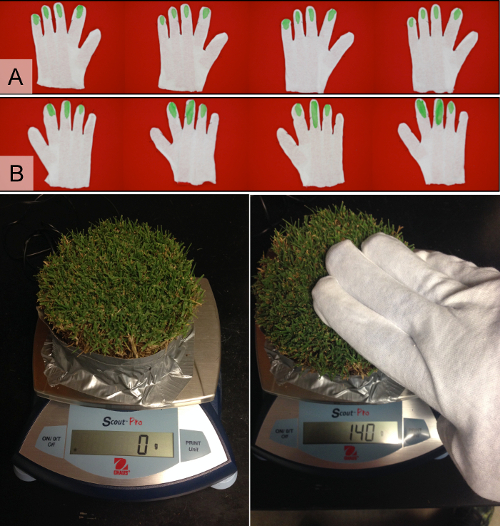
Figure 1: Hand wiping pressure quantification. Approach used to quantify pressure from fronthand (A) and backhand (B) wiping motions. To do so, spray a green food coloring solution (water + 10% v/v food coloring + 1% v/v nonionic surfactant) over a nonporous surface (ex. glass or metal tray) and press hand as intended for pesticide dislodge sampling. Quantify the contact surface area by digital image analysis as described by Campillo et al.17 to determine proportion of green pixels per image of known area. Collect a turfgrass core from the intended research area when soil is at field capacity and secure it to a digital weight scale. Quantify the mass of downward force when hand wiping. Hand wiping pressure should not exceed 2 kPa. Please click here to view a larger version of this figure.
- Hand wipe
NOTE: Requires one person.- Calibrate hand wiping pressure to 2 kPa.
- Calculate wiping force by securing a turfgrass core collected at soil field capacity to a digital scale and pressing to provide 150 to 200 g (tare prior to pressing).
- Quantify area of front- and backhand used for turfgrass sampling. Primarily use fingers to contact unique turfgrass blades while limiting them from laying over.
- Prepare a water-based solution of 10% v/v green food coloring + 1% v/v nonionic surfactant, and spray on a nonporous surface to create a thin film.
NOTE: The nonionic surfactant is used to increase solution coverage over the nonporous surface by reducing surface tension. - With a cotton glove on, press hand on the nonporous surface (Figure 1).
- Remove the glove and quantify area of hand in contact with the nonporous surface by taking a digital photo over a known area of each glove, and use ImageJ16 to select for green pixels similarly to Campillo et al.17. This will provide a percent of the total image in green pixels, which is used to calculate area.
- Prepare a water-based solution of 10% v/v green food coloring + 1% v/v nonionic surfactant, and spray on a nonporous surface to create a thin film.
- Combine wiping force mass with wiping area to calculate hand pressure.
- Calibrate hand wiping speed to 1.2 km/h by marking a 0.3 m distance on the ground. Adjust the hand speed such that wiping this distance takes 1 s.
- Mark sampling area (420 cm2) by placing a circular bucket (23 cm diameter) upside down where the open end is facing downward. Apply light pressure to the center of the bucket and with opposite hand paint around the outer edge of the bucket (using turf marking paint).
- With a cotton glove over a nitrile glove on the dominant hand, wipe over the sampling area for 30 s. Alternate front- and backhand surfaces, while adjusting directions perpendicularly (Figure 2).
- Repeat step 5.1.4 with a new cotton glove.
NOTE: Variation in gloves required per sample can vary based on the pesticide of interest, turfgrass system and sampling area. This should be determined prior to experiment initiation via preliminary efforts collecting four to six gloves per sampling area immediately after application, as well as the following morning when canopy moisture is present to identify the number of gloves to transfer maximum pesticide residue.
- Repeat step 5.1.4 with a new cotton glove.
- Following sample collection, store gloves in a glass jar temporarily on ice or dry ice in the field, and transfer to a freezer within 3 h following sample collection completion.
- Calibrate hand wiping pressure to 2 kPa.
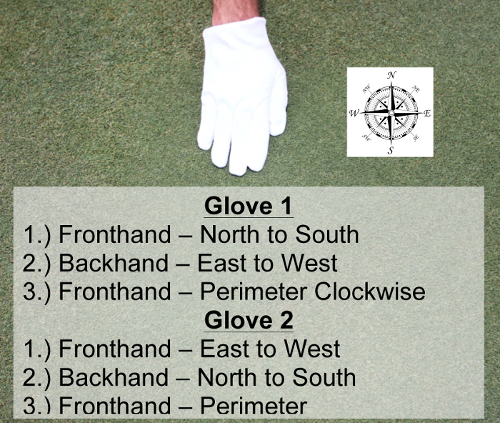
Figure 2: Hand wiping directions. Progression is intended to contact maximum unique treated vegetation surface area to glove. Two gloves are required to avoid overloading cotton when sampling <415 cm2 area; however, this should be confirmed in pesticide- and site-specific conditions prior to experiment initiation. Please click here to view a larger version of this figure.
- Modified California roller
NOTE: Requires three people. Apparatus building specifications found at Fuller et al.9- Use a roller (roller: 14.5 kg, 10 cm diameter by 61 cm length covered with 1.2 cm polyurethane foam; handle: 1.2 m length) and a frame (62 cm width by 91 cm length) that a cotton sheet (>200 thread count; 70 cm width by 99 cm length) is secured to.
- Have Persons B and C secure cotton sheet to frame with clamps and secure to sampling area with metal nails.
NOTE: Cut cotton sheets prior to a sample collection event to reduce time for a given collection. - Have Person A and B secure plastic (6 mm) around the roller to prevent contamination across samples.
- Without adding down pressure, have Person A roll the roller over the cotton cloth five times (one down and back roll equals one time). Roll speed should target 1.6 ± 0.2 km/h.
- Have Person C remove the frame from the ground and take to a nearby sampling table.
- While Person C is holding the frame, have Person A visually inspect the cloth and remove grass/soil debris with tweezers.
- Have Person A remove the cotton cloth, and with Person B fold it such that the side in contact with turfgrass is folded together and store in glass sample jar.
- Store the glass jar temporarily in a cooler on ice or dry ice in the field, and transfer to a freezer within 3 h following sample collection completion.
- Following sample collection, discard the plastic surrounding the roller, clean the frame, sampling table and tweezers with 1:1 ammonia:water, rinse with water and dry prior to repeating the process.
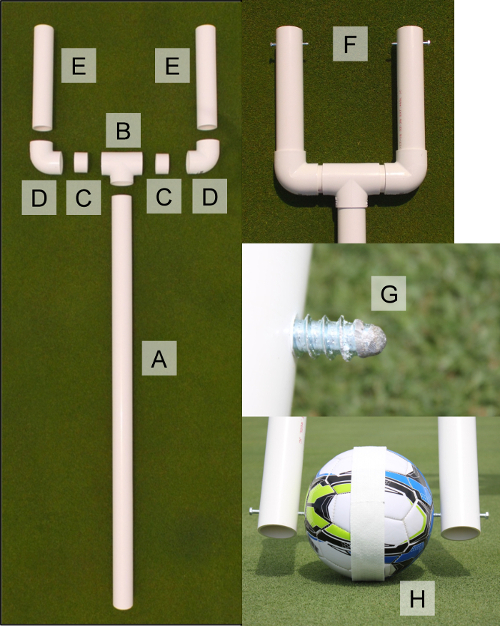
Figure 3: Soccer ball roller. Excluding A to B, all junctions are glued with PVC adhesive. Part C length can vary by supplier due to varying dimensions of parts B and D. Please click here to view a larger version of this figure.
- Soccer ball roll
NOTE: Requires one person.- Use a soccer ball roller frame constructed of polyvinyl chloride (PVC) pipe (schedule 40; 5 cm inner diam).
- Secure the handle (122 cm length; Figure 3A) to a slip tee coupler (Figure 3B). This is the only junction not secured with PVC glue to make for easier storage.
- Lay the roller on a flat surface (aids with alignment) and secure both sides of the tee coupler to slip 90° elbow fittings (Figure 3D) with 7 cm pipe length (Figure 3C).
- Insert 24 cm pipe lengths (Figure 3E) to the open end of the elbow fittings
- Drill lag bolts (0.6 cm diam by 7.5 cm length; Figure 3F) through the end of the pipe perpendicular to the handle and parallel with the flat surface.
- Set distance between lag bolts to approximately 18.4 cm (can vary across brands/quality of soccer balls used).
- File/grind sharp point off lag bolt ends with a hand file/grinder so that soccer balls are not punctured when rolling (Figure 3G).
- Release soccer ball air pressure to 24 kPa. Although this will underinflate the ball when loose from the PVC roller, it will increase pressure to approximately 42 kPa when the ball volume is reduced after securing to the roller.
- Mount the soccer ball onto the roller by touching the ball endpoints (maximum diameter) to lag bolts.
NOTE: To reduce overall sampling time and potential contamination, have one soccer ball per sample at a given collection timing.- Spin ball by hand to ensure the ball roll is symmetrical.
- Press lightly on top of the mounted soccer ball to ensure it is adequately secured.
- Double-wrap a sorbent strip (5 cm width by 132 cm length) around the circumference of the ball that aligns with the PVC roller handle, which creates constant turfgrass-sorbent strip contact when rolling (Figure 3H).
- Secure the sorbent strip to the ball with adhesive tape strips (2.5 cm by 2.5 cm).
NOTE: Cut sorbent strips prior to a sample collection event to reduce time for a given collection.
- Secure the sorbent strip to the ball with adhesive tape strips (2.5 cm by 2.5 cm).
- Roll the ball at a constant speed (1.6 ± 0.2 km/h) over a 3.7 m distance of unique treated turfgrass. Depending on plot dimensions, this distance may require side-by-side rolls to complete. When doing so, take precaution to not contact vegetation that has yet to be sampled.
NOTE: The 3.7 m ball roll distance may need to be adjusted based on the pesticide of interest and turfgrass system. This should be determined prior to experiment initiation via preliminary efforts collecting samples of varying distances immediately after application, as well as the following morning when canopy moisture is present to identify the optimal distance to transfer maximum pesticide residue. - Following the ball roll, remove the sorbent strip and fold it such that the side in contact with turfgrass is folded together and store in a glass jar.
- Store the glass jar temporarily in a cooler on ice or dry ice in the field, and transfer to a freezer within 3 h following sample collection completion.
- Use a soccer ball roller frame constructed of polyvinyl chloride (PVC) pipe (schedule 40; 5 cm inner diam).
6. Turfgrass Vegetation Collection
- Remove the plunger inside of the cup cutter to keep sampling equipment from contacting treated foliage (Figure 4A).
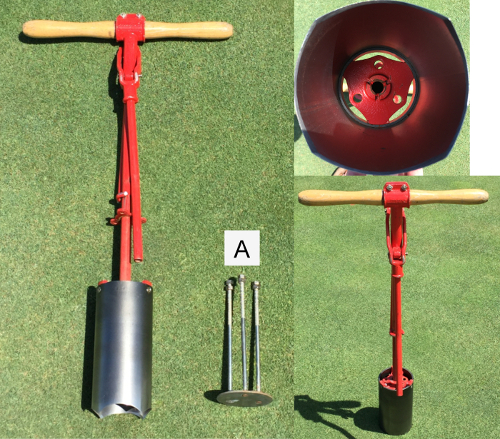
Figure 4: Turfgrass core collection. Golf course cup cutter is a robust, relatively cheap apparatus for turfgrass/soil collection. Remove the inside plunger used to eject cores prior to use for transferable pesticide residue sample collections so that vegetation is not inadvertently contacted, which may reduce pesticide residue concentrations. Please click here to view a larger version of this figure.
- Harvest a turfgrass core of representative quality.
- Use the cup cutter to outline the core and cut to 5-7.5 cm soil depth to aid with removal.
- Cut with a knife (blade length: 10 to 15 cm) at a diagonal angle outside the edge of the core to remove the core from the ground. Pay special attention to prevent hand/knife contact with treated aboveground vegetation.
- Level the bottom soil surface with scissors so that it will sit flat in a sample container. Soil depth should allow enough space such that turfgrass vegetation does not contact the sample container lid.
NOTE: When weather permits, the golf course cup cutter step (6.2.1 in protocol) is typically completed in the afternoon when foliage is dry before sample collection the following morning.
Access restricted. Please log in or start a trial to view this content.
Results
Building on previous research efforts comparing transferable pesticide residue methods within a single turfgrass system, and turfgrass systems within a single transferable pesticide residue method, a field study (initiated May 24, 2016 in Raleigh, North Carolina, USA) was conducted to compare methods across turfgrass systems. In short, 2,4-D, a broadleaf herbicide used commonly in turfgrass systems, transfer from three turfgrass species (creeping bentgrass, Agrostis stolonifera L...
Access restricted. Please log in or start a trial to view this content.
Discussion
Regulating agencies have not identified a specific method to quantify transferable pesticide residues from turfgrass. This research supports utilizing different methods based on site- and exposure process-specific criteria, as they all have utility for human risk assessments. However, they all have limitations that researchers should be cognizant of prior to their use. Lastly, turfgrass species is not a site selection parameter currently stated in transferable pesticide residue protocols, and this research builds on prev...
Access restricted. Please log in or start a trial to view this content.
Disclosures
The authors have no disclosures to make.
Acknowledgements
We thank Khalied Ahmed, Laney McKnight and Drew Pinnix for field and laboratory assistance, as well as the Lake Wheeler Turfgrass Field Laboratory support staff, including Dustin Corbett and Marty Parish, for maintaining research areas. This work was partially supported by the North Carolina State University Center for Turfgrass Environmental Research and Education.
Access restricted. Please log in or start a trial to view this content.
Materials
| Name | Company | Catalog Number | Comments |
|---|---|---|---|
| General | --- | --- | |
| Nitrile gloves | Any | NA | |
| Coolers | Any | NA | |
| Turf paint | Any | NA | |
| Field plot measuring equipment | Any | NA | |
| Protective foot apparel | Any | NA | |
| Whatman 3 MM Chr Chromatography Paper | Fisher Scientific | 05-716-3E | |
| Name | Company | Catalog Number | |
| Ball roll | --- | --- | |
| PVC pipe (5 cm inner diameter) | Home Depot | 531137 | |
| Hacksaw for PVC cutting | Any | NA | |
| 90° elbow (5 cm inner diameter) | Home Depot | RCE-2000-S | |
| Tee coupler (5 cm inner diameter) | Home Depot | PVC024001600HD | |
| PVC adhesive | Any | NA | |
| Lag bolt (0.6 cm diameter by 7 cm length) | Home Depot | 801366 | |
| Size 4 soccer ball | Any | NA | |
| Pressure gauge | Any | NA | |
| Hand air pump | Any | NA | |
| Fabric scissors | Any | NA | |
| Scott Rags-In-A-Box | Uline | S-12809 | |
| Adhesive tape | Any | NA | |
| 8 oz sealable glass jar | Any | NA | |
| Name | Company | Catalog Number | |
| Hand wipe | --- | --- | |
| 100% cotton heavyweight inspection gloves | Uline | S-19284 | |
| Digital camera | Any | NA | |
| ImageJ software | National Institutes of Health | https://imagej.nih.gov/ij/ | |
| Digital scale that measures up to 400 g | Any | NA | |
| Stopwatch | Any | NA | |
| Plastic bucket (23 cm diameter) | Home Depot | 209313 | |
| 16 oz sealable glass jar | Any | NA | |
| Name | Company | Catalog Number | |
| Modifed California roller | --- | --- | |
| Metal conduit (1.25 cm diameter by 1.8 m length) | Home Depot | 101543 | |
| PVC pipe (10 cm inner diameter) | Home Depot | 531103 | |
| Sand + reebar to bring roller to 14.5 kg | Any | NA | |
| PVC plug | Home Depot | 33403D | |
| Polyurethane foam sheet (1.25 cm thick) to cover PVC pipe | Any | NA | |
| 6 mm painter's plastic | Any | NA | |
| Plexiglass sheet (107 cm length by 76 cm width by 0.6 cm thick) | Any | NA | |
| Toggle clamps | Any | NA | |
| Metal nails (10 to 15 cm length) to secure frame to ground | Any | NA | |
| 100% cotton sheets (>200 threadcount) | Any | NA | |
| Tweezers | Any | NA | |
| 32 oz sealable glass jar | Any | NA | |
| Name | Company | Catalog Number | |
| Turfgrass vegetation core collection | --- | --- | |
| Lever action golf course cup cutter | Par Aide Product Company | 1001-1 | |
| Knife | Any | NA | |
| Fiskars Herb Scissors | Home Depot | 96086966J | |
| Turf plug plastic container | Any | NA |
References
- Census of Agriculture: United States Summary and State Data [Internet]. , United States Department of Agriculture. Washington, DC, USA. Available from: http://www.agcensus.usda.gov/Publications/2007/Full_Report/usv1.pdf (2009).
- Milesi, C. Mapping and modeling the biogeochemical cycling of turf grasses in the United States. Environ. Manag. 36, 426-438 (2005).
- Turgeon, A. J. Turfgrass management. , 8th ed, Pearson Education, Inc. Upper Saddle River, NJ, USA. (2008).
- Cisar, J. L., Synder, R. H., Sartain, J. B., Borgert, C. J. Dislodgeable residues of chloropyrifos and isazofos and implications for golfer exposure. Int. Turf. Soc. 9, 12-18 (2001).
- Morgan, M. K. Adult and children's exposure to 2,4-D from multiple sources and pathways. J. Expos. Sci. Environ. Epidemiol. 18 (5), 486-494 (2008).
- Overview of Risk assessment in the Pesticide Program [Internet]. , United States Environmental Protection Agency. Washington, DC, USA. Available from: https://www.regulations.gov/document?D=EPA-HQ-OPPT-2009-0157-0003 (2016).
- OCSPP Harmonized Test Guidelines - Master List [Internet]. , United States Environmental Protection Agency. Washington, DC. USA. Available from: https://www.epa.gov/sites/production/files/2015-11/documents/ocspp-testguidelines_masterlist-2015-11-19.pdf (2015).
- Occupational and Residential Exposure Test Guidelines - OPPTS 875.1100 Dermal Exposure - Outdoor. , United States Environmental Protection Agency. Washington, DC, USA. Available from: https://www.epa.gov/pesticide-science-and-assessing-pesticide-risks/overview-risk-assessment-pesticide-program (1996).
- Fuller, R. Modified California roller for measuring transferable residues on treated turfgrass. Bull. Environ. Contam. Toxicol. 67 (6), 787-794 (2001).
- Klonne, D. Comparative study of five transferable turf residue methods. Bull. Environ. Contam. Toxicol. 67 (6), 771-779 (2001).
- Rosenheck, L. Determination of a standardized sampling technique for pesticide transferable turf residues. Bull. Environ. Contam. Toxicol. 67 (6), 780-786 (2001).
- Welsh, A. Transferable turf residue following imidacloprid application. , Department of Pesticide Regulation - California Environmental Protection Agency. Sacramento, California, USA. Available from: http://www.cdpr.ca.gov/docs/whs/pdf/hs1860.pdf (2005).
- Kim, D. S., Marshall, E. J. P., Brain, P., Caseley, J. C. Effects of crop canopy structure on herbicide deposition and performance. Weed Res. 51 (3), 310-320 (2011).
- Jeffries, M. D. Factors influencing dislodgeable 2,4-D plant residues from hybrid bermudagrass (Cynodon dactylon L. x C. transvaalensis.) athletic fields. PLoS One. 11 (2), 1-16 (2016).
- Sears, M. K., Bowhey, C., Braun, H., Stephenson, G. R. Dislodgeable residues and persistence of diazinon, chloropyrifos and isofenphos following their application to turfgrass. Pestic. Sci. 20 (3), 223-232 (1987).
- Rasband, W. S. ImageJ. , U.S. National Institutes of Health. Bethesda, Maryland, USA. Available from: http://imagej.nih.gov/ij (2007).
- Campillo, C., Prieto, M. H., Daza, C., Mońino, M. J., García, M. I. Using digital images to characterize canopy coverage and light interception in a processing tomato crop. HortSci. 43 (6), 1780-1786 (2008).
Access restricted. Please log in or start a trial to view this content.
Reprints and Permissions
