Optimized sampling protocols and the development of new wipe materials can be facilitated by standardized measurements of collection efficiency from wipe-sampling. Our approach for sampling trace explosives uses an automated device to control speed, force, and distance during wipe-sampling followed by extraction of collected explosives.
Method Article
Standardized Method for Measuring Collection Efficiency from Wipe-sampling of Trace Explosives
In This Article
Summary
Abstract
One of the limiting steps to detecting traces of explosives at screening venues is effective collection of the sample. Wipe-sampling is the most common procedure for collecting traces of explosives, and standardized measurements of collection efficiency are needed to evaluate and optimize sampling protocols. The approach described here is designed to provide this measurement infrastructure, and controls most of the factors known to be relevant to wipe-sampling. Three critical factors (the applied force, travel distance, and travel speed) are controlled using an automated device. Test surfaces are chosen based on similarity to the screening environment, and the wipes can be made from any material considered for use in wipe-sampling. Particle samples of the explosive 1,3,5-trinitroperhydro-1,3,5-triazine (RDX) are applied in a fixed location on the surface using a dry-transfer technique. The particle samples, recently developed to simulate residues made after handling explosives, are produced by inkjet printing of RDX solutions onto polytetrafluoroethylene (PTFE) substrates. Collection efficiency is measured by extracting collected explosive from the wipe, and then related to critical sampling factors and the selection of wipe material and test surface. These measurements are meant to guide the development of sampling protocols at screening venues, where speed and throughput are primary considerations.
Introduction
Screening for traces of explosives at airports and other venues is a crucial step in the protection of the public against the threat of terrorism. Current practices are heavily focused on wipe-sampling of surface contamination from items handled by people, the people themselves, and items destined for cargo holds. Collection wipes are analyzed immediately in the field using commercial explosive trace detectors (ETDs) that are typically based on thermal desorption of collected solid material, with detection by ion mobility spectrometry1 or, more recently, mass spectrometry. The total amount of time available for sample collection and analysis is limited by the need to minimize the impact on passenger and cargo throughput. Sampling protocols must be optimized to collect the most sample in the shortest time, which requires standardized measurements that can weigh factors important to wipe collection.
Wipe-sampling is a general practice used for sampling surface contamination in health, environmental, and regulatory arenas2,3,4,5,6,7. Typical practices include holding the wipe by hand and sampling within a fixed area using a general coverage pattern. To increase control over wiping factors, including force and speed, we developed an instrumental approach to simulate wipe-sampling8, which has also been used to evaluate efficiencies in biological wipe-sampling9. A commercial device intended for adhesion measurements was adapted to the purpose; it includes a planar surface that moves at a fixed speed and distance under a stationary wipe. The force during sampling is controlled by a weight placed on top of the wipe holder. Surfaces of interest (fabrics, plastics, metals, etc.) are placed on the planar surface and a particle sample is placed in a fixed area on that surface. Our earlier work used polystyrene latex microspheres as the test particles, and particle size was shown to have an effect on particle collection, with larger (42 μm) spheres collected more efficiently than smaller (9 μm) spheres. We also found some improvement in collection efficiency with an increase in applied force during sampling, and observed differences in collection from different surfaces and for different wipes.
In subsequent work, we found that polystyrene particles could be redeposited by continuing to wipe the surface after collection, reducing the apparent collection efficiency10. This is an important consideration in trace explosives detection, as items sampled in screening scenarios, such as suitcases, can be large relative to the wipe collection area, requiring extensive travel distances to cover even a small percentage of the area of the item. Therefore, the travel distance on the surface after collection of the sample is an important factor, and field protocols typically define a maximum allowable distance covered prior to each analysis.
The shapes of microspheres are unlike real explosive particles11,12 and their chemical and physical properties may make them an inadequate simulant for explosives in wipe collection experiments. To address this limitation, we developed a test material containing the explosive 1,3,5-trinitroperhydro-1,3,5-triazine (RDX) with a known particle size. The test material is made by inkjet printing nanoliter volumes of an RDX solution in arrays on Teflon substrates, with micrometer-sized solid deposits formed by evaporation at each point in the array. The deposits are transferred to the test surfaces by rubbing onto the surface, and the resultant particle sizes are defined by the starting deposit size. The desired particle diameters, as determined by analysis of fingerprints containing trace explosives, is 10 to 20 μm. Deposits can also be formed by pipetting microliter volumes of solution onto Teflon substrates13, but they will dry into a single large deposit, generally much larger that the desired range of particle sizes (for RDX masses relevant to this work). The inkjet RDX particle standard is used in this work along with quantitative extraction and analysis procedures to demonstrate the method for determining wipe collection efficiency. These measurements are designed to promote the development of new sampling wipes with better collection efficiencies, and support best practices in field sampling, including targeting surfaces that yield more sample, the appropriate force to use during collection, and the area to cover prior to analysis.
Protocol
1. Apparatus
- Select or fabricate a device with a moveable plane (see schematic in Figure 1).
NOTE: Here, use a TL-slip/peel tester but this device has features, such as the measurement of frictional forces, that are not necessary to this method and may increase the cost over a simpler device.- Select plane dimensions with a minimum length of 15 cm by a minimum width of 3 cm. The length controls the maximum travel distance for a single sampling path (Figure 1).
- Choose a plane that moves at defined speeds from 50-400 mm/s with a repeatability at the chosen speed of ± 10%. The range is based on data from a volunteer population performing wiping experiments.10
- Fabricate a wipe holder (Figure 2). CAD drawings available in supplementary information.
- Include a clamping mechanism to hold the wipe and expose a circular collection area 30 mm in diameter. The collection area is based on typical ETDs where the desorber area in the instrument defines the allowable collection area.
- Include a removable soft backing behind the collection area to provide an even distribution of force. It is removable in case of contamination that cannot otherwise be removed by cleaning. The backing can be made of sponge rubber foam, as described in ASTM D189414, or another soft material, such as felt, cut to size.
NOTE: The properties of the sponge rubber described in ASTM D1894 include a required softness measured as the ability to compress the foam 25% when using a pressure of 85 ± 15 kPa (12.5 ± 2.5 psi). We evaluate the effectiveness of any backing material to evenly distribute force by mapping the pressure using a force-sensitive film8,10. The pressure over the entire collection area (30 mm diameter circle) can be calculated based on the total force only for uniform distributions of force. - Include attachable weights to provide total forces (combined weight of holder and weight) on the wipe ranging from approximately 1 to 15 N (approximately 100 to 1,500 gram-force). Set the minimum force by the weight of the wipe holder. The force range is based on data from a volunteer population performing wiping experiments, where the average force exerted was 7 N.10 The maximum force will be limited by the ability to ensure smooth movement over the surface during travel.
- Include an eye-hook or similar device for attaching a restraining wire. The wire restrains the wipe holder from moving during the motion of the plane. The wire should be parallel to the surface or be at a slight positive angle during movement of the plane.
2. Material Selection and Instrumental Configuration
- Select test surfaces based on similarity to the screening environment. Choices may include synthetic leather, metal, plastic, cardboard, fabric, etc. Use surfaces that are flat and fit on the plane of the testing device. Very flexible surfaces may need to be backed by a rigid surface to prevent movement during wipe-sampling.
- Cut surfaces to size if necessary and clean with solvent (ethanol or methanol are generally suitable) and/or by blowing off particles with pressurized air. Clean surfaces immediately prior to the conduct of wipe-sampling.
- Use wipes made from any material considered for use in wipe-sampling. They must have minimum dimensions to cover the 30 mm diameter circular collection area on the wipe holder and be clamped in place.
- Cut wipes to size if necessary to fit into wipe holder.
- Test a subset of wipes prior to use following procedures described in section 4 to determine extraction efficiency and blank contamination levels with respect to RDX or other contaminants that could interfere with the analysis.
- Prepare RDX particle standards by inkjet printing arrays onto polytetrafluoroethylene (PTFE) substrates. Their fabrication and use is described in detail in the publication under review. 200 ng of RDX is a minimum amount, given typical analytical detection limits of the quantification technique of approximately 5 ng/mL, and the maximum amount, based on reported amounts of RDX in fingerprints, should be a few micrograms. The samples can be held under refrigeration for up to 30 days after printing.
NOTE: The particles derived from these standards range in size from 1 μm to 40 μm in diameter, simulating well the particles in fingerprints made after handling plastic explosives12. The area distribution of the transferred sample is dependent on the printed array size, but will typically be within a 5 mm by 5 mm area; well within the 30 mm diameter circular sampling area. This protocol uses RDX particle standards produced by inkjet printing that have a known particle size distribution and a known area distribution when transferred onto the test surface. Other dry-transfer samples13 can be used if the same parameters are known. Samples produced by direct solution deposition onto the test surfaces are not recommended. - Configure and test device for wipe sampling.
- Move the plane to the starting position (Figure 1).
- Referring to Figure 3, place a test surface, without adhering it, on the device plane.
- Prepare a template from paper, as shown in the schematic in Figure 1, and place it flush to the edges of the test surface, as shown in Figure 3. The template marks the location of the wipe starting position and the location and length of the sampling path.
- Adhere the template to the surface using tape. Move the surface, with the template, back and forth on the plane until the wipe sits on the starting location when the restraining wire is taut. Move the surface, with the template, side-to-side on the plane, until the restraining wire is centered down the travel path.
- Mark the location on the plane where the substrate will be adhered, as determined above. Adhere surface, with the template, to the plane using double-stick tape.
- Use software controls for the instrument to input travel distance and travel speed.
- Initiate movement of the plane to test that the wipe follows the sampling path for the entire travel distance, and to ensure smooth travel.
NOTE: Some combinations of wipe and test surface may result in a high level of friction during motion. Skipping and lifting of the wipe during motion is undesirable. The wipe may deviate from the sampling path for long travel distances or for some combinations of wipe and test surface. The most critical factor is to ensure that the wipe passes through the sample deposit location. Adjusting the angle of the restraining wire may help alleviate the problem. - Measure the travel distance from the location of the sample deposit to the end of travel.
NOTE: If the sample is placed near the start of the sampling path, as in Figure 1, the travel distance will be at its maximum for the test surface length. Smaller travel distances can be selected by limiting the total length of travel, or by moving the location of the sample.
3. Wipe-sampling
- Clean test surface and allow to dry.
- Place the surface on a top loading balance and place a paper template on top (see 2.4.2), holding it in place at a corner.
- Take a particle sample in hand and use glancing illumination to check that the array is complete.
- Place a finger behind the deposit and put the PTFE substrate deposit-side down on the test surface, with the deposit inside the marked sample area. Translate the PTFE substrate along the test surface within the sampling path using a minimum of 10 N (observe the weight on the balance to equal or exceed 1,000 gram-force) to dry-transfer the particles.
- For test surfaces with a striated texture, translate the PTFE substrate along the surface orthogonal to the striations, even if this is orthogonal to the sampling path.
- Use glancing illumination to inspect the PTFE substrate after dry-transfer to ensure the removal of the array. If array elements remain, choose whether to continue or discard the experiment and start again. The choice will depend on the detection limits from extraction and analysis, and the minimum mass needed on the surface.
- Reserve the PTFE substrate for extraction and determination of transfer efficiency.
- Place the test surface on the plane in the previously defined location and adhere it to the plane using double stick tape or equivalent.
- Load the selected wipe into the holder and attach the appropriate weights for the selected force.
- Record the temperature and humidity near the experiment to within ± 2 °C and ± 5% RH.
- Attach the restraining wire to the wipe holder and place the holder wipe-side down on the test surface. Immediately initiate movement of the plane. Lift the wipe holder off of the test surface after movement ceases and remove the wipe from the holder.
4. Extraction and Analysis
- Extract and analyze any RDX remaining on PTFE transfer substrate.
- Flow 1 mL of methanol containing an internal standard over the surface and into a 2 mL glass vial. Use an isotopically tagged RDX as an internal standard. A suitable analogue with similar chemical structure and physical properties can be used if an isotopically tagged standard is not obtainable. For RDX, an additional acceptable internal standard would be cyclotetramethylenetetranitramine (HMX). The method of preparing the PTFE transfer substrate suggests wrapping the PTFE around the paper to minimize solvent loss to the paper.
- Quantify solutions using previously developed analytical protocol. The protocol used in this study is based on electrospray ionization mass spectrometry (ESI-MS).
- Extract and analyze RDX collected on the wipe.
- Cut the wipe material down to the 30 mm diameter circular collection area and place the cut portion inside a 2 mL glass vial. Add 1 mL of methanol containing the internal standard.
- Cap the vial and vortex at 10,000 rpm for 30 s.
- Quantify solutions as rapidly as possible to prevent re-adsorption of the analyte and/or internal standard onto the wipe material. Complete analyses within an hour of extracting whenever possible.
- Extract and analyze a subset of unused RDX particle standards on PTFE to obtain a baseline starting mass in the same manner as 4.1.
- Calculate transfer efficiency (TE) from the PTFE substrate to determine the mass of RDX deposited on the surface.

where RDXInitial is the average deposited mass of the extracted baseline samples (step 4.3) and RDXRemain. is the mass of RDX remaining on the PTFE substrate after dry-transfer (step 4.1). - Calculate collection efficiency (CE) of the wipe relative to the deposited mass on the surface.

where RDXWipe is the mass of RDX extracted from the wipe (step 4.2).
5. Quality Control
- Perform a minimum of 3 replicates. Variability in CE can be relatively high and 10 or more replicates may be needed to determine the significance of various sampling factors.
- Clean and reuse test surfaces for replicates if blank testing indicates the efficacy of the cleaning procedure. Solvents may affect the surface texture, and any procedure requiring their use must apply to all replicates.
- Use fresh wipes for each replicate.
- Measure process blanks by following the same procedure but with blank PTFE substrates.
6. Reporting
- Calculate and report the average and standard deviation of TE and CE for (n) replicates.
- Report 1) type of wipe, 2) test surface, 3) force, 4) speed, 5) travel distance, 6) temperature, and 7) humidity.
- Report the type and details of sample used. If samples have been prepared other than by inkjet printing, report estimated particle size and reproducibility.
- Report any other factors, controlled or observed.
Results
The ability of this protocol to accurately measure collection efficiency from a wide variety of possible test surfaces is dependent on the physical characteristics of the sample and its confinement to a specific area on the surface. If the sample is outside the defined area, it may not be fully encountered during wipe-sampling, and the collection efficiency will be artificially reduced. In addition, if the particles are significantly different from real particles expected in trace explosives residues, the collection efficiency measurements may not be representative. For these reasons, we recommend the use of a specific type of sample which has been demonstrated to generate appropriate particle size characteristics and to transfer to test surfaces within a confined area consistent with the protocol. Direct solution deposition to form particles is dependent upon the texture and composition of the surface and may not result in representative samples.
Results are given in Table 1 for a commercial ETD wipe 1 (meta-aramid polymer) given a 7.5 N force and a test surface representative of luggage (ballistic nylon woven fabric), for two different travel distances. The travel speed for all experiments is 50 mm/s, and the temperature and relative humidity during collection were 20 ± 2 °C and 40 ± 4% RH, respectively. The results show that a longer path length results in a reduced collection efficiency, which is expected due to redeposition of particles10. The 36 cm travel distance was achieved by using three separate passes on the surface, lifting the wipe at the end of each path and translating the surface to expose a fresh sampling path. This method of extending the travel distance requires that the wipe is lifted and placed down multiple times, and may produce different results compared to a continuous sample path. In screening scenarios, it is likely that the wipe is lifted and replaced many times on the item, so that this approach for extending the travel distance is appropriate.
The TEs of the RDX deposits from the PTFE substrate are high, as expected for this surface. Because the TEs are close to 100%, and there is quality assurance provided by visual inspection of the substrate (step 3.2.3), the measurement of TE could be eliminated without significantly affecting the CE results for this test surface. Other test surfaces may have lower or more variable TEs. The uncertainties in CE are within the range expected for this technique based on our experience to date. A second commercial ETD wipe (PTFE-coated woven fiberglass) generally has lower uncertainties than the meta-aramid polymer wipe, although it also has lower CEs in general (Figure 4). Our previous work with polystyrene microspheres8 is consistent with the lower collection efficiencies observed for ETD wipe 2 compared with wipe 1.
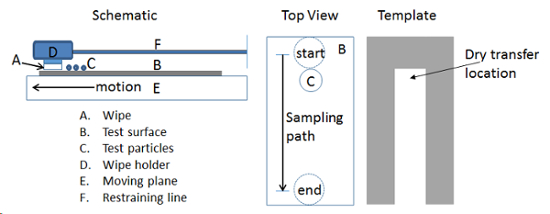
Figure 1. Schematic for wipe sampling apparatus (left and middle) with template for sample placement on the test surface (right). The footprint of the wipe collection area, a 30 mm diameter circle, is shown at the start and end of the sampling path. The wipe is placed on the test surface, travels directly through the sample location (typically 5 mm by 5 mm or smaller), and ends on the surface. The travel distance is from C, the location of the sample, to the end. Please click here to view a larger version of this figure.
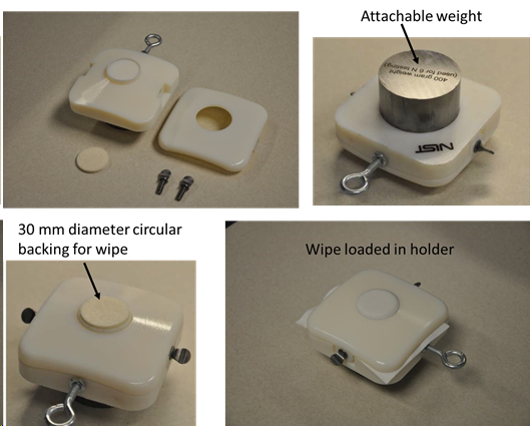
Figure 2. Example wipe holder. The component parts for the custom holder are shown in the top left, and include two plastic components produced by 3D printing. These two components serve to clamp the wipe in place and are held together by two thumb screws. The attachable stainless steel weight is a solid rod with a threaded stud at one end for attachment to the holder. The eye bolt is for attachment of the restraining line.
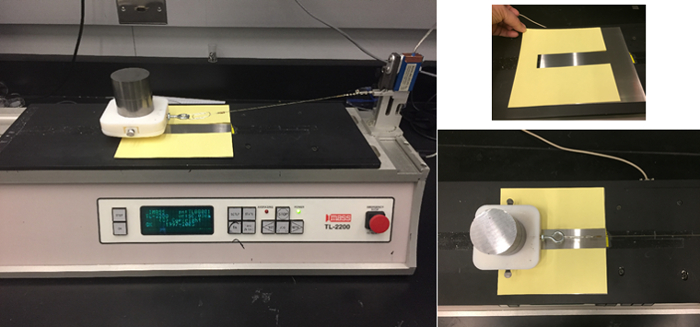
Figure 3. Configuration of device. A yellow paper template is made to fit a 10 cm by 10 cm square steel test surface, with a cutout for the sampling path. The surface with template is placed on the moveable plane and adjusted until the restraining line is taut and centered over the sampling path. The template is used to configure the device and when transferring the test sample, but is not in place during wipe sampling. Please click here to view a larger version of this figure.
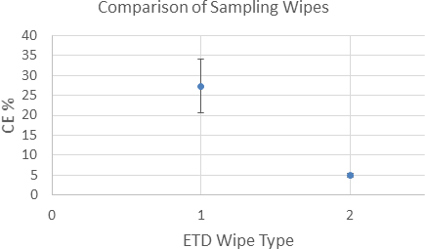
Figure 4. Results for synthetic leather test surface and a 36 cm travel distance, achieved by using 3 passes of 12 cm each, for two different wipes. Uncertainties in CE are given as 1 standard deviation.
| Travel distance (cm) | Force (N) | TE (%) | RSD (%) | CE (%) | RSD (%) | n |
| 36* | 7.5 | 97.4 ± 2.1 | 2.2 | 11.7 ± 4.0 | 34.0 | 9 |
| 12 | 7.5 | 98.5 ± 1.3 | 1.3 | 22.6 ± 3.4 | 15.2 | 4 |
| *3 passes of 12 cm each. | ||||||
Table 1. Results for commercial ETD wipe 1 and woven nylon fabric test surface for two different travel distances. Uncertainties in TE and CE are given as 1 standard deviation.
Discussion
Sample collection is currently seen as the limiting step to improving detection capabilities in screening environments. Wipe-sampling is in need of measurement and standardization in order to evaluate current capabilities and support the development of new sampling materials and protocols. The approach described here is designed to provide this measurement infrastructure, and controls most of the factors known to be relevant to wipe-sampling. Previous work has shown that particle size, applied force during collection, test surface, sampling wipe, and travel distance are all important factors to control. The instrumental approach allows for control over the applied force, speed of wiping, and travel distance, and the values selected for these parameters should fall within the range expected in real situations. The force is applied by using a backing weight over the collection area, and care should be taken to achieve an even distribution of force in order to calculate the pressure.
Test surfaces are selected by the user and should relate to real screening environments to replicate the expected range of sampling challenges. Sampling wipes are selected in order to evaluate current practices and/or measure the efficacy of newly designed materials. In order to compare results among laboratories, the same test surfaces and wipes must be used, which can be done by specifying critical parameters or by sharing materials purchased from a single source. The ETD wipes are commercially available, but they are continually under production and different lots may have different properties. These are issues that can be addressed in the future by coordinated interlaboratory efforts.
The samples used to evaluate collection efficiency should match the physical characteristics expected in real situations. In the case of explosives, we have developed an approach for inkjet printing solutions of RDX to produce micrometer sized deposits which transfer efficiently to a range of substrates and produce particle deposits ranging in size from 1 to 40 μm. Alternatively, fixed-size polystyrene microspheres could be used. Pipetting RDX solutions onto Teflon substrates usually results in a single deposit that may be quite large, and the particle sizes after transfer to surface are unknown. This approach can be used for sampling studies if the particle sizes are characterized and shown to be reproducible.
This method was described for evaluating sampling efficiency for explosives, but can also be applied to environmental, nuclear, or forensic science applications. The samples, again, should be developed to match the real applications, and in the case of particle residues, the same type of dry transfer from Teflon would be appropriate. For surface contamination arising from sources other than particle transfer, such as condensation from vapor, different types of samples might be more appropriate.
A current limitation of the technique is the inability to change directions in sampling. The current configuration allows for movement in a single direction only, and therefore cannot control for directional changes that typically occur in field sampling of objects. We are currently addressing this need by incorporating x - y movement and allowing for specific sampling patterns to fill an area.
Disclosures
The authors have nothing to disclose. Certain commercial equipment, instruments, or materials are identified in this document. Such identification does not imply recommendation or endorsement by the National Institute of Standards and Technology, nor does it imply that the products identified are necessarily the best available for the purpose.
Acknowledgements
Dr. Jayne Morrow and Dr. Sandra Da Silva, both from NIST, contributed to an earlier version of the method. The Science and Technology Directorate of the U.S. Department of Homeland Security sponsored the production of a portion of this material under Interagency Agreement HSHQPM-15-T-00050 with the National Institute of Standards and Technology (NIST).
Materials
| Name | Company | Catalog Number | Comments |
|---|---|---|---|
| Slip/Peel Tester | Imass | TL-2300 | replaces TL-2200 used in protocol |
| 3D printer | Stratasys | Connex500 | VeroWhite resin as printing material |
| steel rod with thread | McMaster-Carr | 7786T14 | cut to size for desired weight, multiple online vendors available |
| felt or rubber | backing material in wipe holder, multiple online vendors available | ||
| PTFE substrate | SPI Supplies | 01426-AB | 1" wide Bytac Bench and Shelf protector, Al-backed, cut to size |
| RDX solution | Cerilliant Analytical Reference Standards | ERR-001S | 1,000 mg/mL in acetonitrile |
| Inkjet printer | MicroFab Technologies, Inc. | jetlab4 xl-B | |
| Isotopically tagged RDX | Cambridge Isotope Laboratories | CLM-3846-S | For internal analytical standard |
| 2 mL glass vial | Restek | 21140 /24670 | |
| Methanol | Sigma Aldrich | 14262 | Chromasolv grade |
| ETD wipe 1 | DSA Detection | DSW8055P | Ionscan 500 DT wipe |
| ETD wipe 2 | DSA Detection | ST1318P | Itemiser DX wipe |
| Ballistic nylon fabric | Seattle Fabrics | 1050 Denier Ballistics | |
| Synthetic leather fabric | contact authors for sample |
References
- Ewing, R. G., Atkinson, D. A., Eiceman, G. A., Ewing, G. J. A critical review of ion mobility spectrometry for the detection of explosives and explosive related compounds. Talanta. 54, 515-529 (2001).
- US EPA. A Performance-Based Approach to the Use of Swipe Samples in a Response to a Radiological or Nuclear Incident, EPA/600/R-11/122. 2011. , Available from: https://www.epa.gov/sites/production/files/2015-07/documents/600-r-11-122_use_of_swipe_samples.pdf (2016).
- Ashley, K., Braybrooke, G., Jahn, S. D., Brisson, M. J., White, K. T. Standardized Surface Dust Sampling Methods for Metals, with Emphasis on Beryllium. J. Occup. Environ. Hyg. 6, D97-D100 (2009).
- Lioy, P. J., Freeman, N. C. G., Millette, J. R. Dust: a metric for use in residential and building exposure assessment and source characterization. Environ. Health Perspect. 110 (10), 969-983 (2002).
- ASTM International. American Society for Testing and Materials. E1728-10 Standard Practice for Collection of Settled Dust Samples Using Wipe Sampling Methods for Subsequent Lead Determination. , West Conshohocken, PA, USA. E1728-E1710 (2010).
- Cettier, J., et al. Efficiency of wipe sampling on hard surfaces for pesticides and PCB residues in dust. Sci. Total Environ. 505, 11-21 (2015).
- Jain, S., Heiser, A., Venter, A. R. Spray desorption collection: an alternative to swabbing for pharmaceutical cleaning validation. Analyst. 136, 1298-1301 (2011).
- Verkouteren, J. R., et al. A method to determine collection efficiency of particles by swipe sampling. Meas. Sci. Technol. 19 (11), 115101(2008).
- Da Silva,, Urbas, S. M., Filliben, A. A., J, J., Morrow, J. B. Recovery balance: a method for estimating losses in a Bacillus anthracis spore sampling protocol. J. Appl. Microbiol. 114, 807-818 (2013).
- Verkouteren, J. R., Ritchie, N. W. M., Gillen, G. Use of force-sensing array films to improve surface wipe sampling. Env. Sci. Process. Impact. 15, 373-380 (2013).
- Verkouteren, J. R. Particle characteristics of trace high explosives: RDX and PETN. J Forensic Sci. 52, 335-340 (2007).
- Verkouteren, J. R., Coleman, J. L., Cho, I. Automated mapping of explosives particles in composition C-4 fingerprints. J. Forensic Sci. 55, 334-340 (2010).
- Brady, J. J., Argirakis, B. L., Gordon, A. D., Lareau, R. T., Smith, B. T. A method to control the polymorphic phase for RDX-Based Trace Standards. Proc. Of SPIE. 9824, 982418(2016).
- ASTM International. D1894-14 Standard Test Method for Static and Kinetic Coefficients of Friction of Plastic Film and Sheeting. American Society for Testing and Materials. , West Conshohocken, PA, USA. (2010).
- Dry transfer method for the preparation of explosives test samples. US patent. , 6470730 (2002).
Reprints and Permissions
