Nutrients present in particulate form can contribute significantly to the overall loads in agricultural drainage waters. This study describes a novel method to capture flow-weighted water and suspended particulates from farm canal drainage over the entire duration of the drainage event.
A subscription to JoVE is required to view this content. Sign in or start your free trial.
Method Article
Capturing Flow-weighted Water and Suspended Particulates from Agricultural Canals During Drainage Events
In This Article
Summary
Abstract
The purpose of this study is to describe the methods used to capture flow-weighted water and suspended particulates from farm canals during drainage discharge events. Farm canals can be enriched by nutrients such as phosphorus (P) that are susceptible to transport. Phosphorus in the form of suspended particulates can significantly contribute to the overall P loads in drainage water. A settling tank experiment was conducted to capture suspended particulates during discrete drainage events. Farm canal discharge water was collected in a series of two 200 L settling tanks over the entire duration of the drainage event, so as to represent a composite subsample of the water being discharged. Imhoff settling cones are ultimately used to settle out the suspended particulates. This is achieved by siphoning water from the settling tanks via the cones. The particulates are then collected for physico-chemical analyses.
Introduction
The fate and transport of suspended particulates has been the subject of numerous studies due to its role in eutrophication, particularly in agricultural systems1,2. A comprehensive evaluation of nutrients contained in particulate matter within an aquatic system is necessary to investigate numerous environmental issues such as, the internal cycling of nutrients and release to the overlying water column3, substrate stability, light availability within the water column, and eventually water quality concerns to downstream ecosystems4. The quantity of phosphorus (P) stored in the particulate form (organic matter or sediments) is typically greater than in the water column5. A study conducted by Kenney et al.6 showed that recent sediments that were deposited in Lake Lochloosa, Florida were between the age range of 1900 and 2006. These younger sediments contained nearly 55 times more P than that which was present in the water column. One approach to characterize the potential impact that particulates may have on a particular system is to conduct a quantitative inventory of phosphorus stored in sediment discharged during drainage events. Collection and analysis of these discharged particulates can help estimate downstream nutrient enrichment impacts on sensitive ecosystems.
Storm events typically represent a small fraction of time, yet may contribute the majority of P load discharge in farm drainage. This is because in order to prevent fields from flooding, a large volume of water is drained over short periods of time. Rainfall intensity and flow rates are vital driving factors that can control the concentration of suspended sediments in overland runoff7. Designing monitoring methods that captures flow-weighted composite water samples would help avoid errors associated with complex, high intensity rain events. During high discharge events like storms, the quick and drastic changes in concentrations may not be representative of the average pollutant concentration for the incremental volume. Therefore, flow-weighted water samples far more accurately represents the concentration of a discharge event as it is a summation of loads over a period of time8. The most common flow-weighted samples are automatically collected discrete or composite samples. By capturing the exported suspended particulates from farm drainage during discharge allows us to quantify the severity of the event on P loading. The method described in this study helps capture the particulates that can later be characterized for various physical and chemical properties. The novelty of sampling drainage discharge using a continuous composite flow method versus grab sampling is that it is a better representation of field conditions over the entire duration of the drainage event. Whereas, grab sampling is a “snapshot” in time and may not fully represent the effect of the entire event.
The Everglades Agricultural Area (EAA) in South Florida, USA is a large expanse of the original Everglades that was channelized and drained for farming, commercial, and residential development. Nearly 1,100 million m3 of water is discharged annually from and through the EAA to the south and southeast9. Soils in the EAA are Histosols that commonly contain over 85% organic matter by weight and have less than 35% mineral content10. Canal sediments typically have low bulk density (between 0.14 g cm-3 to 0.35 g cm-3), high organic matter content (between 31 - 35%) and Total P (TP) values ranging between 726 -1,089 mg kg-1 11.
For the purpose of this demonstration, a farm within the EAA was selected. The hydroscape of how water flows within the EAA depends on pumps and gravity. Each farm in the EAA comprises on at least one main canal, and multiple field ditches. The field ditches run perpendicular to the main canal. The pumps typically serve a dual purpose; they deliver irrigation water to the farm, and also discharge drainage water off-site. When the fields need to be drained, water in the main canal is lowered, and water from the field drains into the ditches, driven by a hydraulic gradient. Due to only a slight slope in surface most of the rainfall that occurs on the fields flows through the soil profile in transit to the field ditches. During irrigation, the system is reversed. There is no network of tile drainage in the EAA. The water table is maintained at a specific height due to a confining layer of limestone bedrock underling the soils. Water is brought in through the main canals; field ditches are filled, and water is allowed to seep into the soil profile to raise the water table levels in the fields. Typically, demands for irrigation water in the EAA occur during March, April, and May (dry season), with very little drainage discharge. In contrast, the volume of water being discharged between June and October (wet season) is significantly higher. The presence of canal bank berms and ditches allows for minimal surface runoff as a potential source of P loading into farm canals12.
In this visual experiment, we present a novel method of capturing flow-weighted suspended particulates during drainage events that can later be used for physico-chemical characterization such as bulk density, organic matter content, and P fractionation13,14.
Access restricted. Please log in or start a trial to view this content.
Protocol
1. Datalogger Installation and Workings
- Identify a study farm and install a datalogger that triggers an autosampler to collect composite flow samples on a flow proportional basis, which requires monitoring canal levels, pump head revolutions, and pump calibration equation.
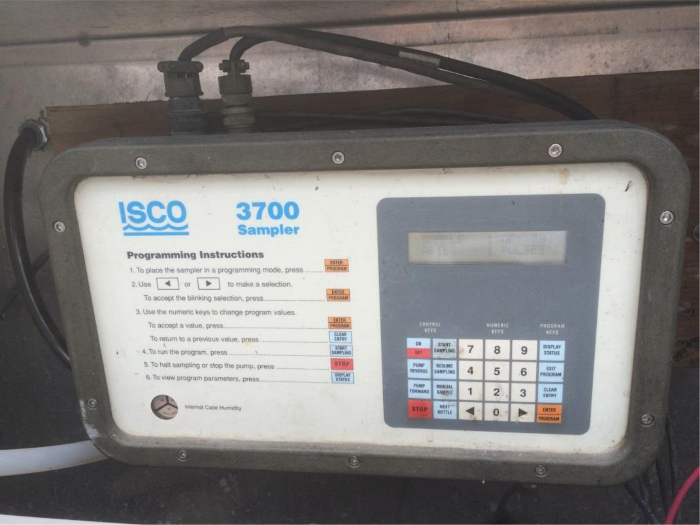
Figure 1: ISCO sampler used to program auto-sampling procedures for the composite drainage water and the particulates water sampling. Please click here to view a larger version of this figure.
- Monitor the farm canal levels using pressure transducers installed in the inflow and outflow canals adjacent to the pump station.
- Monitor pump speed using proximity switches that are installed on the pump heads; speed is recorded by the datalogger in revolutions per minute (rpm).
NOTE: Proximity switches are pieces of metal which when passed over each other count the number of rpms. They are welded onto the pump heads. - Measure rainfall using a tipping bucket rain gauge that is connected to the datalogger.
NOTE: The datalogger communicates by radio telemetry to a base radio station located at UF/IFAS Everglades Research and Education Center. Telemetry is not necessary for controlling sample collection, only for data collection and storage.
2. Drainage Flow-weighted Water Sampling
- Calculate drainage flow using a datalogger and a pump calibration equation for each pump. Drainage flow-weighted sampling is achieved by an autosampler that is actuated by the datalogger after a trigger drainage volume is achieved.
NOTE: The pump speed and flow rates vary over 24 h. The ISCO sampling is triggered by the volume of water discharged, not the rate. The autosampler is programmed to collect a sub-sample after a fixed volume of water discharge. The volume of water discharge is calibrated based on the number of pump rpms. - Collect a composite water sample (minimum 500 mL) using an in situ automated sampler located at the pump station and program it to capture a daily composite water sample during drainage events.
NOTE: The ISCO sampler is plumed to the collection tanks using tubing diverted through a datalogger that takes a 2 L sample every 2 min up to 400 L. - Program sample trigger volumes to allow for a maximum of 30 samples per 24 h discharge period.
- Program the datalogger to collect composite flow samples by following these steps: Enter Program → Program → Flow Based Sampling → Sample every 1 Pulses → 30 Composite Samples → Sample Volume of 130 mL → Calibrate Sample Volume [NO] → Enter Start Time [NO] → Program Sequence Complete.
- Store the flow-weighted composite samples in an onsite refrigerator at 4 °C until collection and transportation back to the laboratory for analyses in an ice-filled cooler.
- Analyze the water samples for soluble reactive P within 24 h from the time of sample collection. Samples used for Total P (TP) analysis can be acidified and stored at 4 °C for up to 28 days15.
3. Capturing Suspended Particulates
- Place a series of two 200 L PVC settling tanks to collect farm canal discharge water over the duration of the drainage period to capture and characterize the suspended particulates.
- Program the datalogger to collect suspended particulates samples by following these steps: Program → Time Based Sampling → Sample every 2 min → Composite Samples [200] → Calibrate Sample Volume [NO] → Enter Start Time [NO] → Sequence Complete → Push Sampling Button.
- Collect flow-weighted drainage water in the setting tanks (2 L every 2 min) based on the volume of water over a 24 h collection period.
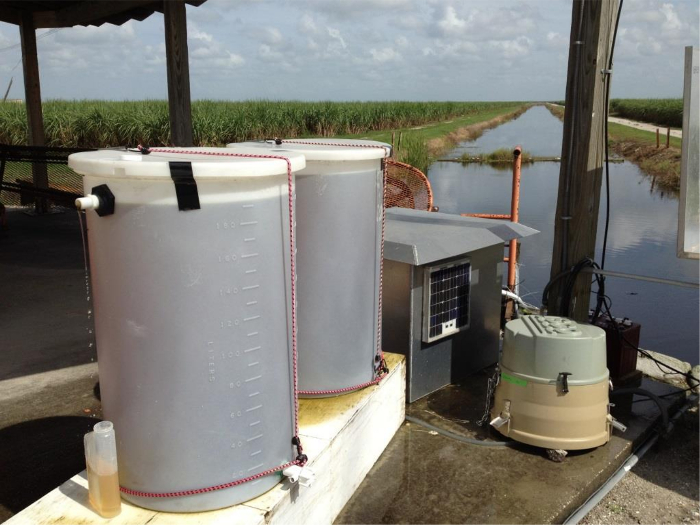
Figure 2: Two 200 L tanks used to collect drainage water. Suspended particulates settle out at the bottom of the tank and are transferred in five-gallon buckets. Please click here to view a larger version of this figure.
- Siphon off the excess water using hoses as particulates start to settle in the tanks.
- Transfer the particulates into five-gallon buckets, transport them back to laboratory, and place them in a refrigerator at 4 °C.
- Siphon off the excess water after settling for 24 h, and transfer the particulates into Imhoff settling cones.
- After settling for at least 1 h, siphon off the excess water one last time before settled particulates are transferred into pre-weighed 500 mL screw-top jars for storage at 4 °C.
- Weigh jars with particulate samples.
- Proceed with phosphorus fractionation analyses as described by Hedley and Stewart14.
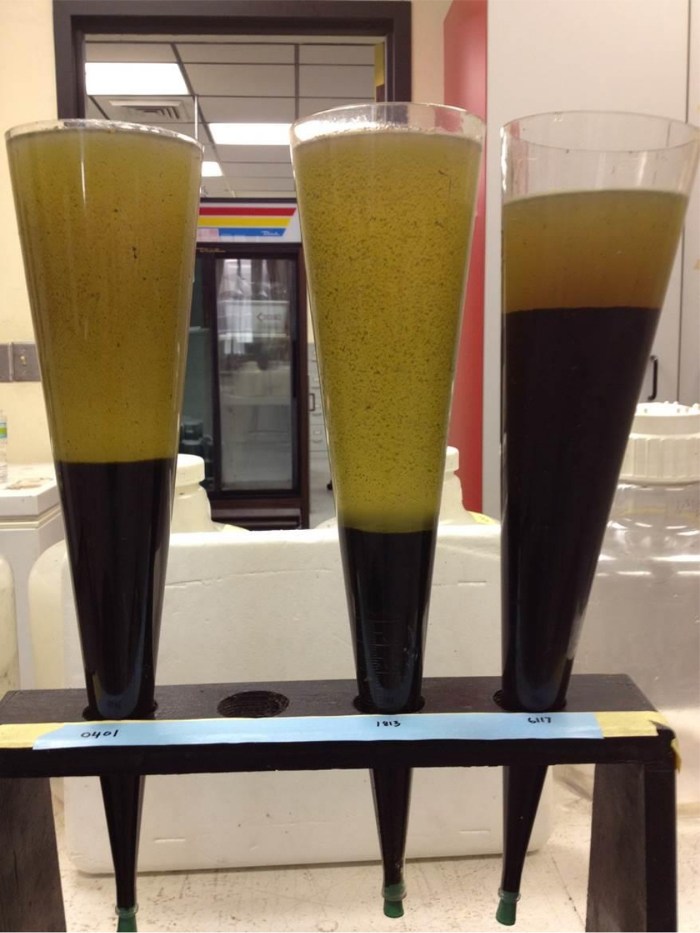
Figure 3: Imhoff settling cones used to collect the suspended particulates captured in the settling tank. Please click here to view a larger version of this figure.
Access restricted. Please log in or start a trial to view this content.
Results
The method described in this study allows us to capture water and particulate matter that is being discharged during pumping events in farms canals. The water and particulates that are collected are flow-weighted, which means that they are representative of the entire duration of the pumping event and not just a onetime snapshot; making it highly representative of the type of material being discharged. The water and suspended particulates can be stored to be analyzed for various physical ...
Access restricted. Please log in or start a trial to view this content.
Discussion
The autosamplers for drainage water particulate collection were placed near the exiting pump station dataloggers. Power was supplied by 12 V batteries that are charged by solar panels. The autosamplers were controlled by the on-site dataloggers, which turned the autosamplers on when the exit pumps ran, and turned them off when pumping stopped. Openings of the sampler intake lines were positioned 0.5 m above the canal bottom and upflow from the pump station. The intake lines were held in place by installing a metal rebar ...
Access restricted. Please log in or start a trial to view this content.
Disclosures
There are no disclosures associated with this study.
Acknowledgements
We wish to thank Pablo Vital and Johnny Mosley for help with field sampling, and Viviana Nadal and Irina Ognevich for help with laboratory analyses.
Access restricted. Please log in or start a trial to view this content.
Materials
| Name | Company | Catalog Number | Comments |
|---|---|---|---|
| Datalogger | Campbell Scientific | model CR1000 | |
| Auto-sampler | ISCO | model 3700 | |
| Pressure transducer | KPSI | model 700 | |
| Tipping bucket rain guage | Texas Electronics | model TR-525 | |
| Potassium Chloride | Fisher | 7447-40-7 | |
| Sodium Hydroxide | Fisher | 1310-73-2 | |
| Hydrochloric Acid | Fisher | 7647-01-0 | |
| Sulfuric Acid | Fisher | 7664-93-9 | |
| Potassium Persulfate | Fisher | 7727-21-1 | |
| Ammonium Molybdate Tetrahydrate | Fisher | 12054-85-2 | |
| L-Ascorbic Acid | Fisher | 50-81-7 | |
| 100 mg/L Anhydrous Phosphate Standard | ERA | 061 | |
| Antimony Potassium Tartrate Trihydrate | Fisher | 28300-74-5 | |
| Durapore Membrane Filters | Millipore | HVLP04700 | |
| Whatman #41 Filter Paper | Whatman | 1441-150 | |
| Fixed Speed Reciprocal Shaker E6010 | Eberbach Corporation | E6010.00 | |
| Disposable Culture Tubes | Fisher | 14-961-29 | |
| Allegra 25R Centrifuge | Becker Coulter | U.S. 605168-AC | |
| Parafilm | Bemis Company Inc PM 999 | 13-374-12 | |
| Oak Ridge Centrifuge Tubes | Nalgene | 3119-0050 | |
| Fisherbrand 20mL HDPE Scintillation Vials with Urea Cap | Fisher | 03-337-23C | |
| Fisherbrand Natural Polypropylene Jars with White Polypropylene Unlined Cap | Fisher | 02-912-024A | |
| 0.45 membrane filters | Cole-Parmer | Item # UX-15945-25 | |
| 100 ml digestion tubes | Fisher | TC1000-0735 | |
| Glass funnels | Fisher | 03-865 | |
| Spectronic 20 Genesys | Thermo-Fisher | 4001-000 | |
| QuikChem | Latchat | 8500 |
References
- Sims, J. T., et al. Phosphorus loss in agricultural drainage: historical perspective and current research. J. Environ. Qual. 27, 277-293 (1997).
- Van Esbroeck, C. J., et al. Surface and subsurface phosphorus export from agricultural fields during peak flow events over the non-growing season in regions with cool, temperate climates. J. Soil Water Conserv. 72, 65-76 (2017).
- Bhadha, J. H., et al. Phosphorus mass balance and internal load in an impacted subtropical isolated wetland. Water Air Soil Pollut. 218, 619-632 (2011).
- Eyre, B. D., McConchie, D. The implications of sedimentological studies for environmental pollution assessment and management: Examples from fluvial system in north Queensland and western Australia. Sediment. Geol. 85, 235-252 (1993).
- Bhadha, J. H., et al. Soil phosphorus release and storage capacity from an impacted subtropical wetland. Soil Sci. Soc. Amer. J. , 74(2010).
- Kenney, W. F., et al. Whole-basin, mass-balance approach for identifying critical phosphorus-loading thresholds in shallow lakes. Journal of Paleolim. 51, 515-528 (2014).
- Freebairn, D. N., Wockner, G. H. A study of soil erosion on vertisols of the Eastern Darling Downs, Queensland. Effects of surface conditions on soil movement within contour bay catchments. Aust. J.Soil Res. 24, 135-158 (1986).
- Erickson, A. J., et al. Optimizing stormwater treatment practices: a handbook of assessment and maintenance. , Springer. New York. (2013).
- Abtew, W., Obeysekera, J. Drainage Generation and Water Use in the Everglades Agricultural Area Basin. J. Amer. Water Res. Asso. 32, 1147-1158 (1996).
- Daroub, S. H., et al. Best management practices and long-term water quality trends in the Everglades Agricultural Area. Cri. Rev. Environ. Sci. Technol. 41, 608-632 (2011).
- Bhadha, J. H., et al. Influence of suspended particulates on phosphorus loading exported from farm drainage during a storm event in the Everglades Agricultural Area. J. Soil Sed. 17, 240-252 (2017).
- Diaz, O. A., et al. Sediment inventory and phosphorus fractions for water conservation area canals in the Everglades. Soil Sci. Soc. Amer. J. 70, 863-871 (2006).
- Reddy, K. R., et al. Forms of soil phosphorus in selected hydrologic units of Florida Everglades. Soil Sci. Soc. Amer. J. 62, 1134-1147 (1998).
- Hedley, M. J., Stewart, J. W. Method to measure microbial phosphate in soils. Soil Biol. Biochem. 14, 377-385 (1982).
- EPA. Method 365.1, Revision 2.0: Determination of Phosphorus by Semi-Automated Colorimetry. O'Dell, J. W. , (1993).
- Bhadha, J. H., et al. Effect of aquatic vegetation on phosphorus loads in the Everglades Agricultural Area. J. Aqu. Pla. Man. 53, 44-53 (2015).
Access restricted. Please log in or start a trial to view this content.
Reprints and Permissions
