This protocol describes a clinically-applicable means of dissolving hydrophobic compounds in an aqueous environment using combinations of self-assembling peptide and amino acid solutions. Our method resolves a major limitation of hydrophobic therapeutics, which lack safe, efficient means of solubility and delivery methods into clinical settings.
Method Article
Solubility of Hydrophobic Compounds in Aqueous Solution Using Combinations of Self-assembling Peptide and Amino Acid
In This Article
Summary
Abstract
Self-assembling peptides (SAPs) are promising vehicles for the delivery of hydrophobic therapeutics for clinical applications; their amphipathic properties allow them to dissolve hydrophobic compounds in the aqueous environment of the human body. However, self-assembling peptide solutions have poor blood compatibility (e.g., low osmolarity), hindering their clinical application through intravenous administrations. We have recently developed a generalized platform for hydrophobic drug delivery, which combines SAPs with amino acid solutions (SAP-AA) to enhance drug solubility and increase formulation osmolarity to reach the requirements for clinical uses. This formulation strategy was thoroughly tested in the context of three structurally different hydrophobic compounds – PP2, rottlerin, and curcumin – in order to demonstrate its versatility. Furthermore, we examined effects of changing formulation components by analyzing 6 different SAPs, 20 naturally existing amino acids at low and high concentrations, and two different co-solvents dimethyl sulfoxide (DMSO) and ethanol. Our strategy proved to be effective in optimizing components for a given hydrophobic drug, and therapeutic function of the formulated inhibitor, PP2, was observed both in vitro and in vivo. This manuscript outlines our generalized formulation method using SAP-AA combinations for hydrophobic compounds, and analysis of solubility as a first step towards potential use of these formulations in more functional studies. We include representative solubility results for formulation of the hydrophobic compound, curcumin, and discuss how our methodology serves as a platform for future biological studies and disease models.
Introduction
SAPs are a class of biomaterials that have been studied extensively as 3D scaffolds in regenerative medicine1,2,3,4. More recently however, they have been exploited as vehicles for delivery of therapeutics due to their unique biological properties5,6,7,8. SAPs naturally assemble into stable nanostructures9, thus providing a means of drug encapsulation and protection. SAPs are amphipathic, comprised of a specific pattern of hydrophobic and hydrophilic amino acid repeats, driving their self-assembly9,10 and allowing them to serve as a medium between hydrophobic and hydrophilic environments. Consequently, for the clinical delivery of hydrophobic drugs – which have extremely low bioavailability and absorption in the body due to lack of solubility in aqueous environments11,12 – SAPs are promising as a delivery vehicle. Furthermore, their sequence pattern also implies that SAPs can be rationally designed and engineered to maximize compatibility with any given drug or compound (i.e., based on functional groups) and further assist solubility.
SAPs have been applied as effective drug delivery vehicles in many in vitro and in vivo settings13,14,15,16. They have also shown great safety and biocompatibility. However, due to low osmolarity of SAP-drug preparations, they cannot be used for intravenous injections as in clinical settings13. Considering this restraint, we have recently developed a strategy which combines SAPs with amino acid solutions in order to reduce the use of toxic co-solvents and increase the formulation osmolarity, and therefore, clinical relevance. We chose to use amino acids as they are the building blocks of SAPs, are already clinically-accepted, and in combination with SAPs, they increase hydrophobic drug solubility while reducing the amount of SAP required17,18.
We have scrutinized SAP-AA combinations as a generalized platform for hydrophobic drug solubility and subsequent delivery by creating a multi-step screening pipeline and applying it to the Src inhibitor, PP2, as a model hydrophobic compound. In this process, we examined the effect of changing components of the formulation – ultimately testing 6 different SAPs, all 20 amino acids at 2 different concentrations (low and high; low based on concentrations in existing clinical applications, and high concentrations were 2x, 3x, or 5x the clinical concentration based on the maximum solubility of each amino acid in water), and 2 different co-solvents – and selected combinations that solubilized PP2 for further analysis. This drug formulation proved to be effective as a drug delivery vehicle in cell culture, as well as in vivo models using both intratracheal and intravenous administrations. Likewise, our work touched on the versatility of SAP-AA combinations in solubilizing multiple, structurally-different hydrophobic compounds in aqueous environments; specifically, the drugs rottlerin and curcumin18. This manuscript outlines the SAP-AA formulation method and analysis of curcumin solubility as an example of the primary step in our screening pipeline. This protocol provides a simple, reproducible way to screen for the optimal SAP-AA combinations, which dissolve any given hydrophobic compound.
Protocol
1. Preparation of Amino Acid Solutions
- Prepare and label two 50 mL conical centrifuge tubes for each amino acid (one each for both "low" and "high" concentrations).
- Prepare a large 2 L flask containing purified water (18.2 MΩ·cm at 25 °C).
- Calculate the amount of each amino acid (in grams) to reach the desired concentrations, and weigh the appropriate amount of amino acid into their respective 50 mL centrifuge tubes using a spatula.
NOTE: For the "High" concentration of the two negatively charged amino acids, PBS is used instead of water. We could not increase their concentrations due to their low water solubility, and using PBS instead of water helps to maintain the low pH. Furthermore, the concentration calculations were obtained using a final volume of 40 mL for each amino acid solution. All amino acid concentrations are outlined in Table 3. Be sure to rinse the spatula in between amino acids to avoid contamination. We recommend a water rinse, followed by wiping with 70% ethanol. - Add 40 mL of purified water (or PBS) into each 50 mL tube using a serological pipette. Cap tubes and vortex or shake vigorously until dissolved. Water bath sonication (room temperature, 130 W, 40 kHz) can also be used to assist in the solubility process.
NOTE: The following amino acid solutions are sensitive to light and should be covered with aluminum foil: tryptophan, phenylalanine, and tyrosine (which consist of aromatic ring-like structures) and cysteine (reactive -SH group).
2. Preparation of SAP-AA Solutions
- Prepare 20 mL scintillation vials for the self-assembling peptides. For a given self-assembling peptide, prepare one vial per prepared amino acid solution (each combination will be made in a separate vial).
- Using a high-performance analytical balance (with a readability down to 0.1 mg or less), weigh approximately 1 ± 0.2 mg of peptide into the bottom of each vial. Cap after weighing and record the exact weight of the peptide on the cap.
- Pipette the appropriate volume of amino acid solution (prepared in Section 1) into each vial containing peptide, in order to reach the desired concentration of self-assembling peptide (0.1 mg/mL for long peptides with a length of 16 amino acids, or 0.2 mg/mL for shorter peptides with a length of 8 amino acids).
- Sonicate for 10 min in a water bath sonicator (130 W, 40 kHz) at room temperature, ensuring the solutions within vials are completely immersed in the water bath.
3. Preparation of Drug-DMSO or Drug-Ethanol Stock Solutions
- Combine 1 mg of drug (in this case, curcumin) with 100% DMSO, and another 1 mg with 100% ethanol to create two stock solutions.
NOTE: We added 200 µL of DMSO and 400 µL ethanol to make DMSO-curcumin and ethanol-curcumin stocks that were 5 mg/mL and 2.5 mg/mL, respectively, due to varying solubility in each solvent; however, it is important to note that the concentration of stock should be adjusted depending on the hydrophobic drug of interest. Factors such as drug solubility and effective biological concentration are important in determining this value. Also, keep in mind that the stock will be diluted 100-fold and 50-fold in DMSO and ethanol formulations, respectively, when combined with SAP-AA solutions (see Section 4). It may be preferred to prepare a larger volume of stock depending on the number of formulations required – in this case, more than 1 mg of drug would be used. The stock can be stored at -20 °C; thaw on ice and vortex before use. - Vortex vials for 15 s to completely dissolve the drug.
4. Preparation of Drug Formulations
- Prepare clear, 1.5 mL microcentrifuge tubes for each formulation. Be sure to label tubes with the intended self-assembling peptide, amino acid (and concentration), and co-solvent.
- Add 10 µL of Drug-DMSO stock, or 20 µL Drug-Ethanol stock to appropriate microcentrifuge tubes.
- Add 990 µL of SAP-AA acid solutions to the appropriate labeled microcentrifuge tubes containing Drug-DMSO stock, and 980 µL to those containing Drug-Ethanol stock. This produces 1 mL drug formulations with 1% DMSO or 2% ethanol.
NOTE: The final concentration of all curcumin formulations was 0.5 mg/mL according to the protocol. Again, this will vary when using other hydrophobic compounds and/or beginning with a different stock concentration (see step 3.1) - Vortex vigorously for 30 s and allow formulations to rest for 30 min.
5. Solubility Testing
- After rest period, vortex vigorously once again for 30 s.
- Centrifuge the formulations at 14,220 x g for 1 min.
- Analyze the bottom of the microcentrifuge tubes for precipitation (by visualization).
Results
For the hydrophobic drug, curcumin, we produced formulations using all 20 naturally existing amino acids at low concentrations, in combination with only one SAP, EAK16-II, as a proof-of-principle. We also tested formulations using both DMSO and ethanol as co-solvents. In total, this produced 40 curcumin formulations, each containing different components. It is important to note that, in our previous studies using the Src inhibitor, PP2, we included more options for SAP (total of 6) and amino acid concentration (clinical, as well as a higher concentration), which produced a total of 480 different formulations. Trends from this work were taken into account when selecting EAK16-II as the SAP for this study. Concentrations of various components are included in Table 1, Table 2, and Table 3 as a reference. All hydrophobic drug formulations are screened for drug solubility by visualization, and considered soluble if the solution is completely clear of any precipitate after centrifugation (Figure 1). If the drug precipitates to the bottom of the tube, this is considered non-soluble and does not go through further testing. Furthermore, solubility is tested in triplicate and by two different individuals; if these results are not reproducible, formulations are also not considered to be truly soluble.
Out of the 40 formulations tested in this study, 7 formulations successfully dissolved curcumin (Table 4). Grouping formulations by components identified two major trends: ethanol seems to be a better co-solvent for dissolving curcumin, and positively charged amino acids lysine (K) and arginine (R) also seem to be optimal components for dissolving curcumin (Table 4). It is interesting to note the color change for formulations containing R and K, which reveal curcumin is dissolved in the alkaline condition (Figure 1). It is helpful to group formulations by properties of the various components to make such observations.
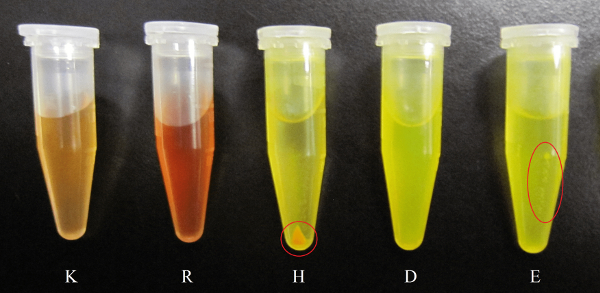
Figure 1: Example of precipitation analysis. For these curcumin formulations containing the peptide EAK16-II, ethanol, and charged amino acids, precipitate can be seen clearly in the microcentrifuge tubes after centrifugation. Formulations containing lysine (K), arginine (R) or aspartic acid (D) dissolve curcumin (no precipitate), whereas those containing histidine (H) or glutamic acid (E) do not (precipitate, circled in red). Please click here to view a larger version of this figure.
| Drug | Formulation Concentration (mg/mL) |
| PP2 | 0.05 |
| Curcumin | 0.05 |
| Rottlerin | 0.02 |
Table 1: Concentration of drugs used in formulations. Drug formulation concentrations differ as each have a different bioactive concentration, and also different loading capacities.
| Self-Assembling Peptide | Properties | Formulation Concentration (mg/mL) |
| EAK16-I | EAK family, long | 0.1 |
| EAK16-II | EAK family, long | 0.1 |
| EAK16-IV | EAK family, long | 0.1 |
| EFK8-II | Modified EAK, short | 0.2 |
| A6KE | Surfactant-like, short | 0.2 |
| P6KE | Surfactant-like, short | 0.2 |
Table 2: Concentration of self-assembling peptides used in formulations. With the addition of amino acids, only small concentrations of self-assembling peptide are required (0.1-0.2 mg/mL). Shorter peptides are double the concentration compared to longer peptides as they have half the sequence length (8 amino acids versus 16 amino acids).

Table 3: Concentration of amino acid solutions used in formulations. Low concentrations of amino acids were chosen based on the existing clinical applications of each. High concentrations are 2x, 3x, or 5x the clinical concentration and within the maximum solubility of each amino acid in water. This figure has been modified from Pacheco et al.18

Table 4: Representative solubility results for curcumin. A summary of the SAP-AA combinations which effectively dissolved curcumin after screening for solubility. This figure has been modified from Pacheco et al.18
Discussion
In the formulation procedure, there are various critical steps and points to consider in troubleshooting. First, as we are working with various components and concentrations, multiple vortex steps throughout the protocol ensure that all concentrations are uniform and correct. Some of the high-concentration, hydrophobic amino acid solutions may still not be completely dissolved after vortexing, and in this case, they can be shaken vigorously by hand to assist in the process. Likewise, it is essential that SAP-AA solutions undergo the sonication step outlined in step 2.4 as SAPs naturally tend to aggregate, and sonication will assist in fragmenting SAP clusters, thus resulting in a more uniform solution. Second, for a given hydrophobic drug, the stock and final concentrations within SAP-AA formulations should depend on the effective concentration of that compound in biological settings. The protocol should be modified accordingly to reflect this active concentration. Furthermore, drug loading capacity is also an important factor to consider; it is likely that each drug will have a unique loading capacity using this strategy, and that each SAP-AA combination may support a different amount of drug based on compatibility. This demonstrates the importance of screening to find the optimal SAP-AA combination for a given compound.
There are a number of advantages to using our technique over others; more specifically, there is great significance over the conventional method of using SAPs alone for encapsulation and potential delivery of a compound. As mentioned previously, amino acids are already clinically-accepted and adding these solutions to SAP formulations increases osmolarity to decrease hemolytic activity, such that intravenous injections in clinical scenarios are possible. We have also found that they greatly increase hydrophobic compound solubility in cases where SAPs alone are insufficient for solubility17,18. The multiple different combinations of SAPs and amino acids involved allows for expansion into a high-throughput method to screen for hydrophobic drug solubility. Solubility data can be analyzed in detail to reveal trends; we have found that sorting results by formulation component (SAP or amino acid) shows a pattern likely to be unique for each hydrophobic drug. As an example, positively charged amino acids improve solubility of curcumin (Figure 1), whereas our previous studies showed that negatively charged amino acids were better for PP218. These trends can help determine the suitability of specific components for dissolving drugs with similar chemical structure. Furthermore, the simplicity of our solubility screen is both an advantage and a limitation; although it is easy to perform, there are more technical and accurate ways to experimentally assess the solubility of a compound within solution (e.g., spectroscopy or chromatographic methods). However, the screening strategy outlined in this protocol allows for the quick and efficient selection of SAP-AA combinations which result in the highest drug solubility, and accordingly, the highest potential biological activity for further analysis. As there are numerous formulations of differing combinations of self-assembling peptide, amino acid, amino acid concentration, and co-solvent, (480 total in our previous manuscript18), this is a necessary step for narrowing down to find optimal components for a given drug. After finding soluble drug formulations, they can be assessed for solubility by more technical methods and should be further validated in functional assays, which assess biological activity and safety. These functional assays should be tailored to the intended use of the formulated drug, as outlined in our manuscript optimizing PP2 formulations18. Expanding our platform on other hydrophobic compounds will reveal additional trends and mechanisms for enhancing solubility, and assist in engineering new SAPs for clinical formulation of specific hydrophobic compounds.
The future of our method lies in the potential pipeline for drug deliver, as well as its ability to be automated. There are many steps that involve weighing powders and dispensing liquids, which are the major time-limiting factors in the formulation process. Although it may seem like a lengthy procedure to perform in laboratory settings, these steps can easily performed using robotic devices. Likewise, the method has great potential to be scaled up into commercial production with the use of automated scales and dispensers in order to simultaneously test the solubility of many hydrophobic drugs. This would greatly speed up the formulation and screening processes, while increasing accuracy and reducing human error. Thus, our drug formulation method consisting of SAP-AA combinations is a generalized platform for solubility and delivery of hydrophobic compounds, and would greatly benefit from high-throughput technologies.
Disclosures
The authors have nothing to disclose.
Acknowledgements
This work is supported by Canadian Institutes of Health Research, operating grants MOP-42546 and MOP-119514.
Materials
| Name | Company | Catalog Number | Comments |
|---|---|---|---|
| EAK16-I | CanPeptide Inc. | Custom peptide | Sequence: AEAKAEAKAEAKAEAK, N-terminus acetylation and C-terminus amidation, >95% pure by HPLC |
| EAK16-II | CanPeptide Inc. | Custom peptide | Sequence: AEAEAKAKAEAEAKAK, N-terminus acetylation and C-terminus amidation, >95% pure by HPLC |
| EAK16-IV | CanPeptide Inc. | Custom peptide | Sequence: AEAEAEAEAKAKAKAK, N-terminus acetylation and C-terminus amidation, >95% pure by HPLC |
| EFK8-II | CanPeptide Inc. | Custom peptide | Sequence: FEFEFKFK, N-terminus acetylation and C-terminus amidation, >95% pure by HPLC |
| A6KE | CanPeptide Inc. | Custom peptide | Sequence: AAAAAAKE, N-terminus acetylation and C-terminus amidation, >95% pure by HPLC |
| P6KE | CanPeptide Inc. | Custom peptide | Sequence: PPPPPPPKE, N-terminus acetylation and C-terminus amidation, >95% pure by HPLC |
| Alanine | Sigma-Aldrich | A7469-100G | L-Alanine |
| Isoleucine | Sigma-Aldrich | I7403-100G | L-Isoleucine |
| Leucine | Sigma-Aldrich | L8912-100G | L-Leucine |
| Methionine | Sigma-Aldrich | M5308-100G | L-Methionine |
| Proline | Sigma-Aldrich | P5607-100G | L-Proline |
| Valine | Sigma-Aldrich | V0513-100G | L-Valine |
| Phenylalanine | Sigma-Aldrich | P5482-100G | L-Phenylalanine |
| Tryptophan | Sigma-Aldrich | T8941-100G | L-Tryptophan |
| Tyrosine | Sigma-Aldrich | T8566-100G | L-Tyrosine |
| Glycine | Sigma-Aldrich | G8790-100G | L-Glycine |
| Asparagine | Sigma-Aldrich | A4159-100G | L-Asparagine |
| Glutamine | Sigma-Aldrich | G8540-100G | L-Glutamine |
| Serine | Sigma-Aldrich | A7219-100G | L-Serine |
| Threonine | Sigma-Aldrich | T8441-100G | L-Threonine |
| Histidine | Sigma-Aldrich | H6034-100G | L-Histidine |
| Lysine | Sigma-Aldrich | L5501-100G | L-Lysine |
| Arginine | Sigma-Aldrich | A8094-100G | L-Arginine |
| Aspartic Acid | Sigma-Aldrich | A7219-100G | L-Aspartic Acid |
| Glutamic Acid | Sigma-Aldrich | G8415-100G | L-Glutamic Acid |
| Cysteine | Sigma-Aldrich | C7352-100G | L-Cysteine |
| Dimethyl Sulfoxide | Sigma-Aldrich | D4540-500ML | DMSO |
| Ethanol | Sigma-Aldrich | 277649-100ML | Anhydrous |
| Curcumin | Sigma-Aldrich | 08511-10MG | Hydrophobic drug, curcumin |
| Rottlerin | EMD Millipore | 557370-10MG | Hydrophobic drug, rottlerin |
| PP2 | Enzo | BML-EI297-0001 | Hydrophobic drug, PP2 |
| Scintillation Vials | VWR | 2650-66022-081 | Borosilicate Glass, with Screw Cap, 20 mL. Vials for weighing peptide. |
| Falcon 50 mL Conical Centrifugation Tubes | VWR | 352070 | Polypropylene, Sterile, 50 mL. For amino acid solutions. |
References
- Holmes, T. C., de Lacalle, S., Su, X., Liu, G., Rich, A., Zhang, S. Extensive neurite outgrowth and active synapse formation on self-assembling peptide scaffolds. Proc. Natl. Acad. Sci. U. S. A. 97 (12), 6728-6733 (2000).
- Davis, M. E., Motion, J. P. M., et al. Injectable self-assembling peptide nanofibers create intramyocardial microenvironments for endothelial cells. Circulation. 111 (4), 442-450 (2005).
- Matson, J. B., Stupp, S. I. Self-assembling peptide scaffolds for regenerative medicine. Chem. Commun. 48 (1), 26-33 (2012).
- Tatman, P. D., Muhonen, E. G., Wickers, S. T., Gee, A. O., Kim, E., Kim, D. Self-assembling peptides for stem cell and tissue engineering. Biomater. Sci. 4 (4), 543-554 (2016).
- Keyes-Baig, C., Duhamel, J., Fung, S. -Y., Bezaire, J., Chen, P. Self-assembling peptide as a potential carrier of hydrophobic compounds. J. Am. Chem. Soc. 126 (24), 7522-7532 (2004).
- Kumar, P., Pillay, V., Modi, G., Choonara, Y. E., du Toit, L. C., Naidoo, D. Self-assembling peptides: implications for patenting in drug delivery and tissue engineering. Recent Pat. Drug Deliv. Formul. 5 (1), 24-51 (2011).
- Wang, H., Yang, Z. Short-peptide-based molecular hydrogels: novel gelation strategies and applications for tissue engineering and drug delivery. Nanoscale. 4, 5259-5267 (2012).
- French, K. M., Somasuntharam, I., Davis, M. E. Self-assembling peptide-based delivery of therapeutics for myocardial infarction. Adv. Drug Deliv. Rev. 96, 40-53 (2016).
- Zhang, S., Holmes, T., Lockshin, C., Rich, A. Spontaneous assembly of a self-complementary oligopeptide to form a stable macroscopic membrane. Proc. Natl. Acad. Sci. U. S. A. 90 (8), 3334-3338 (1993).
- Bowerman, C. J., Nilsson, B. L. Self-assembly of amphipathic β-sheet peptides: insights and applications. Biopolymers. 98 (3), 169-184 (2012).
- Amidon, G., Lennernäs, H., Shah, V., Crison, J. A theoretical basis for a biopharmaceutic drug classification: the correlation of in vitro drug product dissolution and in vivo bioavailability. Pharm. Res. 12 (3), 413-420 (1995).
- Shi, Y., Porter, W., Merdan, T., Li, L. C. Recent advances in intravenous delivery of poorly water-soluble compounds. Expert Opin. Drug Deliv. 6 (12), 1261-1282 (2009).
- Bawa, R., Fung, S. -Y., et al. Self-assembling peptide-based nanoparticles enhance cellular delivery of the hydrophobic anticancer drug ellipticine through caveolae-dependent endocytosis. Nanomedicine. 8 (5), 647-654 (2012).
- Liu, J., Zhang, L., Yang, Z., Zhao, X. Controlled release of paclitaxel from a self-assembling peptide hydrogel formed in situ and antitumor study in vitro. Int. J. Nanomed. 6, 2143-2153 (2011).
- Wu, Y., Sadatmousavi, P., Wang, R., Lu, S., Yuan, Y., Chen, P. Self-assembling peptide-based nanoparticles enhance anticancer effect of ellipticine in vitro and in vivo. Int. J. Nanomed. 7, 3221-3233 (2012).
- Fung, S. Y., Yang, H., et al. Self-Assembling Peptide as a Potential Carrier for Hydrophobic Anticancer Drug Ellipticine: Complexation, Release and In Vitro Delivery. Adv. Funct. Mater. 19 (1), 74-83 (2009).
- Fung, S. -Y., Oyaizu, T., et al. The potential of nanoscale combinations of self-assembling peptides and amino acids of the Src tyrosine kinase inhibitor in acute lung injury therapy. Biomaterials. 32 (16), 4000-4008 (2011).
- Pacheco, S., Kanou, T., et al. Formulation of hydrophobic therapeutics with self-assembling peptide and amino acid: A new platform for intravenous drug delivery. J. Control. Release. 239, 211-222 (2016).
Reprints and Permissions
Request permission to reuse the text or figures of this JoVE article
Request Permission