This protocol describes the measurement of the electromotive force of alkaline-earth elements in liquid metal alloys at high temperatures (723-1,123 K) to determine their thermodynamic properties, including activity, partial molar entropy, partial molar enthalpy, and phase transition temperatures, over a wide composition range.
Method Article
Determination of Thermodynamic Properties of Alkaline Earth-liquid Metal Alloys Using the Electromotive Force Technique
Opens in a new tab
In This Article
Summary
Loading...
$$\rightleftharpoonup{xx}$$
$$\longleftharp{xx}$$,
$$\longrightharp{xx}$$,
Abstract
Loading...
$$\rightleftharpoonup{xx}$$
$$\longleftharp{xx}$$,
$$\longrightharp{xx}$$,
A novel electrochemical cell based on a CaF2 solid-state electrolyte has been developed to measure the electromotive force (emf) of binary alkaline earth-liquid metal alloys as functions of both composition and temperature in order to acquire thermodynamic data. The cell consists of a chemically stable solid-state CaF2-AF2 electrolyte (where A is the alkaline-earth element such as Ca, Sr, or Ba), with binary A-B alloy (where B is the liquid metal such as Bi or Sb) working electrodes, and a pure A metal reference electrode. Emf data are collected over a temperature range of 723 K to 1,123 K in 25 K increments for multiple alloy compositions per experiment and the results are analyzed to yield activity values, phase transition temperatures, and partial molar entropies/enthalpies for each composition.
Introduction
Loading...
$$\rightleftharpoonup{xx}$$
$$\longleftharp{xx}$$,
$$\longrightharp{xx}$$,
Electromotive force (emf) measurements can directly determine the partial molar Gibbs free energy change of a chemical reaction and provide accurate thermodynamic properties such as activity, partial molar enthalpy, and partial molar entropy1. The acquisition of thermochemical data is crucial to a variety of research topics in the materials community, from the refinement of multi-component phase diagrams, to the experimental validation of first-principle materials modeling, to the synthesis of new intermetallic species with advantageous properties. Recently, Kim et al. utilized emf measurements to assess the viability of using liquid metal electrodes to separate alkaline-earth species from molten salt electrolytes2.
Electrochemical separation using molten salts (e.g., LiCl-KCl) is a promising technology for separating uranium and transuranic metals from used nuclear fuel for recycling3. As used fuel is processed as an anode in the molten salt, fission products with lower standard reduction potentials than uranium are oxidized and accumulate in the molten salt as dissolved ions (e.g., Ba2+, Sr2+, Cs+, and rare-earth metal cations)4. Consequently, the molten salt electrolyte must be periodically replaced and/or processed further to separate the accumulated fission products4. Of particular concern are alkali/alkaline-earth fission products (Ba2+, Sr2+, and Cs+) because these ions exhibit the lowest standard reduction potentials among the constituent cations, making them difficult to separate from the molten salt solution.
However, Lichtenstein et al. recently demonstrated that barium exhibits low thermodynamic activity in liquid bismuth (8.7 x 10⁻¹² at barium mole fraction xBa(in Bi) = 0.05, 1,123 K), implying strong atomic interactions between barium and bismuth5. Kim et al. observed that these interactions caused a shift in the deposition potentials of barium ions into a liquid bismuth electrode (-3.74 V to -2.49 V vs. Cl-/Cl2(g)), resulting in a preferential deposition of barium from the electrolyte solution (BaCl2-LiCl-CaCl2-NaCl, 16-29-35-20 mol%) at 773 - 973 K6. This shift in deposition potential could be leveraged by using liquid metal electrodes to selectively separate alkali/alkaline-earth fission products from the electrolyte used for electrochemical processing of used nuclear fuel. To determine the viability of separating alkali/alkaline-earth fission products from molten salt electrolyte, the thermodynamic properties of these elements in the prospective liquid metals (e.g., Bi, Sb) must be determined.
In previous studies, Delcet et al. utilized coulometric titration to determine the thermodynamic properties of binary alloys (e.g., Ba-Bi, Ba-Sb, Ba-Pb)7. For Ba-Bi alloys up to xBa = 0.50, they employed coulometric titration using a single-crystal BaF2 electrolyte at 1,123 K and observed comparable activity values of barium in bismuth (2.4 x 10⁻¹² at xBa(in Bi) = 0.05, 1,123 K). However, it was reported that the results were inaccurate due to the uncertainty regarding barium content in the binary alloys. Barium metal is highly reactive and soluble in its halide salts (~15 mol% in BaCl2 at 1,163 K), which can cause increased electronic conduction in the halide salt at higher temperatures and lead to inaccurate compositional accounting during coulometric titration. To determine the thermodynamic properties (e.g., excess partial molar Gibbs free energy, partial molar enthalpy, partial molar entropy) of binary alloys containing highly reactive elements, the emf method described in this protocol was used.
Thermochemical properties of binary alloys can be determined by measuring the equilibrium cell potential Ecell (i.e., emf) of an alloy (A-B) relative to the reference potential of the pure metal A. Then, the cell potential is directly related to the change in partial molar Gibbs free energy (or chemical potential) of the cell reaction according to the Nernst relation ( ).
).
For emf measurements of alkaline-earth alloys in this work, the fluoride-ion conducting CaF2 is chosen as the base electrolyte because the Ca2+/Ca redox potential (E0 = -5.59 V) is more negative than other alkaline-earth redox potentials (e.g.,  , versus F-/F2(g) at 873 K) in the fluoride system8. This implies that CaF2 is more chemically stable than the other alkaline-earth fluoride AF2 (A = Sr or Ba), and that Ba2+ or Sr2+ ions are the electroactive species in the CaF2-BaF2 and CaF2-SrF2 electrolyte, respectively. Utilizing the high stability of CaF2, which minimizes side reactions with Ba or Sr alloys as well as the ionic conductivity of CaF2 at elevated temperatures, the single-phase binary CaF2-AF2 electrolyte was successfully employed to accurately measure the emf of binary alkaline earth-liquid metal alloys. Confirmation of the formation of the single-phase binary electrolyte is confirmed with x-ray diffraction (XRD) analysis in Figure 19.
To measure the cell potential of an alkaline-earth alloy, the following electrochemical cell was implemented using a solid-state binary CaF2-AF2 (97 mol% CaF2, 3 mol% AF2) electrolyte10:
 ,
,
where the pure alkaline-earth metal A (A = Ca, Sr, or Ba) acts as the reference electrode (RE), solid CaF2-AF2 as the electrolyte, fixed composition A-B alloys as working electrodes (WE), and B is a candidate liquid metal such as Bi or Sb. The half-cell reactions in the electrochemical cell are:


and the overall cell reaction is:

where e- is an electron exchanged in the cell reactions and z is the number of electrons exchanged (z = 2 for alkaline-earth elements). For this overall reaction, the change in partial molar Gibbs free energy of the A metal,  , is given by:

where  is the partial molar Gibbs free energy of A metal in the metal B,
  is the standard Gibbs free energy of pure A metal, R is the ideal gas constant, T is the temperature in Kelvin, and aA is the activity of A in the metal B. The measured cell emf, Ecell, is directly related to the change in partial molar Gibbs free energy of A by the Nernst equation,
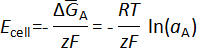
where F is the Faraday constant.
Protocol
Loading...
$$\rightleftharpoonup{xx}$$
$$\longleftharp{xx}$$,
$$\longrightharp{xx}$$,
1. Fabrication of Electrochemical Cell Components
- Fabrication of the binary CaF2-AF2 electrolyte
- Calculate the mass required for each component of the binary electrolyte for a 350.0 ± 5.0 g mixture with 97 mol% CaF2 and 3 mol% AF2 (e.g., 333.4 g of CaF2 and 16.6 g of SrF2).
- Measure out and pour the salt mixture into a 1.5 L plastic bottle, along with approximately 1.3 kg of yttria-stabilized zirconia milling media (3 mm diameter) and 25.0 ± 0.1 g of polyvinyl alcohol (PVA, organic binder). Then add isopropyl alcohol (IPA) until the bottle is 4/5 full. Close the bottle and manually shake its contents for approximately 1 min to evenly distribute the components of the mixture.
- Place the plastic bottle with the salt mixture on the ball mill (two-rollers, 12.5" length). Set the speed of the ball mill to 250 revolutions per minute (RPM) and mill for 24 h.
- Pour the mixture through a sieve (10 mesh) into a pan to separate the milling media and the salt mixture. Using a squeeze bottle, rinse the sieve lightly with 10 mL of IPA to capture the remaining mixture.
- Dry the ball-milled homogeneous mixture in a fume hood for ~24 h and then grind the mixture into a fine powder using a mortar and pestle.
NOTE: If the drying process needs to be accelerated, the pan can be placed on a hot plate set to 373 K. - Measure out 130.0 ± 1.0 g of electrolyte powder and load the powder uniformly into a pellet die (75 mm diameter, 60 mm height).
- Using a die press, uniaxially press the powder with 30 MPa of pressure for 2 mins to form a green pellet 75 mm in diameter and 17 mm thickness. To remove the pellet from the pellet die, invert the pellet die, place a stainless-steel ring (101 mm outer diameter (OD), 35 mm height, 4.8 mm thickness) centered on top of the pellet die with the pellet centered within the ring. Carefully press the pellet die punch with ~1.0 bar of pressure to remove the pellet from the die.
- Use a small drill bit (1 mm diameter) to create tapping holes (~0.5 mm in depth) in the green pellet, one in the center and six evenly spaced 25.4 mm between drill centers. Then use the large drill bit (11.2 mm diameter) to manually drill seven wells centered on the tapping holes, each one approximately 12 mm deep (approximately ¾ of the way through the pellet).
- For each of the six electrolyte caps required, measure out 4.5 ± 0.5 g of electrolyte powder and load the powder uniformly into a pellet die (19 mm diameter, 50 mm height).
- Uniaxially press the electrolyte powder with 7.5 MPa for 1 min into a green pellet 19 mm × 10 mm in diameter and thickness. To remove the pellet from the pellet die, invert the pellet die, place a stainless-steel ring (37.5 mm OD, 30 mm height, 3.5 mm thickness) centered on top of the pellet die with the pellet centered within the ring. Carefully press the pellet die punch with ~1.0 bar of pressure to remove the pellet from the die. Use a small drill bit (2 mm diameter) to manually drill a center hole through each cap.
NOTE: Green pellets from 1.1.8. and 1.1.10. are ready for sintering to form a single-phase solid electrolyte in the following steps. - For each large electrolyte pellet and set of six small electrolyte caps, lightly cover an alumina plate (10 cm diameter, 4.65 mm thick) with coarse alumina powder to facilitate the separation of the sintered pellet from the alumina plate. Place the electrolyte pieces on top of the alumina powder such that they do not touch each other.
- Place the above assembly from 1.1.11 in a high temperature box furnace. Sinter the pieces with the following heating profile: 393 K for 12 h to remove moisture, 823 K for 12 h to burn out the PVA, and 1,273 K for 3 h to sinter, all with heating rates of 5 K/min. Then cool to 298 K at a rate of 2.5 K/min.
- Fabrication of the alkaline-earth alloy electrodes
- In an argon-filled glovebox, measure out the mass of the two components of the binary alloy, with a combined mass of at least 6.0 g (e.g., 5.6 g of Bi and 0.4 g of Ba for Ba-Bi alloy at barium mole fraction xBa = 0.10). Place in a tray and remove from the glovebox.
NOTE: Reactive metals are stored under mineral oil to prevent oxidation. To remove the mineral oil, sonicate the alkaline-earth metal pieces in acetone for 10 s. - Place all the metal pieces on the center of the arc-melter stage and secure the stage.
- Pull vacuum on the chamber for 3 min until a vacuum of approximately -1.0 bar (gauge pressure) is achieved, and then fill with argon to 0.0 bar (gauge pressure). Repeat this procedure at least three times to ensure an inert argon atmosphere during the arc-melting process.
- Close the eye-protection shield on the arc-melter unit and turn on the current to create a stable electric arc between the stage and the tungsten tip of the arc-melter. Melt the metal pieces into a single homogeneous piece by exposing the pieces to the electric arc. Sufficient melting can be confirmed by the absence of observable separate phases in the alloy piece.
NOTE: If highly reactive elements are being melted, using a high current for longer than ~5 s can result in vaporization of material and cause inconsistencies in alloy composition. - After melting the pieces into a single alloy, turn off the current and the arc-melter. Unscrew the stage from the chamber, flip the alloy, and screw the stage back into the chamber of the arc-melter. Repeat 1.2.3 - 1.2.5 three times to form a homogeneous alloy.
- After re-melting the alloy, unscrew the stage from the chamber again and break or cut the alloy into approximately 3 to 6 smaller pieces. Place the pieces on the stage and screw the stage back into the chamber of the arc-melter. Re-melt the pieces into a single piece according to steps 1.2.3 - 1.2.5.
- Allow the system to cool for 3 - 5 min. Detach the stage from the arc-melter system, and store the alloy in a plastic bag. Place the bag under an inert argon atmosphere (e.g., glovebox) until the final electrochemical cell assembly.
NOTE: For each experiment, two reference electrode alloy pieces and up to four working electrode alloy pieces of different compositions will be required.
- In an argon-filled glovebox, measure out the mass of the two components of the binary alloy, with a combined mass of at least 6.0 g (e.g., 5.6 g of Bi and 0.4 g of Ba for Ba-Bi alloy at barium mole fraction xBa = 0.10). Place in a tray and remove from the glovebox.
- Preparation of the tungsten electrical leads and thermocouple
- Cut 6 tungsten wires (1 mm diameter) 46 cm in length. Manually sand along the length of each wire to remove surface contaminants, such as an oxide layer, using 100 grit emery paper. Clean the wire surface using wipes wetted with acetone.
- Insert the wire into an alumina tube (6.35 mm diameter, 30.5 cm long) that will prevent electrical shorting between the electrical leads and stainless-steel test chamber during electrochemical measurement. Leave approximately 12.7 cm at one end (bottom) as bare wire for making contact with the electrodes, and 2.5 cm at the other end (top) for electrical contact with the potentiostat leads.
- Mix approximately 3 g of quick cure epoxy and hardener for 1 min using the end of a wood applicator stick.
- With the wire in the tube, apply approximately 3 g of the epoxy to the top end of the tube to seal it. Lay the tube and wire vertically using a laboratory stand and allow the epoxy to cure for 15 min. Repeat for each tungsten wire (electrical lead).
- Insert the bottom end of a 45 cm thermocouple (type-K) into the top of a new 30.5 cm long alumina tube and seal the gap between the thermocouple and alumina tube using a quick cure epoxy similar to Step 1.3.4, leaving ~5 mm of the thermocouple exposed at the top. Allow the epoxy to cure for 15 min.
2. Assembly of the Electrochemical Cell
- Cleaning of the electrochemical cell assembly components
- Before the assembly of the electrochemical cell, thoroughly sand the inner surface of the stainless-steel test chamber with 100 grit emery paper until there is no visible contamination on the stainless-steel surfaces. Clean the test chamber, chamber cap, and alumina crucible (8.2 cm diameter, 3.0 cm height) using de-ionized water and rinse with IPA.
- Sonicate the parts of the vacuum fittings and the o-rings in isopropanol for ~10 min and allow them to dry inside the drying oven at ~373 K. Apply a thin coating of vacuum grease to o-rings for improved vacuum quality. Then move all electrochemical setup components into an argon filled glovebox for assembly.
- Loading of the electrochemical cell assembly
- Place the sintered electrolyte (step 1.1) at the center of the alumina crucible located in the test chamber carrier.
- Load enough electrode material into each well such that the top of the material is flush with the surface of the electrolyte. Fill two wells with reference electrode materials (e.g., Ba-Bi (xBa = 0.05)) of identical composition. Then fill four wells with working electrode material, each well having a different composition (Figure 2). In this step, shape arc-melted electrode materials close to the cylindrical shape of the electrolyte wells and drill a center through hole (2 mm diameter) for electrical lead insertion using machining tools (e.g., mini-lathe, drill bits, etc.).
NOTE: Minimize the exposure duration of samples to air to mitigate oxidation. Extensive oxidation is indicated by the presence of a non-lustrous (dull) surface layer on the samples. To remove the oxide layer, sand the surface of the sample(s) using 100 grit emery paper and clean with a dry wipe. - Insert the electrical lead assembly (tungsten wire with alumina tube in 1.3) through the vacuum fitting port of the chamber cap, the baffle plates of the chamber, the hole in an electrolyte cap, and in the hole in an alloy electrode. Repeat this procedure for all six electrodes. Then insert the thermocouple through the last vacuum fitting port and into the seventh well at the center. Firmly touch the electrolyte surface with the alloy. A complete assembly is shown in Figure 2 and Figure 3.
NOTE: Each tungsten wire must firmly touch the electrolyte surface. If the alloy is too brittle to be machined, the tungsten wire can be held pressed against the alloy by pressing the wire against the alloy and securing its placement by tightening the vacuum fitting on the vacuum fitting port. - Place the large o-ring in the groove of the top of the stainless-steel vacuum chamber. Carefully lower the assembled electrochemical cells into the test chamber. Securely tighten all vacuum-seal components and the clamp of the test chamber.
- Removing moisture and oxygen from electrochemical cell assembly for emf measurement
- Load the assembled test chamber into a crucible furnace. Place two overlapping layers of fiberglass insulation around the exposed surface of the vacuum chamber that is not in the furnace to ensure a uniform temperature distribution in the electrochemical cell and prevent the failure of the epoxy seals at the top of the test chamber.
- Attach the cooling water lines to the cooling tube inlet and outlet ports on the test chamber (Figure 3 and Figure 4).
- Attach the vacuum/argon line to the inlet port of the test chamber and close the outlet port valve. Evacuate the test chamber until the vacuum gauge reading is below 10 mtorr.
NOTE: If the vacuum level cannot achieve less than 10 mtorr, check seal components of the test chamber, including o-rings, clamps, tube fittings, and epoxy seals. - Under active vacuum (<10 mtorr), increase the furnace temperature to 373 K at a heating rate of 5 K/min and hold for 10 h; increase to 543 K at the same heating rate and hold for 10 h. NOTE: The drying procedure takes about 20 h.
- Once the above drying procedure is completed, purge the chamber with ultra-high purity argon. Repeat evacuation (<10 mtorr) and argon purge (~1 atm) at least three times to ensure an inert atmosphere for operation at elevated temperatures.
- After the last argon purge, open both the inlet and outlet valves of the test chamber and adjust the flow meter to maintain continuous argon flow of 50.0 mL/min at ambient atmospheric chamber pressure (~1 atm).
3. Electrochemical Measurements
- Establishing electrical contact between cell assembly and potentiostat
- Connect the counter electrode cable and the reference electrode cable from the potentiostat once the furnace has reached 543 K.
NOTE: Each electrode cable (e.g., reference electrode, counter electrode, working electrode, sensing electrode cables) has a plug at the end of the cable that allows electrical connection. - Attach an alligator clip to the end of the reference electrode cable from the potentiostat and clip it onto the electrical lead of the reference electrode from the cell assembly.
- Plug in five working electrode cables, one into each port 1 through 5, on the multiplexing (MUX) switch box. Attach an alligator clip to each working electrode cable and connect each alligator clip to the electrical lead for each working electrode from the electrochemical cell assembly, allowing for sequential voltage measurements of the other five electrodes relative to the reference electrode.
NOTE: One working electrode should possess the same composition as the reference electrode. The voltage difference between these two identical electrodes should be approximately zero and should be monitored during the entire measurement. A voltage difference less than 2 - 3 mV indicates the stability and reliability of the reference electrode system for accurate emf measurements. - Attach one end of a ground cable to the stainless-steel test chamber and plug the other end directly into the ground port of an electrical outlet.
NOTE: This procedure effectively suppresses the electrical noise coming from the furnace heating elements because the stainless-steel test chamber serves as a Faradaic cage during the electrochemical measurements. - Create a program using electrochemical software to measure the open circuit potential (OCP) for each working electrode sequentially using the potentiostat software under galvanostatic mode.
NOTE: The custom program, available by request, measures and records the OCP of each working electrode, rotating through each working electrode sequentially over time, with each rotation lasting for 15 min. The program should rotate through the set of working electrodes to record OCP measurements at each temperature increment. - Increase the furnace temperature from 543 K to 1,073 K at 5.0 K/min, where the electrolyte becomes ionically conductive for emf measurements.
NOTE: At 1,073 K, the reference electrode should be fully molten to establish stable electrical contact with the electrolyte and electrical lead for enhanced stability of reference electrode potentials during the emf measurements.
- Connect the counter electrode cable and the reference electrode cable from the potentiostat once the furnace has reached 543 K.
- Setting the thermal profile of the furnace for thermal cycling during emf measurement
NOTE: The temperature range is contingent upon the phase transition behavior of the electrode compositions (e.g., melting temperature) as well as the reactivity of the alloy composition. A typical temperature profile for the study of the Ba-Bi and Sr-Bi alloy systems, between 723 and 1,073 K, is given below.- Program the furnace controller to decrease the furnace temperature from 1,073 K to 723 K and to increase from 723 K to 1,073 K in 25 K intervals at a ramping rate of ± 5 K/min. At each temperature step (each 25 K interval), hold the temperature for 1 - 2 h to allow components to reach thermal and electrochemical equilibrium.
NOTE: Thermal equilibrium is reached once the cell temperature remains steady within ± 1 K at each temperature step as denoted by the thermocouple data displayed by the associated data acquisition (DAQ) system.
- Program the furnace controller to decrease the furnace temperature from 1,073 K to 723 K and to increase from 723 K to 1,073 K in 25 K intervals at a ramping rate of ± 5 K/min. At each temperature step (each 25 K interval), hold the temperature for 1 - 2 h to allow components to reach thermal and electrochemical equilibrium.
- Temperature and emf data collection
- Record the temperature of the electrochemical cell during the entire thermal cycle using a thermocouple DAQ system; include the upper and lower temperature limits of the furnace program and the type of thermocouple. Begin the emf measurement program at the same time as the temperature recording.
NOTE: The OCP measurement of each working electrode is measured against the reference electrode. The OCP measurement between the two reference electrodes should be less than 2-3 mV. - Use the cell temperature and the OCP measurements of each working electrode to determine the emf values of each alkaline earth-liquid metal alloy as a function of temperature. The OCP values at each temperature are the emf values between the working and reference electrodes.
- Record the temperature of the electrochemical cell during the entire thermal cycle using a thermocouple DAQ system; include the upper and lower temperature limits of the furnace program and the type of thermocouple. Begin the emf measurement program at the same time as the temperature recording.
Results
Loading...
$$\rightleftharpoonup{xx}$$
$$\longleftharp{xx}$$,
$$\longrightharp{xx}$$,
Figure 5 displays emf measurements made upon cooling and reheating an electrochemical cell: Ba-Bi(xBa = 0.05)|CaF2-BaF2|Ba-Bi(xBa = 0.05, 0.10, and 0.20), where a Ba-Bi alloy at xBa = 0.05 serves as the reference electrode5.
The potential difference between the two identical Ba-Bi alloys at xBa = 0.05 remains less than 2 mV during the entire measurement, demonstrating the stability and reliability of the reference electrode. For alloy compositions at xBa = 0.10 and xBa = 0.20, a symmetric emf profile is obtained during the heating and cooling cycles, indicating reproducible emf values during thermal cycling. At each temperature step (each 25 K interval), the cell temperature and the cell emf value reach thermal and electrochemical steady-state in less than 1 - 2 h (Figure 5)5.
To determine thermodynamic properties of the Ba-Bi alloys against the standard state of pure Ba(s), the emf values of the Ba-Bi (xBa = 0.05) alloy reference electrode must be calibrated with respect to pure Ba. The emf values of the reference electrode with respect to pure Ba are determined by using a separate electrochemical cell: Ba(s)|CaF2-BaF2|Ba-Bi(xBa = 0.05) and the results are presented in Figure 6. Using the linear fit of this measurement at xBa = 0.05 (Figure 6), the emf values of Ba-Bi alloys (Ecell) are determined relative to pure Ba metal5.
The emf values of Ba-Bi alloys, relative to pure Ba(s), are plotted as a function of temperature at each electrode composition, as shown in Figure 7 for selected Ba-Bi alloys (xBa = 0.05 - 0.25)5. From linear fits of the emf data plotted versus temperature, the change in partial molar entropy was calculated using the following thermodynamic equation:
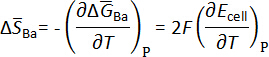
and the partial molar enthalpy of barium in bismuth can be calculated using thermodynamic relations such as the Gibbs-Helmholtz equation, as shown below. The results are summarized in Table 15.

The activity of barium was also determined using the collected emf values and the Nernst equation:
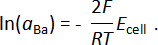
The results are summarized in Table 25.
Emf values for Ba-Bi alloys (xBa = 0.05 - 0.80) were also used to determine the phase transition temperatures for each alloy composition. In conjunction with differential scanning calorimetry (DSC) phase transition data, inductively coupled plasma atomic emission spectroscopy (ICP-AES) composition data, similar to that displayed in Table 312, and crystal structure data from XRD analysis, emf data were used to refine the most recent Ba-Bi phase diagram reported by Okamoto (Figure 8)5,11.
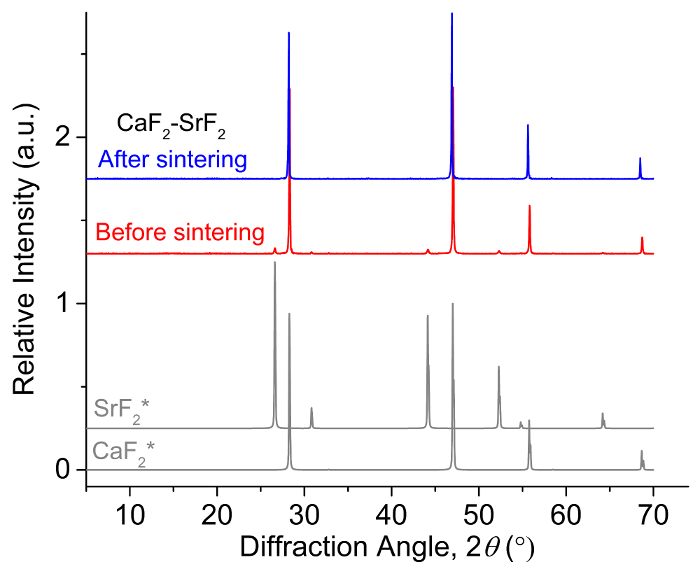
Figure 1: Single-phase CaF2-SrF2 electrolyte XRD spectra. XRD spectra (normalized to the most intense peak for each spectrum) of CaF2-SrF2 electrolyte before and after sintering. Pure (*) CaF2 and SrF2 diffraction patterns are provided for comparison. This figure has been modified from Smith et al.9 Please click here to view a larger version of this figure.
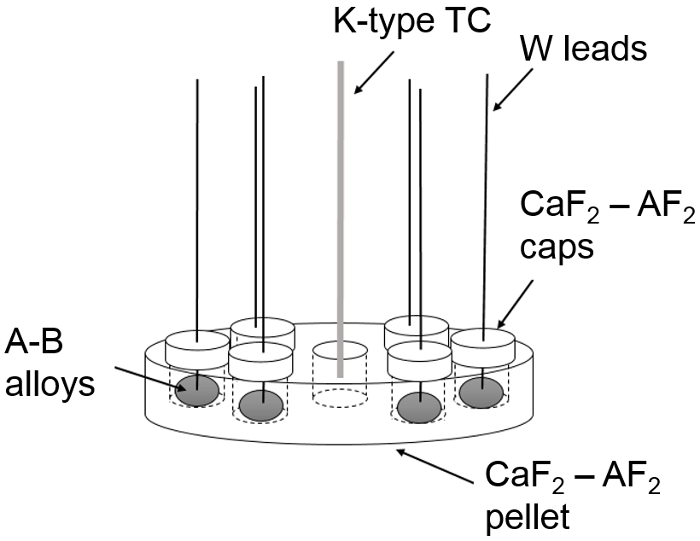
Figure 2: Electrochemical cell of A-B alkaline earth-liquid metal alloys. A schematic of the electrochemical cell assembly used for emf measurements with electrolyte, electrolyte caps, electrode materials, tungsten leads, and thermocouple (TC). Two of the 6 A-B alloys are reference electrodes and 4 are working electrodes. Please click here to view a larger version of this figure.
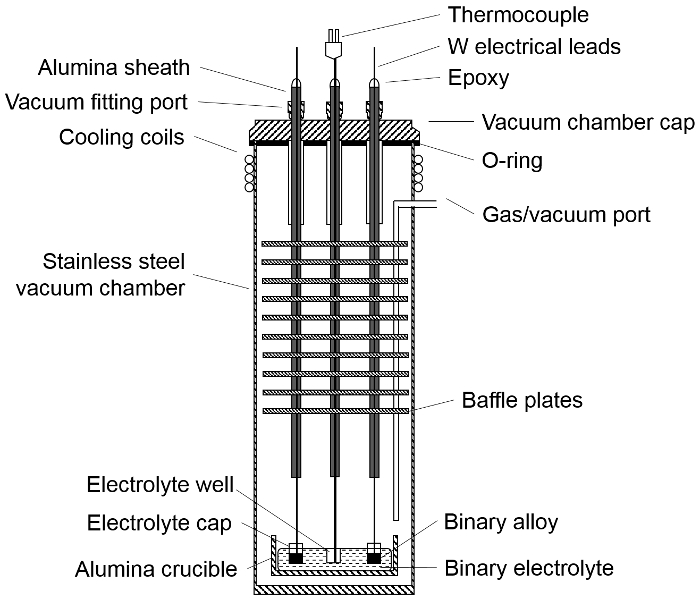
Figure 3: Electrochemical setup for emf measurements. An illustration of the electrochemical cell components and the associated components for proper operating conditions. Please click here to view a larger version of this figure.
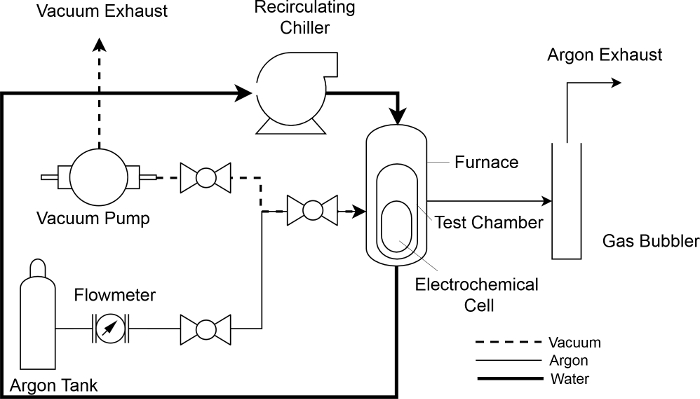
Figure 4: Instrumentation diagram of experimental setup. A schematic of cooling water (solid, bold), argon (solid, thin), and vacuum (dashed) fluid flow through the emf measurement system. Please click here to view a larger version of this figure.
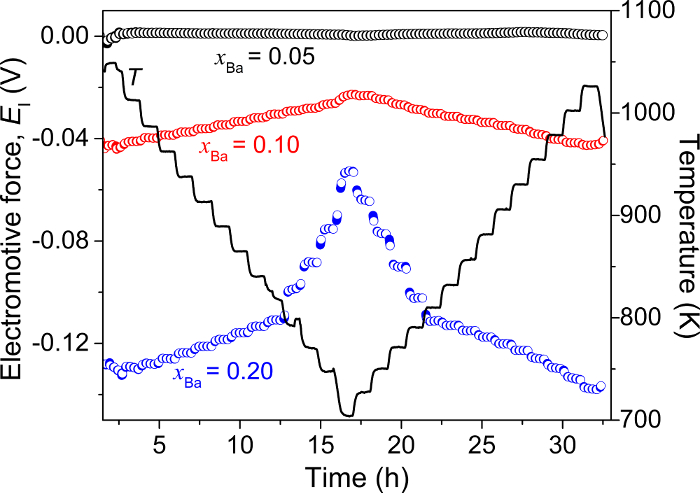
Figure 5: Electrochemical emf measurements of Ba-Bi alloys (xBa = 0.05 - 0.20). Electromotive force (E1) and temperature measured as a function of time upon cooling and reheating a Ba-Bi(xBa = 0.05)|CaF2-BaF2|Ba-Bi(xBa = 0.05, 0.10, and 0.20) cell. This figure has been modified from Lichtenstein et al.5 Please click here to view a larger version of this figure.
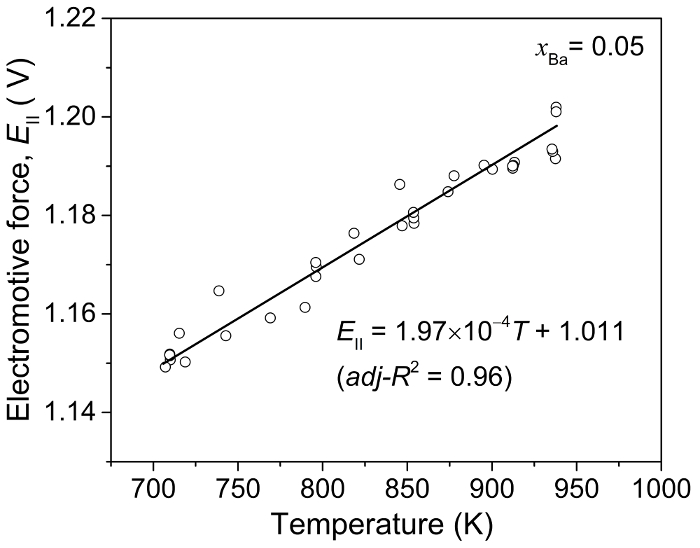
Figure 6: Pure Ba vs. Ba-Bi alloy (xBa = 0.05) emf value calibration. Electromotive force (EII) measured as a function of temperature using a Ba(s)|CaF2-BaF2|Ba-Bi(xBa = 0.05) cell. This figure has been modified from Lichtenstein et al.5 Please click here to view a larger version of this figure.
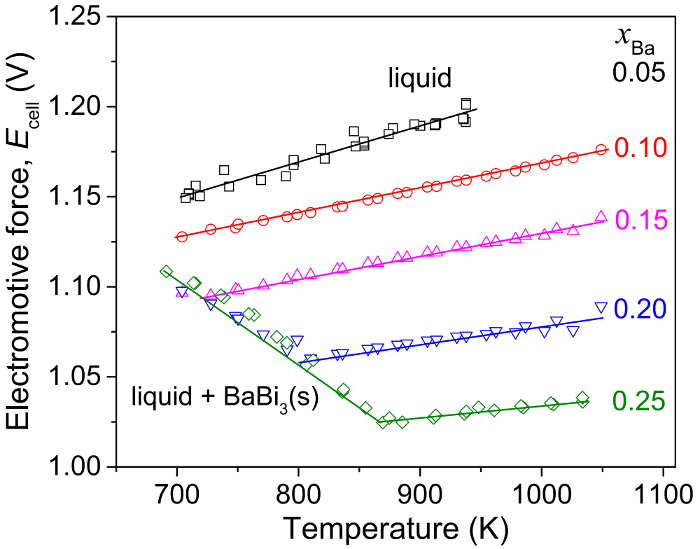
Figure 7: Emf measurements of Ba-Bi alloys (xBa = 0.05 - 0.25). Electromotive force (Ecell) as a function of temperature for Ba-Bi alloys at xBa = 0.05, 0.10, 0.15, 0.20, and 0.25 based on a Ba(s)|CaF2-BaF2|Ba-Bi(XBa = 0.05 - 0.25), where solid lines represent linear fits. This figure has been modified from Lichtenstein et al.5 Please click here to view a larger version of this figure.
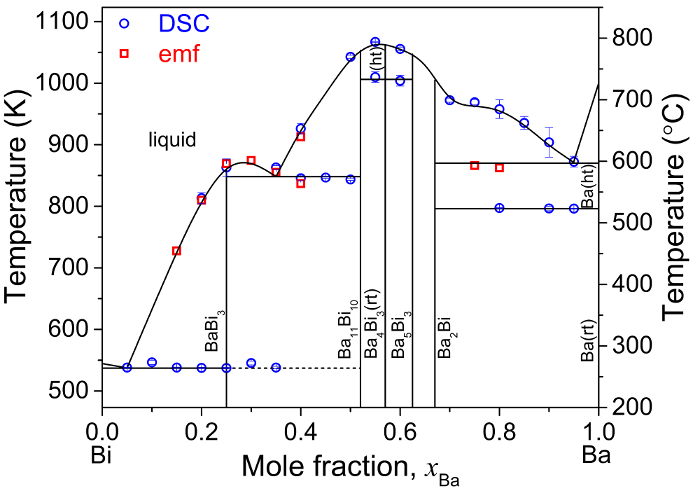
Figure 8: Ba-Bi phase diagram. Experimentally determined Ba-Bi phase diagram based upon emf measurements in complement with DSC and XRD characterization of Ba-Bi alloys, where (rt) and (ht) represent room temperature and high temperature, respectively. This figure has been modified from Lichtenstein et al.5 Please click here to view a larger version of this figure.
| x Ba | T (K) | ∂Ecell/∂T (μV K‒1) | ∂(Ecell/T)/∂(1/T) (mV) |  (J mol‒1 K‒1) (J mol‒1 K‒1) |  (kJ mol‒1) (kJ mol‒1) |
| 0.05 | 707-938 | 197 ± 6 | 1011 ± 5 | 38 | -195.1 |
| 0.1 | 704-1048 | 137 ± 1 | 1031 ± 1 | 26.4 | -199 |
| 0.15 | 728-1048 | 125 ± 2 | 1005 ± 2 | 24.1 | -193.9 |
| 0.2 | 809-1048 | 94 ± 7 | 984 ± 6 | 18.1 | -189.9 |
| 0.25 | 881-1048 | 73.4 ± 5 | 961 ± 5 | 14.2 | -185.4 |
| 0.25 | 704-881 | -480 ± 14 | 1448 ± 13 | -92.6 | -279.4 |
Table 1: Thermodynamic properties of Ba-Bi alloys (xBa = 0.05 - 0.25). Change in partial molar entropies () and partial molar enthalpies () for Ba-Bi alloy compositions xBa = 0.05 to xBa = 0.25 calculated from linear fits of emf values, where the slopes and intercepts are  and
and  , respectively. This table has been modified from Lichtenstein et al.5
| x Ba | E (V) | ln a Ba | ||||
| 773 K | 873 K | 973 K | 773 K | 873 K | 973 K | |
| 0.05 | 1.164 | 1.183 | 1.203 | -35 | -31.5 | -28.7 |
| 0.10 | 1.137 | 1.15 | 1.164 | -34.1 | -30.6 | -27.8 |
| 0.15 | 1.101 | 1.114 | 1.127 | -33 | -29.6 | -26.9 |
| 0.20 | 1.075 | 1.066 | 1.076 | -32.2 | -28.3 | -25.7 |
| 0.25 | 1.075 | 1.027 | 1.032 | -32.2 | -27.3 | -24.6 |
Table 2: Measured emf values (E) and the natural log of activity of barium in bismuth (ln aBa). The measured emf values of Ba-Bi alloys (xBa = 0.05 - 0.25) versus Ba(s) and the natural log of activity of barium in bismuth at 773 K, 873 K, and 973 K. This table has been modified from Lichtenstein et al.5
| Mole fraction, x Ba | |
| Nominal | Measured |
| 0.03 | 0.03 |
| 0.05 | 0.05 |
| 0.10 | 0.09 |
| 0.15 | 0.14 |
| 0.20 | 0.20 |
| 0.25 | 0.25 |
| 0.30 | 0.30 |
Table 3: Nominal and measured barium content of Ba-Sb binary alloys. The nominal and measured barium content of Ba-Sb binary alloys. Barium content of Ba-Sb alloys was confirmed using inductively coupled plasma atomic emission spectroscopy (ICP-AES). This table has been modified from Lichtenstein et al.12
Discussion
Loading...
$$\rightleftharpoonup{xx}$$
$$\longleftharp{xx}$$,
$$\longrightharp{xx}$$,
The emf cell in this work uses a CaF2-based solid electrolyte and electrode materials at fixed compositions, compared to an emf cell that uses a coulometric titration technique where the electrode composition is changed at a constant temperature. With coulometric titration, the electrode composition is determined by Faraday's law, assuming perfect coulombic efficiency. However, highly reactive alkaline-earth metals are moderately soluble (e.g., Ba ~15 mol% solubility in BaCl2) in their own halide salts, which can promote electronic conduction through the electrolyte and prevent accurate control of the composition of the electrode during coulometric titration7,13. The electrochemical cell in this work operates with electrode materials at fixed compositions, thus eliminating uncertainty in compositional accounting by coulometric titration, and enables accurate emf measurements of alkaline-earth alloys. Furthermore, the unique electrochemical cell in this work measures the emf values of four alloy compositions simultaneously within the same experiment to accelerate the evaluation of the thermodynamic properties over a wide range of compositions and temperatures.
As the arc-melter is used to fabricate the binary alloys, it is possible that the final composition of the alloys can deviate from the initial composition due to the high temperature of the electric arc and the high vapor pressures of the metals. To accurately report the emf-temperature relationship of the binary alloys, their composition was confirmed using inductively coupled plasma atomic emission spectroscopy (ICP-AES), as shown in Table 3 for the Ba-Sb system12.
Before drying the electrochemical cell components according to step 2.3.4, difficulties in obtaining high-quality vacuum (<10 mtorr) may occur. The o-ring in the vacuum chamber setup may not be seated correctly in its stainless-steel groove. There may also be a gap in the epoxy seals of the alumina tubes, to which additional epoxy may be applied to plug possible leaks. During emf measurements, if the electrical leads lose contact with the A-B alloys and large fluctuations in emf values are observed, contact may be re-established with the alloys by gently twisting the alumina tube, thereby wetting the liquid alloy to the lead.
Occasionally the emf values may exhibit a large hysteresis between the cooling and heating cycles. In general, a hysteresis of emf values between cooling/heating cycles may originate from (1) the degradation of electrolyte with reactive electrode compositions, especially at high alkaline-earth concentrations; (2) the degradation of electrode materials due to vaporization at elevated temperatures and oxidation with the residual oxygen inside the test chamber; or (3) non-equilibrium phase behavior of electrode materials, including undercooling effects and the formation of metastable phases during the cooling cycle.
When the degradation reaction between the electrode and the electrolyte is evident, the experimental set-up can be modified to mitigate the degradation of the electrochemical cell by decreasing the maximum operating temperature. In the presence of undercooling effects, emf values obtained during the heating cycle may be utilized in determining equilibrium thermodynamic properties. When the formation of metastable phases causes a hysteresis in emf measurements, the phase behavior of electrode materials requires scrutiny through complementary techniques, e.g., structural characterization by XRD, analysis of phase constituents by scanning electron microscopy (SEM) with energy-dispersive spectroscopy (EDS), and phase transition temperatures by DSC. Phase transition data may also be difficult to obtain with the described emf measurement technique above 1,223 K, as the CaF2-AF2 electrolyte may begin to degrade.
The emf measurement technique in this work can be used to determine the empirical thermodynamic properties of binary alkaline earth-liquid metal alloys, including activity, partial molar entropy, partial molar enthalpy, and phase transition temperatures. These thermodynamic data are utilized as an experimental basis for refining binary phase diagrams of alkaline-earth alloys with complementary techniques (XRD, DSC, and SEM), as exemplified in Figure 85. Based on the activity values of each alkaline-earth metal (A = Ca, Ba, and Sr) in liquid metals (B = Bi and Sb), the strength of atomic interactions between alkaline-earth elements and liquid metals can be leveraged to electrochemically separate out alkaline-earth fission products from molten salt solutions.
Disclosures
Loading...
$$\rightleftharpoonup{xx}$$
$$\longleftharp{xx}$$,
$$\longrightharp{xx}$$,
The authors have no conflicts of interest to disclose concerning the material in the publication.
Acknowledgements
Loading...
$$\rightleftharpoonup{xx}$$
$$\longleftharp{xx}$$,
$$\longrightharp{xx}$$,
This work was supported by the US Department of Energy, Office of Nuclear Energy's Nuclear Energy University Programs (Award No. DE-NE0008425); Integrated University Program Graduate Fellowship (Award No. DE-NE0000113); and the Ministry of Trade, Industry & Energy, Republic of Korea, the Energy Efficiency & Resources Core Technology Program of the Korea Institute of Energy Technology Evaluation and Planning (KETEP) (No. 20142020104190). Publication of this article was funded in part by The Pennsylvania State University Libraries Open Access Publishing Fund.
Materials
| Name | Company | Catalog Number | Comments |
|---|---|---|---|
| 1 L bottle | US Plastic | 69032 | HDPE, wide mouth |
| Acetone, 99.5% | Alfa Aesar | 30698 | ACS Grade |
| Alumina dish | AdValue Technology | AL-4120 | 81 mm OD, 30 mm height |
| Alumina plate | AdValue Technology | AL-D-82-6 | 10 cm in diameter, 4.65 mm thickness |
| Alumina powder | AluChem | AC99 tabular alumina | |
| Alumina tube | Coorstek | 66631-12.0000 | 0.25 in. OD, 12 in. length |
| Arc-Melter | Edmund Buhler GmbH | MAM1 | |
| Argon, 99.999% | Praxair | AR 5.0UH-K | Ultrahigh purity |
| Ball mill | Norton Chemical Process Products Corporation | CF-70109 | 6 sets of 2 12.5 in. rollers, RPM 1725/1425 |
| Barium | Alfa Aesar | 653 | 99.2% purity |
| Barium fluoride | Sigma-Aldrich | 652458 | 99.999% purity |
| Bismuth | Sigma-Aldrich | 556130 | 99.999% purity |
| Boron nitride | Saint-Gobain | AX-05 | |
| Calcium fluoride | Alfa Aesar | 11055 | 99.95% purity |
| Cotton tip applicator | Dynarex | 4301 | 100 count, 3 in. long |
| Die press | Carver, Inc. | 3850 | Clamping force: 12 tons; Platens: 6 x 6 in. |
| Drill bit 29 piece set | Chicago-Latrobe | 45640 | 1/16 in. - 1/2 in. x 1/64 in. |
| Drying pan | Pyrex | 5300114 | 15.5 in. x 9.5 in. x 2.25 in. |
| Emery paper | McMaster-Carr | 4681A21 | Grit size: 100 |
| Fiberglass insulation | McMaster-Carr | 9346K38 | |
| Flowmeter | Brooks | MR3A00SVVT | Range: 0.1 to 1 standard cubic feet per hour (SCFH) of Air |
| Gas bubbler | Ace Glass | 8761-10 | |
| High temperature box furnace | Thermolyne | F48020-80 | 48000 Furnace, 8-segment program, Max. 1,200 °C |
| High temperature crucible furnace | Mellen | CC12-6X12-1Z | 6 in. ID, 12 in. depth. Max temp 1,200 °C. 208 V |
| High vacuum grease | Sigma-Aldrich | Z273554 | Brand: Dow Corning |
| Inert atmopshere glovebox | Mbraun | MB200 | |
| Isopropyl alcohol | Macron Chemicals | 3032-21 | ACS Grade |
| Large pellet die set | MTI Corporation | EQ-Die-75D | |
| Polyvinyl alcohol, 99+% | Sigma-Aldrich | 341584-5KG | Hydrolyzed, molecular weight (MW): 89,000-98,000 |
| Potentiostat | Autolab | PGSTAT302N | |
| Potentiostat-multiplexing switch box | Autolab | MUX SCANNER16 F/16 X WE | Multiplexer (MUX) SCANNER16 |
| Potentiostat control software | NOVA | NOVA 1.11 | |
| Precision mini lathe | Harbor Freight Tools | 93212 | Brand: Central Machinery |
| Quick cure epoxy | Grainger | 5A462 | Brand: Devcon |
| Recirculating chiller | VWR International | 13271-204 | Model: 1175PD |
| Small pellet die set | MTI Corporation | EQ-Die-18D-B | |
| Sonicator | VWR International | 97043-968 | |
| Squeeze bottle | VWR International | 16650-022 | LDPE, 500 mL |
| Stainless steel mesh sieve | Amazon | 10 mesh, 2 mm holes | |
| Strontium | Sigma-Aldrich | 343730 | 99% purity |
| Strontium fluoride | Sigma-Aldrich | 450030 | 99.99% purity |
| Thermocouple | Omega | KMQXL-125U-18 | K-type thermocouple |
| Thermocouple acquisiton board | National Instruments | NI-9211 | |
| Tungsten wire | ThermoShield | 88007-0.100 | 99.95% wire |
| Vacuum pump | Pfeiffer | PK D56 707 | Duo Line 1.6 |
| Wipes | Kimtech | S-8115 | ULine distributor |
| Wire cutters | McMaster-Carr | 5372A4 | |
| Yttria-stabilized zirconia milling media | Tosoh, USA | 3 mm diameter |
References
Loading...
$$\rightleftharpoonup{xx}$$
$$\longleftharp{xx}$$,
$$\longrightharp{xx}$$,
- Ipser, H., Mikula, A., Katayama, I. Overview: The emf method as a source of experimental thermodynamic data. CALPHAD: Comput. Coupling Phase Diagrams Thermochem. 34 (3), 271-278 (2010).
- Kim, H., Smith, N., Kumar, K., Lichtenstein, T. Electrochemical Separation of Barium into Liquid Bismuth by Controlling Deposition Potentials. Electrochim. Acta. 220, 237-244 (2016).
- National Research Council. Electrometallurgical Techniques for DOE Spent Fuel Treatment: Final Report. , National Academy Press. Washington, D.C. (2000).
- Simpson, M. F. Projected Salt Waste Production from a Commercial Pyroprocessing Facility. Sci. Technol. Nucl. Install. 2013, 1-8 (2013).
- Lichtenstein, T., Smith, N. D., Gesualdi, J., Kumar, K., Kim, H. Thermodynamic properties of Barium-Bismuth alloys determined by emf measurements. Electrochim. Acta. 228, 628-635 (2017).
- Kim, H., Boysen, D. A., Ouchi, T., Sadoway, D. R. Calcium-bismuth electrodes for large-scale energy storage (liquid metal batteries). J. Power Sources. 241, 239-248 (2013).
- Delcet, J., Delgado-Brune, A., Egan, J. J. Coulometric Titrations Using CaF2 and BaF2 Solid Electrolytes to Study Alloy Phases. Symp. Calc. Phase Diagrams Thermochemistry Alloy Phases. 275, Metallurgical Society of AIME Milwaukee. 275-287 (1979).
- Roine, A. Outokummpu HSC Chemistry 5.1. Chemical Reaction and Equilibrium Software with Extensive Thermochemical Database. , (2002).
- Smith, N. D., Lichtenstein, T., Gesualdi, J., Kumar, K., Kim, H. Thermodynamic Properties of Strontium-Bismuth Alloys Determined by Electromotive Force Measurements. Electrochim. Acta. 225, 584-591 (2017).
- Kim, H., et al. Thermodynamic properties of Calcium-Bismuth alloys determined by emf measurements. Electrochim. Acta. 60, 154-162 (2012).
- Okamoto, H. Ba-Bi (Barium-Bismuth). , 2nd ed, ASM International, Materials Park. (1990).
- Lichtenstein, T., Gesualdi, J., Nigl, T. P., Yu, C. T., Kim, H. Thermodynamic Properties of Barium-Antimony Alloys Determined by Emf Measurements. Electrochim. Acta. , (2017).
- Wagner, C. Limitation of the Use of CaF2 in Galvanic Cells for Thermodynamic Measurements due to the Onset of Electronic Conduction under Reducing Conditions. J. Electrochem. Soc. 115 (9), 933-935 (1968).
Reprints and Permissions
Request permission to reuse the text or figures of this JoVE article
Request Permission