Hair cortisol concentration analysis provides an alternative to traditional measures of cortisol; however, to collect hair samples from African Americans, scientists need to be culturally informed and competent. The purpose of this protocol is to demonstrate a culturally informed technique to collect hair samples for cortisol analysis from African Americans.
Method Article
Collecting Hair Samples for Hair Cortisol Analysis in African Americans
In This Article
Summary
Abstract
The hormone cortisol is typically assessed in saliva, serum, or urine samples. More recently, cortisol has been successfully extracted from hair, including humans. The advantage of hair cortisol concentration is that it reflects a retrospective representation of hypothalamic-pituitary-adrenal (HPA) axis function over time, much like hemoglobin A1C represents glycemic control. However, obtaining hair samples can be challenging, due to the cultural beliefs and hair care practices of minority participants. For example, African Americans may be reluctant to provide samples. Additionally, few researchers are trained to collect hair samples from African Americans. The purpose of this paper is to present a culturally informed protocol to help researchers obtain hair samples from African Americans. To illustrate the representative results of this protocol implementation, de-identified data from African Americans that participated in a community-based study on chronic stress are provided. Hair practice preferences are assessed. The participants are made comfortable by showing pictures of hair samples prior to cutting their hair. The single strain twist and gently pull method is used to collect approximately 30 - 50 strands of hair from the posterior vertex region of the scalp. This protocol will significantly improve collection of hair samples from African Americans.
Introduction
Collecting samples of saliva, blood, or urine for cortisol analysis has unique procedural challenges and greater participant burden, as the procedure requires multiple saliva samples, venipuncture samples, or 24-hour urine collection. Obtaining cortisol from hair samples is a simple and acceptable alternative to using saliva, serum, or urine samples1,2. Hair cortisol provides a retrospective representation of hypothalamic-pituitary-adrenal (HPA) axis function over time. Approximately 3 cm of hair collected from the scalp is equal to average cortisol release for the past 3 months1. However, researchers encounter unique challenges when attempting to collect hair samples across diverse populations. Such challenges include religious or spiritual beliefs including exposing hair (e.g., Muslim women), hair as sacred (American Indian groups), or cultural norms that connect hair to standards of beauty and self-image.
In the African American culture, particularly among women, scalp hair is a very personal and important aspect of their body image3,4. Further, historical experiences (e.g., the Tuskegee experiments) continue to foster mistrust in the research process5. Some African American folklore and cultural beliefs also suggest that the hair sample could be used in rituals that could cause harm6,7. Researchers should be aware of potential challenges that they may face in studies when African American participants are asked to provide hair samples.
In addition to issues surrounding body image, the specific techniques for collecting and handling hair samples from African Americans may differ from that of European Americans6,7. For example, African Americans may have straight, thin, curly, kinky, coarse, or a combination of these hair types, each requiring different techniques to collect and secure adequate hair samples for processing. Recent studies on samples of African American teens8, as well as multi-ethnic samples9, showed that collection of hair for cortisol level measurement was acceptable among African American participants. At present, there are no visual training procedures designed to provide researchers with the skill and cultural knowledge to collect hair samples in African Americans. The purpose of this paper is to present a culturally informed protocol to help researchers obtain adequate hair samples from African American participants. This method was developed with careful consideration of physical, psychosocial, and cultural characteristics relevant to collection of hair samples from African American adults. To date, there are no visual methods of collecting these samples, and this protocol will be the first guide that details proper hair sample collection from African American adults. To illustrate the representative results of the protocol implementation, de-identified data are presented from African Americans that participated in a community-based study on chronic stress that were aged 65 and older. Both male and female research assistants from a variety of racial backgrounds contacted potential participants from a clinic generated list and flyers. The primary investigator, who is an African American woman, spoke at community centers and senior subsidized housing apartments to older adult African Americans about the study, including a description of the hair collection methods.
Protocol
The study is approved by the University Hospitals Cleveland Medical Center Institutional Review Board, and the protocol follows the guidelines of participant protection and data safety as indicated by the review committee.
1. Prepare Participant for Hair Sample and Hair Sample Collection Questions
- Explain to participant that the hair sample collected is less hair than that is lost normally in brushing each day from the back of the head (posterior vertex). Tell the participant that the site for the hair sample is hidden by surrounding hair and, thus, is not visible after collection. Inform the participant that the sample will be used to measure a hormone called cortisol present in the hair10,11.
- Take out the sample photo and show the participant the amount of hair that will be collected (30 - 50 strands).
NOTE: See Figure 1 for photo of a hair sample. - Ask the participant the hair care practice12 questions listed in Table 1.
2. Collect the Hair Sample
- Tell the participant that the sample is collected in a private area behind a portable partition, curtain, or closed door. Assure participants that, if they wear a wig or hairpiece, their hair is not cut in an area where others may see. Measure hair length from scalp to end by pulling the hair gently and taut.
- If the hair is short (less than 3 cm), follow the short hair protocol in step 3 (although if the hair is less than 1 cm long, the sample cannot be collected, and, ideally, the hair should be at least 3 cm long). For hair longer than 6 cm, follow the long hair protocol in step 4. Otherwise, continue to the next step.
- Ensure that materials are ready by placing the hair cutting supplies (a sheet of aluminum foil, business envelope, salon grade scissors, large and small tooth parting comb, alcohol preps, painters tape, permanent marker, non-latex gloves [optional], and hair clips)10 on a surface next to the participant. Clean the scissors and comb with the alcohol prep pad before collecting the sample. Cut out an 8 x 10" sheet of aluminum foil to use for the sample.
- Put on non-latex gloves. Take the comb and part the hair horizontally along the posterior vertex of the scalp between the tips of the ears.
- Take a clip and move the hair from the top of the part, then place another clip at the bottom to expose a 5 x 10 cm rectangle between the two clips of loose hair (about the size of a deck of playing cards).
- Ask the participant if they prefer use of a wide tooth or narrow tooth comb through the 2 - 3" rectangle of hair. Ask the participant how she or he would like to have the remaining hair in the comb discarded. Give the hair in the comb to the participant, or, if (and only if) the participant states that it is okay to discard the loose hair, discard the remaining hair from the comb into a trash can.
- Grasp approximately 30 - 50 strands of hair to the right of the 2 - 3" rectangle and gently pull and twist the hair away from the scalp in a rolling motion between the fingers.
- Ensure that the sample is collected as close to the scalp as possible, but do not cut the scalp. Use salon-grade scissors and make a clean straight cut.
- Grasp the hair sample and ensure that the root end is aligned carefully along the cut.
- Attach the hair to the sheet of aluminum foil by taping with painter's tape. Do not cover the scalp end, and do not use painter's tape on hair that is shorter than or equal 3 cm. Place the loose cut hair into the center of the foil and fold into a square, ensuring that the hair does not fall out of the foil.
- Take the marker and label the scalp end on the aluminum foil. Use premade bar-coded labels to attach to the foil and envelope.
- Fold the aluminum foil without folding the hair on the scalp end to prevent bed head (crumpled and bent hair), place it in the business size envelope, and seal.
- Label the outside of the envelope with the participant's unique study identification number, date, and the name of the primary investigator, or use a bar code label if available.
- Store the sample in a dry area at room temperature.
3. Sample Collection for Short Hair (1 - 3 cm)
- Follow steps 2.3 and 2.4.
- After parting, ask the participant to hold the parted hair close to the scalp. Cut the hair along the part, while holding the hair tightly with index finger and thumb10.
- Place loose hairs in foil and fold it securely. Do not tape the hair to the foil.
- Follow steps 2.11 through 2.14.
4. Sample Collection for Long Hair (longer than 6 cm)
- Part the hair left to right at the posterior vertex.
- Use the hair clips to hold back the extra hair.
- Create a twist of hair and hold tightly with the index finger and thumb so as not to drop the sample10.
- Make a clean straight cut as close to the scalp as possible. Collect 30 - 50 strands of hair.
- If the participant has thin hair, then cut 2 - 3 small areas (1 cm apart) across the posterior vertex to conceal the site of the cut.
- Follow steps 2.10 through 2.14.
5. Sample Processing
- Store the foil packets containing the hair sample at room temperature indefinitely until analysis.
Note: Hair cortisol is extremely stable in hair and can be stored for years. In fact, cortisol has been measured in hair samples from mummified remains11. - Analyze hair cortisol as previously published12. Samples can be shipped overnight at ambient temperature.
Results
In our study, twenty-one African Americans (mean age = 75; SD = 6.9; 85% female) consented to participate. Four participants (19%) refused to provide a hair sample and two (9.5%) could not provide a sample because their hair was too short. A total of 15 hair samples were obtained and processed (Table 2). The length of the hair samples that were processed ranged from 1 cm to 4.8 cm. Technical problems included samples were poorly aligned at the scalp end, tangled, or curly, and painter's tape being placed over the scalp end.
After implementation of the single strain twist and gently pull protocol, hair samples were aligned and cortisol content determined. The proximal 3 cm from the scalp end of the hair sample was cut, washed, and ground, then cortisol extracted with ethanol. Hair cortisol concentrations (HCC) were determined using a commercial high sensitivity EIA kit according to manufacturer's instructions. A pooled control of previously ground hair was also extracted and included on each EIA plate in duplicate for determination of inter-assay coefficients of variation. All samples were run in duplicate. Inter-assay coefficient of variation (CV) for the control hair pool was less than 10%, and intra-assay CV of duplicates was less than 4%. Hair cortisol concentrations are reported as pg/mg. The average amount of cortisol was 20.4 pg/mg, standard deviation was 22.7 pg/mg, and results ranged from 4.3 pg/mg to off-scale, even after additional dilution (Figure 2). Additionally, it took less technician time to process the samples in the laboratory.
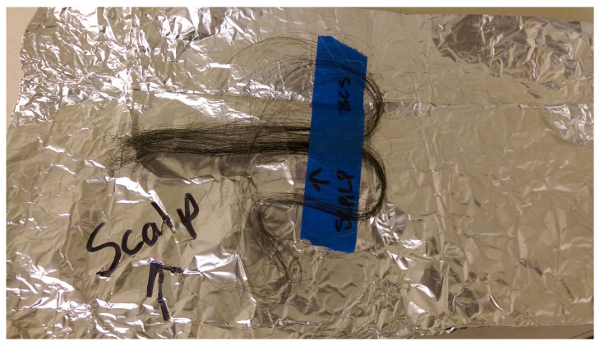
Figure 1. Photograph of a hair sample, demonstrating the placement of painter's tape on the foil to secure the sample. Please click here to view a larger version of this figure.
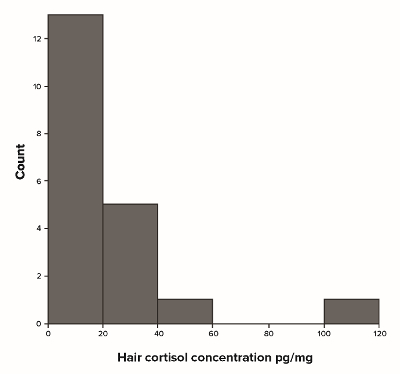
Figure 2. Histogram of hair cortisol concentration. Results are unevenly distributed. Hair cortisol results are often skewed and require statistical transformation (e.g., log transformation) to correct for uneven distribution of data. Please click here to view a larger version of this figure.
| Tell me the number of times that you wash your hair a week? |
| Tell me the number of times that you wash your hair a month? |
| Tell me the number of times that you wash your hair a year? |
| Do you use conditioners on your hair? Yes or No |
| Do you color or bleach your hair? |
| Have you permed your hair or gotten a touch up of your perm in the last 3 months? |
| Have you used a chemical straightener on your hair in the last 3 months? |
| Do you take over the counter or prescription medications for any scalp conditions? |
| Have you taken any steroids in the past 3 months? For example, inhaled medications, steroid injections in a joint, or other oral steroids such as prednisone, cortisone, dexamethasone, or aldosterone. |
Table 1. List of hair care practices that could potentially influence the concentration of cortisol within the hair. For example, the practice of Brazilian Hair Straightening decreases the amount of cortisol in the hair.
| Hair wt (mg) | Cortisol (pg/mg) | Hair Length | Color | Hair Cutting Technique | Comments |
| 9.15 | 10.3 | 3 cm | black and white | Thining shear | Hair not aligned. |
| 5.91 | 46.0 | 3 cm | blonde and black. Cut both. | Thining shear | Hair not aligned. Hair tangled so only took hairs that could be identified as scalp end. |
| 5.02 | 13.7 | 3 cm | black and white | Thining shear | Hair not aligned. Hair tangled so only took hairs that could be identified as scalp end. |
| 30.9 | 30.2 | 1.4 cm | black and white | Thining shear | Hair placed into envelope without tinfoil. Difficult to collect hair. |
| 31.07 | 6.7 | 1 cm | black and white | Thining shear | Hair placed into envelope without tinfoil. Difficult to collect hair. |
| 6.45 | 12.7 | 3.3 cm | black and white | Salon grade scissors | Hair extremely curly. Cut hair as close to 3 cm as possible. |
| 6.13 | 105.2 | 3 cm | black and white | Thining shear | Hair not aligned. Hair tangled so only took hairs that could be identified as scalp end. |
| 6.81 | 23.5 | 3.2 cm | black and white | Salon grade scissors and twist and pull | Hair extremely curly. Cut hair as close to 3 cm as possible. |
| 4.94 | 6.2 | 3 cm | black | Salon grade scissors and twist and pull | |
| 11.7 | 10.5 | 2.8 cm | black and white | Salon grade scissors and twist and pull | Hair extremely curly. Cut hair as close to 3 cm as possible. |
| 14 | 4.3 | 3.1 cm | black and white with blonde tips. Cut all. | Salon grade scissors and twist and pull | Hair extremely curly. Cut hair as close to 3 cm as possible. |
| 29.08 | off-scale | 4.8 cm | black and white | Thining shear | Hair wedged between two pieces of tape. Could not identify scalp side so took the entire length. |
| 15.02 | 8.4 | 3 cm | black with reddish purple and white scalp. Cut all. | Salon grade scissors and twist and pull | |
| 18.25 | 16.0 | 3 cm | black | Salon grade scissors and twist and pull | |
| 16.42 | 29.5 | 3 cm | white with some light brown | Salon grade scissors and twist and pull | |
| 32.93 | 14.6 | 3 cm | Black and grey | Salon grade scissors and twist and pull | |
| 29.9 | 13.5 | 3 cm | grey with some light brown and black | Salon grade scissors and twist and pull | |
| 28.89 | 36.8 | 3 cm | grey | Salon grade scissors and twist and pull | |
| 22.42 | 7.8 | 3 cm | black | Salon grade scissors and twist and pull | |
| 6.04 | 23.6 | 3 cm | grey | Salon grade scissors and twist and pull | |
| 30.47 | 5.0 | 3 cm | black with some white and brown | Salon grade scissors and twist and pull |
Table 2. Hair cortisol concentration results. Each horizontal line in the table represents one participant. The first column is hair weight in mg, followed by the cortisol concentration in pg/mg in the sample. Samples were measured, and the length was indicated in the third column from the left. A 4.8 cm length of hair was used for one participant because the sample amount was limited. Participants' hair color and comments regarding the samples are also listed.
Discussion
Essential steps in the hair collection protocol include providing an example of how much hair will be taken, showing the sample site (posterior vortex), use of the single strain twist and gently pull method, and securing the sample with painter's tape away from the scalp end. By gently twisting and pulling the sample, the curly hair is lengthened and the scalp end alignment is maintained. This reduces laboratory time needed to align the scalp ends, measure, and cut the sample. Although thinning shears have been used in prior research, they are not the preferred tool for cutting hair because of uneven scalp end alignment and increased time to prepare the hair sample for analysis.
Gathering hair samples from African Americans is feasible for measurement of cortisol. Appreciating the significance of hair in the African American culture is necessary to garner support for collecting hair samples. Investigators should not convey judgment regarding hair hygiene, such as the frequency of hair washings, because some African Americans tend to have dry hair as compared to non-Hispanic whites13. African American hair grows slower, at a mean rate of 256 µm/day-1 as compared to non-Hispanic whites (M = 396 µm/day-1, SD = 55 µm/day-1)14. Participants may also wear hairstyles such as weaves/sew-in hair, box braids, and kinky twists or crochet braids. These hairstyles can take hours to complete, with costs ranging from $50 to more than $500. When possible, inquire about the hairstyle and coordinate hair sample collection with the participant. In these cases, the natural hair may need to be collected between beautician appointments or at the salon.
The lack of appreciation by the researcher regarding the importance of hair, style preferences, and costs can lead to participant unwillingness to provide a hair sample. As reflected in the current study, this phenomenon of African American participants' reluctance or inability to provide hair samples was documented in a study of multi-race youths and the feasibility and acceptability of hair collection for cortisol measurement8. Ford et al. (2016) sampled 516 mixed-race youths aged 11-17 from the community. The African American adolescents were less likely to provide a hair sample due to shortness of hair and refusal (OR = 0.26; 95% CI [0.13, 0.51])8.
The participant in the present study were age 65 and older. The greatest limitation to hair cortisol analysis is shaved heads, which is common among males or those with thinning hair. Gathering enough hair for samples in older adults can be challenging due to hair loss. The hair weight matters more because if there is not enough mass, then the microplate reader cannot accurately detect the cortisol levels. Standardizing the hair weight as a normalizing factor prior to processing samples for cortisol analysis may be a future consideration to address this challenge.
Several limitations have been outlined in previous hair cortisol studies, including variations in hair care practices and the lack of normative values for cortisol results8,12,15. The use of hair straighteners, relaxers, permanents, conditioners and dyes alter the level of cortisol in the hair. Exposure to bleaches and permanents decreases the amount of cortisol, while peroxides increase measured cortisol15. Also, the lack of normative values presents a challenge to comparing hair cortisol results across studies to establish normal values. The hair cortisol findings from our study are limited and could only be generalized to other older adults and persons with chronic conditions. Generally, hair cortisol levels in persons with chronic conditions (diabetes, cardiovascular) and mood disorders are higher than those without chronic conditions9,16. Another study of community-dwelling African American older adults reported cortisol ranges from 0.93 to 6.36 pg/mg, which was lower than the range in our study16. Another study of a sample of multiethnic older adults with cardiovascular disease reported a median cortisol level of 22.1 pg/mg, similar to the findings of this study.
Future applications of the techniques outlined in this paper should include teaching the participant the twist and gently pull procedure, enabling them to collect their own hair samples. Self-sample collection has been done in African American women with breast cancer and was considered more acceptable16. However, the response rate for African American women providing a hair sample was poor in the breast cancer study. To improve participation of African Americans in studies that collect hair biospecimens, research is needed to understand better the reasons for refusal and any potential age or cohort demographic associated influences on the refusal rates. As found in the present study, approaching potential participants in a non-judgmental fashion, acknowledging the importance of hair and hair practices within the African American community, sharing a photo of the hair sample, providing privacy, and adoption of the twist and gently pull method were all factors that attributed to the success of getting participants enrolled in the study.
At present, no published protocols consider cultural preferences to collect hair samples for cortisol. Likewise, few investigators are trained to collect hair from African Americans. The single strain twist and gently pull to cut the hair sample protocol can be used in other studies that require hair samples from African Americans. This protocol has the potential to increase the number of hair samples from African Americans, as well as the number of culturally informed investigators and data collectors.
Disclosures
The Behavioral Immunology and Endocrinology Laboratory is designated as a Laboratory of Excellence by Salimetrics, LLC.
Acknowledgements
This publication was made possible by the Clinical and Translational Science Collaborative of Cleveland; KL2TR000440 from the National Center for Advancing Translational Sciences (NCATS) component of the National Institutes of Health; and NIH Roadmap for Medical Research. Dr. Jodi Ford's work in this area has been funded by the National Institutes of Health National Institute on Drug Abuse (1R21DA034960) and The Ohio State University Institute for Population Research seed grant funding from the National Institute of Child Health and Development (2P2CHD058484). The content is solely the responsibility of the authors and does not necessarily represent the official views of the National Institutes of Health. Dr. Laudenslager's work in this area has been funded by a contract from the Patient-Centered Outcomes Research Institute (CE-1304-6208), a grant from the Administration for Children and Families (90YR0058), and a grant from the Developmental Psychobiology Research Group Endowment Fund of the Department of Psychiatry, University of Colorado Denver Anschutz Medical Campus.
Materials
| Name | Company | Catalog Number | Comments |
|---|---|---|---|
| Salon grade scissors | Cricket | S-3 550 | Carded Professional Hair Shear, 5.5 inch |
| Large tooth comb | Goody | No catalog number__Goody Stylista Rake Comb | Link to Company website http://www.goody.com/Products/Styling_Tools/Goody_Stylista_Rake_Comb?colId=d11c04a1-1dd3-4848-a313-046fc6c109ec&c_id=35a36c88-d359-4104-a53c-dfbfd8452780 |
| Small tooth comb | Goody | No catalog number_ Goody Start.Style.Finish. Link to company website http://www.goody.com/Products/Styling_Tools/Goody_StartStyleFinish_Combs?colId=d11c04a1-1dd3-4848-a313-046fc6c109ec&c_id=35a36c88-d359-4104-a53c-dfbfd8452780 | |
| Alcohol preps | Kendall Webcol Alcohol Preps | No catalog number. Kendall Webcol Alcohol Preps | https://www.buyemp.com/product/kendall-webcol-alcohol-preps |
| Painter's tape | 3M Scotch | ScotchBlue ORIGINAL Painter’s Tape | https://www.scotchblue.com/3M/en_US/scotchblue/products/painters-tape/ |
| Permanent marker | Sharpie | Black Sharpie Fine Point | http://www.sharpie.com/sharpie/fine/SHFineBlackFine.html |
| Non-latex gloves | Protégé | 93997 | Protege®Nitrile Powder-Free Examination Gloves http://aureliagloves.com/product/protege/ |
| Hair clips | Goody | Goody Start.Style.Finish. Curl Clips | http://www.goody.com/Products/Styling_Tools/Goody_StartStyleFinish_Curl_Clips |
| Envelope | Office Depo | 330808 | Office Depot® Brand Clasp Envelopes, 9" x 12", Brown, Box Of 100 |
| Foil sheets | Choice | 1229105 | Box of 500 Sheets Food Service Interfolded Pop-up foil sheets |
| Pre-weighed 2 ml cryovial | Wheaton, Millville, NJ, USA | W985902 | |
| 100% isopropanol | Spectrum | I1275 | 67-63-0 | |
| Liquid nitrogen | Ohio State Unversity Stores | Gas Cylinder Warehouse | http://osustores.osu.edu/prodservices/liquidnitrogen.aspx |
| Stainless steel ball bearing | McMasterCarr | 9291K42 | https://www.mcmaster.com/#standard-stainless-steel-balls/=1acqby0 |
| Specially milled aluminum cassettes | FisherScientific | Retsch 20.745.0001 | |
| HPLC grade methanol | FisherScientific | A452N1-19 | https://www.fishersci.com/shop/products/methanol-hplc-fisher-chemical-6/p-216129 |
| Microcentrifuge tube | Eppendorf North America | 22363352 | https://online-shop.eppendorf.us/US-en/Laboratory-Consumables-44512/Tubes-44515/Eppendorf-Safe-Lock-Tubes-PF-8863.html?_ga=2.36544352.1776616592.1511283212-1254533852.1511283212 |
| Cortisol ELISA Kit | Salimetrics LLC, State College, PA, USA | 1-3002 (5PK 1-3002-5) | https://www.salimetrics.com/assay-kit/cortisol-salivary-elisa-eia-kit |
| Centtrifuge for the micorcentrifuge tube | Beckman Coulter | Microfuge 20 series | http://centrifugebybeckman.com/?page_id=727/?pi_ad_id=creative?utm_term=microfuge |
References
- Sauve, B. K. G., Walsh, G., Tokmakejian, S., Van Uum, S. H. Measurement of cortisol in human hair as a biomarker of systemic exposure. Clin Invest Med. 30 (5), 183-191 (2007).
- Wright, K. D., Hickman, R., Laudenslager, M. L. Hair cortisol analysis: a promising biomarker of HPA activation in older adults. Gerontologist. 55, Suppl 1 140-145 (2015).
- Awad, G. H., et al. Beauty and body image concerns among African American college women. J Black Psychol. 41 (6), 540-564 (2015).
- Capodilupo, C. M., Kim, S. Gender and race matter: the importance of considering intersections in Black women's body image. J Couns Psychol. 61 (1), 37-49 (2014).
- Miracle, V. A. The Belmont Report: the triple crown of research ethics. Dimens Crit Care Nurs. 35 (4), 223-228 (2016).
- Fishman, B. M., Bobo, L., Kosub, K., Womeodu, R. J. Cultural issues in serving minority populations: emphasis on Mexican Americans and African Americans. Am J Med Sci. 306 (3), 160-166 (1993).
- Webb, J. Y. Louisiana voodoo and superstitions related to health. HSMHA Health Rep. 86 (4), 291-301 (1971).
- Ford, J. L., Boch, S. J., McCarthy, D. O. Feasibility of hair collection for cortisol measurement in population research on adolescent health. Nurs Res. 65 (3), 249-255 (2016).
- Wosu, A. C., et al. Hair cortisol in relation to sociodemographic and lifestyle characteristics in a multiethnic US sample. Ann Epidemiol. 25 (2), 90-95 (2015).
- Laudenslager, M. L. Hair collection and shipping instructions. , Available from: http://www.ucdenver.edu/academics/colleges/medicalschool/departments/psychiatry/Research/biel/Pages/Overview.aspx (2016).
- Webb, E., et al. Assessing individual systemic stress through cortisol analysis of archaeological hair. J Archaeolog Sci. 37 (4), 807-812 (2010).
- Russell, E., et al. Toward standardization of hair cortisol measurement: results of the first international interlaboratory round robin. Ther Drug Monit. 37 (1), 71-75 (2015).
- Bosley, R. E., Daveluy, S. A primer to natural hair care practices in black patients. Cutis. 95 (2), 78-80 (2015).
- Loussouarn, G. African hair growth parameters. Brit J Derm. 145 (2), 294-297 (2001).
- Hoffman, M. C., Karban, L. V., Goodteacher, A., Laudenslager, M. L. Chemical processing and shampooing impact cortisol measured in human hair. Clin Invest Med. 37 (4), 252-257 (2014).
- Ramirez, J., Elmofty, M., Castillo, E., DeRouen, M., Shariff-Marco, S., Allen, L., et al. Evaluation of cortisol and telomere length measurements in ethnically diverse women with breast cancer using culturally sensitive methods. J Community Genet. 8, 75-86 (2017).
Reprints and Permissions
